


The reporting that sparked this guide
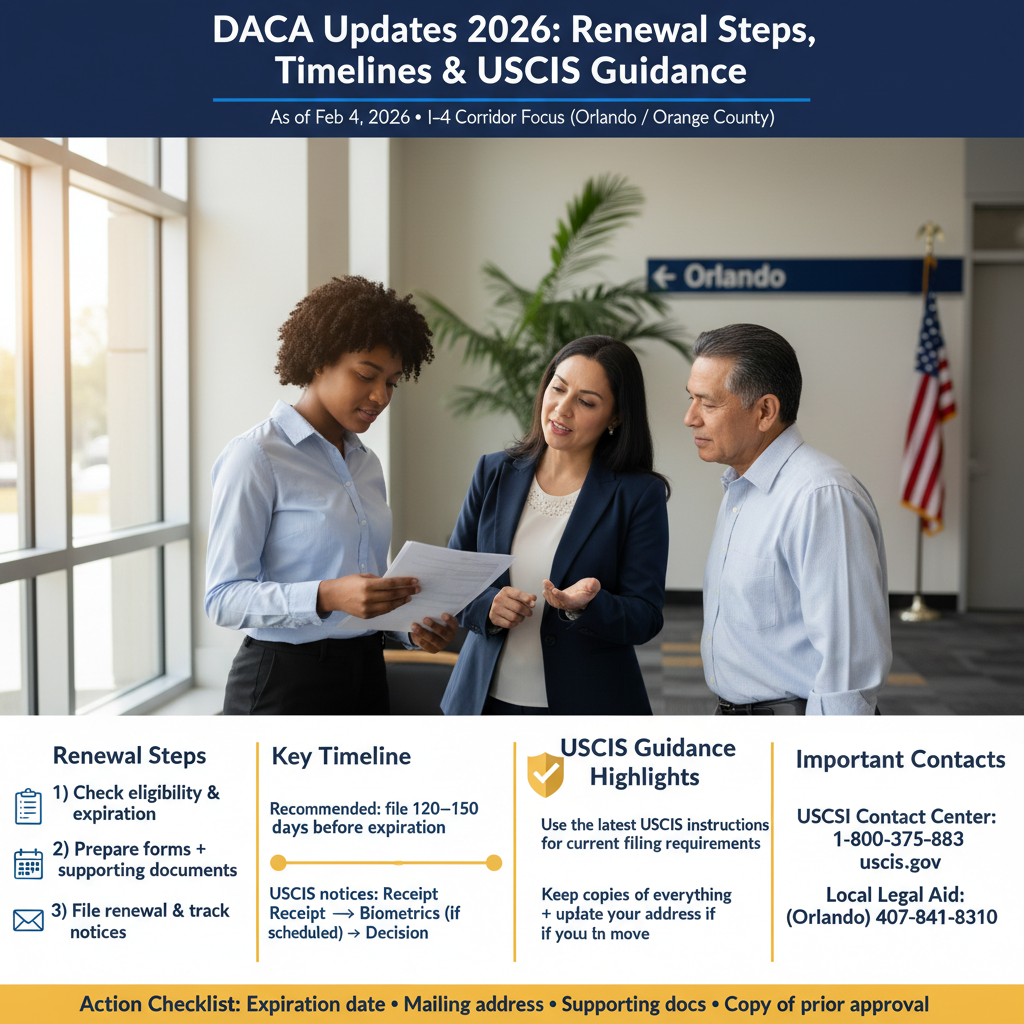
The reporting that sparked this guide comes from: DACA Program Updates and Renewal Information (USCIS). This article is designed to translate the latest DACA-related updates and USCIS guidance into practical renewal steps you can follow—especially if you live in Orlando, Orange County, or anywhere along the I-4 corridor.
Need Help? Our Orlando immigration team is ready to assist. Call +1 786-791-3106 for a free consultation, or message us online. Se Habla Español.
What This News Means for Immigrants in Orlando and Across Florida
Why this news is showing up now
DACA (Deferred Action for Childhood Arrivals) continues to be one of the most closely watched immigration programs in the United States. It frequently appears in the news because it sits at the intersection of executive policy, federal court litigation, and USCIS operational guidance.
Important: In recent years, DACA has been shaped by ongoing federal court rulings that affect what USCIS can accept and approve. As a result, many “updates” are not new legislation—rather, they are changes in how USCIS processes requests, posts guidance, or communicates timeframes and evidence expectations.
Another reason DACA news trends is timing: large numbers of recipients have work permits (EADs) expiring in waves. This creates spikes in renewal filings and questions about the best time to apply. USCIS generally encourages filing within a recommended window to reduce the risk of an employment authorization gap.
How it can affect Florida residents
For Florida residents—including those in Orlando, Kissimmee, Winter Park, Sanford, and throughout Orange County—DACA updates can directly affect:
- Work authorization and the ability to keep your job, renew professional licenses, or maintain employment eligibility (Form I-9 compliance).
- Driver’s license renewals and state ID timing, because many DMV processes track the EAD validity period.
- Travel planning, especially if you are considering advance parole (where available and appropriate) and need to understand risks and documentation.
- Family planning and longer-term strategies, including whether you may qualify for Adjustment of Status through a family petition such as Form I-130 and Form I-485 (depending on your entry history and other factors).
If your case is in Orlando, you may interact with the USCIS system through online filing tools, biometrics scheduling, and (in some situations) local field office processing. The Orlando area also has a high concentration of employers along the I-4 corridor, making uninterrupted work authorization especially important.
What DACA Program Updates and Renewal Information Is (and Why It Matters)
A plain-English definition
DACA is a discretionary policy under which the federal government may choose to “defer” (pause) removal action for certain people who came to the U.S. as children and meet specific guidelines. DACA is not a visa, not a green card, and not U.S. citizenship. It is a temporary protection from removal plus the ability to request an Employment Authorization Document (EAD).
“DACA program updates and renewal information” generally refers to USCIS guidance about:
- Who can file (new/initial requests versus renewals)
- Which forms and fees to submit
- When to file (timing windows)
- How USCIS handles biometrics
- How to respond to Requests for Evidence (RFEs)
- Processing times and common delays
Key terms you need to know
- DACA: Deferred Action for Childhood Arrivals (temporary protection and eligibility to apply for work authorization).
- Deferred action: A discretionary decision to defer removal action for a period of time.
- EAD: Employment Authorization Document (work permit), typically requested with Form I-765.
- Renewal: A request to continue DACA and work authorization for another period (if eligible).
- RFE: Request for Evidence—USCIS asks for missing/clarifying documentation.
- Notice of Action: USCIS receipt and decision notices (commonly I-797).
- Biometrics: Fingerprints/photo/signature appointment (if required).
- Processing times: USCIS estimates that vary by form type and workload. Check USCIS Processing Times.
- 90-day window: A commonly discussed practical timeframe for planning renewals; many applicants aim to file well before expiration to reduce the risk of gaps. (USCIS guidance has often referenced filing months before expiration; confirm current recommendations.)
- 180 days: A widely used planning benchmark in immigration for timing strategies; for DACA, many people plan filings around several months before expiration to avoid delays.
- Adjustment of Status: The process of applying for a green card from inside the U.S. using Form I-485 (only if eligible).
- Priority Date: The place in line for certain immigrant visa categories (often tied to Form I-130 or employment-based filings).
Reminder: DACA does not automatically place you on a path to permanent residency. However, some DACA recipients may have separate pathways through family or employment-based immigration. A renewal is often a critical “bridge” that preserves stability while you explore long-term options.
Current Immigration Law: The Foundation
DACA exists through executive branch policy and has been shaped by federal court decisions. USCIS administers DACA requests and employment authorization under existing immigration regulations and agency authority. The legal and procedural “foundation” includes:
- The Immigration and Nationality Act (INA) framework that governs immigration benefits and enforcement.
- Regulations governing employment authorization (commonly under 8 C.F.R. provisions) and USCIS adjudications.
- Agency policy memoranda and Federal Register notices that outline eligibility and procedures.
For official updates and the most current instructions, start with the USCIS official website and the DACA page, plus the forms and instructions at USCIS Forms.
Federal requirements
While the exact eligibility criteria and what USCIS can approve has been affected by litigation, the renewal process typically requires:
- Submitting the correct forms (usually Form I-821D, Form I-765, and Form I-765WS).
- Paying the correct fee (or requesting a fee exemption if available and appropriate—note: fee exemptions for DACA are limited and not always available).
- Maintaining continuous residence and meeting other eligibility rules.
- Avoiding disqualifying criminal issues (some arrests/charges can cause denial or referral to enforcement).
Warning: Any contact with law enforcement—even without a conviction—can complicate a DACA renewal. Get a legal screening before filing if you have any arrest, citation, or pending charge.
USCIS will also evaluate whether you pose a public safety risk or otherwise fall outside prosecutorial discretion factors. This is highly fact-specific.
Florida-specific considerations
DACA is a federal program, but Florida residents face practical state-level issues:
- Driver’s license timing: Florida DHSMV processes often track your lawful presence/work authorization validity. Plan renewal early to avoid gaps.
- Employment verification: Many employers in Central Florida (tourism, healthcare, logistics along the I-4 corridor) run strict reverification schedules based on EAD expiration.
- Mobility within the state: If you move within Orange County or to another Florida county, update your address with USCIS promptly to avoid missing notices.
If your case is in Orlando, you may also have questions about local biometrics sites and mail delivery reliability. USCIS notices are time-sensitive—missing a biometrics appointment or an RFE deadline can lead to denial.
Forms you may see in DACA-related planning: Form I-821D (DACA), Form I-765 (EAD), and Form I-765WS (worksheet). In longer-term family strategies, you may also hear about Form I-130 and Form I-485 for Adjustment of Status depending on eligibility, and the Priority Date concept in visa availability.
Need Help? Our Orlando immigration team is ready to assist. Call +1 786-791-3106 for a free consultation, or message us online. Se Habla Español.
How to Renew DACA: A Complete Step-by-Step Guide
Below is a practical, start-to-finish renewal roadmap based on USCIS procedures and common renewal workflows. Because the DACA landscape can change, always cross-check instructions on the USCIS official website and the latest form instructions at USCIS Forms.
Reminder: Many applicants plan to file several months before expiration to reduce risk of a work authorization gap. Some people refer to a 90-day window or even 180 days as planning benchmarks. The safest approach is to file early enough to account for biometrics, RFEs, and processing delays.
1) Confirm you are filing a renewal (and check eligibility red flags)
Start by confirming whether you are eligible to file a DACA renewal under current USCIS acceptance policies. Even if you have renewed before, issues can arise that require legal analysis.
Gather and review these items:
- Copy of your current (or most recent) DACA approval notice (I-797)
- Copy of your current EAD (front and back)
- Any criminal history documents (if applicable), including certified dispositions
- Any immigration court documents (if applicable), including hearing notices
- Your full address history since your last filing
Warning: If you have had any arrest, charge, or conviction since your last renewal, do not “guess” what to disclose. USCIS runs background checks. In many cases, you should obtain certified court records before filing.
If you are in removal proceedings, you may also need to consider how your case interacts with the Executive Office for Immigration Review (EOIR). Coordination between USCIS filings and immigration court strategy matters.
2) Choose the right filing method and create a USCIS online account
USCIS increasingly uses online tools for case tracking and, in some contexts, for filing. Whether you file online or by mail depends on USCIS options available for DACA renewals at the time you file. An online account helps you:
- Track receipt notices and case status updates
- Receive alerts and messages
- Upload responses if USCIS allows online RFE responses for your case type
Documents/info to have ready for account setup and filing:
- A reliable email address you check daily
- A secure way to store passwords and two-factor authentication
- Your A-Number (if you have one)
- Your prior receipt numbers
Important: If you move, update your address as soon as possible. Missed mail is one of the most common reasons people miss deadlines.
3) Prepare your renewal packet: forms, fees, and supporting evidence
A typical DACA renewal includes:
- Form I-821D (Consideration of Deferred Action for Childhood Arrivals)
- Form I-765 (Application for Employment Authorization)
- Form I-765WS (Worksheet)
You must use the current edition of each form and follow the latest instructions on USCIS Forms.
Documents commonly included (as applicable):
- Copy of your current EAD (front/back)
- Copy of your last DACA approval notice (I-797)
- Two passport-style photos (if required for your filing method)
- Any name change documents (marriage certificate, court order)
- Certified court dispositions for any arrests/charges (even if dismissed)
- Proof of fee payment method (check/money order or online payment confirmation)
Reminder: A DACA renewal is not the place to “hide” issues. If something changed since your last filing (address, travel, police contact, immigration court involvement), talk to an attorney before submitting.
4) File the application correctly (and keep proof of submission)
Filing errors can cause rejections, delays, or denials. Whether you file online or by mail, you should create a clean record.
Best practices for filing:
- Save a complete PDF copy of everything submitted (forms + evidence)
- If mailing, use trackable delivery and keep the delivery confirmation
- Make sure signatures and dates are correct
- Confirm the correct filing address and fee amount at time of filing
What to include in your “proof” folder:
- Full copy of submitted forms
- Fee receipt / cashed check image (if applicable)
- USCIS receipt notices (I-797C)
- Delivery tracking and confirmation
Important: A rejected filing can cost you weeks—time you may not have if your EAD is near expiration. This is why planning around a 90-day window or even 180 days is often discussed for risk management.
5) Attend biometrics (if scheduled) and respond quickly to any USCIS notice
USCIS may schedule biometrics or may reuse prior biometrics. If you receive an appointment notice, attend exactly as scheduled unless USCIS provides rescheduling instructions.
Bring to biometrics (typically):
- The biometrics appointment notice
- Government-issued photo ID (passport, state ID, etc.)
- Any USCIS receipt notices
If you live in Central Florida, plan travel time and arrive early. If your case is in Orlando, biometrics may be scheduled at a regional Application Support Center (ASC). Always follow the location listed on your notice.
Warning: If USCIS issues an RFE, the response deadline is strict. Missing it can lead to denial. If you receive an RFE, consider getting legal help to ensure your response is complete and consistent.
6) Track your case, plan for employment reverification, and prepare for the decision
After filing, monitor your case status and processing times:
- Use your USCIS account and receipt number to track status
- Check USCIS Processing Times for current estimates
- Watch for mail notices—some updates come by mail first
Many employers reverify work authorization before the EAD expiration date. If your renewal is pending and your current EAD is expiring, talk to your employer’s HR department early. DACA does not always provide automatic extension rules that apply to some other EAD categories.
Keep these documents ready for HR/DMV needs:
- Current EAD
- Renewal filing receipts (if helpful for internal tracking)
- New EAD once approved
- Approval notices (I-797)
7) If approved, update records; if delayed or denied, act fast
If approved, you will receive a new DACA approval notice and a new EAD with updated validity dates. Immediately:
- Update your employer’s I-9 reverification (as required)
- Renew your Florida driver’s license/state ID if needed
- Store your notices and EAD securely and keep digital copies
If the case is delayed beyond normal timeframes, you may consider a case inquiry through USCIS tools and, in some situations, assistance from counsel. If denied, you should consult an attorney immediately to understand the reason, whether a motion is possible, and whether there are risks of referral to enforcement.
Need Help? Our Orlando immigration team is ready to assist. Call +1 786-791-3106 for a free consultation, or message us online. Se Habla Español.
Practical Steps You Can Take Today
If you are a DACA recipient in Orlando or anywhere in Florida, here are concrete actions you can take today to reduce risk and improve your renewal experience.
- Checklist item #1: Confirm your expiration dates. Look at both your DACA approval period and your EAD card expiration. Put reminders on your calendar for 180 days and 90-day window planning points.
- Checklist item #2: Order certified court records early (if applicable). If you had any police contact, start gathering certified dispositions now. Waiting can cause missed deadlines.
- Checklist item #3: Update your address and keep mail reliable. If you recently moved in Orange County or along the I-4 corridor, ensure USCIS has your correct address and that your name is on the mailbox.
- Checklist item #4: Build a clean document folder. Keep a dedicated folder (paper + digital) containing all prior receipts, approvals, EAD copies, and your latest filing packet.
- Checklist item #5: Budget for filing fees and photos. Fees change. Verify the current amount on the USCIS official website and plan for passport photos if required.
- Checklist item #6: Track processing times. Check USCIS Processing Times monthly so you can identify unusual delays.
- Checklist item #7: Avoid notario fraud. Only licensed attorneys or accredited representatives should give legal advice. If something feels rushed or “guaranteed,” it’s a red flag.
Timeline expectations (general): DACA renewals can take weeks to several months depending on USCIS workload, biometrics needs, and whether an RFE is issued. Always plan for delays—especially during peak filing seasons.
For Central Florida residents, also consider how renewal timing affects:
- Employer reverification schedules
- Florida driver’s license renewal availability
- School enrollment/employment onboarding requirements
How Imigrar Helps Immigrants in Orlando
At Imigrar, our mission is to Keep Families Together. We help DACA recipients and their families understand renewal requirements, reduce risk, and plan for longer-term immigration solutions when available.
Our support can include:
- Renewal readiness review (spotting red flags before you file)
- Document organization and consistency checks across prior filings
- RFE strategy and response preparation
- Screening for other immigration options (family-based petitions like Form I-130, potential Adjustment of Status through Form I-485 when eligible, and understanding Priority Date implications)
- Guidance for clients in or near the Orlando USCIS Field Office jurisdiction and throughout Florida
Se Habla Español. We serve clients in Orlando and nationwide, with a focus on clear communication and practical next steps.
Call us at +1 786-791-3106 for a free consultation, or message us online at imigrar.com/contact.
Frequently Asked Questions
Q: Am I still eligible to renew DACA if I had an arrest or ticket?
A: It depends on the type of incident and the outcome. Some offenses can disqualify you or trigger heightened scrutiny. Important: Before filing, obtain certified court dispositions and consult an attorney. Do not rely on memory or informal summaries. USCIS will run background checks, and inconsistencies can lead to denial.
Q: Does renewing DACA give me legal status or a green card?
A: No. DACA is not lawful permanent resident status and does not directly lead to a green card or citizenship. It is deferred action plus the ability to apply for work authorization. However, some DACA recipients may qualify for separate pathways (for example, through a U.S. citizen spouse or parent in certain cases). Those pathways may involve Form I-130, Form I-485, and an analysis of eligibility for Adjustment of Status.
Q: How early should I file my DACA renewal?
A: Many applicants plan to file months before expiration to reduce the chance of an EAD gap. People often reference a 90-day window and even 180 days as planning benchmarks. The best approach is to review current USCIS guidance and file early enough to account for biometrics, RFEs, and processing delays.
Q: What documents do I need for a DACA renewal?
A: Most renewals include Form I-821D, Form I-765, and Form I-765WS, plus copies of your current/previous EAD and DACA approval notice. If anything changed (name change, address changes, any police/court issues), include supporting documentation. Always use the latest form editions from USCIS Forms.
Q: How much does it cost to renew DACA?
A: The total cost depends on USCIS fee schedules in effect when you file and whether biometrics fees are included. Reminder: USCIS fees can change, so verify current amounts directly on the USCIS official website before submitting payment.
Q: What happens if my DACA renewal is denied?
A: A denial can mean loss of deferred action and loss of work authorization, and it may increase immigration enforcement risk depending on your circumstances. If you receive a denial, speak with an immigration attorney immediately to understand the reason, whether any motion or re-filing is possible, and how to protect yourself. If you are in removal proceedings or have an immigration court case, coordination with EOIR strategy may be necessary.
Q: Can I travel internationally with DACA?
A: International travel is legally sensitive. Some DACA recipients have sought advance parole when available and appropriate, but policies and availability can change. Warning: Traveling without proper authorization can trigger serious consequences, including being unable to return. For official travel and visa information, consult the U.S. Department of State and speak with counsel before making plans.
Q: If my case is in Orlando, will the Orlando USCIS Field Office decide my DACA renewal?
A: Many DACA renewals are handled through USCIS service center workflows, with biometrics and certain in-person needs handled locally. If your case is in Orlando, you may still receive notices directing you to local facilities for biometrics or other steps. Always follow the instructions on your USCIS notices and keep address information current.
Common Mistakes (and How to Avoid Them)
Mistake #1: Filing too late and risking a work authorization gap
Waiting until the last minute is one of the biggest DACA renewal risks. Processing times fluctuate, and an RFE can add weeks. Avoid this by planning around 180 days and the 90-day window benchmarks and filing early enough to absorb delays.
Mistake #2: Not disclosing arrests or submitting incomplete court records
USCIS will see many criminal history events through background checks. Submitting incomplete information—or failing to provide certified dispositions—can lead to denial. If you had any police contact, get records first and consult a lawyer.
Mistake #3: Using outdated forms or incorrect fees
USCIS can reject filings that use the wrong form edition or incorrect payment. Always download the current forms and confirm the fee on the USCIS official website and USCIS Forms.
Need Help? Our Orlando immigration team is ready to assist. Call +1 786-791-3106 for a free consultation, or message us online. Se Habla Español.
Additional official resources to bookmark

Closing: Protect your DACA and plan your next step
DACA renewals are about more than paperwork—they protect your ability to work, drive, and care for your family. For Central Florida residents, timing and documentation are especially important because delays can ripple into employment and DMV deadlines.
Important: If you have any criminal history, prior immigration issues, or you are unsure about eligibility, get legal advice before filing. A small mistake can create big consequences.
Need Help? Our Orlando immigration team is ready to assist. Call +1 786-791-3106 for a free consultation, or message us online. Se Habla Español.


