


The reporting that sparked this guide
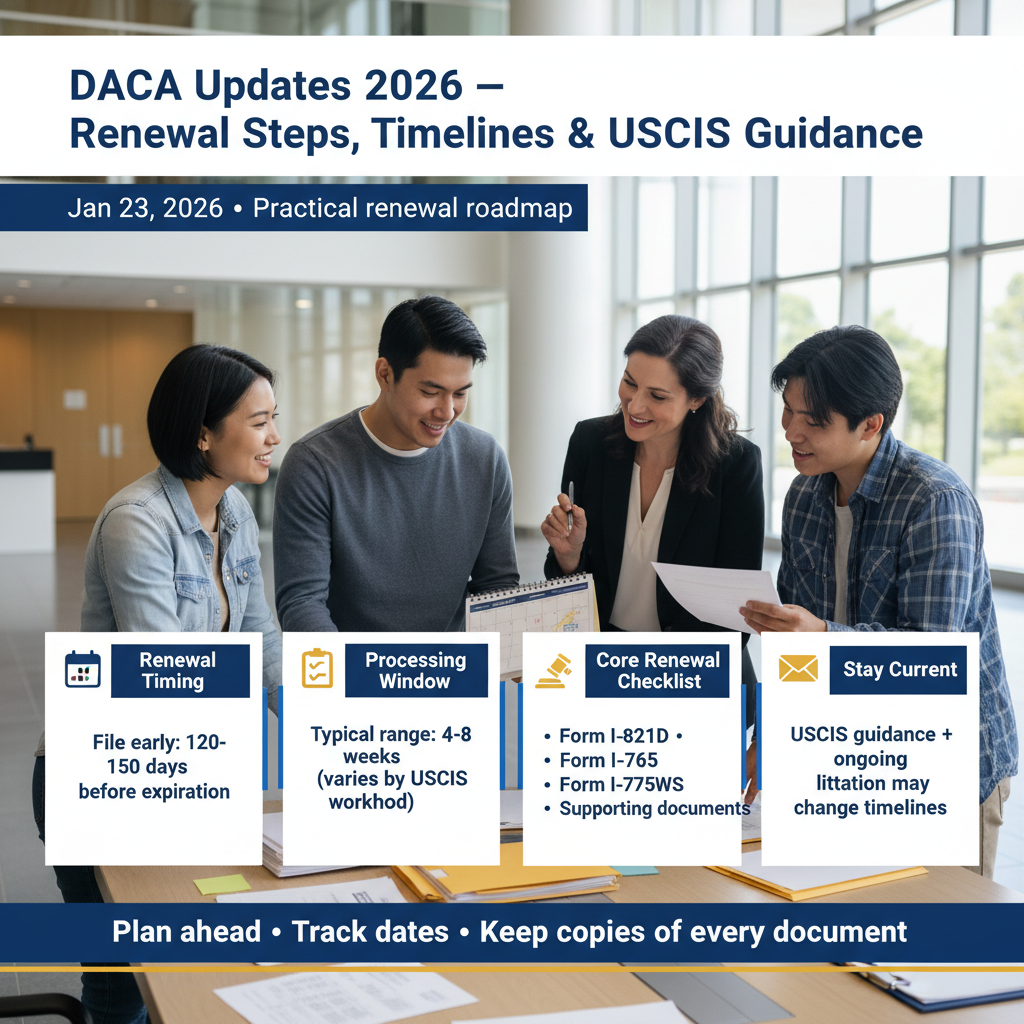
This article is based on the current wave of coverage and public interest around DACA updates and renewals, anchored in USCIS guidance and related reporting aggregated here: DACA Program Updates and Renewal Information (USCIS).
Important: DACA remains a fast-moving area due to ongoing litigation and policy updates. This guide focuses on what USCIS currently accepts and how to renew properly, while explaining what may change and how to protect yourself.
Need Help? Our Orlando immigration team is ready to assist. Call +1 786-791-3106 for a free consultation, or message us online. Se Habla Español.
What This News Means for Immigrants in Orlando and Across Florida
Why this news is showing up now
DACA frequently trends because it sits at the intersection of immigration policy, federal court litigation, and real-life deadlines. Many recipients must renew every two years to maintain:
- Deferred action (temporary protection from removal), and
- Employment Authorization (a work permit, commonly called an EAD).
When USCIS updates online instructions, fees, filing addresses, or processing time patterns—or when court decisions affect the program—news coverage spikes. Another reason: large groups of recipients share similar expiration cycles, meaning renewals surge at the same time. That can create delays, increased Requests for Evidence (RFEs), and higher anxiety for families trying to plan work, school, and travel.
Reminder: Even when there is no “big” policy announcement, the practical reality is that DACA recipients must manage renewals strategically to avoid gaps in work authorization.
How it can affect Florida residents
For Florida residents—especially in Central Florida and the I-4 corridor (Orlando, Kissimmee, Sanford, Lakeland, Tampa)—DACA renewals affect not just immigration status, but daily stability:
- Employment continuity: Employers often require an unexpired EAD for I-9 compliance.
- Driver’s license and ID: Florida licensing rules often tie validity periods to immigration documents.
- Education and career licensing: Certain programs, internships, and professional pathways may require valid work authorization.
- Family planning: DACA recipients frequently live in mixed-status households; renewals reduce risk and uncertainty.
If your case is in Orlando or you live in Orange County, you may also be coordinating DACA renewal timing with other immigration strategies—such as family-based petitions (Form I-130), Adjustment of Status (Form I-485), or consular processing through the U.S. Department of State.
Warning: A late DACA renewal can lead to an EAD gap, which may cause job loss, benefit interruptions, and avoidable stress. Planning ahead is not optional—it’s a key part of protecting your future.
What DACA Program Updates and Renewal Information Is (and Why It Matters)
A plain-English definition
DACA stands for Deferred Action for Childhood Arrivals. It is a discretionary policy that can grant eligible individuals:
- Deferred action (a decision by DHS not to pursue removal for a set period), and
- Eligibility to apply for a work permit (EAD) using Form I-765.
DACA is not permanent legal status, not a visa, and not a green card. It does not automatically lead to citizenship. However, it can be life-changing because it allows recipients to work lawfully and live with greater stability while exploring long-term options (family petitions, marriage-based cases, employer sponsorship, humanitarian relief, or other pathways).
Key terms you need to know
- Deferred action: Temporary prosecutorial discretion not to remove someone for a period of time.
- EAD (Employment Authorization Document): The work permit card issued after Form I-765 approval.
- USCIS: U.S. Citizenship and Immigration Services, the agency that processes DACA renewals. See the USCIS official website.
- Filing window: USCIS has historically recommended filing renewals well in advance. Many practitioners advise planning around 180 days before expiration to reduce the risk of gaps.
- Processing times: How long USCIS takes to decide. Always verify at USCIS Processing Times.
- RFE: Request for Evidence—USCIS asks for more documents before deciding.
- Notice of Action: Receipt notices (often Form I-797) confirming USCIS accepted your filing.
- Priority Date: A term more relevant to family/employment green card queues; included here because many DACA recipients also pursue Form I-130 and later Adjustment of Status via Form I-485.
Important: “Program updates” often mean changes to instructions, fees, filing methods (online vs. paper), evidence expectations, or how USCIS communicates. Small changes can cause big problems if you file the wrong edition of a form or send an incorrect fee.
Current Immigration Law: The Foundation
DACA exists within a broader legal framework. While DACA itself is an executive-branch policy and has been shaped by federal litigation, the immigration system is governed primarily by federal statutes and regulations.
Federal requirements
Key legal foundations and authorities that shape DACA-related practice include:
- Immigration and Nationality Act (INA): The primary federal immigration statute (Title 8 of the U.S. Code). While DACA is not an INA-created status, many related benefits and consequences (work authorization categories, unlawful presence rules, admissibility) trace back to the INA.
- 8 C.F.R. § 274a (employment authorization regulations): These regulations govern EAD categories and work authorization rules.
- Administrative Procedure Act (APA): Federal courts have analyzed DACA under APA standards in litigation, influencing whether and how USCIS can implement or modify the program.
- USCIS policy guidance: USCIS instructions and FAQs—always confirm directly on the USCIS official website.
DACA renewals generally involve these USCIS forms:
- Form I-821D (Consideration of Deferred Action for Childhood Arrivals)
- Form I-765 (Application for Employment Authorization)
- Form I-765WS (Worksheet explaining economic need)
You can confirm form editions and instructions at USCIS Forms.
Florida-specific considerations
Immigration is federal, but Florida residents experience DACA through state and local systems—employment markets, licensing, and ID rules. Practical Florida considerations include:
- Driver’s license timing: Florida often ties license validity to your immigration document expiration date. Renew early if your license will expire near your EAD expiration.
- Employment verification: Florida employers must comply with federal I-9 rules; an expired EAD can create immediate job issues.
- Local enforcement and court matters: Any criminal arrest—even if charges are dropped—can complicate DACA. If you have immigration court issues, consult the Executive Office for Immigration Review resources and speak with counsel.
- Orlando logistics: For Central Florida residents, biometrics or identity verification steps (when required) can involve travel planning around the Orlando area. The Orlando USCIS Field Office may be relevant for other case types, even if DACA processing is centralized.
Reminder: DACA is discretionary. USCIS can deny based on eligibility issues, criminal history, misrepresentation, or failure to respond to requests. Treat the renewal like a legal filing, not “just paperwork.”
Need Help? Our Orlando immigration team is ready to assist. Call +1 786-791-3106 for a free consultation, or message us online. Se Habla Español.
How to Renew DACA: A Complete Step-by-Step Guide
Below is a practical renewal roadmap based on USCIS filing mechanics and common issues we see. Always verify current instructions and addresses on the USCIS official website because USCIS can change procedures.
Important: Many attorneys recommend planning your renewal around 180 days before your current DACA/EAD expires. While people often talk about a 90-day window, waiting until the last 90 days can be risky if processing slows or an RFE is issued.
1) Confirm your expiration date and build a renewal calendar
Start by checking the expiration date on your EAD card and your DACA approval notice. Create a renewal plan that accounts for:
- USCIS processing variability
- Possible RFEs
- Mail delays
- Employer re-verification timing
Documents to gather for this step:
- Front and back copy of your current EAD card
- Your most recent DACA approval notice (I-797)
- Any USCIS receipt numbers from prior filings
- A valid government-issued photo ID (if available)
2) Screen for risk factors before filing (do not skip)
Before you submit a renewal, evaluate whether anything changed since your last approval. This is where many denials and delays originate.
Risk factors to review:
- Any arrests, charges, citations, or court dates (even if “dismissed”)
- Any travel outside the U.S. (including brief trips)
- Any prior immigration encounters (CBP, ICE, court)
- Any use of false documents or misrepresentations
Documents to gather for this step:
- Certified court dispositions for every arrest/charge
- Police reports (if available)
- Proof of case dismissal or completion of probation
- Prior immigration paperwork (NTA, removal order, voluntary departure)
Warning: Filing without addressing criminal or immigration-court issues can trigger a denial or referral. If you have any record, speak with an attorney before filing.
3) Prepare the correct USCIS forms (I-821D, I-765, I-765WS)
A standard DACA renewal includes:
- Form I-821D
- Form I-765
- Form I-765WS
Use the most current form editions listed on USCIS Forms. Read the instructions carefully—USCIS rejects many filings due to outdated editions, missing signatures, or incorrect answers.
Documents to gather for this step:
- Copy of your EAD (front/back)
- Legal name change documents (if applicable)
- Address history and employment history (basic timeline)
- Any prior A-number, USCIS online account info (if you have it)
Reminder: Even though DACA is not a green card process, many DACA recipients also have family cases pending. If you have a pending Form I-130 with a Priority Date, tell your attorney—your broader strategy matters.
4) Assemble evidence and a clean, organized filing package
Most renewals rely heavily on prior approvals, but you still must submit a complete, consistent package. USCIS wants clarity and consistency.
Typical evidence checklist:
- Copy of current EAD (front/back)
- Copy of last DACA approval notice
- Two passport-style photos (if required by your filing method/instructions)
- Any documents supporting changes since last filing (name change, corrected DOB, etc.)
- Certified dispositions for any criminal matters (if applicable)
Documents to gather for this step:
- Document translations (certified) if not in English
- Proof of address (if your mailing address changed)
- Cover letter (recommended) summarizing contents and any special notes
5) Pay the correct fees and submit using the correct method
USCIS may allow online filing for certain form combinations and may also require paper filing in other situations. Fees can change. Verify the current amount and payment method on the USCIS official website before you submit.
Documents/items to gather for this step:
- Correct filing fee payment (per USCIS instructions)
- Proof of payment method (money order copy, card authorization if applicable)
- Mailing envelope with tracking (if paper filing)
Important: Incorrect fees are a top cause of rejections. A rejection can cost you weeks—sometimes pushing you into an EAD gap.
6) Track receipts, biometrics instructions, and respond fast to USCIS notices
After filing, USCIS will issue receipt notices. Sometimes USCIS reuses biometrics; other times it schedules an appointment or requests identity verification steps. Follow every notice exactly and keep copies.
Documents/items to gather for this step:
- USCIS receipt notices (I-797)
- USCIS online account login (if applicable)
- Biometrics appointment notice (if issued)
- Photo ID for any appointment
Check your case progress at USCIS Processing Times, but remember that processing time ranges are not guarantees.
7) Prepare for approval, EAD delivery, and employer re-verification
Once approved, you should receive:
- An updated DACA approval notice, and
- Your new EAD card by mail.
Documents/items to gather for this step:
- New EAD card (make front/back copies)
- Approval notices
- Employer HR contact details for I-9 updates
- DMV appointment notes (if you need to renew your Florida license)
Reminder: If your case is in Orlando and you are also pursuing a green card route (for example through marriage), you may later file Form I-485 for Adjustment of Status. Plan carefully—some paths depend on lawful entry, waivers, or consular processing.
Practical Steps You Can Take Today
DACA renewals go smoothly when you treat them like a project with deadlines. Here is an actionable checklist you can start today.
Actionable renewal checklist
- 1) Mark your dates: Put your EAD expiration date on your calendar and set reminders at 180 days, 150 days, 120 days, and 90-day window milestones.
- 2) Create a “USCIS folder”: Keep digital scans (PDF) and paper copies of every prior approval, EAD, and receipt notice.
- 3) Order court records early: If you have any arrest history, request certified dispositions now—some Florida clerks take weeks.
- 4) Verify your address: If you moved along the I-4 corridor (Orange County to Osceola, Seminole, Polk, Hillsborough), make sure your mailing address is stable to avoid lost notices.
- 5) Check processing trends: Review USCIS Processing Times and plan extra buffer time.
- 6) Talk to HR proactively: Ask what your employer needs for I-9 re-verification and when they will request it.
- 7) Consider long-term strategy: If you have a U.S. citizen spouse/parent/child (over 21), ask about Form I-130 and whether Adjustment of Status via Form I-485 is possible in your situation.
Document preparation guidance
Keep these items ready (and updated):
- Copies of your EAD (front/back) and approval notices
- Valid passport or consular ID (if available)
- Any name change documents
- Certified court dispositions (if applicable)
- Proof of any corrections to prior filings (if you previously made an error)
Important: If a document is not in English, use a proper certified translation. Poor translations can trigger delays.
Timeline expectations
Processing times vary widely. Some renewals are decided quickly; others take months due to background checks, RFEs, or workload surges. Plan as if it will take longer than you hope.
- Best practice: Prepare to file around 180 days before expiration.
- Risk zone: Filing inside the 90-day window increases the chance of an EAD gap if there is any delay.
- Tracking: Use official tools and keep your receipts. If your case is outside normal time, an attorney can advise on next steps.
Need Help? Our Orlando immigration team is ready to assist. Call +1 786-791-3106 for a free consultation, or message us online. Se Habla Español.
How Imigrar Helps Immigrants in Orlando
At Imigrar, we help DACA recipients and their families protect work authorization, reduce renewal risk, and plan for long-term status options. Our team in Orlando serves clients across Florida and nationwide with organized, deadline-driven support.
- Renewal strategy: We help you time your renewal to reduce EAD gaps and avoid preventable rejections.
- Risk screening: We identify issues (arrests, prior immigration history, document inconsistencies) before USCIS does.
- Evidence and presentation: We prepare clean filing packets and respond to RFEs effectively.
- Long-term planning: When appropriate, we explore family-based options like Form I-130 and potential Adjustment of Status using Form I-485, including how Priority Date and admissibility rules can affect you.
If your case is in Orlando, we can also help you coordinate your DACA renewal with other immigration matters that may involve the Orlando USCIS Field Office (for example, interviews for family-based green cards).
We offer a free consultation to discuss your renewal timing, documents, and any red flags. Se Habla Español.
Frequently Asked Questions
Q: Am I still eligible to renew DACA if I had a minor traffic issue in Florida?
A: Many traffic issues are not disqualifying, but it depends on what happened (citation vs. arrest, DUI allegations, reckless driving, driving without a license, etc.). Important: If you were arrested or had a criminal charge, get a certified court disposition before filing. If you’re unsure, speak with an attorney so you don’t submit a renewal that triggers a denial or an RFE.
Q: Does DACA renewal give me lawful status or a path to a green card?
A: DACA renewal continues deferred action and work authorization, but it does not create lawful permanent resident status and does not automatically lead to citizenship. Some DACA recipients may qualify for a green card through other paths (family-based Form I-130, employment, humanitarian relief). Whether you can file Form I-485 for Adjustment of Status depends on your individual facts, including your manner of entry and admissibility.
Q: How early should I file my DACA renewal to avoid losing my work permit?
A: Many practitioners recommend planning around 180 days before your EAD expires. While people often reference a 90-day window, filing that late can be risky if USCIS slows down or issues an RFE. Check current USCIS guidance on the USCIS official website and build buffer time.
Q: What documents do I need for a DACA renewal?
A: Most renewals include copies of your current EAD (front/back), your last approval notice, and completed forms Form I-821D, Form I-765, and Form I-765WS. If anything changed (name, address history, criminal history), you may need additional documents such as certified court dispositions or name change records. Always verify current instructions at USCIS Forms.
Q: How much does it cost to renew DACA?
A: USCIS filing fees can change, and the total depends on current fee rules and how you file. Confirm the exact amount and acceptable payment methods directly with USCIS before submitting to avoid rejection. You can start at the USCIS official website. If cost is a barrier, ask an attorney about reputable nonprofit resources and planning options—avoid “notario” fraud.
Q: What happens if my DACA renewal is denied?
A: A denial can mean loss of deferred action and loss of work authorization. The consequences depend on the reason for denial (eligibility, criminal issues, missed deadlines, failure to respond to an RFE, or discretionary concerns). Warning: If you receive a denial notice or an RFE/NOID, consult an attorney immediately to evaluate options. If you have immigration court proceedings, information from the Executive Office for Immigration Review may also be relevant, but legal advice is critical.
Q: Can I travel outside the U.S. with DACA?
A: Travel rules are complex and can change. DACA recipients should not assume international travel is permitted. Always review current USCIS guidance and talk to an attorney before making plans. For broader travel and visa context, see the U.S. Department of State, but remember that DACA travel questions are highly fact-specific.
Common Mistakes (and How to Avoid Them)
Mistake #1: Filing too late and triggering an EAD gap
Waiting until the last minute is one of the most common—and most damaging—errors. If USCIS takes longer than expected, you can lose your work authorization while the renewal is pending.
- How to avoid it: Build your plan around 180 days before expiration and treat the 90-day window as a risk zone.
- Orlando tip: For Central Florida residents commuting along the I-4 corridor, job changes happen fast—don’t let paperwork timing jeopardize your employment.
Mistake #2: Using the wrong form edition, missing a signature, or paying the wrong fee
USCIS can reject filings for technical errors. A rejection is not the same as a denial, but it can still cause dangerous delays.
- How to avoid it: Download forms only from USCIS Forms, verify the edition date, follow the checklist, and confirm fees on the USCIS official website.
- Reminder: Keep proof of delivery (tracking) if you file by mail.
Mistake #3: Hiding or minimizing arrests or immigration history
USCIS runs background checks. If you omit an arrest or fail to disclose immigration encounters, you can face denial and credibility issues.
- How to avoid it: Disclose accurately and provide certified dispositions. If you have concerns, consult counsel before filing.
- Warning: “Notario” advice can be dangerous—get real legal guidance.
Need Help? Our Orlando immigration team is ready to assist. Call +1 786-791-3106 for a free consultation, or message us online. Se Habla Español.

Closing: Protect Your DACA—And Plan Your Next Step
DACA renewals are more than routine filings—they are time-sensitive legal submissions that protect your ability to work and live with stability. The safest approach is to plan early, file correctly, and address any risk factors (criminal history, immigration court issues, prior errors) before USCIS raises them.
For Central Florida residents, including Orange County and communities along the I-4 corridor, timing matters—jobs, driver’s licenses, and family responsibilities depend on a valid EAD. If your case is in Orlando or you want a legal team that can help you renew and also explore longer-term options like Form I-130, Form I-485, and Adjustment of Status, Imigrar is here to help.
Need help with your DACA renewal or a long-term plan? Call Imigrar at +1 786-791-3106 for a free consultation or message us online. Se Habla Español. Our tagline is “Keep Families Together,” and we take that mission seriously.


