


The reporting that sparked this guide
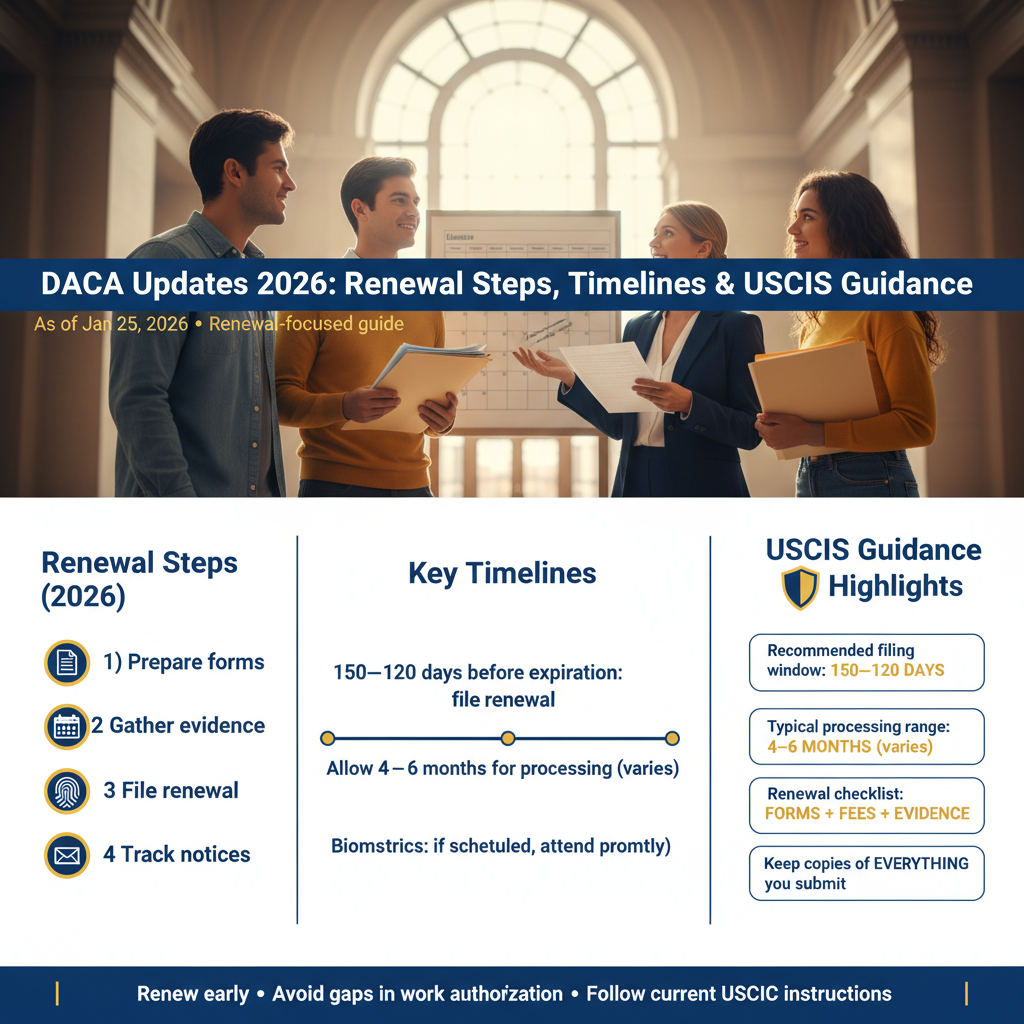
This article is based on ongoing, trending coverage and public-facing updates connected to USCIS guidance and DACA renewal practices. For the news stream that prompted this resource, see: DACA Program Updates and Renewal Information (USCIS).
Important: DACA is a fast-moving area of immigration policy and litigation. This guide focuses on practical, USCIS-aligned renewal steps and risk-reduction strategies for recipients and their families. It is not legal advice for your specific case.
Need Help? Our Orlando immigration team is ready to assist. Call +1 786-791-3106 for a free consultation, or message us online. Se Habla Español.
What This News Means for Immigrants in Orlando and Across Florida
Why this news is showing up now
DACA continues to generate headlines because it sits at the intersection of (1) executive-branch policy, (2) federal court litigation, and (3) real-life deadlines that affect work authorization and daily stability. Even when there is no brand-new statute passed by Congress, USCIS operational guidance, processing patterns, and court rulings can change what applicants should do—especially regarding timing and documentation.
In practical terms, “DACA updates” usually involve one or more of the following:
- USCIS renewal filing practices, including online filing options and evidence expectations
- Processing-time fluctuations that can impact when you should file (and how early)
- Litigation-driven limits (for example, whether USCIS can accept first-time DACA requests)
- Work permit (EAD) continuity planning so you can keep your job and driver’s license
Reminder: Many recipients feel “nothing changed,” until their EAD is about to expire. The most important “update” for many people is a reliable plan to renew early, track the case, and respond quickly to any USCIS notice.
How it can affect Florida residents
For Florida residents—especially in Central Florida along the I-4 corridor (Orlando, Kissimmee, Sanford, and surrounding Orange County communities)—DACA renewal timing can impact:
- Employment authorization (keeping your job, onboarding, or job changes)
- Driver’s license/REAL ID renewal (Florida often ties validity to your current immigration document dates)
- School and professional licensing (where proof of lawful presence or work authorization is required)
- Travel decisions (DACA recipients should be extremely cautious and seek counsel before any travel-related plan)
If your case is in Orlando or you rely on the Orlando-area USCIS infrastructure, your filing still goes through USCIS lockbox and service center processes. However, your local footprint matters for biometrics appointments (if scheduled), mail reliability, and quickly responding to USCIS notices.
What DACA Program Updates and Renewal Information Is (and Why It Matters)
A plain-English definition
DACA (Deferred Action for Childhood Arrivals) is a USCIS-administered policy that can grant certain eligible individuals:
- Deferred action (a decision by the government to defer/hold off on removal action for a period of time), and
- Employment authorization (an EAD/work permit) for the same period, if approved.
DACA is not the same as permanent residency (a green card) and it is not U.S. citizenship. It is a time-limited protection and work authorization that must be renewed.
When people talk about “DACA updates,” they are typically referring to changes in eligibility rules, acceptance of new applications, or the most current USCIS guidance on how to renew—especially as court decisions affect whether USCIS can grant first-time requests.
Key terms you need to know
- DACA Renewal: A request to extend your deferred action and EAD after your current period is nearing expiration.
- EAD: Employment Authorization Document (work permit). For DACA recipients, this is commonly issued under category (c)(33).
- Notice of Action (I-797): USCIS receipt and decision notices that prove filing and approval.
- Biometrics: Fingerprints/photo appointment (USCIS may reuse biometrics in some cases, but can still schedule an appointment).
- Removal Proceedings: Immigration court process. The immigration court system is overseen by EOIR; see Executive Office for Immigration Review.
- Warning: DACA does not automatically protect you from all immigration consequences if you have arrests/charges, certain convictions, fraud issues, or if you depart the U.S. without appropriate legal permission.
- Adjustment of Status and Priority Date: These are common green card concepts. Many DACA recipients explore family-based paths involving Form I-130 and Form I-485 (when eligible). Even if you are only renewing DACA today, it is smart to understand these terms for long-term planning.
Current Immigration Law: The Foundation
DACA is not a statute passed by Congress. It is rooted in executive authority and implemented through DHS/USCIS policy. That said, USCIS still processes DACA renewals using specific regulations and statutory authorities that govern employment authorization, inadmissibility, removability, and agency procedure.
Federal requirements
Key legal and regulatory foundations that often come into play include:
- Immigration and Nationality Act (INA) provisions governing removability and discretion (DACA is an exercise of prosecutorial discretion).
- 8 C.F.R. § 274a (employment authorization regulations), including categories of EAD eligibility.
- Administrative Procedure Act (APA) principles that frequently appear in DACA litigation and rulemaking.
USCIS publishes official DACA guidance, filing instructions, and alerts on the USCIS official website. You can also find filing editions and instructions on the USCIS Forms page.
For DACA renewals, the core forms typically include:
- Form I-821D (Consideration of Deferred Action for Childhood Arrivals)
- Form I-765 (Application for Employment Authorization)
- Form I-765WS (Worksheet explaining economic need)
Important: Even though DACA uses the forms above, many DACA recipients also have family-based or other immigration options. Those often involve Form I-130 (Petition for Alien Relative) and Form I-485 (Application to Register Permanent Residence or Adjust Status) as part of Adjustment of Status, depending on eligibility and how the person entered the U.S.
Florida-specific considerations
Florida does not create DACA rules—DACA is federal. But Florida residents often face state-level practical impacts tied to federal document validity, including:
- Driver’s license issuance/renewal tied to your EAD expiration date
- Employment verification (Form I-9) issues when an EAD expires during HR audits
- Mailing reliability and address updates due to frequent moves in high-growth areas like Orange County
If your case is in Orlando, be proactive about stable mailing and tracking because a missed USCIS notice can cause avoidable delays or even denial.
How to Renew DACA: A Complete Step-by-Step Guide
This step-by-step guide focuses on DACA renewals (not first-time requests). It is designed for recipients who want a clear plan, document checklist, and realistic timeline strategy.
Reminder: USCIS processing times vary. Check current estimates at USCIS Processing Times and plan around your EAD expiration date.
1) Confirm you are filing a renewal (and check your expiration dates)
Start by confirming the expiration date on:
- Your current EAD card (front of card shows “Card Expires”)
- Your DACA approval notice (Form I-797) showing the deferred action validity period
Important: Many people track only the EAD date. You should track both deferred action and EAD dates, because they usually align but can differ depending on issuance timing.
Plan to file early. Many practitioners recommend filing around 180 days (about 6 months) before expiration when possible, especially when processing times are unpredictable.
Documents to gather for this step:
- Copy (front and back) of your current EAD
- Copy of your last DACA approval notice (I-797)
- USCIS receipt numbers from prior filings (if available)
- A list of all addresses you’ve lived at since your last filing
2) Screen for issues that can derail a renewal (arrests, charges, travel, fraud)
Before you file, identify potential risk factors that may require legal review:
- Any arrest, citation, or criminal charge (even if dismissed or sealed)
- Any conviction (including misdemeanors)
- Any allegation of fraud or misrepresentation in prior immigration filings
- Any departure from the U.S. for any reason since your last approval
Warning: Filing a renewal with undisclosed arrests or incorrect answers can lead to denial and may increase enforcement risk depending on the facts. If you have any criminal or travel history, consult an attorney before submitting.
Documents to gather for this step:
- Certified court dispositions for every charge (even dismissed cases)
- Arrest reports (if available)
- Proof of sentence completion (if applicable)
- Any immigration documents related to prior entries/exits
Need Help? Our Orlando immigration team is ready to assist. Call +1 786-791-3106 for a free consultation, or message us online. Se Habla Español.
3) Prepare the correct USCIS forms and make sure editions match
A DACA renewal package commonly includes:
- Form I-821D
- Form I-765
- Form I-765WS
Use the most current form editions and instructions from USCIS Forms. USCIS can reject filings that use an outdated edition, incorrect fee, missing signature, or wrong filing address.
Documents to gather for this step:
- Prior copies of your last filed I-821D/I-765 (helpful for consistency)
- Two passport-style photos (if required by instructions for your filing method)
- Government-issued photo ID (state ID/driver’s license, if available)
4) Build your evidence packet (and keep it simple but complete)
Most renewals do not require the same extensive evidence as an initial request, but you should still include clear copies of key documents and anything needed to explain changes.
Common evidence includes:
- Copy of your current EAD (front/back)
- Copy of your last DACA approval notice (I-797)
- Any legal name change document (marriage certificate, court order), if applicable
- Any court dispositions for new legal issues since last renewal
Reminder: If you moved, update your address carefully and consider filing an address change (if needed) so you don’t miss biometrics or RFE notices.
Documents to gather for this step:
- Proof of current address (lease, utility bill) for your records
- Copies of all USCIS notices since your last renewal
- Updated contact info (email/phone) for case tracking
5) Pay the correct fee and submit the renewal (online or by mail, if eligible)
USCIS requires specific fees for DACA-related filings, and the amount and payment methods can change. Always confirm current fees and payment rules directly on the USCIS official website before you submit.
Depending on USCIS system availability and your situation, you may be able to file certain parts online. Many applicants still file by mail. The critical point is accuracy: correct fee, correct forms, correct signatures, correct filing address.
Important: A rejected filing does not protect your timeline. If your EAD is close to expiring, a rejection can be the difference between staying employed and a work authorization gap.
Documents to gather for this step:
- Payment method allowed by USCIS for your filing channel (check USCIS instructions)
- Cover letter (recommended) listing included forms and evidence
- Complete copy of the packet for your records
- Shipping label/receipt with tracking (if mailing)
6) Track receipts, biometrics, and any USCIS requests (RFE) quickly
After filing, USCIS will issue receipt notices. You can monitor your case online and watch for:
- Receipt notices (confirm USCIS accepted the filing)
- Biometrics appointment notice (if required)
- Requests for Evidence (RFE)
- Approval notice and EAD production updates
Use the official USCIS tools and keep screenshots/records:
- USCIS official website for account/case updates
- USCIS Processing Times to compare your timeline
Warning: If you receive an RFE, deadlines are strict. Missing an RFE deadline can lead to denial.
Documents to gather for this step:
- All USCIS receipt numbers
- Copies of any notices received (front/back)
- Proof of timely response to any RFE (delivery confirmation)
7) Plan for life events during processing (employment, DMV, travel, and long-term options)
While your renewal is pending, plan for common pressure points:
- Employment: Some employers ask for updated documents early. Prepare a plan for I-9 reverification timing.
- DMV: If your Florida driver’s license expiration aligns with your EAD, renew as soon as you receive the new card.
- Travel: Talk to counsel before any travel-related decision. DACA recipients should not assume travel is safe or permitted without proper legal authorization.
- Long-term strategy: Explore whether family-based immigration could be possible through Form I-130 and, if eligible, Form I-485 via Adjustment of Status. If a visa category applies, your Priority Date and manner of entry can be decisive.
Documents to gather for this step:
- Employment verification needs (HR letter, reverification dates)
- DMV checklist items (proof of address, identity, lawful presence documents)
- Family documents for long-term planning (birth certificates, marriage certificates)
Practical Steps You Can Take Today
Use this checklist to reduce risk and prevent avoidable delays.
- 1) Check your expiration dates today. Put reminders at 180 days, 120 days, and 60 days before expiration.
- 2) Build a “DACA renewal folder.” Keep digital and paper copies of your EAD (front/back), I-797 approvals, and receipts.
- 3) Order certified court records if anything happened. Even a minor issue can require documentation. Do not guess—get the disposition.
- 4) Verify your address is correct everywhere. USCIS notices go to the last address on file. If you move along the I-4 corridor (Orange County to Seminole/Volusia), update promptly to avoid missed appointments.
- 5) Budget for fees and mailing. Confirm current fees on USCIS and plan for trackable shipping if mailing.
- 6) Watch processing times weekly. Use USCIS Processing Times and keep a screenshot log.
- 7) If you have a complex factor, get legal screening early. Arrest history, prior removal orders, or entries/exits can change the strategy.
Timeline expectations: DACA renewal timelines can vary widely. Some cases move quickly, while others take months depending on workload, biometrics, and whether USCIS issues an RFE. The safest approach is early filing (often around 180 days before expiration) and meticulous packet preparation.
Document preparation guidance: Keep copies of everything you submit. If you mail a packet, assemble it in a logical order with a cover letter and tabs. If you file online, save PDFs of every uploaded document and every confirmation screen.
Need Help? Our Orlando immigration team is ready to assist. Call +1 786-791-3106 for a free consultation, or message us online. Se Habla Español.
How Imigrar Helps Immigrants in Orlando
At Imigrar, our mission is to Keep Families Together. We help DACA recipients and their loved ones understand renewal timing, avoid common filing traps, and build a long-term immigration plan—not just a short-term fix.
Our support commonly includes:
- Renewal readiness review (deadlines, prior filings, and risk screening)
- Document organization and evidence strategy (especially for complications)
- USCIS filing preparation and tracking
- RFE response planning and submission support
- Long-term options analysis (family petitions like Form I-130, potential Adjustment of Status using Form I-485, consular processing considerations, and how a Priority Date may affect timing)
If your case is in Orlando, we can also help you plan around local logistics—mail reliability, biometrics scheduling, and the practical realities of living and working in Orange County and the broader Central Florida region.
Free consultation available. Se Habla Español. Call +1 786-791-3106 or message us online to get started.
Frequently Asked Questions
Q: Am I still eligible to renew DACA if I had a ticket, arrest, or charge?
A: Possibly, but you should not assume it is “fine” without review. Eligibility can depend on the exact charge, the final disposition, and whether it counts as a disqualifying offense. Get certified court dispositions for every incident (even dismissed cases) and speak with an immigration attorney before filing. Warning: Incorrect answers or missing disclosures can lead to denial.
Q: Does renewing DACA give me legal status or a path to a green card?
A: DACA is not lawful permanent resident status and does not automatically lead to a green card. It can, however, help you stay employed and present in the U.S. while you explore other options. Some people may have a family-based path through Form I-130 and potentially Form I-485 (via Adjustment of Status) depending on eligibility factors like manner of entry, admissibility, and whether a visa is available using the correct Priority Date.
Q: When should I file my DACA renewal—what’s the best timing?
A: Many applicants aim to file around 180 days before expiration to reduce the risk of an EAD gap. Processing times can change, so check USCIS Processing Times and plan ahead. Reminder: Do not wait for the 90-day window if processing is slow—late filing is one of the most common reasons people lose work authorization temporarily.
Q: What documents do I need for a DACA renewal?
A: Most renewals include copies of your current EAD (front/back), your prior approval notice(s), and completed Form I-821D, Form I-765, and Form I-765WS. If anything changed (name change, new legal issue, or other updates), you should include supporting documents like a marriage certificate or certified court records.
Q: How much does it cost to renew DACA?
A: Fees can change, and the correct amount depends on USCIS fee rules at the time you file. Always confirm the current fee and acceptable payment methods on the USCIS official website before submitting. Important: Incorrect fees are a common reason for rejection, which can trigger dangerous delays.
Q: What happens if my DACA renewal is denied?
A: A denial can lead to loss of deferred action and loss of work authorization, and it may increase your exposure to enforcement depending on your history. If you receive a Notice of Intent to Deny (NOID), an RFE, or a denial, speak with an attorney immediately to evaluate options. If removal proceedings become involved, immigration court information is handled through EOIR: Executive Office for Immigration Review.
Q: Can I travel internationally with DACA?
A: Do not travel without individualized legal guidance. Travel rules and risk levels can vary, and improper travel can create serious re-entry issues. For general travel documentation concepts, see the U.S. Department of State, but you should consult an immigration attorney for DACA-specific risk analysis before making any plans.
Q: If I moved in Central Florida, will that affect my renewal?
A: It can if USCIS sends notices to an old address. For Central Florida residents who move frequently along the I-4 corridor, address consistency is critical. Keep your mailing address stable, monitor your mail daily, and retain copies of all USCIS notices. If your case is in Orlando, missing a biometrics appointment or RFE deadline due to mail issues can delay or derail your renewal.
Common Mistakes (and How to Avoid Them)
Mistake #1: Filing too late and risking an EAD gap
Waiting until the last minute is one of the most common and costly errors. If your EAD expires, you may lose the ability to work and may face driver’s license renewal issues. Avoid this by building a calendar plan and aiming to file around 180 days before expiration, especially when processing times are unpredictable.
Mistake #2: Submitting the wrong form edition, missing signatures, or incorrect fees
USCIS can reject a renewal for technical reasons. Always download forms from USCIS Forms, confirm the correct filing instructions, and verify the fee on the USCIS official website. Reminder: A rejection can push you past your expiration date.
Mistake #3: Not disclosing an arrest/charge or failing to include certified dispositions
Even if a case was dismissed, USCIS may require proof of the final outcome. Do not rely on memory or informal paperwork. Get certified court documents and consult counsel. Warning: Incomplete or inaccurate disclosures can lead to denial and broader immigration consequences.
Need Help? Our Orlando immigration team is ready to assist. Call +1 786-791-3106 for a free consultation, or message us online. Se Habla Español.
Additional Official Resources (Bookmark These)
Use official government sources to confirm current instructions, forms, and timelines:
- USCIS official website
- USCIS Forms
- USCIS Processing Times
- U.S. Department of State
- Executive Office for Immigration Review
Important: If you are considering a family-based case alongside DACA renewal, ask about how Form I-130, Form I-485, Adjustment of Status, and your Priority Date may affect timing and eligibility.

Closing: Protect Your DACA Renewal and Your Future
DACA renewals are often straightforward—until they aren’t. The safest strategy is to file early, document everything, and get legal guidance if you have any complicating factor (arrests, travel, prior immigration orders, or inconsistencies in prior filings).
If your case is in Orlando, if you live in Orange County, or if you’re anywhere in Central Florida along the I-4 corridor, our team at Imigrar is ready to help you renew with confidence and plan for long-term options beyond DACA.
Need help now? Call Imigrar at +1 786-791-3106 for a free consultation or contact us online. Se Habla Español.


