


The reporting that sparked this guide
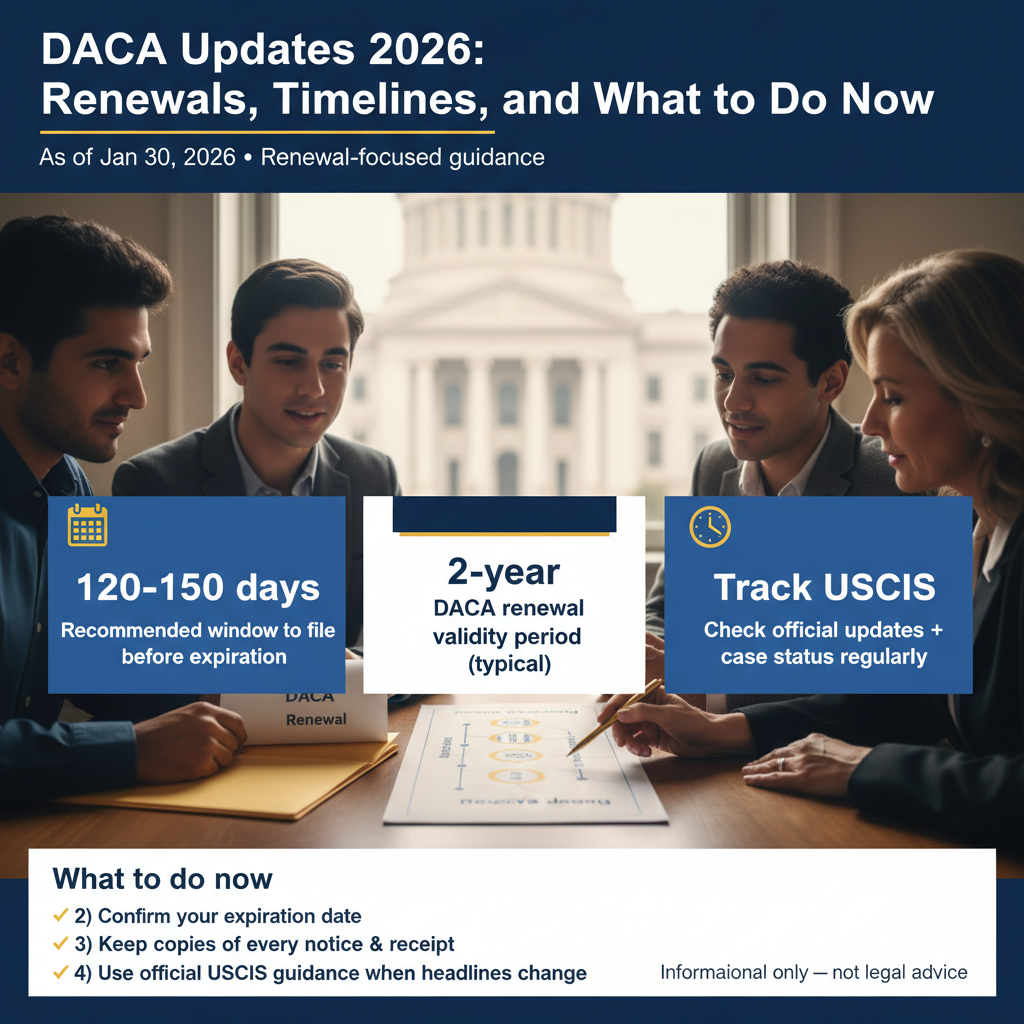
This article is based on recent coverage and USCIS-linked updates appearing in immigration news feeds. The specific reference that prompted this guide is:
DACA Program Updates and Renewal Information (USCIS)
Reminder: News headlines can move faster than official policy. When in doubt, rely on the USCIS official website and speak with qualified counsel before filing.
Need Help? Our Orlando immigration team is ready to assist. Call +1 786-791-3106 for a free consultation, or message us online. Se Habla Español.
What This News Means for Immigrants in Orlando and Across Florida
Why this news is showing up now
DACA (Deferred Action for Childhood Arrivals) continues to generate “breaking” headlines because the program has been shaped by ongoing federal litigation and shifting administrative guidance for more than a decade. While many people think of DACA as a single, stable program, the reality is that DACA’s availability—especially for new applicants—has been affected by court orders, appeals, and agency updates.
USCIS announcements and reminders tend to trend at certain times of year because:
- Large numbers of DACA recipients reach renewal time in the same window (creating spikes in filings and processing backlogs).
- USCIS periodically updates filing addresses, online filing options, fee amounts, or evidence guidance.
- Litigation milestones lead to public confusion about whether DACA is “ending,” “paused,” or “still renewable.”
Important: As of today (2026-01-30), the most consistent practical takeaway for most recipients is that DACA renewals are generally the key action item—especially renewing the work permit (EAD) on time.
How it can affect Florida residents
For Florida residents—especially in Central Florida along the I-4 corridor (Orlando, Kissimmee, Sanford, Winter Garden, and surrounding Orange County communities)—DACA renewal timing can affect:
- Employment eligibility and continuity of work authorization.
- Driver’s license renewal and access to certain state services that rely on lawful presence and valid EAD dates.
- School and professional licensing issues, depending on institution requirements.
- Family stability and household finances—consistent with Imigrar’s mission to Keep Families Together.
If your case is in Orlando or you interact with the local system (DMV, employers, schools), a lapse in your EAD can create immediate practical problems—even if you remain eligible to renew.
What DACA Program Updates and Renewal Information Is (and Why It Matters)
A plain-English definition
DACA is a federal policy that can grant two main benefits to eligible individuals who came to the United States as children and meet specific guidelines:
- Deferred action (a discretionary decision by DHS not to pursue removal for a set period, typically two years).
- Work authorization through an Employment Authorization Document (EAD), typically valid for the same period.
DACA is not a visa and not permanent status. It does not automatically lead to a green card or citizenship. But it can provide stability, lawful presence for certain purposes, and the ability to work legally.
Warning: Because DACA is discretionary and heavily litigated, it is critical to file renewals carefully, on time, and with accurate documentation.
Key terms you need to know
- Deferred Action: A prosecutorial discretion decision to defer removal action for a period of time.
- EAD: Employment Authorization Document (work permit). For DACA, commonly issued under category (c)(33).
- USCIS: U.S. Citizenship and Immigration Services—the agency that adjudicates DACA renewal requests.
- Biometrics: Fingerprints/photo/signature appointment used for background checks; USCIS may reuse biometrics in some cases.
- RFE: Request for Evidence—USCIS asks for additional documents before deciding.
- Removal Proceedings: Immigration court cases handled under EOIR. If you are in proceedings, DACA renewal may require extra strategy and coordination with your attorney. See Executive Office for Immigration Review.
- Adjustment of Status: A process to apply for a green card from inside the U.S. (not the same as DACA). Mentioned here because many DACA recipients later explore family-based options such as Form I-130 plus Form I-485, depending on eligibility.
- Priority Date: A concept used in many visa categories—especially family- and employment-based immigration—when a visa number is limited. DACA itself does not create a Priority Date, but many DACA recipients later pursue options where the Priority Date matters.
Current Immigration Law: The Foundation
DACA exists within the broader framework of U.S. immigration law and DHS enforcement discretion. While DACA was created through executive action rather than a statute passed by Congress, it operates alongside statutes and regulations that govern employment authorization, removal, and agency procedure.
Federal requirements
Key federal legal foundations and authorities that commonly come up in DACA discussions include:
- Immigration and Nationality Act (INA) provisions giving DHS broad authority over immigration enforcement and administration (generally codified at 8 U.S.C.).
- Employment authorization regulations at 8 C.F.R. § 274a (work authorization categories and EAD rules).
- Administrative Procedure Act (APA) (5 U.S.C. § 551 et seq.), frequently referenced in DACA litigation regarding agency rulemaking and procedure.
USCIS administers DACA requests and EAD applications through specific forms and instructions available on the USCIS official website and the USCIS Forms library.
Important: For DACA renewals, the core filing package typically includes:
- Form I-821D (Consideration of Deferred Action for Childhood Arrivals)
- Form I-765 (Application for Employment Authorization)
- Form I-765WS (Worksheet demonstrating economic need)
Although this guide focuses on DACA renewals, many readers also ask about family-based pathways. Common family-based forms include Form I-130 and, where eligible, Form I-485 for Adjustment of Status. Those are separate processes with different eligibility rules.
Florida-specific considerations
Florida does not control DACA eligibility (that is federal), but Florida residents experience DACA’s impact through practical, state-level touchpoints:
- Driver’s licenses and IDs: Validity often ties to your EAD expiration date. A renewal filed late can create gaps that affect driving privileges.
- Employment verification: Employers must complete Form I-9 (federal), and an expired EAD can lead to job interruption.
- Local access and logistics: For Central Florida residents, biometrics appointments or related immigration services may require travel planning. If your case is in Orlando, keep your address current with USCIS to avoid missed notices.
Reminder: Always verify current filing instructions and addresses directly with the USCIS official website, because USCIS may update them.
How to Renew DACA: A Complete Step-by-Step Guide
This section focuses on DACA renewals. Because court orders have affected the acceptance of new DACA requests at various times, many people seeing trending news are current recipients wondering: “Can I still renew?” and “How do I avoid delays?”
Important: USCIS has historically recommended filing DACA renewal requests well in advance. A common best practice is to file around 180 days before expiration to reduce the risk of a work authorization gap. Many people also reference a 90-day window as a minimum planning benchmark—do not wait until the last minute.
1) Confirm you are eligible to renew (and check for red flags)
Before you file, review whether anything has changed since your last approval. Renewals are not automatic.
Gather and review these items:
- Prior DACA approval notices (I-797) and EAD card (front/back copy).
- Any new criminal records, arrests, citations, or charges (even if dismissed or sealed).
- Any prior immigration documents: Notices to Appear (NTA), immigration court paperwork, or removal orders.
- Proof of continuous residence updates if something significant changed (moves, travel, etc.).
Warning: Any arrest or charge can affect eligibility. Do not guess—get certified dispositions and speak with an attorney before filing.
2) Create (or update) your USCIS online account and mailing address
USCIS increasingly relies on online accounts for case tracking, notices, and messaging. Even if you file by mail, having an account can help you monitor progress.
Documents and information to prepare:
- Your current legal name and any prior names.
- Current physical address and mailing address.
- Email address and phone number you check regularly.
- Alien Registration Number (A-Number), if you have one.
If your case is in Orlando and you move within Orange County or along the I-4 corridor, update your address promptly to avoid missing biometrics notices or RFEs.
3) Prepare the correct DACA renewal forms (I-821D, I-765, I-765WS)
DACA renewals typically require a coordinated package. A common cause of delay is inconsistent answers across forms (dates, addresses, travel history, education/employment info).
Required documents and data points:
- Form I-821D (renewal request) completed accurately.
- Form I-765 (EAD request) with category (c)(33) where applicable.
- Form I-765WS worksheet showing economic need.
- Copy of your current/most recent EAD.
- Copy of your last DACA approval notice (I-797), if available.
- Two passport-style photos if required by the filing method/instructions (confirm current USCIS instructions).
Reminder: Always use the most current edition of each form from USCIS Forms. USCIS can reject outdated editions.
4) Pay the correct fee (and choose a safe payment method)
DACA renewals require fees tied to the work authorization request and biometrics (where applicable). USCIS fee rules can change, so confirm the exact amount and accepted payment methods on USCIS before filing.
What to prepare:
- A payment method accepted by USCIS for your filing type (online vs. mail).
- Proof of payment/receipt records for your files.
- A plan if you need help paying (family budgeting, community resources, or attorney guidance).
Warning: Filing with the wrong fee or an incorrect payment method can lead to rejection, which can be devastating if you are close to expiration.
5) File the renewal package and track your receipt number
After filing, USCIS typically issues receipt notices. Use those to track your case and respond quickly to any requests.
Include and keep copies of:
- A full photocopy/PDF of everything you submitted (forms, evidence, payment).
- Delivery confirmation (if filing by mail) and the date it arrived.
- USCIS receipt notices for Form I-821D and Form I-765.
To estimate how long cases are taking, check USCIS Processing Times, but remember processing times can fluctuate and are not guarantees.
6) Attend biometrics if scheduled (or confirm biometrics reuse)
USCIS may schedule a biometrics appointment or may reuse prior biometrics. If you receive an appointment notice, attend it. Missing biometrics can lead to denial.
Bring to biometrics:
- The biometrics appointment notice (original).
- Government-issued photo ID (passport, state ID/driver’s license, etc.).
- Any USCIS receipts and a copy of your filing package (recommended).
Orlando note: For Central Florida residents, plan ahead for traffic and timing. If your case is in Orlando and you receive a notice connected to the Orlando area, do not assume you can “walk in” on a different day—follow the instructions exactly.
7) Respond quickly to RFEs and monitor for approval (DACA + EAD)
If USCIS issues an RFE, respond by the deadline with organized evidence. After approval, you should receive updated DACA approval and your new EAD card.
Prepare in case of an RFE:
- Certified court dispositions (if the RFE is about an arrest/charge).
- Updated proof of identity (if requested) and copies of prior approvals.
- Evidence clarifying discrepancies (addresses, dates, school/employment history).
- A cover letter explaining what you are submitting and why.
Important: If your EAD is delayed and you are at risk of job loss, speak with an attorney immediately about options and employer communication strategies.
Need Help? Our Orlando immigration team is ready to assist. Call +1 786-791-3106 for a free consultation, or message us online. Se Habla Español.
Practical Steps You Can Take Today
DACA renewals are often won or lost on organization and timing. Here is an actionable checklist you can start today—especially if you are within 180 days of expiration.
- Check your expiration dates for both DACA and the EAD card, and set calendar alerts for 180, 150, and 90-day window milestones.
- Order certified court dispositions for any incident—arrest, charge, or citation—no matter how minor it seems. Do not rely on memory.
- Update your address with USCIS and confirm you can receive mail reliably (important if you move within Orange County or the I-4 corridor).
- Create a “DACA renewal folder” (digital + paper) containing your prior approvals, EAD copies, passport/ID, and a copy of your last filing.
- Review your forms for consistency (names, dates, addresses, travel, school/work history). Inconsistencies often trigger RFEs.
- Budget for fees and avoid last-minute payment issues that can cause rejection.
- Track processing times and plan employment conversations early using USCIS Processing Times as a general reference.
Timeline expectations: DACA renewal processing can vary widely depending on USCIS workload, biometrics scheduling, and whether an RFE is issued. Many applicants plan for several months from filing to EAD delivery. If you have travel, employment changes, or license renewals coming up, plan conservatively.
Reminder: Avoid relying on rumors on social media. Verify changes directly with USCIS official website.
How Imigrar Helps Immigrants in Orlando
At Imigrar, we help DACA recipients and their families protect work authorization, reduce renewal delays, and plan long-term immigration strategies. We are based in Orlando, Florida and serve clients nationwide.
Our support often includes:
- Renewal strategy based on your timeline, prior filings, and any risk factors.
- Form preparation and consistency review to reduce RFEs and rejections.
- Criminal/immigration history screening and document collection guidance.
- Coordination for clients in or near removal proceedings (EOIR) when appropriate, with reference to Executive Office for Immigration Review.
- Long-term planning: For eligible clients, exploring family-based options such as Form I-130 and, where legally possible, Form I-485 for Adjustment of Status—including how a Priority Date may affect timing.
Se Habla Español. If you are a Central Florida resident and your case is in Orlando, we can help you prepare confidently and avoid common pitfalls that cause delays.
Need Help? Our Orlando immigration team is ready to assist. Call +1 786-791-3106 for a free consultation, or message us online. Se Habla Español.
Frequently Asked Questions
Q: Can I still renew DACA even if there’s bad news in the headlines?
A: In many situations, current DACA recipients remain focused on timely renewals even when headlines sound alarming. The safest approach is to verify current USCIS guidance on the USCIS official website, then file early (often around 180 days before expiration). If you have any arrests, prior deportation orders, or missed renewals, speak with an attorney before filing.
Q: What if my DACA expired—can I renew?
A: It depends on how long it has been expired and what USCIS is accepting at the time you file. Expiration can increase the risk of a work authorization gap and can raise questions about whether USCIS will treat the request as a renewal or as a different type of filing. Because policies and litigation posture can change, get individualized legal advice immediately if your DACA is expired or close to expiring.
Q: Will renewing DACA change my immigration status or help me get a green card?
A: Renewing DACA generally does not create lawful permanent resident status and does not automatically lead to a green card. It is deferred action plus work authorization. However, many DACA recipients later pursue other pathways. For example, some may qualify through family petitions like Form I-130 and, if eligible, Form I-485 for Adjustment of Status. Those options are highly fact-specific and may involve a Priority Date and other legal barriers.
Q: How long does a DACA renewal take in 2026?
A: Processing times vary. Use USCIS Processing Times as a general benchmark, but plan for variability. Delays can happen due to biometrics scheduling, background checks, mail issues, or an RFE. Filing around 180 days before expiration is a common strategy to reduce the risk of an EAD gap.
Q: What documents do I need for a DACA renewal?
A: Most renewals include Form I-821D, Form I-765, and Form I-765WS, plus copies of your prior approvals and EAD card. If anything changed (name, address history, arrests/charges), you may need additional documents such as certified court dispositions or legal name change records. Always follow the latest instructions from USCIS Forms.
Q: How much does it cost to renew DACA?
A: The cost is driven by USCIS filing fees connected to the work authorization request and biometrics policies, which can change. Confirm the current fee and accepted payment methods directly on the USCIS official website before filing. Warning: Incorrect fees or payment methods can cause a rejection and delay.
Q: What happens if my DACA renewal is denied?
A: A denial can stop deferred action and can lead to loss of work authorization. In some situations, a denial may also increase enforcement risk depending on your history and DHS policy. If you receive an RFE or intent to deny, respond quickly and consider legal representation immediately. If you are in removal proceedings, your case may involve EOIR processes (see Executive Office for Immigration Review).
Q: If I live in Central Florida, where will my case be handled?
A: DACA renewals are generally adjudicated by USCIS service centers, not by a local office interview. However, biometrics and some related issues can be local. For Central Florida residents, the Orlando area is a key hub for USCIS-related services. If your case is in Orlando, keep your address updated and watch your mail carefully so you don’t miss time-sensitive notices.
Common Mistakes (and How to Avoid Them)
Mistake #1: Filing too late and risking a work authorization gap
Waiting until the last few weeks invites disaster: a rejected filing, an RFE, or a biometrics delay can push your approval past your expiration date.
How to avoid it: Aim to file around 180 days before expiration and treat the 90-day window as the absolute latest planning threshold, not the goal.
Mistake #2: Not disclosing arrests or failing to submit certified dispositions
USCIS will run background checks. If something appears and you did not address it properly, you can face delays or denial.
How to avoid it: Obtain certified court dispositions for every incident and consult an attorney to evaluate immigration consequences before filing.
Mistake #3: Using outdated forms or incorrect fees
USCIS can reject filings that use the wrong form edition, missing signatures, or incorrect payment methods.
How to avoid it: Download fresh forms from USCIS Forms, confirm instructions on the USCIS official website, and double-check the fee immediately before submission.
Additional official resources (use these, not rumors)
For accurate, up-to-date information, start with these official sources:
- USCIS official website
- USCIS Forms
- USCIS Processing Times
- U.S. Department of State (useful for broader immigration context and consular information)
- Executive Office for Immigration Review (if you or a family member is in immigration court)
Reminder: If you are exploring family-based immigration while on DACA, timelines may depend on a Priority Date and visa availability; those concepts are separate from DACA but often part of a long-term plan.
Need Help? Our Orlando immigration team is ready to assist. Call +1 786-791-3106 for a free consultation, or message us online. Se Habla Español.

Closing: Protect your DACA—renew early and plan long-term
DACA remains one of the most important protections for hundreds of thousands of people who call the U.S. home. But it requires careful maintenance: filing on time, staying organized, and getting legal advice when anything changes—especially arrests, prior immigration court issues, or missed renewals.
If your case is in Orlando, if you live in Orange County, or if you’re anywhere along the I-4 corridor in Central Florida, Imigrar can help you renew with confidence and build a strategy that supports your family’s future—because we Keep Families Together.
Need help with a DACA renewal or a long-term plan beyond DACA? Call Imigrar at +1 786-791-3106 for a free consultation, or message us online. Se Habla Español.


