


The landscape of U.S. immigration policy is ever-evolving, and few programs encapsulate this dynamic nature as much as Deferred Action for Childhood Arrivals (DACA). For hundreds of thousands of individuals across the nation, including many here in Orlando and throughout Florida, DACA represents a lifeline, offering temporary protection from deportation and the ability to work legally. As we move through 2026, staying informed about the latest updates and understanding the renewal process is not just recommended, it's absolutely critical.
At Imigrar, we understand the anxieties and uncertainties that come with these shifts. Our mission, "Keep Families Together," drives us to provide clear, actionable, and compassionate legal guidance. This comprehensive guide is designed to cut through the complexity, offering DACA recipients and their families in Florida the precise information they need to navigate the renewal process with confidence.
The reporting that sparked this guide
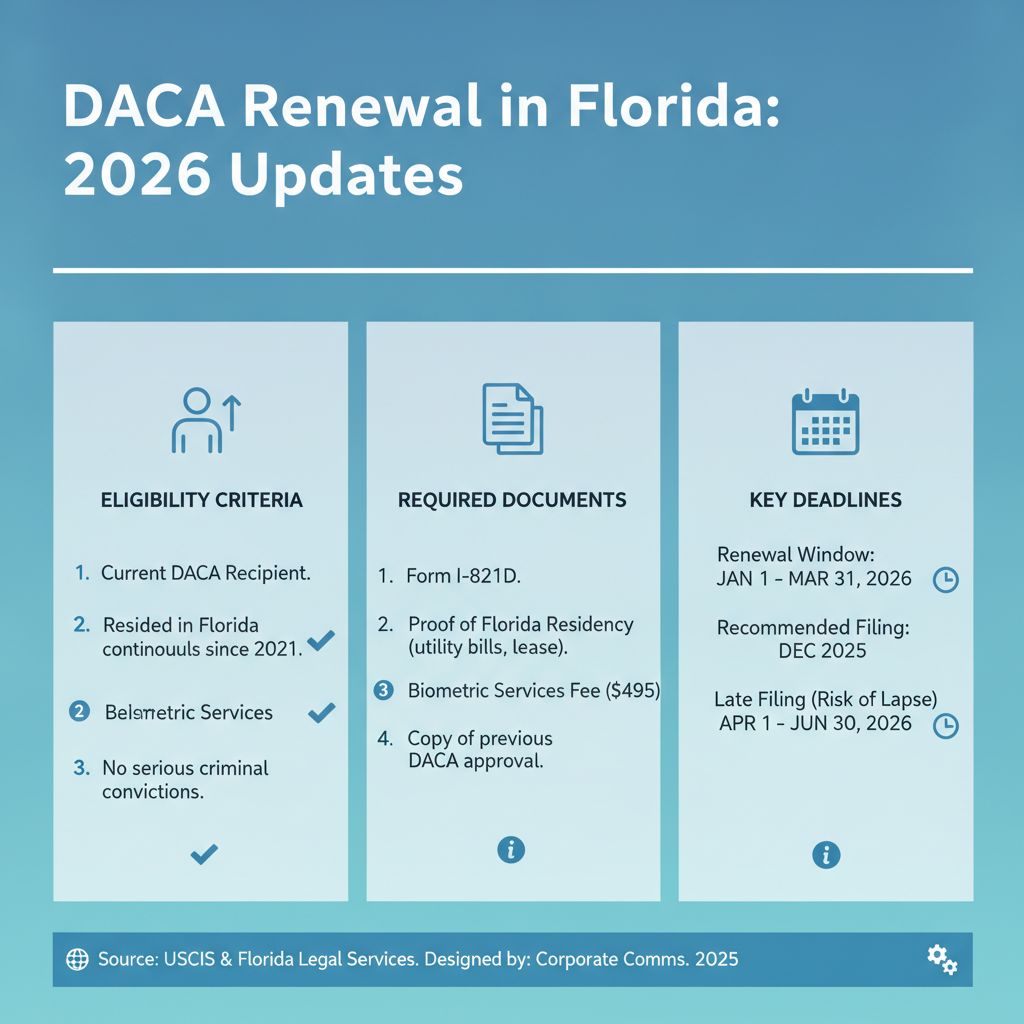
This article is inspired by the ongoing national conversation and the latest advisories from U.S. Citizenship and Immigration Services (USCIS) regarding the DACA program. The continuous legal challenges and administrative updates necessitate constant vigilance for DACA recipients. For the most recent official announcements directly from the source, we encourage you to consult the official USCIS news releases and general immigration law discussions:
DACA Program Updates and Renewal Information (USCIS)
What This News Means for Immigrants in Orlando and Across Florida
The continuous legal and administrative scrutiny surrounding DACA means that recipients must remain highly vigilant. For DACA holders and their families in Florida, these updates are not abstract legal discussions; they directly impact their daily lives, their ability to work, and their sense of security.
Why this news is showing up now
The Deferred Action for Childhood Arrivals (DACA) program has been a subject of intense legal and political debate since its inception in 2012. As of August 24, 2026, DACA's future remains in a state of ongoing uncertainty due to various court challenges. Specifically, the program is still under an injunction resulting from the decision in Texas v. United States. This ruling, which was upheld by the Fifth Circuit Court of Appeals and subsequently sent back to the lower courts, has critical implications:
- No New DACA Applications: USCIS is generally prohibited from approving new, initial DACA requests. This means individuals who have never held DACA are typically unable to apply for it at this time.
- Renewals Are Still Processed: Crucially, USCIS continues to accept and process DACA renewal requests for individuals who have previously been granted DACA. This ongoing processing is what makes timely and accurate renewals paramount.
- Administrative Reviews: The program is also subject to ongoing administrative reviews and potential regulatory changes, which can influence processing times, required documentation, and even the criteria for renewal. Each court decision or administrative notice can trigger a wave of new information, making it essential for recipients to stay informed.
These legal battles ensure DACA remains a trending topic, as its very existence hinges on judicial outcomes and executive policy. The news is showing up now because the program operates under a cloud of legal challenges that frequently produce new developments, requiring beneficiaries to be constantly aware of their status and obligations.
How it can affect Florida residents
For the estimated 20,000 DACA recipients living in Florida, these national updates have very direct and personal consequences:
- Employment Stability: A renewed Employment Authorization Document (EAD) is vital for maintaining legal employment. Any delay or denial in renewal can lead to job loss and severe financial hardship for individuals and their families. This is particularly relevant in Florida's diverse economy, where DACA recipients contribute significantly across various sectors.
- Driving Privileges: In Florida, DACA recipients are eligible for a driver's license upon presentation of their valid EAD. An expired DACA status means an expired EAD, which in turn can lead to the inability to renew a driver's license, impacting independence, commuting to work, and daily life in a state heavily reliant on personal transportation.
- Educational Opportunities: While federal financial aid remains largely inaccessible, some Florida colleges and universities have policies that consider DACA recipients for in-state tuition rates or other benefits. Maintaining DACA status is often a prerequisite for accessing these opportunities.
- Community Impact: Florida is home to vibrant immigrant communities, including many DACA recipients. The stability of these individuals directly impacts the social and economic fabric of cities like Orlando, Kissimmee, and Miami. Uncertainty around DACA creates stress and instability across these communities.
- Local USCIS Office: For many Central Florida residents, the Orlando USCIS Field Office (Orlando Field Office) handles specific aspects of their immigration process, such as biometrics appointments. Understanding the processing landscape and potential backlogs at this and other regional offices is key to managing expectations for renewal timelines.
Staying informed and proactively managing your DACA renewal is the most powerful step you can take to protect your status and future in Florida.
What DACA Is (and Why It Matters)
Understanding DACA isn't just about knowing its name; it's about grasping its purpose, its limitations, and its profound impact on individuals and families across the United States. For non-lawyers, the terminology can be confusing, but the core concept is straightforward.
A plain-English definition
DACA, or Deferred Action for Childhood Arrivals, is a U.S. immigration policy established by the Obama administration in June 2012. In simple terms, it provides temporary relief from deportation (known as "deferred action") to certain undocumented immigrants who came to the United States as children. It is not a path to U.S. citizenship or lawful permanent residency (a "green card"). Instead, it offers two primary benefits:
- Protection from Deportation: For a renewable period, typically two years, DACA recipients are considered to have "deferred action" on their cases, meaning the government agrees not to pursue their removal from the U.S.
- Work Authorization: Along with deferred action, DACA recipients are eligible to apply for an Employment Authorization Document (EAD), which allows them to legally work in the United States. This EAD is also valid for two years and must be renewed alongside DACA.
DACA was designed to allow young people who grew up in the U.S. and consider it their home to live and work without constant fear of deportation, provided they meet specific criteria and have not committed serious crimes. It acknowledges their significant contributions to American society and economy.
Key terms you need to know
To navigate the DACA renewal process and understand its implications, it's helpful to be familiar with certain key terms:
- Deferred Action: This is a discretionary determination by USCIS to defer removal action against an individual. It does not confer lawful status, but it means the individual is not currently a priority for deportation.
- Employment Authorization Document (EAD): Often referred to as a "work permit," this card (Form I-766) allows DACA recipients to legally work in the U.S. for the duration of its validity.
- Dreamers: This term is often used to describe young undocumented immigrants who were brought to the U.S. as children. While DACA specifically refers to the policy, "Dreamers" is a broader term that encompasses those eligible for DACA and those who might have been eligible for the never-passed DREAM Act legislation.
- USCIS: The U.S. Citizenship and Immigration Services is the government agency responsible for overseeing lawful immigration to the United States, including processing DACA requests and renewals. Its official website is USCIS official website.
- Eligibility Criteria: The specific requirements an individual must meet to be considered for DACA. These include age, continuous residence, educational status, and a clean criminal record.
- Advance Parole: A document that allows certain non-citizens, including some DACA recipients, to travel abroad and lawfully return to the U.S. However, Important: As of 2026, Advance Parole for DACA recipients remains highly restricted and generally only granted for humanitarian, educational, or employment purposes under very specific circumstances. Traveling without it, or for unauthorized reasons, can lead to serious immigration consequences.
- Notice of Action (Form I-797): An official document from USCIS confirming receipt of your application, approval, denial, or other case updates.
Need Help? Navigating DACA renewals can be complex, especially with ongoing legal changes. Our Orlando immigration team is ready to assist. Call +1 786-791-3106 for a free consultation, or message us online. Se Habla Español.
Current Immigration Law: The Foundation for DACA
DACA’s legal foundation is unique. It is not codified into federal statute like many other immigration benefits. Instead, it is an exercise of prosecutorial discretion by the executive branch, stemming from a June 15, 2012, memo from then-Secretary of Homeland Security Janet Napolitano. This administrative origin is precisely why DACA has been subject to numerous legal challenges and policy changes, particularly under the Administrative Procedure Act (APA).
Federal requirements
While new initial DACA applications are largely halted due to court orders, the criteria for *renewal* largely adhere to the original 2012 guidelines. To be eligible for DACA renewal, you must meet the following federal requirements:
- Received DACA Previously: You must have previously been granted DACA. USCIS will not accept initial DACA requests from individuals who have never before received DACA.
- Continuous Residence: You must have continuously resided in the United States since you submitted your most recent DACA request that was approved.
- No Disqualifying Criminal History: You must not have been convicted of a felony, a significant misdemeanor, or three or more other misdemeanors. You must also not pose a threat to national security or public safety.
- Physical Presence: You must be physically present in the U.S. at the time of filing your renewal request.
Important: The original criteria for DACA, which included being under the age of 31 as of June 15, 2012; having come to the U.S. before your 16th birthday; continuous residence since June 15, 2007; and being in school, having graduated, or honorably discharged from the military, are still relevant for establishing your original eligibility, but for renewals, the focus shifts to maintaining your status and good conduct.
The primary forms required for DACA renewal are:
- Form I-821D, Consideration of Deferred Action for Childhood Arrivals
- Form I-765, Application for Employment Authorization
- Form I-765WS, Worksheet (to explain your economic need for employment)
You can find these forms and detailed instructions on the USCIS Forms page.
Florida-specific considerations
While DACA is a federal program, its effects ripple down to state and local levels. For Florida residents, these considerations include:
- Driver's Licenses: The Florida Department of Highway Safety and Motor Vehicles (FLHSMV) issues driver's licenses to DACA recipients who provide a valid EAD card and other required identification documents. Maintaining a current DACA status is essential for renewing your Florida driver's license. An expired EAD will prevent renewal.
- In-State Tuition: Some public universities and colleges in Florida may offer in-state tuition or other financial benefits to DACA recipients, provided they meet specific residency requirements. These policies can vary by institution, so it's crucial to check with the specific educational institution in Orlando or elsewhere in Florida you plan to attend.
- Professional Licenses: DACA recipients in Florida may be eligible for certain professional licenses, depending on the profession and state regulations. A valid EAD is often a prerequisite.
- Local Resources: Communities in Central Florida, including Orange County, have various non-profit organizations and legal aid groups that offer assistance to DACA recipients. Imigrar also serves as a vital resource for legal guidance in Orlando and across the state.
- Orlando USCIS Field Office: While renewal applications are generally sent to USCIS Lockbox facilities, DACA recipients in Central Florida might be required to attend biometrics appointments at the Orlando USCIS Field Office. Familiarity with its location and procedures can ease the process.
The interplay between federal immigration policy and state-level benefits means that maintaining your DACA status is crucial for your stability and opportunities in Florida.
How to Renew Your DACA: A Complete Step-by-Step Guide
Renewing your DACA is a meticulous process that requires attention to detail and timely submission. Follow these steps carefully to maximize your chances of a smooth renewal.
1) Determine Your Eligibility for Renewal
Before you begin gathering documents, confirm that you meet the core requirements for a DACA renewal. This is the foundational step and cannot be overlooked.
- Previous DACA Grant: You must have been previously granted DACA. USCIS is currently not accepting initial DACA applications.
- Continuous Residence: You must have continuously resided in the United States since the date your most recent DACA was approved. Brief, authorized travel with Advance Parole does not typically break continuous residence.
- Clean Record: You must not have been convicted of a felony, a significant misdemeanor, or three or more other misdemeanors. Additionally, you must not pose a threat to national security or public safety. Any arrests or citations, even if charges were dropped, should be disclosed to your attorney.
- Timely Filing: USCIS recommends filing your renewal application within the 120 to 150-day window before your current DACA and EAD expire. Filing too early (more than 150 days) may result in your application being rejected, while filing too late risks a gap in your work authorization and protection from deportation.
Reminder: If you have any new criminal history since your last DACA grant, or if you have traveled outside the U.S. without Advance Parole, consult with an experienced immigration attorney immediately.
2) Gather Required Documents
Thorough documentation is paramount. Organize all your supporting evidence before filling out any forms. You will need:
- Copies of Previous DACA Approval Notices: Include all Form I-797C, Notice of Action, for previous DACA grants.
- Copy of Your Current EAD Card: Front and back.
- Proof of Identity: Copy of your passport, birth certificate with photo ID, or other government-issued photo identification.
- Proof of Continuous Residence (since your last DACA approval): While not always requested for renewals, it's wise to have evidence ready, such as:
- School records (transcripts, report cards)
- Employment records (pay stubs, W-2 forms)
- Bank statements
- Rental agreements, utility bills
- Medical records
- Dated photos, letters
- Two Passport-Style Photos: Taken within 30 days of filing, unmounted, on a white background, and meeting USCIS specifications. Write your name and A-number lightly in pencil on the back of each photo.
- Documents Related to Any New Criminal History (since last DACA grant): If applicable, gather certified court dispositions for any arrests, charges, or convictions, even if they were dismissed or expunged. Warning: Do NOT omit this information.
Keep organized copies of everything you submit, and store originals safely.
3) Complete the Forms Accurately
Accuracy is crucial. Any errors or omissions can lead to delays, Requests for Evidence (RFEs), or even denial.
- Form I-821D, Consideration of Deferred Action for Childhood Arrivals:
- Fill out every section completely. If a question does not apply to you, write "N/A" (not applicable) or "None."
- Ensure your name, date of birth, and A-number match your previous DACA documents exactly.
- Pay close attention to the criminal history section. Disclose ALL arrests, charges, or convictions, regardless of the outcome.
- Sign and date the form. Your signature must be original.
- Form I-765, Application for Employment Authorization:
- Select category (c)(33) for DACA recipients.
- Answer all questions truthfully.
- Ensure the information aligns with your Form I-821D.
- Sign and date the form.
- Form I-765WS, Worksheet:
- This worksheet explains your economic need for employment. Provide a clear and concise explanation of why you need an EAD.
- Examples include supporting yourself, contributing to household income, paying for education, or covering medical expenses.
Reminder: Do not leave any blank spaces. If a question is not applicable, write "N/A." If the answer is zero, write "None."
4) Calculate and Pay the Filing Fees
The fees must be paid accurately and in the correct format. Incorrect payment is a common reason for application rejection.
- Total Fee: As of 2026, the total fee for DACA renewal is $495. This consists of:
- Form I-765 Application Fee: $410
- Biometrics Services Fee: $85
- Payment Method: You can pay by money order, personal check, cashier's check, or by credit card using Form G-1450, Authorization for Credit Card Transactions.
- If paying by check or money order, make it payable to "U.S. Department of Homeland Security." Do not abbreviate.
- Write your A-number on the memo line of your check or money order.
- Important: Do not send cash.
- Fee Waivers: Fee waivers are generally NOT available for DACA renewal applications.
Double-check the USCIS website or consult with an attorney for the most current fee schedule, as fees can change.
5) Assemble and Mail Your Application Package
The order and method of submission are important for efficient processing.
- Organize Your Packet:
- Check or money order (or Form G-1450) on top.
- Two passport-style photos in a small envelope attached to the Form I-765.
- Form I-821D.
- Form I-765.
- Form I-765WS.
- Copies of your previous DACA Form I-797C approval notices.
- Copy of your current EAD card (front and back).
- Copies of any other supporting documents (e.g., criminal dispositions, if applicable).
- Mailing Address: Send your application to the correct USCIS Lockbox facility based on your state of residence. For Florida residents, check the "Direct Filing Addresses for Form I-821D" page on the USCIS website. Currently, most DACA renewals from Florida go to the USCIS Chicago Lockbox.
- Use a reliable mail service that provides tracking, such as USPS Certified Mail with a return receipt, FedEx, or UPS. This provides proof of mailing and delivery.
- Keep Copies: Make a complete copy of the entire application package for your records before mailing.
6) Attend Your Biometrics Appointment (If Required)
After USCIS receives your application, they will send you a Form I-797C, Notice of Action, confirming receipt. If a biometrics appointment is needed, you will receive a separate appointment notice (Form I-797C) in the mail, usually within a few weeks.
- What to Bring: Your appointment notice, a valid photo ID (e.g., driver's license, passport, or current EAD), and any other documents requested.
- What Happens: At the Application Support Center (ASC), your fingerprints, photograph, and signature will be collected. This data is used for background checks.
- Important: Do not miss your biometrics appointment. If you have a legitimate reason to reschedule, follow the instructions on your appointment notice immediately. For Central Florida residents, this appointment will likely be at the Orlando USCIS ASC.
7) Monitor Your Case Status and Receive Decision
After your biometrics appointment, you will enter a waiting period. USCIS processing times can vary significantly.
- Check Status Online: Use the receipt number from your Form I-797C (the one confirming receipt of your application) to check your case status online at the USCIS Case Status Online tool.
- Processing Times: You can estimate how long your application might take by checking the
Related Articles
You may also be interested in:
-
Naturalization Test 2026: Navigating New US Citizenship Changes
Prepare for the upcoming 2026 Naturalization Test changes. Imigrar provides a comprehensive guide for immigrants in Orlando and nationwide on new civi...
-
H-1B Visa Lottery FY2027: Navigating the New Rules & What They
Understand the critical H-1B visa lottery changes for FY2027 and their impact on immigrants in Florida. Imigrar provides expert guidance on eligibilit...
-
Family-Based Immigration Petitions: A Complete Orlando Guide
Imigrar's comprehensive guide to family-based immigration petitions. Learn the steps, requirements, and how to keep your family together in Orlando & ...
-
Orlando Family-Based Immigration Petition Guide: Keep Your Loved
Navigate the complex world of family-based immigration petitions with Imigrar's comprehensive guide. Learn step-by-step requirements, timelines, and h...
-
Naturalization Test 2026: Navigating New US Citizenship Changes


