

The reporting that sparked this guide
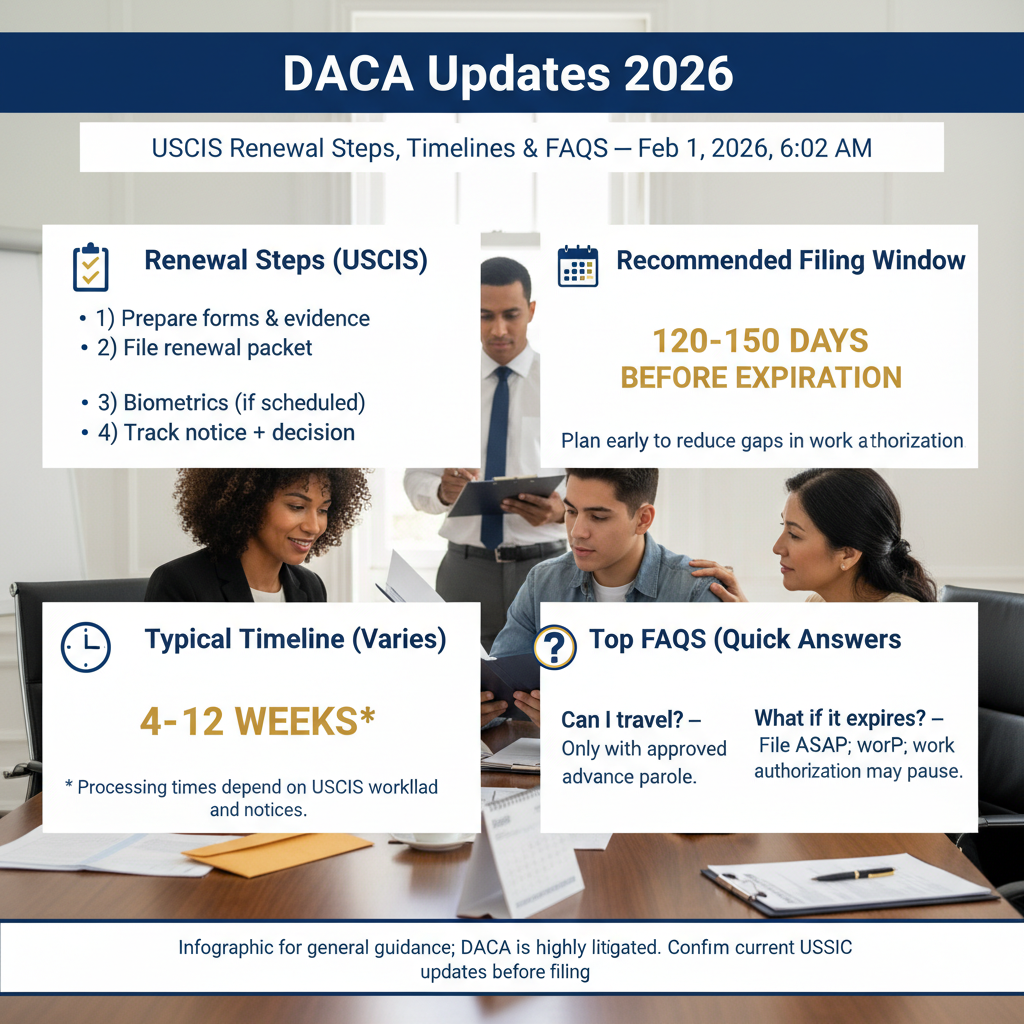
This article is based on ongoing public updates and announcements tied to USCIS and related immigration reporting. The specific item that prompted this guide is: DACA Program Updates and Renewal Information (USCIS).
Important: DACA is a highly litigated policy area. The most reliable way to confirm current filing rules is to check the official resources linked throughout this guide, including the USCIS official website.
Need Help? Our Orlando immigration team is ready to assist. Call +1 786-791-3106 for a free consultation, or message us online. Se Habla Español.
What This News Means for Immigrants in Orlando and Across Florida
Why this news is showing up now
DACA news trends regularly because the program sits at the intersection of court decisions, federal policy changes, and USCIS operational updates. Even when there is no single “big announcement,” many DACA recipients feel the impact of:
- USCIS processing time fluctuations (especially for work permits/EADs)
- Renewal timing decisions (filing too early vs. too late)
- Requests for Evidence (RFEs) and document issues
- Changes in fee policies or filing logistics
- Ongoing federal litigation that can affect first-time filings
Reminder: As of today (2026-02-01), many people are still eligible to renew DACA if they previously received it, but “initial” (first-time) DACA requests have been restricted due to litigation for several years. Always confirm the current rule on the USCIS DACA page before you file.
How it can affect Florida residents
For Florida residents—especially those living and working along the I-4 corridor (Orlando, Kissimmee, Davenport, Lakeland, Tampa)—DACA renewals often directly affect:
- Employment authorization continuity (avoiding gaps in EAD validity)
- Driver license renewals and REAL ID compliance timing
- School enrollment, internships, and professional licensing issues
- Family stability and long-term planning
If your case is in Orlando or Central Florida, the timing of your renewal can matter because missed EAD renewal windows can create work interruptions. While DACA renewals are generally processed by USCIS service centers (not typically decided at an in-person local interview), local realities—like employer deadlines, DMV appointment availability, and document access—can create urgent pressure.
Warning: If you have any arrests, charges, or new contact with law enforcement in Orange County or anywhere in Florida, get legal advice before filing. Even if the case was dismissed, it may affect DACA eligibility or trigger an RFE.
What DACA Program Updates and Renewal Information Is (and Why It Matters)
A plain-English definition
DACA stands for Deferred Action for Childhood Arrivals. It is a discretionary policy that can provide:
- Deferred action (a decision by DHS not to pursue removal for a period of time), and
- Eligibility to apply for an Employment Authorization Document (EAD), commonly called a “work permit.”
DACA does not give lawful permanent residence or citizenship by itself. It also does not automatically give a lawful “status” in the way a visa does. However, it can be life-changing because it allows recipients to work lawfully and, in many cases, obtain state IDs/driver licenses and build a more stable life.
Key terms you need to know
- Deferred action: A discretionary decision to defer removal action for a set period.
- EAD (Employment Authorization Document): The card proving authorization to work (often based on Form I-765).
- Renewal: A request to extend DACA and renew the EAD for another period, typically two years.
- RFE (Request for Evidence): USCIS asks for more documents before deciding.
- Biometrics: Fingerprints/photo appointment. USCIS may reuse biometrics in some cases, but you must follow the notice you receive.
- Processing times: Estimates posted by USCIS; check USCIS Processing Times.
- Removal proceedings: Immigration court cases handled under EOIR; see Executive Office for Immigration Review.
- Adjustment of Status and Priority Date: Not DACA-specific, but important if you may qualify for a green card through family or employment. For example, a family case may involve Form I-130 and later Form I-485 for Adjustment of Status, and the Priority Date can control when you can move forward.
Need Help? Our Orlando immigration team is ready to assist. Call +1 786-791-3106 for a free consultation, or message us online. Se Habla Español.
Current Immigration Law: The Foundation
DACA is not a statute passed by Congress. It is an executive-branch policy administered by DHS through USCIS. That said, DACA decisions are made within the broader framework of U.S. immigration law, including:
- Immigration and Nationality Act (INA) provisions governing admissibility, removability, and benefits eligibility
- USCIS regulations for employment authorization (generally under 8 C.F.R. § 274a and related provisions)
- DHS/USCIS policy guidance and Federal Register notices
Because DACA is discretionary, USCIS can deny requests that do not meet guidelines or that raise public safety/national security concerns—even if you previously received DACA.
Federal requirements
For renewals, USCIS generally expects you to show you still meet DACA guidelines and that you have not become disqualified due to:
- Certain criminal convictions (felony, “significant misdemeanor,” or multiple misdemeanors)
- Public safety concerns or gang allegations
- Fraud/misrepresentation in prior filings
- Failure to respond to USCIS notices
Most renewal packages include:
- Form I-821D (Consideration of Deferred Action for Childhood Arrivals)
- Form I-765 (Application for Employment Authorization)
- Form I-765WS (Worksheet)
Important: Only use the newest edition of each form and follow the USCIS filing instructions. Download forms at USCIS Forms and verify program instructions at the USCIS official website.
Note: This article also references common family-based green card forms (Form I-130, Form I-485) because many DACA recipients explore long-term options beyond DACA. Those forms have different eligibility rules and should be reviewed case-by-case.
Florida-specific considerations
Florida does not “run” DACA, but state-level realities can affect your day-to-day life:
- Driver license timing: Florida DHSMV often ties license validity to your EAD expiration. Plan renewal timing to avoid a gap.
- Employment in high-compliance industries: Tourism, healthcare, and government contractors along the I-4 corridor may have strict I-9 re-verification practices.
- Local records access: If you need certified dispositions for an Orange County case, it can take time to obtain them—start early.
If your case is in Orlando, keep copies of every USCIS receipt notice and approval notice and track your EAD expiration date carefully. The Orlando USCIS Field Office may not decide DACA renewals, but it can become relevant for other immigration benefits (like family-based Adjustment of Status using Form I-485) if you later qualify.
How to Renew DACA: A Complete Step-by-Step Guide
Below is a practical renewal roadmap. Exact requirements can change, so always cross-check USCIS instructions before filing. When in doubt, consult an immigration attorney—especially if you have any criminal history, prior removal orders, or travel issues.
1) Confirm you are eligible to renew and choose the right filing window
USCIS generally recommends filing DACA renewal requests well before expiration. Many attorneys advise planning around 180 days before your current DACA/EAD expires to reduce the risk of a work authorization gap.
Reminder: People often ask about a “90-day window.” In practice, filing only 90 days before expiration can be risky if processing slows. A safer planning target is often closer to 180 days, unless USCIS guidance says otherwise.
Documents to gather at this step:
- Current EAD card (front/back copy)
- Most recent DACA approval notice (if available)
- USCIS receipt notices from your last renewal (if available)
- A list of all addresses and employment history since your last filing
- Any arrest/court documents (certified dispositions), if applicable
2) Review your full immigration and criminal history before you file
A renewal is not just paperwork—USCIS can review your background again. If anything changed since your last approval, it can affect your case.
Warning: Do not guess about arrests or charges. Even a withheld adjudication, nolle prosequi, diversion, or sealed record can still require disclosure and documentation.
Documents to gather at this step:
- Certified court disposition(s) for every arrest/charge
- Police arrest report(s) if available (or attorney advice on whether to submit)
- Proof of compliance with probation/community service (if any)
- Any prior immigration documents: Notices to Appear, removal orders, voluntary departure
3) Prepare the correct USCIS forms and a clean, consistent packet
A standard DACA renewal filing typically includes:
- Form I-821D
- Form I-765
- Form I-765WS
You must complete the forms accurately, consistently, and with the same biographical details used in prior filings unless something legitimately changed (like a legal name change).
Important: If you have ever considered a family-based green card process, understand that forms like Form I-130 and Form I-485 are separate from DACA. If you might be eligible for Adjustment of Status, strategy matters—especially regarding travel history and entries.
Documents to gather at this step:
- Two passport-style photos (only if required by current filing instructions)
- Copy of government-issued ID (if available)
- Copy of current EAD (front/back)
- Prior EAD copies (helpful but not always required)
- Any legal name change documents (marriage certificate, court order)
4) Pay the correct fees (or request a fee exemption only if eligible)
DACA renewal filings include a filing fee component for the work permit request and biometrics, unless USCIS has updated fees or policies. Always verify the current fee amount and acceptable payment methods directly on USCIS.
Check: USCIS official website and USCIS Forms.
Reminder: If you pay the wrong amount or use an incorrect payment method, USCIS may reject the packet, which can cause major delays and risk an EAD gap.
Documents to gather at this step:
- Payment instrument per USCIS instructions (money order, check, or online payment if filing online)
- If applicable, documents supporting a fee exemption request (only if USCIS permits and you qualify)
- Copy of your entire packet for your records before sending
5) File the renewal with USCIS and track receipts and biometrics
USCIS accepts certain filings online and others by mail depending on form type and current program instructions. For DACA renewals, USCIS has increasingly supported online filing for some applicants, but you must confirm the current allowed method on the official DACA page.
After filing, you should receive receipt notices. Then USCIS may:
- Schedule a biometrics appointment, or
- Send a biometrics reuse notice.
If you move, update your address promptly to avoid missing notices.
Documents to gather at this step:
- Proof of mailing/delivery (if filing by mail)
- USCIS receipt notices (save PDFs and paper copies)
- Biometrics appointment notice (if issued)
- Updated address history and proof of new address (lease, utility bill) if you moved
6) Respond quickly to any USCIS notice (RFE, NOID, biometrics reschedule)
If USCIS issues an RFE, your response must be complete and on time. Missing deadlines can lead to denial.
Warning: Do not send random documents that don’t answer the question. RFEs are targeted; address each point and label your evidence clearly.
Documents to gather at this step:
- Copy of the RFE/notice (include it in your response packet as instructed)
- Exactly the evidence requested (court dispositions, identity proof, etc.)
- A cover letter indexing your RFE response
- Proof of delivery for your RFE response
7) Plan for the approval, EAD delivery, and employer/DMV updates
If approved, you will typically receive:
- A DACA approval notice, and
- Your new EAD card.
Once the EAD arrives, update your employer for I-9 purposes if needed and schedule any Florida driver license renewal if your prior license expiration was tied to your old EAD.
For Central Florida residents, build in time for appointments and document retrieval. If you have a job change coming, do not assume your new employer will accept a receipt notice—most require the physical EAD for I-9.
Documents to gather at this step:
- New EAD (store safely; keep copies front/back)
- Approval notice
- SSN card (if you have one) and state ID/driver license documents
- Employer HR contact information and re-verification timeline
Need Help? Our Orlando immigration team is ready to assist. Call +1 786-791-3106 for a free consultation, or message us online. Se Habla Español.
Practical Steps You Can Take Today
Whether your DACA expires in 2 months or 10 months, you can reduce stress and avoid delays by doing the following now.
- 1) Put your expiration date on two calendars. Set reminders at 180 days, 120 days, and 90-day window before expiration.
- 2) Create a “USCIS folder.” Save every receipt notice, approval notice, and a PDF scan of your entire filing packet.
- 3) Order certified court records early (if applicable). For Orange County matters, getting certified dispositions can take time—don’t wait.
- 4) Review your address and travel history. Make sure all addresses and dates are consistent with prior filings.
- 5) Budget for filing fees. Avoid last-minute borrowing that leads to incorrect payments or rushed filings.
- 6) Track USCIS timelines weekly. Use USCIS Processing Times and plan for delays.
- 7) If you may qualify for a green card, get a strategy consult. Some DACA recipients may have family options involving Form I-130 and possibly Form I-485 (Adjustment of Status). Timing and lawful entry issues matter.
Timeline expectations: DACA renewals can take weeks to months depending on USCIS workload, background checks, and whether an RFE is issued. Always plan as if it will take longer than expected—especially if your job, license, or school depends on it.
How Imigrar Helps Immigrants in Orlando
Imigrar is an immigration law firm based in Orlando, Florida, serving clients nationwide. Our mission is simple: Keep Families Together. For DACA recipients, that means helping you protect your ability to work, remain with your family, and plan beyond the next renewal.
We assist with:
- DACA renewal screening for eligibility risks (including criminal and immigration history)
- Preparing and filing renewal packets to reduce errors and delays
- RFE responses and case troubleshooting
- Long-term planning beyond DACA (family petitions like Form I-130, and where eligible, Form I-485 for Adjustment of Status)
- Coordination for clients in Orlando, Orange County, and across the I-4 corridor
Se Habla Español. We offer a free consultation to help you understand your options and next steps.
Frequently Asked Questions
Q: Am I still eligible to renew DACA if I had a gap after my last expiration?
A: Possibly, but it depends on the length of the gap, your prior DACA history, and current USCIS rules shaped by litigation. If you had a lapse, do not assume you can “just renew.” Gather your prior approval notices and EAD copies, and confirm current USCIS guidance on the USCIS official website. If you have any criminal history or prior removal issues, speak with an attorney before filing.
Q: Does DACA give me legal status or a path to a green card?
A: DACA is not lawful permanent residence and does not automatically create a path to a green card. However, some DACA recipients may become eligible for a green card through other routes—most commonly family sponsorship with Form I-130 and, if eligible, Form I-485 for Adjustment of Status. Your manner of entry (lawful vs. unlawful) and other factors can be decisive, and the Priority Date can affect timing in certain categories.
Q: How long does a DACA renewal take right now?
A: Processing times vary. Some renewals are approved quickly; others take several months. Check the latest estimates at USCIS Processing Times. Plan ahead—filing around 180 days before expiration often reduces the risk of an EAD gap, while waiting until the 90-day window can be risky if USCIS is backlogged.
Q: What documents do I need for a DACA renewal?
A: Many renewals can be filed with copies of your current EAD (front/back), prior approval notices (if available), identity documents, and the completed forms (Form I-821D, Form I-765, Form I-765WS). If you had any arrests or charges, you should obtain certified court dispositions and consult counsel before filing. Keep a complete copy of everything you submit.
Q: How much does it cost to renew DACA?
A: The total cost is based on USCIS filing fees for the work permit and biometrics, and it can change. Always confirm the current fee directly through the USCIS official website and the form instructions at USCIS Forms. If you use an attorney, legal fees are separate. Be cautious of notario fraud or anyone promising “guaranteed approval.”
Q: What happens if my DACA renewal is denied?
A: A denial can lead to loss of work authorization and can increase immigration enforcement risk depending on your circumstances. Some denials are based on missing evidence, criminal issues, or USCIS discretion. If denied, get legal advice immediately to evaluate whether a motion, re-filing, or other immigration option exists. If you are in removal proceedings, consult the Executive Office for Immigration Review resources and coordinate your strategy with counsel.
Q: Can I travel internationally with DACA?
A: International travel is a high-risk area and rules have changed over time. Historically, some DACA recipients could apply for advance parole under limited categories, but availability and requirements depend on current DHS/USCIS policy and litigation posture. Before making any travel plans, check USCIS guidance and review travel documentation rules via the U.S. Department of State for general travel document context. Speak with an attorney before applying or traveling.
Q: If my employer asks for proof while my renewal is pending, what can I do?
A: Employers must follow I-9 rules. A USCIS receipt notice does not always satisfy work authorization verification. The key document is usually the unexpired EAD. If your EAD is expiring soon, plan early to avoid gaps. If your renewal is pending and your employer is pressuring you, consult an attorney quickly to discuss timing, documentation, and employer compliance concerns.
Common Mistakes (and How to Avoid Them)
Mistake #1: Filing too late and triggering a work authorization gap
Waiting until the last minute is one of the most common—and most costly—errors. If your EAD expires before approval, you may be unable to work lawfully until the new card arrives.
- How to avoid it: Start preparing around 180 days before expiration. Don’t rely on the 90-day window as your main plan.
Mistake #2: Submitting inconsistent information compared to prior filings
Differences in names, addresses, dates, or entries can trigger delays or RFEs. Sometimes inconsistencies are innocent—sometimes they look like misrepresentation.
- How to avoid it: Compare your draft forms to prior copies. If something changed, explain it clearly and document it (for example, a legal name change).
Mistake #3: Ignoring arrests, sealed records, or “minor” charges
USCIS can still see many records through biometrics and background checks. Not disclosing an arrest can be worse than the arrest itself.
- How to avoid it: Disclose and document properly. Obtain certified dispositions. If you have any Orange County or Central Florida record issues, start early and get legal advice before filing.
Need Help? Our Orlando immigration team is ready to assist. Call +1 786-791-3106 for a free consultation, or message us online. Se Habla Español.
Additional Official Resources to Bookmark
Because DACA rules and procedures can shift, rely on primary sources:
- USCIS official website
- USCIS Forms
- USCIS Processing Times
- Executive Office for Immigration Review
- U.S. Department of State
Important: If you are considering any long-term immigration strategy beyond DACA—such as a family petition with Form I-130—ask about the full timeline and whether a visa category backlog could affect you via your Priority Date.
If your case is in Orlando: local planning notes
For Central Florida residents, DACA renewals often intersect with real-life deadlines: job re-verification, Florida driver license renewals, school terms, and family needs. While DACA renewals are usually adjudicated by USCIS service centers, Orlando-area applicants still benefit from local planning:
- The Orlando USCIS Field Office may become relevant if you later pursue a separate case type (for example, Form I-485 for Adjustment of Status based on a family petition).
- Orange County court record retrieval can take time—especially for older cases. Don’t wait.
- Along the I-4 corridor, employers may have strict HR timelines for I-9 re-verification—ask HR what they require and when.

Closing: Protect your DACA—and plan beyond the next renewal
DACA renewals are about more than forms. They protect your ability to work, support your family, and stay rooted in your community. They also create an opportunity to step back and evaluate whether you may qualify for something more durable—like a family-based process involving Form I-130, a possible Priority Date timeline, and, where eligible, Form I-485 for Adjustment of Status.
Reminder: If anything has changed since your last approval—arrests, charges, immigration court notices, travel, or address history—get legal advice before filing.
Need Help? Our Orlando immigration team is ready to assist. Call +1 786-791-3106 for a free consultation, or message us online. Se Habla Español.


