


At Imigrar, we understand that for Deferred Action for Childhood Arrivals (DACA) recipients, every news update, every court decision, and every filing deadline carries immense weight. The DACA program, which has provided a lifeline to hundreds of thousands of young people across the United States, including a significant population right here in Florida, remains a subject of ongoing legal and political debate. As of June 20, 2026, the landscape continues to evolve, making it more critical than ever to stay informed and proactive.
Need Help with Your DACA Renewal? Our Orlando immigration team is ready to assist. Don't navigate the complexities alone. Call +1 786-791-3106 for a free consultation, or message us online. Se Habla Español.
NEWS SOURCE REFERENCE SECTION
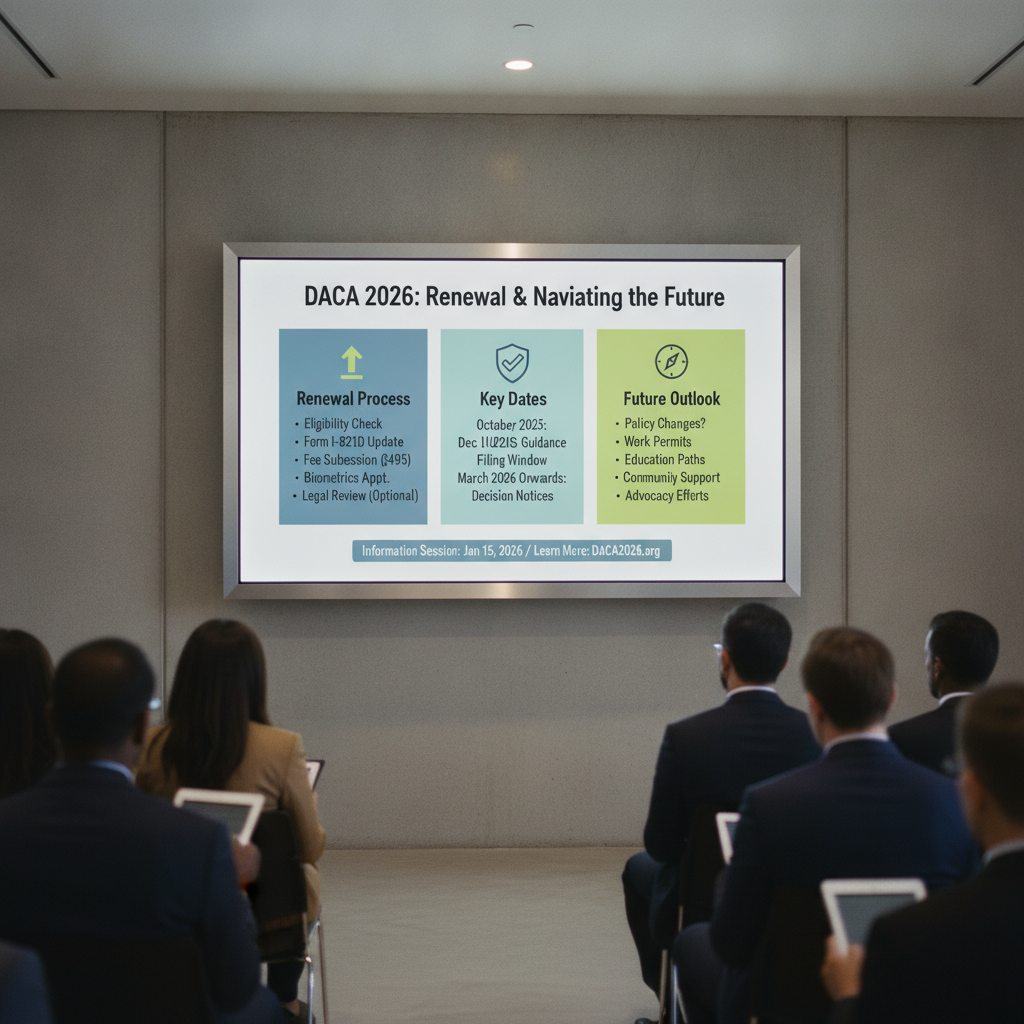
The reporting that sparked this guide: DACA Program Updates and Renewal Information (USCIS)
What This News Means for Immigrants in Orlando and Across Florida
The continuous flow of information regarding the DACA program, often emanating from USCIS announcements, court rulings, and legislative discussions, means that the stability and future of DACA recipients are constantly in flux. For the hundreds of thousands of DACA recipients nationwide, and particularly the tens of thousands who call Florida home, these updates are not abstract legal concepts but deeply personal matters affecting their ability to work, study, and live without fear of deportation.
Why this news is showing up now
The DACA program has been under legal scrutiny for years. While USCIS continues to accept and process DACA renewal applications, new initial applications for DACA remain blocked by federal court orders. The "news" around DACA is often a reflection of ongoing litigation, administrative policy tweaks, or the approach of critical deadlines for renewal. As of mid-2026, the program continues to operate under the cloud of legal challenges, particularly from states seeking to end it. These challenges mean that DACA's future is still uncertain, emphasizing the importance of timely renewals and diligent compliance with current rules.
Furthermore, the political climate frequently brings DACA back into the spotlight. Discussions about comprehensive immigration reform, legislative attempts to provide a pathway to citizenship for Dreamers, and executive actions or inactions all contribute to the ongoing "news cycle" surrounding DACA. For recipients, this means a constant need to monitor official sources like the USCIS official website for the latest directives, especially regarding renewal procedures and any potential changes to eligibility or processing.
How it can affect Florida residents
Florida is home to one of the largest populations of DACA recipients in the country, with estimates placing the number in the tens of thousands. For these individuals, DACA has enabled them to contribute significantly to the state's economy and social fabric, working in essential sectors, pursuing higher education, and raising families. The implications of DACA updates for Florida residents are profound:
- Economic Stability: DACA allows recipients to obtain work authorization (Employment Authorization Document, or EAD), which is crucial for employment. Any disruption to DACA, or delays in renewal, can directly impact their ability to work and support themselves and their families. Many DACA recipients are integral to Florida's service, agriculture, and healthcare industries, and their contributions are vital to the state's economy.
- Educational Opportunities: While Florida does not currently offer in-state tuition to DACA recipients by default (it depends on specific college policies and individual circumstances), DACA status can still impact access to higher education and scholarships. The ability to legally work also helps DACA students fund their education.
- Driver's Licenses: DACA recipients in Florida are generally eligible to apply for a Florida driver's license upon receiving their EAD. This is essential for daily life, commuting to work or school, and maintaining independence in a state heavily reliant on personal transportation, especially across the vast I-4 corridor.
- Family Unity: Many DACA recipients are part of mixed-status families, where some members are U.S. citizens or legal permanent residents. DACA provides a measure of stability and protection, allowing families to remain together. Uncertainty surrounding DACA creates immense stress and anxiety for these families, particularly in communities like Orlando, where diverse populations thrive.
- Community Engagement: DACA recipients are active members of their communities, volunteering, starting businesses, and contributing culturally. The ongoing legal battles and renewal requirements can distract from these contributions and create a sense of instability.
For Central Florida residents, staying updated is particularly important due to the presence of the Orlando USCIS Field Office, which processes various immigration applications. While DACA renewals are primarily handled by specific USCIS Service Centers, local offices can be relevant for biometrics appointments or other related immigration inquiries.
What DACA Is (and Why It Matters)
The Deferred Action for Childhood Arrivals (DACA) program is a U.S. immigration policy established by the Obama administration in June 2012. It offers certain undocumented immigrants who came to the United States as children temporary protection from deportation and the ability to obtain a renewable work permit. DACA is not a law passed by Congress, but rather an exercise of prosecutorial discretion by the executive branch. This administrative nature is precisely why it has been subject to such intense legal and political challenges.
A plain-English definition
Simply put, DACA allows certain individuals who meet specific criteria to avoid deportation for a renewable two-year period and to legally work in the U.S. It does not provide a path to U.S. citizenship or lawful permanent residency (a green card). Instead, it provides temporary relief, enabling recipients to live and work openly without immediate fear of removal, pursue education, and contribute to their communities.
Key terms you need to know
- Deferred Action: This is the core of DACA. It means that the Department of Homeland Security (DHS) chooses not to pursue deportation against an individual for a specific period. It is a temporary measure and can be rescinded at any time.
- Dreamers: This term refers to young undocumented immigrants who were brought to the U.S. as children. Many DACA recipients are often called "Dreamers," a nod to the "DREAM Act" (Development, Relief, and Education for Alien Minors Act), a legislative proposal that has repeatedly failed to pass Congress.
- Employment Authorization Document (EAD): Also known as a work permit, this card (Form I-766) is issued to DACA recipients, allowing them to legally work in the U.S. for the duration of their deferred action period.
- USCIS: U.S. Citizenship and Immigration Services. This is the government agency responsible for administering DACA applications and renewals.
- ICE: U.S. Immigration and Customs Enforcement. This agency is primarily responsible for enforcing immigration laws, including deportations. Deferred action means ICE will generally not target DACA recipients for removal.
- Biometrics Appointment: A required appointment where applicants provide fingerprints, photographs, and a signature for background checks.
- Request for Evidence (RFE): A letter from USCIS asking for additional information or documents to support an application.
- Notice of Action (NOA): A receipt notice or approval notice from USCIS acknowledging an application or informing of a decision.
DACA matters because it has transformed the lives of nearly 600,000 individuals, allowing them to build futures, pursue careers, and contribute billions to the U.S. economy. For many, it's the only home they've ever known, and DACA provides a measure of dignity and opportunity that would otherwise be out of reach.
Confused by Immigration Terms? Our team at Imigrar can clarify the jargon and guide you through your DACA journey. Call +1 786-791-3106 for a free consultation. Se Habla Español.
Current Immigration Law: The Foundation for DACA
While DACA itself is an executive policy, it operates within the broader framework of U.S. immigration law, primarily the Immigration and Nationality Act (INA). The legal challenges to DACA have centered on whether the executive branch exceeded its authority in creating the program without congressional approval, and whether the process followed administrative law procedures.
As of June 20, 2026, the legal status of DACA remains in a state of partial limbo:
- Federal court injunctions continue to prevent USCIS from approving initial DACA applications. This means individuals who have never before received DACA are generally unable to apply.
- USCIS is permitted to accept and process DACA renewal applications. This is critical for current recipients to maintain their protections and work authorization.
Therefore, the "current law" for DACA recipients largely revolves around the existing regulations and guidelines for renewals, as upheld by various court orders. There is no specific federal statute that codifies DACA; it relies on the executive's discretion regarding enforcement of immigration laws.
Important: The legal landscape can change rapidly. Always refer to the USCIS official website or consult with an experienced immigration attorney for the most up-to-date information.
Federal requirements for DACA Renewal
To be eligible for DACA renewal, you must meet the following federal requirements:
- You must have previously received DACA.
- You must not have departed the United States on or after August 15, 2012, without advance parole.
- You must have continuously resided in the United States since the date you submitted your most recent DACA request that was approved.
- You must not have been convicted of a felony, a significant misdemeanor, or three or more other misdemeanors, and not otherwise pose a threat to national security or public safety.
USCIS requires specific forms for renewal, primarily:
- Form I-821D, Consideration of Deferred Action for Childhood Arrivals
- Form I-765, Application for Employment Authorization
- Form I-765WS, Worksheet for Form I-765
These forms, along with supporting documentation and fees, must be submitted to USCIS. You can find the latest versions of these forms and their instructions on the USCIS Forms page.
Florida-specific considerations
For DACA recipients living in Florida, there are several state-specific considerations that impact their daily lives:
- Driver's Licenses: The Florida Department of Highway Safety and Motor Vehicles (FLHSMV) generally issues driver's licenses to DACA recipients who possess a valid Employment Authorization Document (EAD) and a Social Security number. This is a crucial benefit for mobility, especially for those commuting along the I-4 corridor in Central Florida.
- In-State Tuition: Unlike some other states, Florida does not have a statewide law granting in-state tuition to DACA recipients. Eligibility for in-state tuition at Florida public colleges and universities is typically based on residency status, which DACA does not automatically confer. Some institutions may have specific policies or scholarships, but generally, DACA recipients are classified as out-of-state students unless they meet specific, limited exceptions for "undocumented" students through other means (which are rare). It is essential to check with individual university admissions offices in Orlando and across Florida.
- Professional Licenses: The ability for DACA recipients to obtain professional licenses (e.g., nursing, teaching) varies by profession and state regulations. In Florida, some professions may require U.S. citizenship or lawful permanent residency, while others may accept a valid EAD. This can be a significant hurdle for DACA recipients pursuing careers in licensed fields.
- Local Support Networks: Communities in Orlando, Tampa, and Miami have robust immigrant advocacy groups and non-profits that provide resources, legal aid referrals, and support for DACA recipients. These local networks can be invaluable for navigating state-specific challenges.
Understanding these state-level nuances is just as important as knowing the federal requirements. An experienced immigration attorney familiar with Florida laws can provide tailored advice.
How to Renew Your DACA: A Complete Step-by-Step Guide
Renewing your DACA is a critical process that requires careful attention to detail and timely submission. Here’s a complete step-by-step guide to help you through it.
1) Determine Your Eligibility and Gather Documents
Before you begin, ensure you still meet all DACA eligibility criteria as outlined in the "Current Law" section. Review your previous application and any changes in your life since your last approval. The most crucial aspect here is to ensure you have maintained continuous residence and have no disqualifying criminal convictions.
Required Documents for Step 1:
- Your previous DACA approval notice (Form I-797).
- Your current Employment Authorization Document (EAD) (Form I-766).
- Any criminal history records (if applicable, ensure you have certified copies of court dispositions for all arrests or convictions, no matter how minor).
- Records of all departures from the U.S. (if any) and associated advance parole documents.
Reminder: It is highly recommended to renew your DACA between 120 and 150 days before your current DACA and EAD expire. Filing too early could lead to rejection, and filing too late risks a lapse in your work authorization and protection from deportation.
2) Complete Required Forms (Form I-821D, Form I-765, Form I-765WS)
You will need to accurately complete three forms for your DACA renewal. Always download the latest versions directly from the USCIS Forms page.
- Form I-821D, Consideration of Deferred Action for Childhood Arrivals: This is the primary form for DACA itself. Fill out every section completely and accurately. If a question does not apply to you, write "N/A" (not applicable). Do not leave blanks.
- Form I-765, Application for Employment Authorization: This form requests your work permit. For DACA renewals, your eligibility category will typically be (c)(33). Ensure you sign and date the form.
- Form I-765WS, Worksheet for Form I-765: This worksheet provides additional information related to your economic need for employment. While DACA is not a needs-based program, this worksheet is a mandatory part of the application.
Required Documents for Step 2:
- Completed and signed Form I-821D.
- Completed and signed Form I-765.
- Completed and signed Form I-765WS.
Warning: Any missing information, incorrect answers, or unsigned forms can lead to significant delays or even outright rejection of your application. Accuracy is paramount.
3) Compile Supporting Evidence
While DACA renewals generally require less evidence than initial applications, you still need to prove your continued eligibility. The most important documents are copies of your previous DACA approval and EAD.
Required Documents for Step 3:
- Copy of your most recent Form I-797, DACA Approval Notice.
- Copy of the front and back of your most recent Employment Authorization Document (EAD).
- Two passport-style photos (taken within 30 days of filing, with a white background, no glasses, no head coverings unless for religious purposes). Write your name and Alien Registration Number (A-Number) lightly on the back of each photo.
- If you have any new criminal convictions or arrests since your last DACA approval, include certified court dispositions for each.
- If you have traveled outside the U.S. with Advance Parole since your last DACA approval, include copies of your Form I-131 approval notice and passport stamps/visas.
Important: Only send copies of documents unless USCIS specifically requests originals. Keep all original documents for your records.
4) Calculate and Prepare Fees
There are specific fees associated with DACA renewal, which are subject to change by USCIS. As of June 20, 2026, the fee structure is as follows:
- Form I-821D: No fee.
- Form I-765: $410 (Application for Employment Authorization).
- Biometrics Services Fee: $85.
- Total Fee: $495.
You must submit the fee as a single payment for both the Form I-765 and the biometrics services. The payment must be made by money order, personal check, cashier's check, or credit card using Form G-1450, Authorization for Credit Card Transactions. Make checks payable to "U.S. Department of Homeland Security." Do not send cash.
Required Documents for Step 4:
- Check or money order for $495 (or completed Form G-1450).
Reminder: Fee waiver requests are generally not accepted for DACA renewals unless you can demonstrate extreme financial hardship. Consult an attorney if you believe you qualify for a fee waiver.
5) Mail Your Application Packet
Once all forms are completed, signed, and all supporting documents and fees are prepared, assemble your application packet. USCIS has specific mailing addresses based on where you live. For Florida residents, you typically mail your DACA renewal application to the USCIS Chicago Lockbox.
Assemble your packet in this order:
- Check/money order or Form G-1450 on top.
- Form I-821D.
- Form I-765.
- Form I-765WS.
- Copies of your previous Form I-797 (DACA approval) and EAD.
- Two passport-style photos.
- Any other supporting documents (criminal records, advance parole, etc.).
Use a reliable mail service that provides tracking (e.g., USPS Certified Mail, FedEx, UPS). This will give you proof of mailing and delivery.
Required Documents for Step 5:
- Your complete, assembled DACA renewal packet.
- Proof of mailing (tracking number).
6) Attend Biometrics Appointment (if required)
After USCIS receives your application, they will send you a Form I-797C, Notice of Action, acknowledging receipt. Within a few weeks or months, you will likely receive another notice scheduling your biometrics appointment at an Application Support Center (ASC). For Orlando residents, this would typically be at the local ASC.
- Bring the appointment notice, a valid photo ID (like your Florida driver's license or passport), and your EAD to the appointment.
- Be punctual. This appointment is crucial for background checks.
Note: USCIS sometimes reuses previously submitted biometrics, meaning you might not receive an appointment notice. If you don't receive one, it doesn't necessarily mean there's an issue with your application, but you should still monitor your case status.
7) Monitor Your Case Status and Respond to RFEs
After your biometrics appointment, or after your application is received if biometrics are reused, you can monitor your case status online using the receipt number provided on your Form I-797C. Visit USCIS Case Status Online.
- Response to RFEs: If USCIS sends you a Request for Evidence (RFE), it means they need more information or clarification. Respond promptly and thoroughly by the deadline provided. Failure to respond can lead to denial.
- Approval: If your application is approved, you will receive an approval notice (Form I-797) and your new Employment Authorization Document (EAD) in the mail.
- Denial: If your application is denied, USCIS will send a denial letter explaining the reasons. It is crucial to consult with an immigration attorney immediately to discuss potential options.
Important: Keep copies of all correspondence with USCIS. This includes receipt notices, RFE letters, and approval notices.
Practical Steps You Can Take Today for DACA Renewal
Proactive planning is key to a smooth DACA renewal process. Don't wait until the last minute!
Don't Risk a Lapse in Your DACA Status. Let Imigrar guide you through your renewal. Call +1 786-791-3106 for a free consultation. Se Habla Español.
Actionable Checklist (5+ items):
- Mark Your Calendar: Note your DACA and EAD expiration dates. Set a reminder for 150 days before expiration to begin the renewal process.
- Start Saving for Fees: The $495 filing fee can be a burden. Begin saving well in advance to avoid last-minute stress.
- Review Your Records: Gather all previous DACA applications, approval notices, and your current EAD. Check for any changes in address, employment, or criminal history since your last approval.
- Consult an Attorney: If you have any new arrests, convictions, or have traveled outside the U.S. without advance parole, or if you simply feel overwhelmed, schedule a consultation with an experienced immigration lawyer like those at Imigrar immediately.
- Update Your Address: If you have moved, notify USCIS of your change of address online (Form AR-11) to ensure you receive all correspondence.
- Stay Informed: Regularly check the USCIS official website for any program updates or changes to forms and fees.
- Create a Filing System: Organize all your immigration documents in a secure, accessible location. This will make future renewals much easier.
Document preparation guidance
- Copies, Not Originals: Unless specifically requested, always send copies of supporting documents, not originals.
- Clear and Legible: Ensure all copies are clear and easy to read.
- Organize: Use tabs or labels to keep your application neat and organized. Place the fee payment on top.
- Keep a Copy: Make a complete copy of your entire application packet for your records before mailing it.
Timeline expectations
- Optimal Filing Window: Submit your renewal application between 150 and 120 days before your current DACA and EAD expire.
- Processing Times: USCIS processing times for DACA renewals can vary significantly, often ranging from 3 to 6 months. You can check current processing times on the USCIS Processing Times page.
- Biometrics Appointment: If required, this typically occurs 3-6 weeks after USCIS receives your application.
- Potential Delays: Factors like incomplete applications, RFEs, or surges in applications can cause delays. Plan accordingly.
Warning: Allowing your DACA to expire before filing your renewal can result in a lapse in your work authorization and protection from deportation. While USCIS may still accept late renewals, it significantly increases the risk and complexity.

How Imigrar Helps DACA Recipients in Orlando and Beyond
At Imigrar, we understand the immense challenges and anxieties that DACA recipients face, especially with the program's uncertain future. Our mission, "Keep Families Together," resonates deeply with the DACA community, many of whom are striving to build stable lives for themselves and their loved ones here in the U.S.
Our experience and expertise
Our team of dedicated immigration attorneys possesses extensive experience in handling DACA renewals and related immigration matters. We stay abreast of the latest legal developments, court rulings, and USCIS policy changes that impact DACA recipients. We have successfully assisted countless individuals in Orlando, throughout Central Florida, and across the nation with their DACA renewals, ensuring accuracy, timeliness, and compliance with all requirements.
We provide comprehensive legal support, including:
- Eligibility Assessment: Thoroughly reviewing your case to confirm renewal eligibility and identify any potential issues.
- Application Preparation: Meticulously preparing and reviewing all required forms (Form I-821D, Form I-765, Form I-765WS) and supporting documentation.
- Evidence Compilation: Guiding you on what evidence to submit and how to present it effectively.
- Fee Guidance: Ensuring proper fee calculation and payment methods.
- Response to RFEs: Assisting you in preparing timely and comprehensive responses to any Request for Evidence from USCIS.
- Strategic Advice: Offering guidance on complex situations, such as criminal history issues or travel outside the U.S.
- Case Monitoring: Helping you monitor your case status and communicating with USCIS on your behalf when necessary.
We pride ourselves on providing compassionate, clear, and effective legal representation, alleviating the burden from your shoulders so you can focus on your life and future.
Free consultation offer
We believe that everyone deserves access to expert legal advice. That’s


