


The landscape of immigration law is constantly evolving, and for thousands of young people across the United States, few programs hold as much significance as the Deferred Action for Childhood Arrivals (DACA). As an expert legal content writer for Imigrar, an immigration law firm based in Orlando, Florida, we understand the critical need for clear, accurate, and timely information regarding DACA updates and the renewal process. Our mission is to "Keep Families Together," and providing comprehensive guidance is a cornerstone of that commitment.
Today, as of 2026-03-26, DACA continues to operate under a complex web of legal challenges and injunctions. While new DACA applications generally remain paused, the ability for existing DACA recipients to renew their deferred action and employment authorization is a lifeline that must be protected. This extensive guide is designed to empower you with the knowledge and steps necessary to navigate your DACA renewal successfully.
Need Help with Your DACA Renewal? Our experienced Orlando immigration team at Imigrar is ready to assist. Don't risk your status – call +1 786-791-3106 for a free, confidential consultation, or message us online. Se Habla Español.
The reporting that sparked this guide
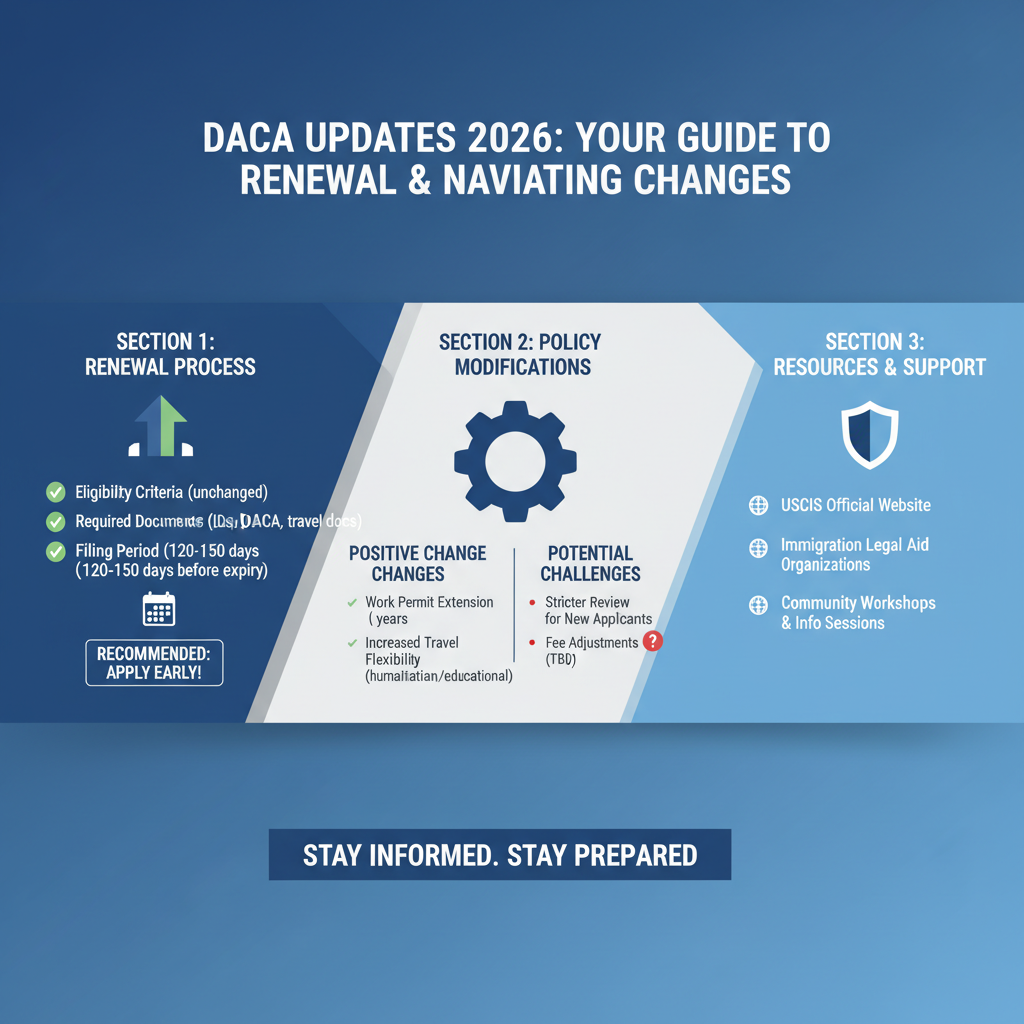
Recent discussions and reports from USCIS regarding the ongoing administration of the DACA program have highlighted the critical importance of staying current with renewal procedures and understanding the program's legal status. While the ultimate fate of DACA remains in the hands of the courts and Congress, USCIS continues to process renewal requests for eligible individuals. This ongoing activity, coupled with the ever-present legal challenges, necessitates a detailed understanding for all DACA recipients.
DACA Program Updates and Renewal Information (USCIS)
What This News Means for Immigrants in Orlando and Across Florida
For DACA recipients and their families in Orlando, Central Florida, and throughout the Sunshine State, ongoing updates about the program are not just news – they are directly tied to their ability to work, study, and plan for their futures. The current legal status of DACA means that while initial applications are generally not being accepted, renewals are vital for maintaining protections.
Why this news is showing up now
The Deferred Action for Childhood Arrivals (DACA) program has been a subject of continuous legal and political debate since its inception in 2012. It has faced multiple attempts to rescind it, leading to a series of court battles and injunctions. The current situation stems from a July 2021 ruling by a federal judge in Texas, which declared the DACA program unlawful and effectively halted the processing of new DACA applications. This ruling was later affirmed by the Fifth Circuit Court of Appeals in October 2022. While the Biden administration has attempted to codify DACA into a formal regulation, this regulation is also subject to the ongoing legal challenge. As of today, March 26, 2026, the program remains largely unchanged from this legal standstill: existing DACA recipients can apply for renewal, but new applications are generally not being processed.
This constant state of flux means that USCIS regularly issues operational updates regarding how it is administering the program under the existing court orders. These updates are crucial because they dictate the practical steps DACA recipients must take to maintain their status. The news cycle surrounding DACA is continuous because the legal challenges are ongoing, and the program's future is not yet definitively resolved by Congress or the Supreme Court. Each court hearing, each regulatory update, and each political discussion brings DACA back into the spotlight, reminding recipients of the need for vigilance and accurate information.
How it can affect Florida residents
Florida is home to a significant population of DACA recipients, many of whom reside in the populous Orlando metropolitan area and along the I-4 corridor. For these individuals, the ability to renew DACA is paramount. Without renewal, DACA recipients risk losing their deferred action status, their Employment Authorization Document (EAD), and their protection from deportation. This can have devastating consequences for families, careers, and educational pursuits.
- Employment: Loss of an EAD means the inability to legally work, directly impacting the livelihoods of individuals and their families. Many DACA recipients are essential workers, entrepreneurs, and contributors to Florida's economy.
- Education: While Florida does not offer in-state tuition for DACA recipients statewide, some institutions and specific programs might have varying policies. Loss of DACA can impact enrollment or access to certain scholarships.
- Driving Privileges: DACA recipients in Florida are eligible to obtain driver's licenses. Losing DACA status would eventually lead to the inability to renew their license, severely impacting daily life and access to transportation in a state heavily reliant on cars.
- Community Integration: DACA provides a sense of stability and allows individuals to pursue their dreams. The uncertainty surrounding the program, even for renewals, creates immense stress and anxiety for thousands of Floridians who consider this state their home.
For Central Florida residents, understanding these nuances is critical. The Orlando USCIS Field Office processes various immigration applications, and while DACA renewals are centrally processed, local implications for things like driver's licenses or specific community resources are felt acutely. Imigrar is deeply rooted in the Orlando community and understands these local impacts, offering tailored advice to those navigating their DACA journey here.
Concerned about your DACA renewal in Florida? Don't face the complexities alone. Our legal team at Imigrar offers personalized guidance. Call us today at +1 786-791-3106 for a free consultation. Se Habla Español.
What DACA Is (and Why It Matters)
Understanding DACA is the first step toward safeguarding your status. It's a program that has profoundly impacted hundreds of thousands of lives, offering a measure of temporary relief and opportunity.
A plain-English definition
The Deferred Action for Childhood Arrivals (DACA) program is an immigration policy established in June 2012 by the Obama administration. It allows certain undocumented immigrants who came to the United States as children to receive a renewable two-year period of deferred action from deportation and eligibility for a work permit (Employment Authorization Document, or EAD).
Important: DACA does not provide a pathway to U.S. citizenship or lawful permanent residency (a "green card"). It grants a temporary, discretionary status that protects recipients from removal (deportation) and allows them to legally work in the U.S. for a specific period.
Key terms you need to know
- Deferred Action: This is a discretionary determination by USCIS to defer removal action against an individual. It means the government is choosing not to pursue deportation proceedings against you for a specific period. It is not a formal immigration status, but it provides temporary lawful presence.
- Employment Authorization Document (EAD): Often referred to as a "work permit," this card (Form I-766) allows DACA recipients to legally work in the United States for the duration of their deferred action period.
- Lawful Presence: While DACA does not grant a lawful immigration status, it does provide a period of "lawful presence" in the U.S. This is crucial for various purposes, including obtaining a driver's license in many states and potentially qualifying for certain benefits.
- Removal Proceedings: These are legal processes initiated by the U.S. government to deport a non-citizen from the country. DACA provides protection from these proceedings.
- Form I-821D: This is the official USCIS form, "Consideration of Deferred Action for Childhood Arrivals," used to request DACA.
- Form I-765: This is the "Application for Employment Authorization," used in conjunction with Form I-821D to apply for a work permit.
- Continuous Residence: A key DACA eligibility requirement, meaning the applicant has resided continuously in the U.S. for a specified period.
DACA matters immensely because it has allowed hundreds of thousands of young people, often referred to as "Dreamers," to pursue higher education, build careers, contribute to their communities, and live without the constant fear of deportation in the only country many have ever known as home. It represents a chance for stability and integration into American society, even if it's not a permanent solution.
Current Immigration Law: The Foundation of DACA
The legal basis for DACA, while complex and subject to ongoing challenges, is rooted in the executive branch's prosecutorial discretion regarding immigration enforcement.
Federal requirements
The DACA program was established via a memorandum from the Secretary of Homeland Security. It is an exercise of "prosecutorial discretion," allowing the Department of Homeland Security (DHS) to prioritize its enforcement resources. While the program is not codified in federal statute, its administration relies on existing regulatory frameworks for deferred action and employment authorization.
As of March 26, 2026, DACA continues to operate under the terms of a federal court injunction. This means:
- USCIS is currently accepting and processing renewal requests for individuals who have previously been granted DACA.
- USCIS is generally *not* accepting new initial DACA requests from individuals who have never been granted DACA.
- USCIS continues to accept applications for advance parole from DACA recipients.
The eligibility criteria for DACA, as outlined in the original 2012 memo and subsequent USCIS guidance, remain the bedrock for renewals. To be eligible for DACA, an individual must generally meet the following criteria (for renewals, these refer back to the original grant and continued eligibility):
- Were under the age of 31 as of June 15, 2012.
- Came to the United States before reaching your 16th birthday.
- Have continuously resided in the United States since June 15, 2007, up to the present time.
- Were physically present in the United States on June 15, 2012, and at the time of making your request for deferred action.
- Had no lawful status on June 15, 2012.
- Are currently in school, have graduated or obtained a certificate of completion from high school, have obtained a general education development (GED) certificate, or are an honorably discharged veteran of the Coast Guard or Armed Forces of the United States.
- Have not been convicted of a felony, a significant misdemeanor, or three or more other misdemeanors, and do not otherwise pose a threat to national security or public safety.
For renewals, the primary focus is demonstrating continued eligibility since the last grant of deferred action and ensuring no disqualifying events have occurred. USCIS processes these requests using Form I-821D, Form I-765, and Form I-765WS. All official forms and instructions can be found on the USCIS Forms page.
Florida-specific considerations
While DACA is a federal program, its impact is felt differently across states. For DACA recipients in Florida, there are specific state-level considerations:
- Driver's Licenses: DACA recipients in Florida are eligible to obtain a driver's license upon presentation of their EAD and other required identity documents. Maintaining DACA status is essential for renewing this privilege.
- Professional Licensing: The ability to obtain professional licenses (e.g., nursing, teaching, real estate) in Florida often depends on having legal work authorization, which DACA provides. Loss of DACA can jeopardize these career paths.
- Higher Education: While there are ongoing efforts to grant DACA recipients in-state tuition in Florida, it is not uniformly available statewide. Some private institutions or specific programs might offer aid or alternative tuition rates. Always check with individual institutions.
- Local Resources: Communities across Florida, including Orlando and Orange County, may offer various support services for immigrants. Organizations often collaborate to provide legal aid referrals, educational resources, and community integration programs for DACA recipients.
Staying informed about both federal DACA policy and its implications for Florida residents is crucial. The attorneys at Imigrar are well-versed in these intersectional issues and can provide guidance tailored to your situation in Central Florida.
For more general information on immigration matters, visit the USCIS official website.
How to Renew Your DACA: A Complete Step-by-Step Guide
Renewing your DACA is a critical process that requires attention to detail and timely submission. Follow these steps carefully to ensure a successful renewal.
1) Understand Eligibility and Timing
The first and most crucial step is to confirm your continued eligibility and to submit your renewal application within the recommended timeframe.
- Continued Eligibility: Ensure you meet all original DACA criteria and have not committed any disqualifying offenses (felony, significant misdemeanor, three or more other misdemeanors, or posing a threat to national security/public safety) since your last DACA grant.
- Renewal Window: USCIS recommends filing your DACA renewal application between 120 days and 150 days before your current DACA and EAD expire. Filing too early may result in a denial, and filing too late risks a lapse in your work authorization and deferred action.
- Warning: If you file outside this window, your application might be rejected, or your EAD could expire before your new one arrives, leaving you without work authorization.
2) Gather Required Documents
Thorough documentation is key. Organize all necessary papers before you begin filling out forms.
- Previous DACA Approval Notices: Include copies of your most recent Form I-797C, Notice of Action, for your DACA approval and EAD.
- Current EAD: A copy of your existing Employment Authorization Document (Form I-766).
- Proof of Identity: Copy of your birth certificate (with certified translation if not in English), passport, or national identity document from your country of origin.
- Proof of Continuous Residence: Evidence that you have continuously resided in the U.S. since your last DACA approval. This can include:
- School records (transcripts, report cards)
- Employment records (pay stubs, W-2s)
- Medical records
- Rental agreements, utility bills
- Bank statements
- Dated photos with explanations
- Affidavits from others (with caution)
- Criminal History Records (if applicable): If you have ever been arrested or cited for any reason, even if charges were dropped or expunged, you must provide certified court dispositions for *each* incident. Failure to disclose this information, no matter how minor, can lead to denial and potential legal trouble.
- Travel Records (if applicable): If you have traveled outside the U.S. with advance parole, include copies of your Form I-512L, Advance Parole Document, and entry/exit stamps.
Reminder: Do not send original documents unless specifically requested by USCIS. Send clear photocopies.
3) Complete USCIS Forms
Accuracy is paramount when completing your DACA renewal forms. Any mistakes can cause delays or even denial.
- Form I-821D, Consideration of Deferred Action for Childhood Arrivals:
- Fill out every section completely and accurately. If a section does not apply, write "N/A" (not applicable).
- Pay close attention to sections asking about your travel history and criminal record.
- Ensure your current mailing address is correct. If your case is in Orlando, make sure your address is updated with USCIS to receive all correspondence.
- Form I-765, Application for Employment Authorization:
- For DACA renewals, select option (c)(33) under Item 27.
- Ensure consistency between this form and Form I-821D.
- Form I-765WS, Worksheet for Form I-765:
- This worksheet is required and helps USCIS determine if you have an economic need for employment authorization.
- Be truthful and provide a realistic assessment of your financial situation.
- Photos: Include two identical, color, passport-style photos taken within 30 days of filing your application. Write your name and Alien Registration Number (A-Number) lightly on the back of each photo.
4) Prepare Supporting Evidence
Beyond the basic documents, ensure you have robust evidence to support your application.
- Proof of Identity and Date of Birth: Birth certificate, passport, national identity card from your country of origin, school ID, military ID, or state-issued ID.
- Proof of Entry Before 16th Birthday: School records, medical records from your childhood, sworn affidavits.
- Proof of Continuous Residence: As listed in step 2. The more evidence you have, the stronger your case. It's better to provide too much than too little.
- Educational/Military Proof: High school diploma, GED certificate, college transcripts, military discharge papers (Form DD-214).
- Criminal Records: If you have any arrests or convictions, even minor ones, obtain certified court dispositions and provide them. Consult with an attorney before submitting if you have a criminal history.
5) Pay Filing Fees
The filing fees are a mandatory part of the DACA renewal process.
- Total Fee: As of March 26, 2026, the total filing fee for a DACA renewal is $495. This includes the Form I-821D fee (which is zero) and the Form I-765 fee of $410, plus the biometric services fee of $85.
- Payment Method: You can pay by money order, personal check, cashier's check, or by credit card using Form G-1450, Authorization for Credit Card Transactions. Make checks payable to "U.S. Department of Homeland Security."
- Fee Waivers: Fee waivers are extremely rare for DACA renewals and are generally only granted in very limited circumstances, such as being homeless, receiving public benefits, or having an income below 150% of the poverty level. If you believe you qualify, you must file Form I-912, Request for Fee Waiver, along with extensive supporting documentation. Consult an attorney before attempting to request a fee waiver.
6) Assemble and Mail Your Application
Proper assembly and mailing are crucial to avoid rejection or delays.
- Order of Documents:
- Payment (check, money order, or Form G-1450 on top)
- Two passport-style photos in a small envelope stapled to the upper left corner of Form I-765
- Form I-765
- Form I-765WS
- Form I-821D
- Copies of previous DACA approval notices (Form I-797C) and EAD card
- Copies of supporting evidence (continuous residence, education, etc.)
- Copies of any criminal dispositions
- Any other supporting documentation
- Mailing Address: Send your complete package to the correct USCIS lockbox facility based on your state of residence. For Florida residents, check the "Direct Filing Addresses for Form I-821D" page on the USCIS official website.
- Important: Use a mailing service that provides tracking (e.g., USPS Certified Mail with Return Receipt, FedEx, UPS) to confirm delivery. Keep a copy of the entire submitted package for your records.
7) Monitor Your Application Status
After filing, track your application's progress.
- Receipt Notice: Within 2-3 weeks, you should receive a Form I-797C, Notice of Action, confirming receipt of your application. This notice will include your receipt number, which you can use to track your case online.
- Biometrics Appointment: USCIS will send you an appointment notice (Form I-797C) for a biometrics (fingerprints, photo, signature) appointment at an Application Support Center (ASC). Attend this appointment as scheduled. The Orlando ASC serves many Central Florida residents.
- Online Status Check: Use the USCIS Case Status Online tool with your receipt number: USCIS Case Status Online.
- Request for Evidence (RFE): If USCIS needs more information, they will send you an RFE. Respond promptly and thoroughly by the deadline.
- Processing Times: Check current processing times for Form I-821D and Form I-765 at USCIS Processing Times. While USCIS aims to process renewals efficiently, delays can occur.
Practical Steps You Can Take Today for DACA Renewal
Proactive preparation is your best defense against potential issues and delays. Here’s what you can do now:
- Know Your Expiration Date: Mark your calendar for your DACA and EAD expiration dates. Set reminders for the 150-day and 120-day renewal windows.
- Gather & Organize Documents: Start collecting all necessary documents now. Create a dedicated folder for your DACA paperwork. This includes previous approval notices, EAD cards, and proof of continuous residence. If your original DACA was approved years ago, you'll need to show continuous residence since your last approval.
- Review Your History: Carefully review your personal history for any arrests, citations, or interactions with law enforcement, no matter how minor. Obtain certified court dispositions for *every* incident. This is non-negotiable.
- Update Your Address with USCIS: If you've moved, file Form AR-11, Alien's Change of Address Card, online or by mail within 10 days of moving. This ensures you receive all USCIS correspondence, especially if you live in Orange County or other surrounding areas in Central Florida.
- Save for Fees: The $495 filing fee is a significant expense. Start saving now so you're not caught off guard.
- Consult an Attorney: Even if you've renewed DACA before, the legal landscape is constantly changing. A consultation with an experienced immigration attorney at Imigrar can provide peace of mind and ensure your application is as strong as possible.
- Keep Copies of Everything: Before mailing your application, make a complete copy of the entire package for your records.
Document preparation guidance
- Clarity: Ensure all copies are clear and legible.
- Translations: Any document not in English must be accompanied by a complete and accurate English translation and a certification by the translator that they are competent to translate from the foreign language into English and that the translation is complete and accurate.
- Originals: Do not send original documents unless USCIS specifically requests them.
Timeline expectations
- Filing Window: 120-150 days before expiration.
- Receipt Notice: 2-3 weeks after filing.
- Biometrics Appointment: 3-8 weeks after filing.
- Decision: Processing times vary but typically range from 3-6 months. Check USCIS Processing Times for the most current estimates.
- Warning: While USCIS strives to process renewals promptly, it's crucial to file early to avoid a lapse in your EAD.

How Imigrar Helps DACA Recipients in Orlando and Beyond
Navigating DACA renewals can be stressful, especially with the program's uncertain future. At Imigrar, we stand by our commitment to "Keep Families Together" by providing expert legal support to DACA recipients in Orlando, across Florida, and nationwide.
Our experience and expertise
Our attorneys have extensive experience with DACA applications and renewals, staying abreast of every legal challenge, court ruling, and USCIS update. We understand the nuances of the application process, the types of evidence required, and how to address potential complications, such as a criminal history or past travel.
- Personalized Guidance: We don't believe in one-size-fits-all solutions. We review your unique circumstances, identify potential issues, and provide a clear strategy for your DACA renewal.
- Thorough Application Preparation: We assist with completing all necessary forms (Form I-821D, Form I-765, Form I-765WS), ensuring accuracy and completeness to minimize the risk of RFEs or denials.
- Document Review & Organization: Our team helps you compile and organize your supporting documents, ensuring you submit a robust application package.
- Addressing Complex Issues: If you have a criminal record, a history of immigration violations, or other complex issues, we can assess their impact on your eligibility and advise on the best course of action.
- Advance Parole Assistance: For DACA recipients considering international travel, we can guide you through the Form I-131, Application for Travel Document (Advance Parole) process.
Free consultation offer
We understand that the cost of legal services can be a barrier. That's why Imigrar offers a free, no-obligation consultation for DACA recipients. This is your opportunity to speak with an experienced immigration attorney, discuss your situation, and understand how we can help protect your deferred action status.
Whether you're located in Orlando, Kissimmee, Sanford, or anywhere else in Florida, our team is accessible and ready to provide the guidance you need. We are committed to making the legal process as clear and stress-free as possible.
Se Habla Español. Our bilingual team is here to serve the Spanish-speaking community, ensuring clear communication and understanding throughout your immigration journey.
Related Articles
You may also be interested in:
-
Family-Based Green Card Guide: Orlando Immigration Petitions
Navigate family-based immigration petitions with our comprehensive guide. Learn requirements, steps, and how Imigrar helps families in Orlando and nat...
-
Family-Based Immigration: Your Path to Keeping Loved Ones
Navigate the complexities of family-based immigration with Imigrar's comprehensive guide. Learn about petitions, requirements, and how to unite your f...
-
TPS Extension: What Orlando Immigrants Need to Know Now
Latest TPS extensions bring crucial updates for immigrants in Florida. Understand eligibility, re-registration, and how Imigrar can help you navigate ...
-
Family-Based Immigration: Your Guide to Keeping Families
Navigate the complexities of family-based immigration petitions with Imigrar's comprehensive step-by-step guide. Learn about requirements, timelines, ...


