


The landscape of immigration policy is constantly shifting, and few programs have seen as much change and legal challenge as the Deferred Action for Childhood Arrivals (DACA) program. For hundreds of thousands of individuals across the nation, including many in Florida, DACA represents a lifeline, offering temporary protection from deportation and the ability to work legally in the U.S.
As of August 2026, DACA continues to operate under significant legal scrutiny, primarily impacting new applications while renewals remain a critical process for current recipients. Understanding the latest updates and ensuring a timely, accurate renewal is paramount for DACA recipients and their families.
Need Help? Our Orlando immigration team is ready to assist. Call +1 786-791-3106 for a free consultation, or message us online. Se Habla Español.
The reporting that sparked this guide:
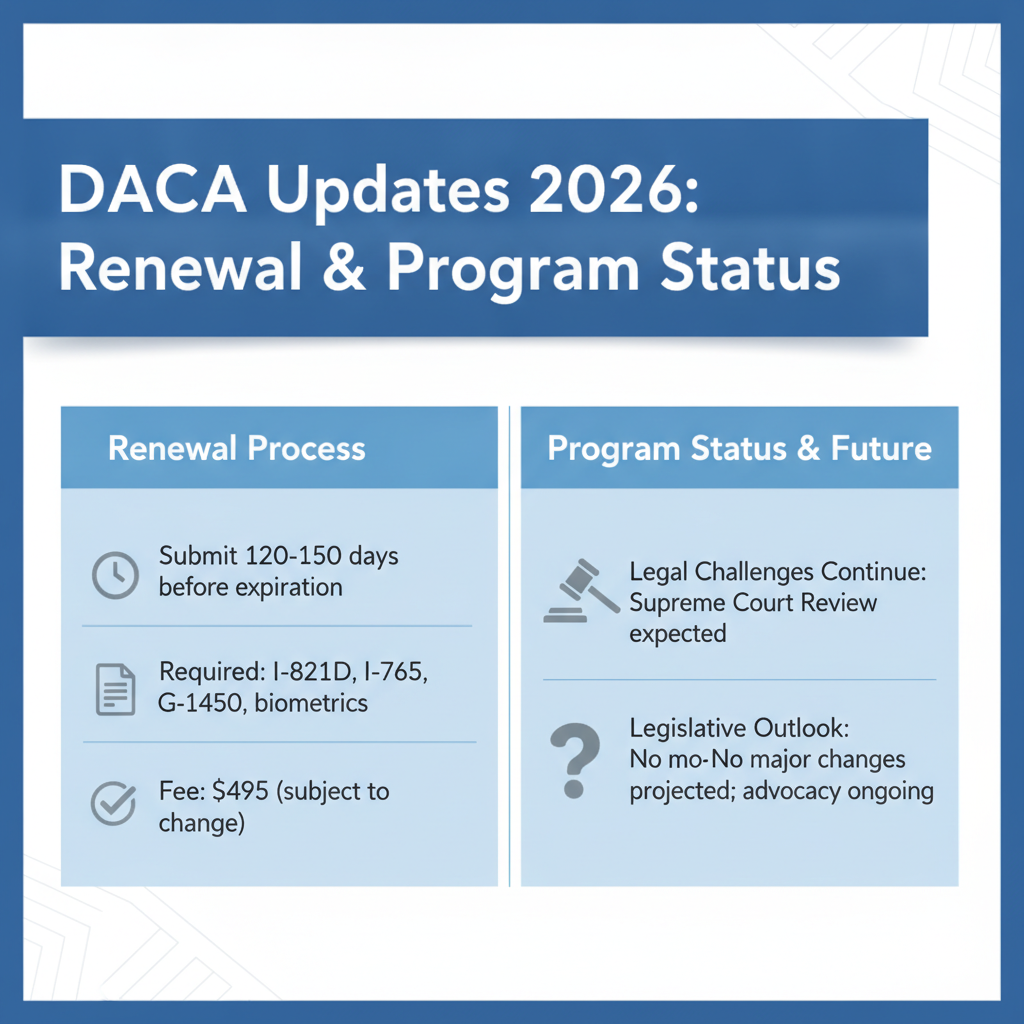
The information and guidance in this article are inspired by ongoing news coverage and updates from official government sources regarding the DACA program. For the latest developments and official announcements, always refer to the U.S. Citizenship and Immigration Services (USCIS) website:
DACA Program Updates and Renewal Information (USCIS)
What This News Means for Immigrants in Orlando and Across Florida
For DACA recipients in Orlando, throughout Central Florida, and across the entire state, staying informed about program updates is not just helpful—it's essential for maintaining your status and planning your future. The DACA program has faced numerous legal challenges since its inception in 2012, leading to periods of uncertainty and changes in policy.
Why this news is showing up now
The DACA program's future has been subject to prolonged litigation. As of our current date in August 2026, federal courts continue to weigh in on the legality of DACA. While previous rulings have generally allowed DACA renewals to proceed, new initial DACA applications have been paused due to court orders. Periodically, the Department of Homeland Security (DHS) and USCIS issue updates in response to these legal developments or internal policy reviews. These updates are crucial because they can affect processing times, eligibility requirements for renewals, or even the long-term viability of the program itself. News reports often highlight these shifts, prompting DACA recipients to seek clarity and guidance.
For DACA recipients, any news related to the program, whether it's about legislative efforts in Congress, new court decisions, or changes in USCIS processing, immediately raises questions about their deferred action and employment authorization. This constant state of flux necessitates reliable and up-to-date information.
How it can affect Florida residents
Florida is home to a significant population of DACA recipients, many of whom contribute to our economy and communities, from Orange County to the furthest corners of the state. For these individuals, DACA provides critical protections:
- Work Authorization: The Employment Authorization Document (EAD) allows DACA recipients to work legally, supporting themselves and their families. Without it, employment opportunities are severely limited.
- Protection from Deportation: DACA provides a temporary reprieve from removal proceedings, offering peace of mind and stability.
- Educational Opportunities: While Florida does not offer in-state tuition benefits to DACA recipients statewide, some institutions and private scholarships may be available, and the ability to work helps fund education.
- Driver's Licenses: DACA recipients in Florida are generally eligible to obtain a driver's license, which is vital for daily life, commuting along the I-4 corridor, and accessing services.
Any disruption to DACA, or even changes in renewal procedures, can have profound impacts. For example, processing delays could lead to gaps in employment authorization, causing financial hardship. Changes in eligibility criteria, however unlikely for renewals, could jeopardize status. Local DACA recipients in Orlando often rely on community resources and legal assistance to navigate these complexities, making access to accurate information critical.
What DACA Is (and Why It Matters)
The Deferred Action for Childhood Arrivals (DACA) program is an administrative policy announced by the Department of Homeland Security (DHS) on June 15, 2012. It was established to provide certain undocumented young people, often referred to as "Dreamers," with temporary protection from deportation and work authorization.
A plain-English definition
Simply put, DACA allows eligible individuals who came to the United States as children to apply for "deferred action." This means the U.S. government agrees to defer any deportation action against them for a period, typically two years. Alongside this deferred action, recipients are also eligible to apply for an Employment Authorization Document (EAD), which allows them to legally work in the U.S. DACA does not provide a path to U.S. citizenship or lawful permanent residency, but it offers a temporary, renewable status that brings a degree of stability and opportunity.
Key terms you need to know
- Deferred Action: A discretionary determination by the government to defer removal action against an individual. Deferred action does not confer lawful status but is a temporary reprieve from deportation.
- DACA Recipient: An individual whose application for Deferred Action for Childhood Arrivals has been approved by USCIS.
- Employment Authorization Document (EAD): Also known as a work permit, this card allows individuals to legally work in the United States. DACA recipients receive an EAD valid for the period of their deferred action.
- USCIS: U.S. Citizenship and Immigration Services, the federal agency responsible for administering lawful immigration to the United States, including processing DACA applications.
- DHS: Department of Homeland Security, the cabinet department under which USCIS operates.
- Renewal: The process by which current DACA recipients apply to extend their deferred action and employment authorization for another two-year period. This is the primary action available to most DACA recipients today.
- Initial Application: The first-time application for DACA. As of August 2026, USCIS is generally not accepting new initial DACA applications due to ongoing court orders.
- Biometrics: The collection of fingerprints, photographs, and signatures required for identity verification and background checks during the application process.
DACA matters immensely because it has allowed hundreds of thousands of young people to pursue higher education, build careers, contribute to their communities, and live without the constant fear of deportation. It has had a significant positive impact on the economy and social fabric of communities nationwide, including vibrant cities like Orlando.
Concerned about your DACA status or renewal? Don't navigate the complexities alone. Imigrar offers expert legal guidance for DACA recipients. Call +1 786-791-3106 today for your free consultation. Se Habla Español.
Current Immigration Law: The Foundation for DACA
It's crucial to understand that DACA is not a federal statute enacted by Congress but rather an executive action. This means it was implemented through a memorandum issued by the Secretary of Homeland Security. This origin is precisely why DACA has been subject to continuous legal challenges, with various courts debating whether the executive branch exceeded its authority in creating the program.
As of August 2026, the legal framework for DACA remains largely defined by the 2012 DHS memorandum, subsequent guidance, and numerous court injunctions. While no specific immigration law or statute directly created DACA, its administration falls under existing immigration authorities. The primary legal challenge often revolves around the Administrative Procedure Act (APA), which governs how federal agencies develop and issue regulations.
Federal requirements
To be eligible for DACA renewal, you must meet the following federal requirements, which have remained consistent for renewals despite legal challenges:
- You must have received DACA previously and your most recent DACA period must not have expired more than one year ago. (Important: USCIS recommends filing for renewal within the 120- to 150-day window before your current DACA and EAD expire).
- You must have continuously resided in the United States since the date you submitted your most recent DACA request that was approved.
- You must not have departed the United States without advance parole on or after August 15, 2012.
- You must not have been convicted of a felony, a significant misdemeanor, or three or more other misdemeanors, and must not pose a threat to national security or public safety.
- You must still meet the original DACA requirements regarding age, entry date, and educational status, unless you have since obtained a GED or high school diploma, or completed military service.
Important: Individuals who have had DACA previously but whose DACA expired more than one year ago, or whose DACA was terminated at any point, cannot file a renewal application. They must file a new initial DACA request, which USCIS is currently generally not accepting due to court orders. If you are in this situation, it is critical to consult with an immigration attorney.
Florida-specific considerations
While DACA is a federal program, its impact on recipients can vary by state. In Florida, DACA recipients face certain state-level realities:
- Driver's Licenses: DACA recipients in Florida are generally eligible to obtain a Florida driver's license or state identification card, provided they have a valid EAD and meet all other state requirements. This is crucial for mobility, especially in a state like Florida where public transportation is not always comprehensive, particularly outside major urban centers like Orlando.
- In-State Tuition: Unfortunately, Florida state law currently does not grant in-state tuition eligibility to DACA recipients at public colleges and universities. This means DACA students typically pay out-of-state tuition rates, which can be a significant financial barrier. However, private institutions may have different policies, and scholarship opportunities may exist.
- Professional Licenses: The ability to obtain professional licenses (e.g., for nursing, teaching, engineering) can vary by profession and state law. DACA recipients should research specific requirements for their desired profession in Florida.
These state-specific considerations highlight the complex environment DACA recipients navigate. For Central Florida residents, understanding these nuances is key to planning for education, career, and daily life.
For official forms and detailed instructions, always refer to the USCIS official website.
How to Renew Your DACA: A Complete Step-by-Step Guide
Renewing your DACA is a critical process that requires careful attention to detail and adherence to deadlines. Missing a step or submitting an incomplete application can lead to delays or even denial, jeopardizing your work authorization and protection from deportation.
1) Determine Your Eligibility and Timeline
Before you begin, confirm you meet the federal renewal eligibility requirements mentioned above. The most crucial aspect of DACA renewal is timing. USCIS recommends filing your renewal application within the 120- to 150-day window before your current DACA and EAD expire. Filing too early (more than 150 days out) can result in your application being rejected. Filing too late (after your DACA expires) can lead to a gap in your work authorization and deferred action, and if it's more than a year past expiration, you may not be able to renew at all.
- Action: Check the expiration date on your current EAD (Form I-766). Mark your calendar for the 150-day and 120-day marks.
- Warning: Do not wait until the last minute. Processing times can vary, and any delays could put your status at risk.
2) Gather Required Documents
Having all necessary documents ready before you start filling out forms will streamline the process. While USCIS generally does not require you to resubmit all original supporting documents you provided for your initial DACA request or previous renewals, you must provide documents that show continued eligibility.
- Proof of Identity:
- Copy of your most recent EAD (front and back).
- Copy of your birth certificate (with certified translation if not in English).
- Copy of your passport identity page or national identity card (if applicable).
- Proof of Continuous Residence:
- Utility bills, bank statements, pay stubs, school records, medical records, or other dated documents showing you have resided in the U.S. since your last DACA approval.
- These documents should cover the entire period since your last DACA approval.
- Proof of Prior DACA Approval:
- Copy of your previous DACA approval notice (Form I-797C, Notice of Action).
- Documentation of Any Criminal History (if applicable):
- Certified copies of court dispositions for any arrests or convictions since your last DACA approval, even if charges were dismissed or expunged.
- Important: Be transparent about any interactions with law enforcement. Failure to disclose can lead to denial.
- Two Passport-Style Photos:
- Taken within 30 days of filing, unmounted, glossy, 2x2 inches, white background.
- Lightly print your name and A-number on the back of each photo.
3) Complete the Necessary Forms
There are three main forms you need to complete for DACA renewal:
- Form I-821D, Consideration of Deferred Action for Childhood Arrivals: This is the primary form for requesting deferred action. Answer all questions truthfully and completely.
- Form I-765, Application for Employment Authorization: This form is for requesting your work permit. Be sure to select "Renewal of my permission to work" and enter (c)(33) as your eligibility category.
- Form I-765WS, Worksheet: This worksheet helps you determine if you need to provide additional financial information for your Form I-765.
Reminder: Download the latest versions of these forms directly from the USCIS Forms page. Do not use outdated forms, as they will be rejected.
- Fill out all sections accurately. If a question does not apply to you, write "N/A." Do not leave any required fields blank.
- Sign and date all forms in blue ink. Ensure your signature matches your legal name.
4) Prepare Your Application Packet
Once your forms are complete and documents are gathered, organize your application packet carefully. A well-organized packet helps USCIS process your application efficiently.
- Order of Documents:
- Payment (check or money order) on top.
- Two passport-style photos in a small envelope, paper clipped to Form I-765.
- Form I-821D.
- Form I-765.
- Form I-765WS.
- Copies of supporting documents (EAD, approval notice, proof of continuous residence, criminal history documents, etc.).
- Payment:
- As of August 2026, the total fee for DACA renewal is $495. This includes the $85 biometrics fee and the $410 Form I-765 fee. There is no separate fee for Form I-821D.
- Pay by money order, personal check, cashier's check, or credit card using Form G-1450, Authorization for Credit Card Transactions.
- Make checks or money orders payable to "U.S. Department of Homeland Security." Do not abbreviate.
- Important: Fee waivers are generally NOT available for DACA applications.
- Make Copies: Make a complete copy of your entire application packet for your records before mailing it.
5) Submit Your Application
Mail your completed and organized application packet to the correct USCIS lockbox facility. The correct address depends on your state of residence. For Florida residents, you will typically mail to the USCIS Chicago Lockbox. Check the USCIS Direct Filing Addresses for Form I-821D page for the most current address.
- Mailing Method: Use a reputable mail service that provides tracking (e.g., USPS Certified Mail with Return Receipt, FedEx, UPS). This provides proof of mailing and delivery.
- Address: Ensure the address is exactly as listed on the USCIS website.
6) Attend Biometrics Appointment (if required)
After USCIS receives your application, you will typically receive a receipt notice (Form I-797C) within a few weeks. Following that, you may receive an appointment notice (Form I-797C) for a biometrics services appointment at an Application Support Center (ASC).
- Action: Attend your biometrics appointment as scheduled. Bring the appointment notice, a valid photo ID (like your EAD or driver's license), and any other requested documents.
- Reminder: Biometrics appointments are mandatory. Failure to attend without rescheduling can lead to delays or denial. The Orlando USCIS Field Office may also handle some specific inquiries, but biometrics are generally done at an ASC.
7) Monitor Your Case Status
You can track the status of your application online using the receipt number provided on your Form I-797C.
- Online Tool: Visit the USCIS Case Status Online tool.
- Processing Times: You can also check estimated processing times for Form I-821D and Form I-765 at the USCIS Processing Times page. Search for the National Benefits Center, as most DACA applications are processed there.
- Address Changes: If you move during the processing of your application, notify USCIS of your change of address immediately by filing Form AR-11, Alien's Change of Address Card, and update any pending applications.
Once approved, you will receive a new DACA approval notice and your new EAD card in the mail. Keep these documents safe!
Practical Steps You Can Take Today for DACA Renewal
Being proactive is the best strategy for DACA renewal. Here’s an actionable checklist to help you prepare:
- Check Your Expiration Date: Locate your current EAD and DACA approval notice. Note the expiration dates. Set a reminder for the 150-day renewal window.
- Start Gathering Documents Now: Even if you're months away from your renewal window, begin collecting proof of continuous residence since your last approval and any court documents if you've had legal issues.
- Download Current Forms: Go to the USCIS website and download the latest versions of Form I-821D, Form I-765, and Form I-765WS. Review them to understand the questions.
- Review Your Previous Application: If you have a copy of your last DACA renewal application, review it. This can help ensure consistency and remind you of information you'll need.
- Save for Fees: The $495 filing fee is a significant expense. Start setting aside funds early to avoid financial stress closer to your renewal deadline.
- Consult with an Attorney: If you have any criminal history, have traveled outside the U.S. without advance parole, or have any other complex issues, consult with an experienced immigration attorney immediately.
- Update Your Address: Ensure USCIS has your current mailing address. If you've moved, file Form AR-11 online or by mail.
Document preparation guidance
- Photocopies: Always submit photocopies of supporting documents, not originals, unless USCIS specifically requests originals.
- Translations: Any document not in English must be accompanied by a complete and accurate English translation and a certification by the translator that they are competent to translate and that the translation is accurate.
- Organization: Use fasteners or paper clips, not staples, to organize your documents. Use cover sheets for different sections (e.g., "Proof of Identity," "Proof of Continuous Residence").
Timeline expectations
While USCIS aims for efficiency, processing times can fluctuate. As of August 2026:
- Filing Window: Apply within 120 to 150 days before your DACA and EAD expire.
- Receipt Notice: Expect Form I-797C within 2-4 weeks after filing.
- Biometrics Appointment Notice: Typically sent within 3-8 weeks after filing. The appointment itself is usually 2-4 weeks after the notice.
- Processing Time: DACA renewals typically take 3-6 months from the date of filing, though some cases may be faster or slower. Check the USCIS Processing Times page for the most current estimates.
- Decision and Card Delivery: Once approved, the approval notice and EAD card are usually mailed within 2-4 weeks.
Warning: Be prepared for potential gaps in employment if you file late or if there are unexpected processing delays. Plan financially for such possibilities.
How Imigrar Helps DACA Recipients in Orlando and Beyond
Navigating the DACA renewal process, especially with its ongoing legal uncertainties, can be overwhelming. At Imigrar, our mission is to "Keep Families Together," and that includes supporting DACA recipients who are integral parts of their families and communities.
Our Orlando-based immigration legal team provides expert guidance and compassionate support for DACA recipients across Florida and nationwide. We understand the unique challenges faced by Dreamers and are committed to helping you maintain your status.
- Our Experience and Expertise: Our attorneys have extensive experience with DACA applications and renewals, staying constantly updated on the latest USCIS policies, court rulings, and legislative developments. We can assess your specific situation, identify potential issues, and ensure your application is complete and accurate.
- Comprehensive Application Preparation: We assist with every step of the renewal process, from gathering necessary documentation and completing complex forms (Form I-821D, Form I-765, Form I-765WS) to preparing your application packet for submission.
- Addressing Complex Cases: If you have a criminal history, have traveled abroad, or have other factors that might complicate your renewal, we can provide strategic advice and representation to address these issues proactively.
- Peace of Mind: With Imigrar, you gain peace of mind knowing that your application is being handled by experienced professionals, minimizing the risk of errors or delays. We are here to answer your questions and guide you through any challenges that arise during processing.
We serve clients throughout Central Florida, including those in Orlando, Kissimmee, Sanford, and communities along the I-4 corridor, as well as DACA recipients across the entire country.
Se Habla Español. We are proud to serve our Spanish-speaking community, ensuring clear communication and understanding throughout the legal process.
Don't risk your DACA status. Let Imigrar's experienced attorneys guide you through the renewal process. Call +1 786-791-3106 for a free, confidential consultation. Se Habla Español.

Frequently Asked Questions About DACA Renewals
Q: Am I still eligible for DACA renewal if I left the U.S. briefly without advance parole?
A: No. One of the core requirements for DACA renewal is that you must not have departed the United States without advance parole on or after August 15, 2012. If you left the U.S. without proper authorization (advance parole) since that date, you are generally no longer eligible for DACA renewal. This is a critical point, and if this applies to you, it's imperative to consult with an immigration attorney immediately to understand your options, which may be limited.
Q: How does a criminal charge impact my DACA renewal?
A: Any criminal charge, even if it was dismissed or you were not convicted, can significantly impact your DACA renewal. USCIS specifically states that you must not have been convicted of a felony, a significant misdemeanor, or three or more other misdemeanors. A "significant misdemeanor" includes offenses like domestic violence, sexual abuse, burglary, DUI, drug distribution, or unlawful possession of a firearm. Even minor misdemeanors can accumulate. It is absolutely crucial to disclose ALL interactions with law enforcement and provide certified court dispositions. Failure to disclose can lead to denial. If you have any criminal history, consult an immigration lawyer before filing.
Q: What is the recommended timeline for submitting my DACA renewal application?
A: USCIS recommends submitting your DACA renewal application within the 120- to 150-day window before your current DACA and EAD expire. Filing too early (more than 150 days out) can result in rejection. Filing too late (less than 120 days out, or after expiration) significantly increases the risk of your DACA and EAD expiring before your renewal is processed, leading to a gap in your employment authorization and protection from deportation. If your DACA expired more than one year ago, you cannot file a renewal and must file an initial application, which is currently generally not being accepted.
Q: What specific documents do I need for my DACA renewal application?
A: For a DACA renewal, you will primarily need:
- Your completed and signed Form I-821D, Form I-765, and Form I-765WS.
- Two passport-style photos.
- The filing fee of $495.
- A copy of your most recent EAD (front and back).
- A copy of your last DACA approval notice (Form I-797C).
- Evidence of continuous residence since your last DACA approval (e.g., utility bills, bank statements, pay stubs, school records, medical records).
- Certified court dispositions for any arrests or convictions since your last DACA approval.
Q: What are the current fees for DACA renewal, and are fee waivers available?
A: As of August 2026, the total fee for a DACA renewal application is $495. This includes the


