


The reporting that sparked this guide
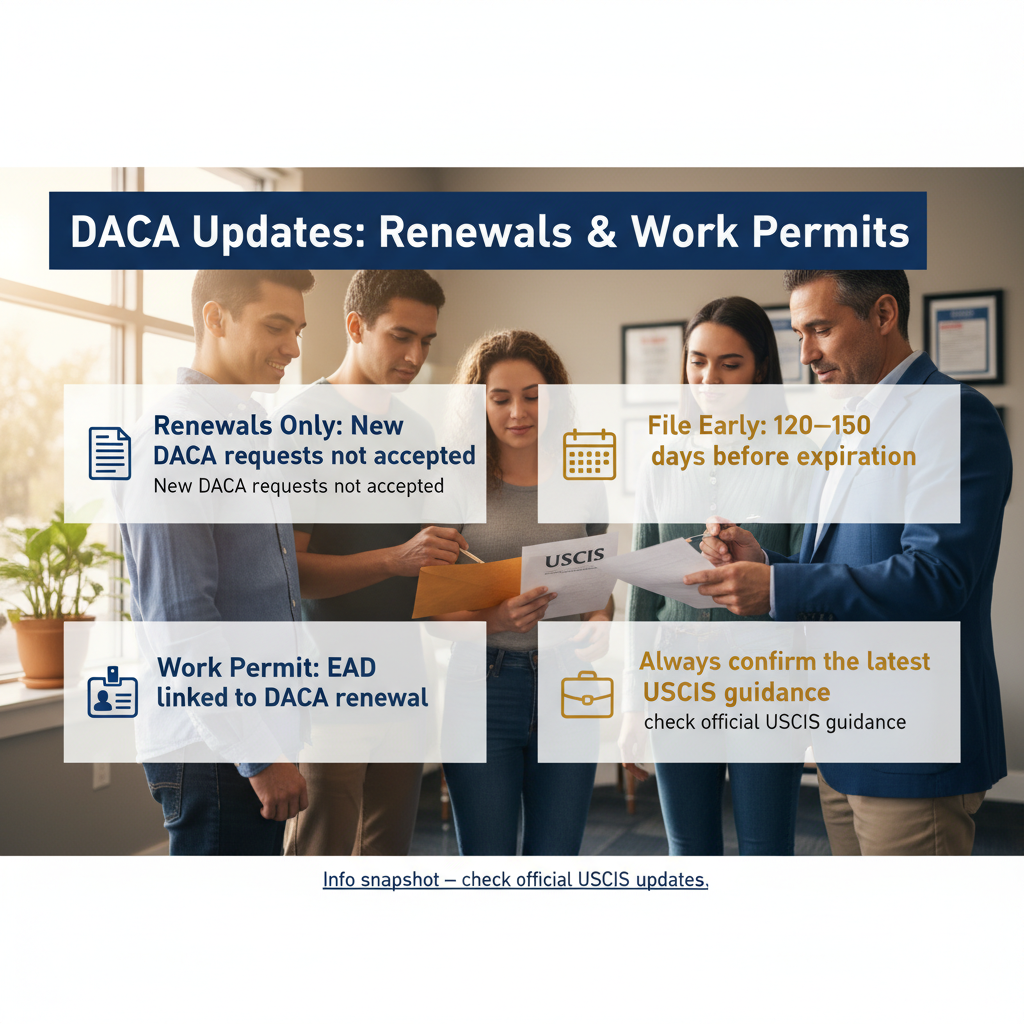
This article is based on recent coverage and public-facing updates related to Deferred Action for Childhood Arrivals (DACA), including USCIS policy reminders and renewal guidance. See: DACA Program Updates and Renewal Information (USCIS).
Reminder: USCIS updates can change quickly. Always confirm details directly through the USCIS official website and consult a qualified immigration attorney for case-specific advice.
Need Help? Our Orlando immigration team is ready to assist. Call +1 786-791-3106 for a free consultation, or message us online. Se Habla Español.
What This News Means for Immigrants in Orlando and Across Florida
Why this news is showing up now
DACA remains one of the most closely watched U.S. immigration programs because it affects hundreds of thousands of people—many of whom live, work, study, and raise families in Florida. DACA has also been the subject of ongoing federal litigation for years, which creates periodic waves of “breaking news” that can feel confusing or alarming.
Here’s the practical reality as of today (2026-02-08): USCIS continues to accept and process DACA renewal requests for people who have previously been granted DACA. However, due to court orders and policy constraints, USCIS’s ability to grant new/initial DACA requests has been limited for some time. That distinction—renewals vs. initial requests—is at the heart of most DACA headlines.
Important: Even when the news cycle is loud, the most time-sensitive issue for most DACA recipients is simple: renew on time so you can reduce the risk of an expired Employment Authorization Document (EAD) and the cascading problems that can follow (job loss, driver’s license issues, gaps in lawful presence protections, and more).
How it can affect Florida residents
Florida DACA recipients often face added urgency because employment, licensing, and transportation are essential across the state—especially for those commuting along the I-4 corridor (Orlando, Kissimmee, Sanford, Lakeland, Tampa). If your work permit expires, you may face:
- Employment interruptions (HR re-verification, unpaid leave, termination risk)
- Driver’s license and ID complications depending on your local DMV documentation requirements
- Higher vulnerability to enforcement if you have police contact or other legal issues
- Financial stress from lost wages and re-filing costs
If your case is in Orlando, it may involve mail filings processed through USCIS lockbox facilities and then routed to service centers; and some related matters (like biometrics) may occur locally. The Orlando USCIS Field Office typically handles in-person appointments for certain case types, while DACA renewals are generally processed through USCIS service centers. Still, Central Florida residents should plan for logistics like biometrics notices, address updates, and mail reliability.
What DACA Program Updates and Renewal Information Is (and Why It Matters)
A plain-English definition
DACA (Deferred Action for Childhood Arrivals) is a form of prosecutorial discretion that can:
- Defer (pause) removal/deportation for a limited period, and
- Allow eligible recipients to apply for a work permit (EAD).
DACA is not lawful permanent residence, does not provide a direct path to citizenship, and does not automatically “fix” immigration status. It is best understood as a temporary protection and work authorization benefit that must be renewed—typically in two-year increments—if you remain eligible.
Key terms you need to know
- DACA renewal: A request by an existing DACA recipient to extend deferred action and employment authorization.
- Deferred action: A discretionary decision not to pursue removal for a period of time.
- EAD / work permit: The Employment Authorization Document, typically requested with Form I-765.
- Biometrics: Fingerprints/photo/signature appointment used for identity and background checks.
- Notice of Action: USCIS receipt and decision notices (often I-797 series).
- Continuous residence and physical presence: Key eligibility concepts that can be affected by travel and certain criminal issues.
- Advance Parole: Limited travel authorization in some humanitarian/education/employment contexts (availability and rules can change; consult counsel before travel).
- Removal proceedings: Immigration court process overseen by Executive Office for Immigration Review.
Warning: Many people confuse DACA with family-based green cards (like Form I-130 and Form I-485) or with concepts like Adjustment of Status and Priority Date. Those may be relevant to a long-term strategy, but they are separate from DACA renewal itself.
Need Help? Our Orlando immigration team is ready to assist. Call +1 786-791-3106 for a free consultation, or message us online. Se Habla Español.
Current Immigration Law: The Foundation
DACA exists through executive branch policy and DHS/USCIS regulations and guidance, shaped heavily by federal court decisions. While DACA itself is not a statute passed by Congress, DACA-related benefits interact with the Immigration and Nationality Act (INA) and federal regulations.
Key legal and regulatory foundations commonly implicated in DACA renewals and work authorization include:
- Immigration and Nationality Act (INA) provisions governing admissibility, removability, and enforcement discretion.
- Federal regulations for employment authorization documents (EADs), generally under 8 C.F.R. parts governing DHS/USCIS processes.
- USCIS form instructions and policy guidance, which USCIS treats as controlling for filing requirements.
Federal requirements
For DACA renewals, USCIS typically requires:
- Form I-821D (Consideration of Deferred Action for Childhood Arrivals)
- Form I-765 (Application for Employment Authorization)
- Form I-765WS (Worksheet demonstrating economic need)
- Filing fees (unless a narrow fee exemption applies)
- Evidence supporting identity and continued eligibility (varies by case)
USCIS filing rules, addresses, and edition dates can change. Always verify on: USCIS Forms and the USCIS official website.
Processing timelines vary. Monitor: USCIS Processing Times.
Florida-specific considerations
Florida does not control DACA approvals (that’s federal), but Florida residents may experience state-level impacts tied to:
- Driver’s license/ID documentation and renewal timing
- Employment verification and HR compliance practices
- Local law enforcement contact and how quickly a legal issue can escalate into immigration risk
For Central Florida residents, mail reliability and address stability can be real issues—especially if you move apartments along the I-4 corridor. USCIS notices are time-sensitive. If you move, update your address promptly (and keep proof).
Reminder: If you have any arrest, charge, or conviction—anywhere in Florida or another state—talk with an immigration attorney before filing. Even some sealed/withheld adjudication outcomes can still matter in immigration.
Also note: while DACA is separate from family-based immigration, many DACA recipients eventually explore family petitions and green card options. These commonly involve Form I-130, Form I-485, Adjustment of Status, and a Priority Date (especially in preference categories). Those topics are not “part of DACA,” but they can be part of a broader plan.
How to Renew DACA: A Complete Step-by-Step Guide
Below is a practical roadmap for DACA renewals based on USCIS instructions and best practices we use in real cases at Imigrar. Your exact document needs may differ.
Important: USCIS often recommends filing DACA renewals well before expiration. Many applicants aim for roughly 180 days before their current DACA/EAD expires to reduce the risk of gaps. Some people refer to a 90-day window for certain benefits in other contexts—do not rely on a “90-day rule” as a safe DACA strategy. Earlier planning is typically safer.
1) Confirm your expiration date and build a filing calendar
Start by locating your current EAD card and approval notices. Your renewal strategy should be driven by your expiration date and current USCIS processing patterns.
- Find the “Card Expires” date on your EAD.
- Set calendar reminders at 210 days, 180 days, 150 days, 120 days, 90 days, and 60 days before expiration.
- Check current estimates on USCIS Processing Times.
Documents to gather for this step:
- Copy (front/back) of current EAD
- Prior DACA approval notices (I-797)
- Any USCIS receipt numbers from your last renewal
- Current passport (if you have one) or government-issued ID
If your case is in Orlando and you’ve moved recently (e.g., between Orange County neighborhoods), confirm USCIS has your correct address so your receipt and biometrics notices don’t get lost.
2) Screen for eligibility issues before you file
Most renewal denials and delays come from issues that could have been spotted early: arrests/charges, travel, fraud concerns, or missing information. A pre-filing screening can prevent costly mistakes.
Documents to gather for this step:
- Certified court dispositions for any arrest/charge (even if dismissed)
- Proof of any travel (tickets, I-94 history if applicable, passport stamps)
- Prior immigration documents (NTA, immigration court papers, prior applications)
- School records or employment records if there are questions about presence
Warning: Do not assume that “it was expunged” or “adjudication was withheld” means it doesn’t matter. Immigration law has its own definitions. If you have any criminal history, consult counsel before filing.
3) Prepare the USCIS forms correctly (I-821D, I-765, I-765WS)
A clean, consistent packet reduces the risk of Requests for Evidence (RFEs) and rejections. The core renewal package typically includes:
- Form I-821D
- Form I-765
- Form I-765WS
Use the latest form editions and instructions from USCIS Forms.
Documents to gather for this step:
- Two passport-style photos (if required by the filing method/instructions)
- Copy of EAD (front/back)
- Government-issued photo ID (passport, state ID, etc.)
- Any name change documents (marriage certificate, court order) if applicable
- Evidence supporting any updates since last filing (if needed)
Reminder: Consistency matters. Your name, address history, and A-number should match prior filings unless there’s a documented change.
4) Pay the correct fees (or evaluate fee exemption carefully)
USCIS fees can change, and the acceptable payment method depends on how you file (online vs. paper) and where you file. Always confirm current fees and payment instructions directly with USCIS.
Documents to gather for this step:
- Payment method documentation (card info for online filing, or money order/cashier’s check if filing by mail—per USCIS instructions)
- If seeking a fee exemption (rare): evidence supporting exemption criteria (financial hardship documentation, benefits letters, etc.)
Warning: Incorrect fees or payment format can cause a rejection, which can be disastrous if you are close to expiration.
5) File your renewal and track receipts immediately
After filing, you should receive receipt notices. Save them, scan them, and share them with your employer if needed (for internal HR tracking). While a receipt does not automatically extend work authorization for DACA in the way some categories receive automatic extensions, it is still vital proof that you filed.
Documents to gather for this step:
- Complete copy of your entire filing packet (PDF + paper copy)
- Delivery confirmation (if filing by mail)
- USCIS receipt notices (once received)
If your case is in Orlando and you rely on USPS mail delivery at an apartment complex, consider using a stable mailing address where you reliably receive mail (and is permitted under USCIS rules), and keep documentation of any address changes.
6) Attend biometrics (if scheduled) and respond to any USCIS notice fast
USCIS may reuse biometrics in some cases, but many applicants still receive an appointment notice. Missing biometrics can lead to denial.
Documents to gather for this step:
- Biometrics appointment notice
- Government-issued photo ID
- Any rescheduling request documentation (only if truly necessary)
Important: If you receive a Request for Evidence (RFE) or Notice of Intent to Deny (NOID), treat it like a deadline emergency. Gather what USCIS asks for, organize it clearly, and respond by the due date.
7) Receive your decision and plan your next renewal early
If approved, you will receive a new approval notice and a new EAD card. Check the dates and your personal information immediately. If anything is incorrect, address it quickly.
Documents to gather for this step:
- New EAD (front/back copy)
- Approval notice
- Updated I-9 documentation for your employer (as applicable)
- Updated DMV documentation for Florida driver’s license renewal (as applicable)
Then, set your next calendar reminders right away. DACA is cyclical—staying ahead of deadlines is the best way to protect your job and stability.
Need Help? Our Orlando immigration team is ready to assist. Call +1 786-791-3106 for a free consultation, or message us online. Se Habla Español.
Practical Steps You Can Take Today
Whether your DACA expires in 30 days or 10 months, you can take concrete actions today to reduce risk and avoid last-minute surprises.
Actionable DACA renewal checklist
- 1) Check your expiration date on your EAD and set reminders at 180 days and earlier milestones.
- 2) Download the newest forms and instructions from USCIS Forms.
- 3) Order certified court records now if you have any arrest/charge history (this can take weeks in some counties).
- 4) Create a “USCIS folder” with: EAD copies, all I-797 notices, prior filings, IDs, and proof of address.
- 5) Confirm your mailing address is stable. If you move along the I-4 corridor (e.g., between Orange County and Polk County), plan for mail continuity.
- 6) Build a budget for filing fees and potential attorney support—especially if your case has complications.
- 7) Check processing times monthly on USCIS Processing Times.
Document preparation guidance
- Scan everything into a single PDF, clearly labeled (e.g., “DACA Renewal 2026 - Full Packet”).
- Use consistent name formatting across documents.
- Keep a change log of addresses and jobs (useful if questions arise).
- If you have any immigration court history, gather all EOIR paperwork and consult EOIR resources for general information (and an attorney for advice).
Timeline expectations
DACA renewal timelines vary by USCIS workload and individual case factors. Generally, you should:
- Aim to file around 180 days before expiration when possible.
- Expect possible biometrics scheduling (or biometrics reuse).
- Plan for several weeks to several months for adjudication depending on current processing patterns.
Reminder: Do not make travel plans based on assumptions. If you are considering any travel, consult an attorney first and review official guidance, including the U.S. Department of State for passport/visa-related context (even though DACA is not a visa).
How Imigrar Helps Immigrants in Orlando
At Imigrar, our mission is to Keep Families Together. We help DACA recipients and their families in Orlando and nationwide with clear, organized, deadline-driven support.
Our team can help you:
- Review eligibility and spot red flags before filing (arrests, travel, prior immigration issues)
- Prepare and file DACA renewal packets accurately and consistently
- Respond to RFEs/NOIDs with strong documentation and legal framing
- Explore longer-term options beyond DACA (family petitions like Form I-130, green card filings like Form I-485, and Adjustment of Status strategies when available)
If your case is in Orlando, we understand the practical realities Central Florida residents face—commuting on the I-4 corridor, fast-moving job changes, and the need to keep documents ready for HR and DMV.
Call us for a free consultation at +1 786-791-3106. Se Habla Español.
Need Help? Our Orlando immigration team is ready to assist. Call +1 786-791-3106 for a free consultation, or message us online. Se Habla Español.
Frequently Asked Questions
Q: Am I still eligible to renew DACA if I had a minor traffic case in Florida?
A: It depends on the exact charge and outcome. Many traffic matters are not disqualifying, but some can be (especially if they involve DUI, drugs, or more serious conduct). Get the certified disposition from the court and speak with an attorney before filing. Warning: Never guess about criminal history in immigration—USCIS background checks will surface records.
Q: Does renewing DACA give me lawful status or a green card?
A: No. DACA is deferred action and does not create lawful permanent resident status. Some DACA recipients may qualify for a green card through other routes (for example, family-based cases involving Form I-130 and possibly Form I-485 through Adjustment of Status), but that is a separate legal process and may involve a Priority Date depending on the category.
Q: How long does a DACA renewal take right now?
A: Timelines vary. Some cases move quickly; others take months due to USCIS workload, biometrics scheduling, or case-specific issues. Check the most current estimates at USCIS Processing Times, and plan to file around 180 days before expiration when possible to reduce the risk of a gap.
Q: What documents do I need for a DACA renewal?
A: Most renewals include Form I-821D, Form I-765, and Form I-765WS, plus copies of your current EAD and prior approval notices. If you have any arrests/charges, you should include certified dispositions and consult counsel. Always follow the latest USCIS instructions on the USCIS Forms page.
Q: How much does it cost to renew DACA?
A: The total cost depends on USCIS fee rules in effect at the time you file and whether a narrow fee exemption applies. Because fees and payment methods can change, confirm the current amount and instructions directly on the USCIS official website. If you are budgeting, also consider costs for passport photos, copying, certified court records, and attorney fees (if you choose representation).
Q: What happens if my DACA renewal is denied?
A: A denial can have serious consequences, including loss of work authorization and increased risk of enforcement depending on your circumstances. If denied, you should immediately consult an attorney to review the denial reason, evaluate whether a motion or re-filing is appropriate, and assess any immigration court risk (see general information at EOIR). Important: Do not ignore denial notices—deadlines may apply.
Q: If my work permit expires while my renewal is pending, can I keep working?
A: In general, once your DACA-based EAD expires, your authorization to work ends unless you have another valid basis for work authorization. Some immigration categories have automatic EAD extensions, but DACA renewals typically require the new EAD to continue work authorization. Talk to your employer’s HR department and consult an attorney about your specific situation before your expiration date.
Q: I live in Orange County—does filing from Orlando change anything?
A: The legal standards are the same nationwide, but local logistics matter. For Central Florida residents, the biggest issues are reliable mail delivery, timely biometrics attendance, and keeping your address updated. The Orlando USCIS Field Office may be relevant for certain appointments, but DACA renewals are generally adjudicated through USCIS service centers after lockbox intake.
Common Mistakes (and How to Avoid Them)
Mistake #1: Filing too late and risking a work authorization gap
Many people wait until the last minute, assuming USCIS will process quickly. That can backfire. Avoid this by building a calendar and aiming to file around 180 days before expiration when possible. If you are already inside 60–90 days, consult an attorney immediately about risk management.
Mistake #2: Not disclosing arrests/charges or misunderstanding “dismissed” cases
USCIS runs background checks. Omitting something can lead to denial and credibility issues. Get certified dispositions and have an attorney evaluate immigration consequences—especially for any DUI, domestic issues, drugs, or theft-related allegations.
Mistake #3: Using outdated forms, wrong fees, or incorrect signatures
Technical errors can cause rejections. Always download current editions from USCIS Forms, verify the fee on the USCIS official website, and double-check signatures and dates.
Reminder: If you are also exploring a family-based path, do not confuse DACA renewal steps with green card steps like Form I-130, Form I-485, Adjustment of Status, or tracking a Priority Date. Those are separate processes with different eligibility rules and risks.

Closing: Protect Your DACA and Your Family’s Stability
DACA news can feel unsettling, but the most effective move for most recipients is practical: renew early, document everything, and get legal guidance if anything in your history has changed (arrests, travel, prior immigration contact, or address instability).
For Central Florida residents—especially those in Orlando and Orange County—planning ahead can prevent work interruptions and reduce stress for you and your family.
Need Help? Our Orlando immigration team is ready to assist. Call +1 786-791-3106 for a free consultation, or message us online. Se Habla Español.
Need help now? Contact Imigrar in Orlando, Florida. Call +1 786-791-3106 for a free consultation or message us online at https://www.imigrar.com/contact. Se Habla Español.
Official resources: USCIS official website | USCIS Forms | USCIS Processing Times | U.S. Department of State | Executive Office for Immigration Review


