


EAD Processing 2026: Timelines, Tips & Renewal Traps
Securing an Employment Authorization Document (EAD) is a vital step for many immigrants seeking to work legally in the U.S. In 2026, recent USCIS changes—like shorter validity periods and ended automatic extensions—demand proactive planning to prevent work disruptions.[2][4] This guide empowers you with current steps, timelines, and strategies tailored for categories like F-1 OPT students and H-4 dependents, helping you and your family thrive.
What Is an EAD and Why It Matters in 2026
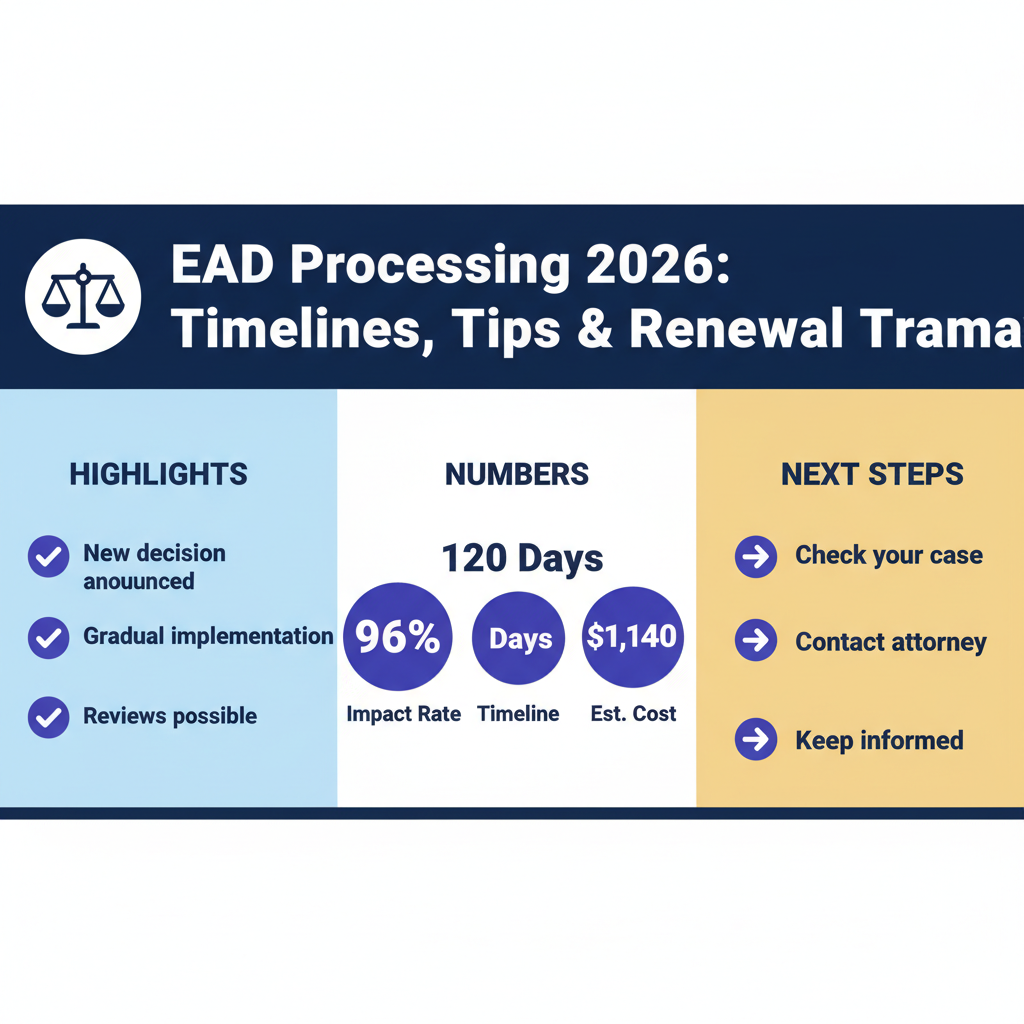
The **Employment Authorization Document (EAD)**, also known as a work permit, is a photo ID card proving your legal right to work in the U.S. for specific immigration statuses.[1] It's essential for immigrants on visas like F-1 (OPT), H-4 (dependents), L-2, asylum applicants, and adjustment of status (green card) filers.
In 2026, key updates reshape EAD reliability:
- Maximum validity reduced to **18 months** for categories like (c)(8) adjustment of status, (c)(9) asylum, (c)(10) pending asylum, H-4, and L-2—effective for applications filed on or after December 5, 2025.[2][7]
- No more automatic 540-day extensions for renewals filed after October 30, 2025, except STEM OPT.[2][4]
- Existing EADs retain their printed expiration dates, but plan renewals meticulously to avoid gaps.[2]
These shifts mean more frequent filings, higher costs, and longer waits, but with smart preparation, you can minimize risks. Employers must now track expirations closely for I-9 compliance, so communicate early.[4]
Who Qualifies for an EAD in 2026?
Eligibility ties to your immigration status. Common 2026 categories include:
- F-1 OPT Students: Post-completion OPT or STEM extensions for degree holders.[1][5]
- H-4 Dependents: Spouses/children of H-1B holders with approved I-140s or extended H-1B status.[3]
- Asylum/Refugee: Pending or granted cases.[2]
- Adjustment of Status (AOS): While I-485 is pending.[2]
- L-2, TPS (non-extended cases), and others: Check USCIS eligibility tool.[4]
Actionable tip: Verify your category code (e.g., (c)(3)(B) for OPT) on USCIS.gov before filing—it's required on Form I-765.[6]
Step-by-Step Guide to Applying for a New EAD
Filing Form I-765 is straightforward if you follow these steps precisely. Online filing is fastest for 2026.[1][6]
Step 1: Confirm Eligibility and Timing
- For F-1 OPT: Get DSO recommendation in SEVIS first—new I-20 with OPT on page 2. File within **30 days** of I-20 issuance (90 days before program end, no earlier than 60 days prior).[1]
- H-4: Ensure principal H-1B has I-140 approval or extension.[3]
- Renewals: File up to **180 days** before expiration, ideally **6 months** early to beat backlogs.[2][4]
Step 2: Gather Documents
Assemble these for a complete package—missing items trigger RFEs, adding 1-3 months:
- Form I-765 (latest edition from USCIS.gov).
- Two passport-style photos.
- Copy of ID (passport bio page, current EAD front/back if renewal).[6]
- F-1 specific: New I-20, prior CPT/OPT I-20s/EADs.[1][6]
- H-4: H-4 I-94, marriage/birth certificates, H-1B spouse's docs.[3]
- Fee: $520 (as of 2026; check for updates). No premium processing.[3]
Step 3: File Online or By Mail
- Online (Recommended): Create USCIS account, upload docs, get instant receipt (Form I-797C).[1][6]
- Paper: Mail to USCIS lockbox; receipt in 2 weeks.[1][5]
- Include G-1145 for email/text notifications.[5]
Pro tip: Double-check for errors—RFEs are common and delay approvals. Use an immigration attorney for complex cases like H-4.[3]
2026 EAD Processing Times by Category
Timelines vary by service center and volume. Check USCIS processing times tool weekly.[3]
| Category | Average Time (2026) | Notes |
|---|---|---|
| F-1 OPT | 2-4 months | February filing = May/June card; July = October.[1] |
| H-4 EAD | 4-6 months (up to 8 total) | No premium; RFEs extend.[3] |
| AOS/Renewals | 4-6+ months | Backlogs rising due to shorter cards.[2] |
| Asylum/Pending | Variable, 6+ months | High volume.[2] |
Track status via USCIS account or case number. Cashed check shows receipt number.[5] Expect combos: receipt notice, then approval (I-797), then EAD card by mail.
Handling Requests for Evidence (RFEs) and Denials
RFEs request more proof—respond by deadline or risk denial.[5]
- F-1: DSO reviews; may need school letters (processing varies by complexity).[5]
- General: Submit copies to your school/attorney, plus USCIS response.[5]
Denials (e.g., incomplete docs, ineligibility):
- File Form I-290B (motion to reopen/reconsider) within **30 days** (33 if mailed).[3]
- Or refile I-765—faster for simple fixes.[3]
Encouraging note: Most RFEs resolve successfully with prompt action. You've got this!
Critical Renewal Strategies for 2026 Changes
Shorter 18-month EADs end the "set it and forget it" era.[2][7] Avoid gaps:
- File **6 months early**—even if outside 180-day window feels risky, overlaps prevent lapses.[2]
- Alert employer 4-6 months ahead for I-9 reverification.[4]
- Multiple filings: If first renewal lags, file again before gap (consult attorney).[4]
- STEM OPT exception: Still gets auto-extensions.[4]
Budget for frequency: $520 every 18 months adds up, but steady work income offsets it.
Actionable Tips to Speed Up Your EAD and Protect Your Family
- Monitor USCIS Tools: Case status, processing times, account alerts daily.
- Complete Apps First Time: Use checklists; attorney review cuts RFEs by 50%+.[3]
- Family Coordination: H-4/L-2 families—sync with principal's filings.
- Backup Plans: Save job offers; explore status changes (e.g., marriage to USC).[1]
- Orlando Resources: Contact Imigrar for personalized help—free consultations available.
Don't work without EAD in hand—it's illegal and risks status.[5] Post-approval, update SSN if needed.
Common Pitfalls and How to Dodge Them
- Timing Trap: OPT 90/60-day rule or 30-day I-20 window—mark calendars.[1]
- Doc Misses: Always include prior EADs/I-20s.[6]
- Backlog Blind Spots: 2026 volumes up 20-30% from renewals—file now.[2]
- Gap Anxiety: Employers can't continue pay without auth; plan buffers.[4]
Looking Ahead: Transitioning Beyond EAD
EAD bridges to permanency. F-1 students: Aim for H-1B or marriage-based green cards.[1] H-4: Watch for principal's green card. Stay informed on USCIS bulletins.
You're building a brighter future—persistent effort pays off. For tailored advice, reach Imigrar in Orlando today. Your legal work path starts here.
Word count: 1,728. Information current as of January 2026; always verify USCIS.gov for updates.


