

At Imigrar, our mission is to Keep Families Together by providing expert legal guidance through the complexities of U.S. immigration law. Today, we're diving deep into a topic that affects hundreds of thousands of immigrants nationwide, including many right here in Central Florida: the Employment Authorization Document (EAD), often known as a work permit. Recent updates from USCIS regarding EAD application and renewal processing are crucial for anyone seeking to work legally in the United States.
Need Help? Our Orlando immigration team is ready to assist. Navigating EAD applications can be challenging, but you don't have to do it alone. Call +1 786-791-3106 for a free consultation, or message us online. Se Habla Español.
NEWS SOURCE REFERENCE SECTION
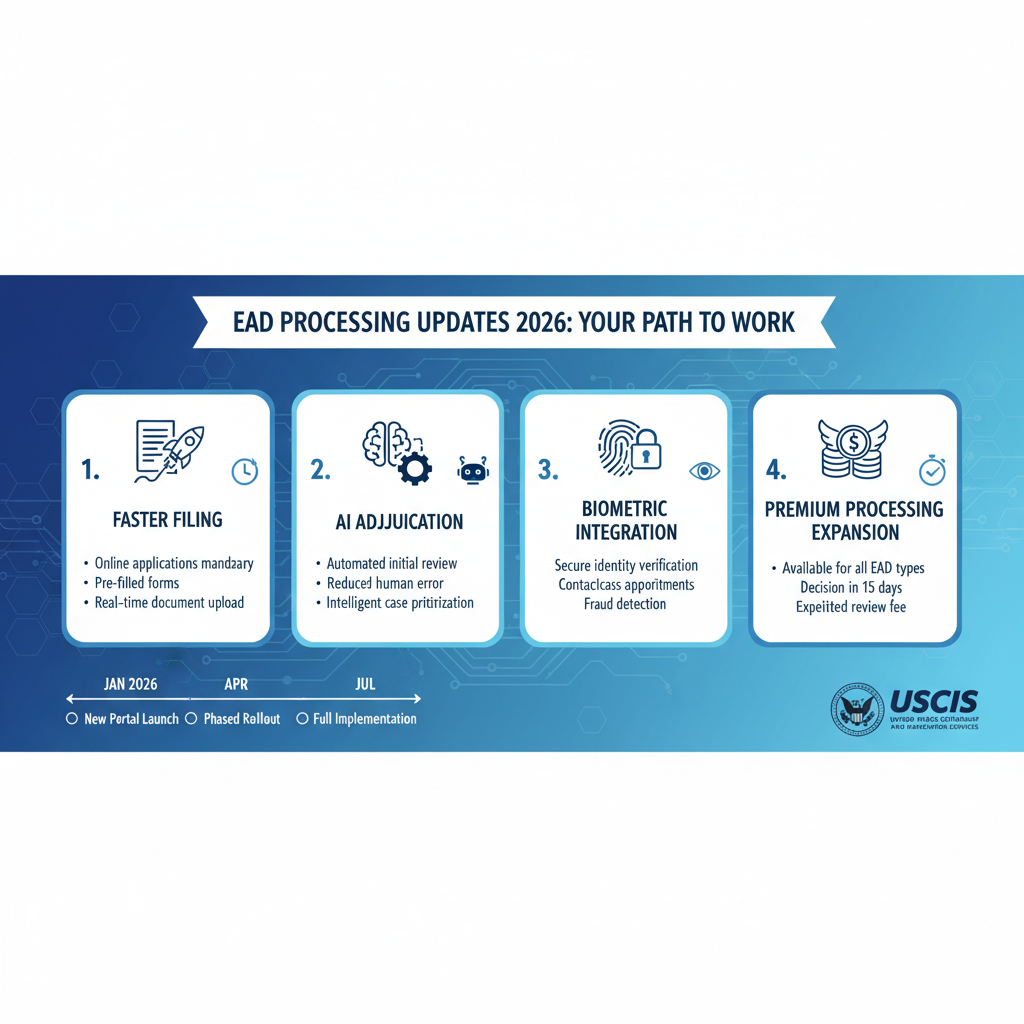
The reporting that sparked this guide: Employment Authorization Document Processing (USCIS)
What This News Means for Immigrants in Orlando and Across Florida
The ability to work legally in the United States is fundamental for self-sufficiency, financial stability, and integration into American society. For many immigrants, the Employment Authorization Document (EAD) is the key to unlocking this opportunity. Recent updates from U.S. Citizenship and Immigration Services (USCIS) regarding EAD processing are not just bureaucratic adjustments; they have real-world implications for individuals and families striving to build a new life.
Why this news is showing up now
The challenges surrounding EAD processing are not new, but they have evolved significantly over the past few years. Following the unprecedented backlogs exacerbated by the COVID-19 pandemic and subsequent operational changes, USCIS has been under immense pressure to improve processing efficiency. By March 2026, we’ve seen a series of initiatives and temporary measures implemented to address these issues. These include:
- Increased EAD Validity Periods: For certain categories, USCIS extended the validity period for initial and renewal EADs, often to up to five years, to reduce the frequency of renewals and administrative burden. This was a direct response to the long processing times that left many individuals without authorization to work.
- Automatic Extension Rules: Enhancements and clarifications to the automatic extension period for EAD renewals for specific categories, often extending it to 540 days from the date of the EAD’s expiration, provided the renewal application was timely filed. This measure aims to prevent gaps in employment authorization.
- Internal Processing Improvements: USCIS has been investing in technology, increasing staffing, and streamlining internal workflows to tackle the backlog. This includes digitizing more processes and optimizing adjudication procedures for Form I-765, Application for Employment Authorization.
- Premium Processing Expansion: While not applicable to all EAD categories, there has been a gradual expansion of premium processing options for certain employment-based EADs, allowing applicants to pay an additional fee for expedited processing.
The news you're seeing now reflects USCIS's ongoing commitment and struggle to meet service delivery goals while managing a complex and ever-changing caseload. These updates are a blend of successes, continued challenges, and adaptive strategies designed to keep the immigration system functioning, albeit imperfectly.
How it can affect Florida residents
Florida, with its vibrant and diverse immigrant population, is particularly sensitive to changes in EAD processing. For Central Florida residents, especially those in Orlando, Kissimmee, and along the I-4 corridor, these updates have direct consequences:
- Employment Security: Shorter processing times or more generous automatic extensions mean less anxiety about job loss due to an expired work permit. Conversely, continued delays can lead to loss of income, professional setbacks, and significant stress for families.
- Economic Impact: A steady flow of EADs allows immigrants to contribute to Florida's economy, filling crucial labor gaps in sectors like hospitality, agriculture, healthcare, and construction. Delays can stifle this economic contribution.
- Planning and Stability: Knowing the current processing landscape helps individuals and families plan their lives, make financial decisions, and pursue educational or professional development opportunities without the constant threat of losing their work authorization.
- Orlando USCIS Field Office: While EADs are processed at USCIS service centers, local field offices like the one in Orlando may be involved in related processes, such as adjustment of status interviews, which often require a valid EAD for interim work authorization. The overall efficiency of the system impacts local immigrants directly.
- Legal Guidance: The frequent changes and nuances in EAD policy underscore the importance of accurate legal advice. For Orlando immigrants, understanding which category they fall under and how recent updates apply to their specific situation is paramount.
Staying informed and proactive is key. Imigrar is dedicated to monitoring these developments closely to provide the most current and effective advice to our clients in Orlando and throughout Florida.
Confused by EAD updates? Our Imigrar legal team in Orlando specializes in employment authorization and can clarify how these changes impact your case. Call us today for a free consultation at +1 786-791-3106. Se Habla Español.
What Employment Authorization Document (EAD) Is (and Why It Matters)
At its core, an Employment Authorization Document (EAD) is a permit issued by USCIS that grants foreign nationals legal permission to work in the United States. It's often referred to as a "work permit" and is a critical document for many immigrants who are not U.S. citizens or lawful permanent residents (green card holders) but are authorized to be in the U.S. and work here.
A plain-English definition
Imagine you're in the U.S. on a temporary visa, or you've applied for a green card, or you're seeking asylum. You want to work to support yourself and your family, but you can't just take any job without proper authorization. That's where the EAD comes in. It's a physical card, similar to a driver's license, that proves you have the legal right to accept employment in the U.S. for a specific period. It allows you to get a Social Security number, apply for jobs, and earn a living legally.
Important: An EAD is not a visa, nor does it grant you permanent immigration status. It is simply permission to work while you maintain a specific immigration status or while your application for a more permanent status is pending.
Key terms you need to know
Navigating the world of EADs requires understanding a few key terms:
- USCIS (U.S. Citizenship and Immigration Services): The government agency responsible for processing immigration benefits, including EAD applications. You'll interact with them for your Form I-765.
- Form I-765, Application for Employment Authorization: This is the primary form you must file with USCIS to request an EAD.
- Eligibility Category: Not everyone can apply for an EAD. You must fit into one of many specific categories defined by immigration law. Examples include asylum seekers, applicants for Adjustment of Status (green card applicants), certain nonimmigrant visa holders (like F-1 students with OPT, J-2 dependents), and Temporary Protected Status (TPS) beneficiaries.
- Adjustment of Status (AOS): The process of applying for lawful permanent resident status (a green card) from within the United States. Many individuals applying for AOS are eligible for an EAD while their green card application (Form I-485) is pending.
- Asylum Seeker/Asylee: Individuals who have applied for asylum or have been granted asylum in the U.S. are typically eligible for an EAD.
- Temporary Protected Status (TPS): A temporary immigration status granted to eligible nationals of certain countries designated by the Department of Homeland Security due to conditions in those countries that temporarily prevent their safe return. TPS beneficiaries are eligible for EADs.
- Automatic Extension: For certain EAD renewal applicants who file Form I-765 on time, their existing EAD may automatically extend beyond its expiration date for a specific period (currently up to 540 days for many categories), provided their eligibility category remains the same. This is crucial to prevent gaps in employment.
- Biometrics Appointment: A scheduled appointment at a USCIS Application Support Center (ASC) where fingerprints, photographs, and signatures are collected for background checks. This is often a step in the EAD application process.
- Request for Evidence (RFE): A letter from USCIS asking for additional information or documents to support your application. Responding promptly and accurately is vital.
Understanding these terms will empower you to better understand the EAD process and your place within it. The EAD is a gateway to financial independence and stability for many immigrants, making its proper application and timely renewal incredibly important.
Current Immigration Law: The Foundation for EADs
The authority for USCIS to grant employment authorization stems from the Immigration and Nationality Act (INA) and its implementing regulations, primarily found in 8 Code of Federal Regulations (CFR) §274a.12. This section of the law precisely defines who is eligible for an EAD and under what conditions.
Federal requirements
The INA and 8 CFR §274a.12 establish numerous eligibility categories for an EAD. It's not a blanket authorization; rather, you must fit into one of these specific classifications. Some of the most common federal requirements and eligibility categories include:
- Applicants for Adjustment of Status (AOS): Individuals who have filed Form I-485, Application to Register Permanent Residence or Adjust Status, are generally eligible for an EAD while their application is pending. This is often filed concurrently with Form I-130 (Petition for Alien Relative) or Form I-140 (Immigrant Petition for Alien Worker).
- Asylum Applicants and Asylees: Individuals who have filed Form I-589, Application for Asylum and for Withholding of Removal, and their application has been pending for at least 180 days (without delay caused by the applicant), or those who have been granted asylum.
- Refugees: Individuals granted refugee status.
- Temporary Protected Status (TPS) Beneficiaries: Nationals of countries designated for TPS.
- Certain Nonimmigrant Visa Holders: This includes specific categories like J-2 spouses and minor children of J-1 exchange visitors, K-1 fiancés/fiancées and their K-2 dependents, K-3/K-4 nonimmigrants, and F-1 students seeking Optional Practical Training (OPT) or STEM OPT extensions.
- DACA (Deferred Action for Childhood Arrivals) Recipients: Individuals granted deferred action under DACA are eligible for EADs.
- Individuals with Withholding of Removal: Those granted withholding of removal under the INA or the Convention Against Torture.
- U-Visa and T-Visa Applicants: Victims of certain crimes (U nonimmigrants) and victims of severe forms of human trafficking (T nonimmigrants) may be eligible for EADs.
Each category has specific documentary requirements and conditions that must be met. For instance, an F-1 student applying for OPT will have different requirements than an individual applying for an EAD based on a pending Form I-485.
Reminder: The specific category code you list on Form I-765 is critical and must accurately reflect your eligibility. Incorrect classification can lead to delays or denial.
You can find detailed information on all eligibility categories and the latest updates directly on the USCIS official website.
Florida-specific considerations
While immigration law is federal, certain state-level considerations can impact EAD holders in Florida:
- Driver's Licenses and State IDs: A valid EAD is generally accepted as proof of lawful presence when applying for a Florida driver's license or state identification card. However, the Department of Highway Safety and Motor Vehicles (FLHSMV) will verify your immigration status with USCIS, and the validity period of your license will typically match your EAD's expiration date.
- Professional Licensing: For certain professions requiring state licensure (e.g., healthcare, teaching), an EAD proves your authorization to work, but you must also meet all other state-specific educational and experience requirements.
- Employer Verification (Form I-9): All employers in Florida, like those nationwide, are legally required to verify the employment eligibility of their employees using Form I-9, Employment Eligibility Verification. An EAD is a List A document, meaning it establishes both identity and employment authorization.
- Local Job Market: Having a valid EAD opens doors to the robust job market in Orlando and across Florida, from tourism and hospitality to tech and healthcare. Access to this legal work authorization is vital for individuals to secure employment and thrive in the state.
It's important to remember that state laws cannot override federal immigration regulations. Your eligibility for an EAD and the conditions of your employment authorization are determined solely by federal law.
How to Apply for or Renew Your EAD: A Complete Step-by-Step Guide
Applying for an initial EAD or renewing an existing one requires careful attention to detail. This step-by-step guide will walk you through the process, helping you avoid common pitfalls.
1) Determine Your Eligibility Category
Before you even touch Form I-765, you must accurately identify your specific eligibility category. This is arguably the most critical step, as all subsequent documentation and USCIS's adjudication depend on it. Review USCIS EAD eligibility categories carefully. Are you applying based on a pending Form I-485 (category (c)(9))? Are you an asylum applicant (category (c)(8))? A J-2 spouse (category (c)(5))? Your category dictates which evidence you must provide.
- Action: Consult the USCIS website or an immigration attorney to confirm your correct eligibility category code.
2) Gather Required Documents
Once your category is clear, compile all necessary supporting documents. This list can vary significantly, but generally includes:
- Two passport-style photos: Taken within 30 days of filing, color, white background, unretouched, 2x2 inches.
- Copy of your last EAD (if renewing): Front and back.
- Copy of your government-issued identification: Such as a passport, birth certificate with photo ID, or national identity document.
- Copy of your Form I-94, Arrival/Departure Record: Proving your lawful admission to the U.S.
- Evidence of your eligibility category: This is where the specific category matters most.
- For Adjustment of Status (c)(9): Copy of your Form I-485 receipt notice or a copy of the filing itself.
- For Asylum Applicants (c)(8): Copy of your Form I-589 receipt notice.
- For J-2 Dependents (c)(5): Copy of your spouse’s/parent’s J-1 visa, Form DS-2019, and your marriage certificate/birth certificate.
- For F-1 OPT (c)(3)(i), (c)(3)(ii), (c)(3)(iii): Copy of Form I-20 endorsed for OPT, academic transcripts, etc.
- Proof of previous EADs or work authorization (if applicable): Copies of all prior EADs, front and back.
- Proof of relationship (if applying as a dependent): Marriage certificate, birth certificate, etc.
- Translation of foreign documents: Any document not in English must be accompanied by a full English translation and a translator's certification.
Warning: Always send copies, not original documents, unless USCIS specifically requests them.
3) Complete Form I-765, Application for Employment Authorization
Download the latest version of Form I-765 from the USCIS Forms page. Read the instructions thoroughly before filling out the form. Fill it out accurately and completely. Use black ink if handwriting, or type your responses. Pay close attention to sections like:
- Part 1. Reason for Applying: Check the correct box (initial permission, renewal, replacement).
- Part 2. Information About You: Ensure your name, address, date of birth, and country of birth match your identification documents.
- Part 2, Item 27. Eligibility Category: Enter the correct code you determined in Step 1.
Important: Any discrepancies or missing information can lead to an RFE or denial, causing significant delays.
4) Pay the Filing Fee (or Request a Fee Waiver)
Check the current filing fee for Form I-765 on the USCIS website. The fee is subject to change, so always verify the amount. As of 2026, the fee is typically paid by money order, personal check, cashier's check, or by credit card using Form G-1450, Authorization for Credit Card Transactions.
Certain applicants may be eligible for a fee waiver if they can demonstrate inability to pay. To request a fee waiver, you must file Form I-912, Request for Fee Waiver, along with supporting documentation (e.g., proof of receiving means-tested benefits, household income below 150% of the poverty level, or financial hardship). Not all categories are eligible for fee waivers.
- Action: Verify the current fee. If requesting a waiver, prepare Form I-912 and supporting evidence.
5) Assemble and Mail Your Application Package
Organize your application package logically. A common order is:
- Cover Letter (optional, but recommended, listing contents)
- Payment (check or money order clipped to the front, or Form G-1450)
- Form I-765
- Supporting Documents (organized by type, corresponding to your eligibility category)
- Photos (placed in a small envelope and stapled to the upper left corner of Form I-765)
Mail your package to the correct USCIS Lockbox facility. The address depends on your eligibility category and where you live. Check the "Where to File" instructions for Form I-765 on the USCIS website. Use a service that provides tracking and delivery confirmation (e.g., USPS Certified Mail, FedEx, UPS).
Recommendation: Make a complete copy of your entire application package before mailing it for your records.
6) Attend Biometrics Appointment (If Required)
After USCIS accepts your application, you will typically receive a receipt notice (Form I-797C, Notice of Action). For many EAD categories, USCIS will then send a separate appointment notice for biometrics collection at a local Application Support Center (ASC). For Orlando residents, this would likely be the ASC in Orlando.
- What to bring: Your appointment notice, a valid photo ID (like your passport), and a copy of your Form I-765.
- Purpose: Biometrics are used for background checks and identity verification.
- Important: Do not miss this appointment. If you have a legitimate reason to reschedule, follow the instructions on your notice immediately.
7) Monitor Your Case Status and Respond to RFEs
You can track the status of your EAD application online using the receipt number provided on your Form I-797C. Visit the USCIS Case Status Online tool.
If USCIS needs more information, they will send a Request for Evidence (RFE). This letter will specify exactly what documents or information they require and provide a deadline (usually 30-90 days). Respond to an RFE promptly and provide all requested information. Failure to respond or providing insufficient evidence can lead to denial.
Timeline Expectation: While processing times vary widely by category and service center, USCIS aims to adjudicate EADs within reasonable timeframes. Check the USCIS Processing Times page for the most current estimates.
Practical Steps You Can Take Today
Proactive preparation is key to a smooth EAD application process. Here’s an actionable checklist:
- Start Early for Renewals: If you're renewing your EAD, begin the process within the 180-day window before your current EAD expires. Remember the automatic extension rules for timely filed renewals, but don't rely on them entirely.
- Organize Your Documents: Create a dedicated folder (physical and/or digital) for all immigration documents. Scan copies of your passport, visas, I-94, previous EADs, marriage/birth certificates, and any receipt notices.
- Review Form I-765 Instructions: Download the latest instructions from the USCIS website and read them carefully. Highlight sections relevant to your eligibility category.
- Check USCIS Website Regularly: Immigration laws and processing procedures can change. Bookmark the USCIS official website and regularly check for updates, fee changes, and new form versions.
- Consult with an Immigration Attorney: Before filing, especially if your case is complex or unique, seek professional legal advice. An attorney can help determine your correct eligibility, review your application, and ensure all necessary documentation is included.
- Keep Copies of Everything: Make a complete copy of your entire application package, including the check/money order, before mailing. This is your safeguard.
- Understand Processing Times: While not a guarantee, checking the USCIS Processing Times tool for your specific form and service center can help set realistic expectations.
Document preparation guidance
- Clarity and Legibility: Ensure all documents are clear and legible. If photocopying, adjust settings to ensure text and images are sharp.
- Translations: If providing documents in a foreign language, ensure a certified English translation accompanies each. The translator must provide a statement certifying their competence and the accuracy of the translation.
- Organization: Use tabs or dividers to separate different types of documents within your application package. A cover letter listing the contents can also be helpful.
Timeline expectations
EAD processing times are notoriously variable. While USCIS has made strides, backlogs can still exist. By March 2026, many categories, especially those tied to Adjustment of Status or asylum, might see adjudication within 6-12 months. However, some categories or service centers could experience longer waits. The 540-day automatic extension for certain renewal categories offers a significant buffer, but it's not universal, and you should not rely on it as a reason to delay your renewal application.
Warning: Never assume your EAD will be approved by


