

For many immigrants seeking to build a life in the United States, the ability to work legally is not just a convenience—it's a necessity. An Employment Authorization Document (EAD), often referred to as a work permit, is the key that unlocks this opportunity. In a constantly evolving immigration landscape, staying informed about the latest processing updates from U.S. Citizenship and Immigration Services (USCIS) is paramount. As your trusted immigration law firm in Orlando, Imigrar is dedicated to providing clear, accurate, and actionable information to help you navigate these critical processes. Today, March 17, 2026, we delve into the recent EAD application and renewal updates that could significantly impact your journey.
The reporting that sparked this guide
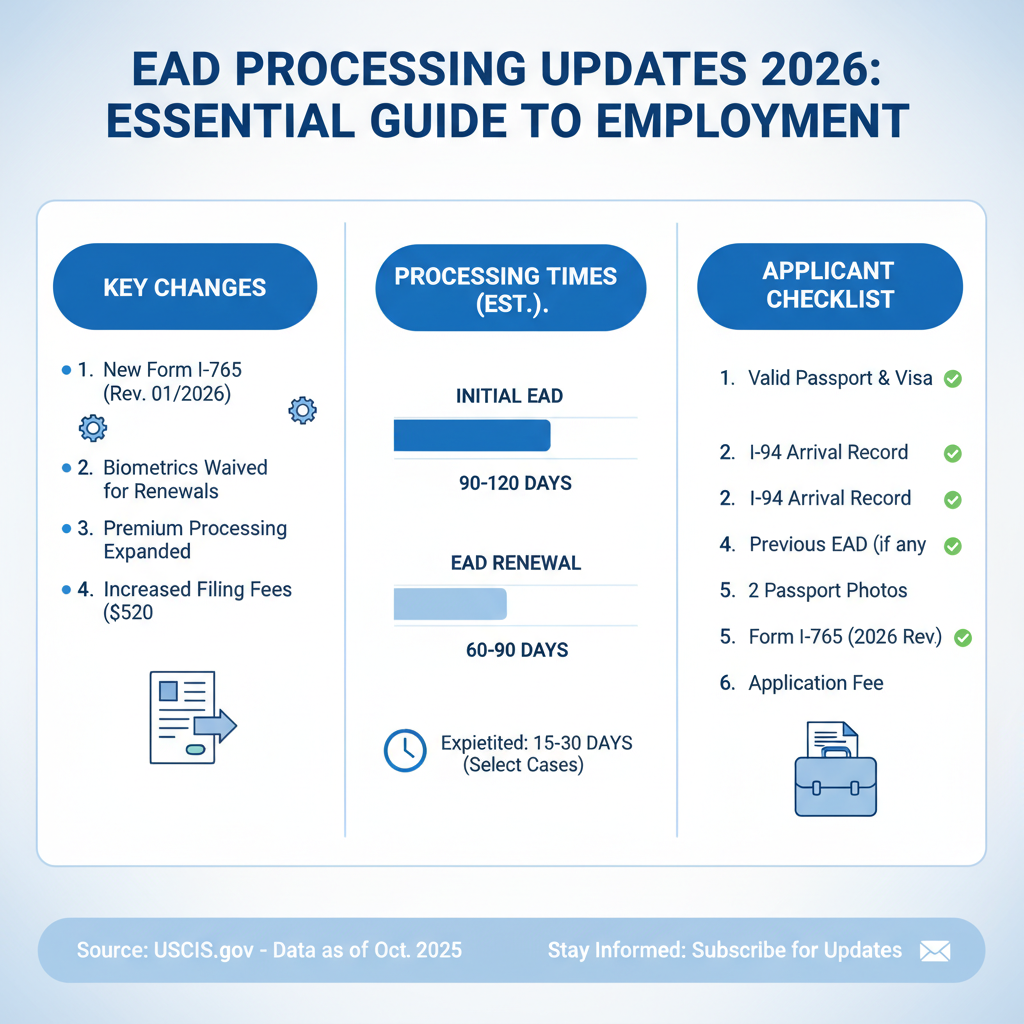
The information discussed in this comprehensive guide is informed by recent trends and official communications from U.S. Citizenship and Immigration Services (USCIS) regarding Employment Authorization Document (EAD) processing. These updates are vital for understanding the current landscape of work authorization in the United States.
What This News Means for Immigrants in Orlando and Across Florida
Recent announcements and operational changes from USCIS regarding Employment Authorization Document (EAD) processing are more than just bureaucratic updates; they are critical developments that directly impact the lives and livelihoods of immigrants across the nation, especially here in Florida. Understanding these changes is crucial for anyone seeking to work legally in the U.S.
Why this news is showing up now
The immigration system, particularly USCIS, has faced significant challenges in recent years, including unprecedented application backlogs, staffing shortages, and the need to modernize its processes. The COVID-19 pandemic exacerbated many of these issues, leading to extended processing times for various forms, including the Form I-765, Application for Employment Authorization. In response to these challenges and continuous advocacy from immigrant communities and legal professionals, USCIS has been implementing a series of operational adjustments. These adjustments aim to improve efficiency, reduce backlogs, and provide clearer guidance for applicants. The updates often involve changes to policy manuals, processing priorities, and sometimes, temporary measures to alleviate burdens on applicants. As of March 2026, USCIS continues to refine these processes, making it essential for applicants to stay abreast of the latest information.
How it can affect Florida residents
Florida is one of the most diverse states in the U.S., home to a vibrant immigrant population that contributes significantly to our economy and culture. From the bustling hospitality industry in Orlando and the I-4 corridor to agriculture and technology statewide, immigrants play a vital role. Therefore, EAD processing updates have a profound impact on Central Florida residents and beyond:
- Employment Stability: Delays in EAD renewals can lead to gaps in employment, causing severe financial hardship for individuals and families. Recent updates, particularly those related to automatic EAD extensions, can provide a lifeline during these periods.
- Economic Contribution: When EADs are processed efficiently, immigrants can enter or re-enter the workforce promptly, contributing to Florida’s economy through taxes, consumer spending, and filling labor gaps.
- Family Well-being: The ability to work directly supports families, allowing them to afford housing, food, education, and healthcare. Any disruption to EAD processing can jeopardize family stability, aligning directly with Imigrar's mission to "Keep Families Together."
- Business Impact: Florida businesses rely on a stable workforce. EAD delays can disrupt operations, particularly for employers sponsoring foreign workers or those who hire individuals awaiting adjustment of status.
- Planning and Uncertainty: For those on temporary visas or awaiting green cards, the EAD is a critical bridge. Uncertainty surrounding processing times makes long-term planning difficult, affecting everything from housing decisions to career choices.
Understanding these impacts is the first step. The next is to arm yourself with accurate information and expert guidance, which Imigrar is here to provide. Whether you're in Orlando, Miami, Tampa, or anywhere else in Florida, these updates are directly relevant to your path to legal employment.
Need Help Navigating EAD Updates? The rules can be complex, but you don't have to face them alone. Our Orlando immigration team is ready to assist. Call +1 786-791-3106 for a free consultation, or message us online. Se Habla Español.
What Employment Authorization Document (EAD) Is (and Why It Matters)
The Employment Authorization Document, commonly known as an EAD or a work permit, is a crucial immigration benefit that allows foreign nationals to legally work in the United States for a specific period. It is a physical card, similar to a driver's license, issued by USCIS, indicating that the holder is authorized to accept employment. For many, obtaining an EAD is a pivotal step towards financial independence and integration into American society.
A plain-English definition
Simply put, an EAD is your official permission slip from the U.S. government to work. If you are not a U.S. citizen or a lawful permanent resident (green card holder), you generally need an EAD to be employed legally in the United States. This document proves to employers that you have the legal authorization to take a job.
It's important to understand that an EAD is not a visa and does not grant you immigration status. Instead, it is a benefit derived from your underlying immigration status or application. For example, individuals applying for asylum, adjusting their status to a lawful permanent resident, or those on certain nonimmigrant visas (like H-4 spouses or F-1 students on Optional Practical Training) may be eligible for an EAD.
Key terms you need to know
Navigating immigration processes often involves specialized terminology. Here are some key terms related to EADs:
- Employment Authorization Document (EAD): The official document (Form I-766 card) granting permission to work.
- USCIS (U.S. Citizenship and Immigration Services): The government agency responsible for processing EAD applications and other immigration benefits. You can find more information on the USCIS official website.
- Form I-765, Application for Employment Authorization: The specific form you must file with USCIS to request an EAD or renew an existing one. This is the central document in the EAD application process.
- Eligibility Category: The specific legal basis under which you qualify for an EAD. Examples include (c)(3)(C) for F-1 OPT, (c)(9) for Adjustment of Status applicants, or (c)(26) for H-4 spouses.
- Initial EAD: Your first application for an EAD under a specific eligibility category.
- EAD Renewal: An application to extend the validity of an existing EAD. It's crucial to file for renewal well in advance of your current EAD's expiration date.
- Automatic EAD Extension: A temporary provision that allows certain EAD categories to continue working for a period (e.g., up to 540 days, as per recent USCIS updates) beyond their EAD expiration date, provided they filed a timely renewal application. This is a critical provision for many Floridians facing processing delays.
- Receipt Notice: A document sent by USCIS acknowledging receipt of your application, usually Form I-797C, Notice of Action. This notice is vital for proving timely filing, especially for automatic extensions.
- Biometrics Appointment: An appointment at a USCIS Application Support Center (ASC) to capture your fingerprints, photograph, and signature. This data is used for background checks.
- Request for Evidence (RFE): A letter from USCIS requesting additional documents or information to support your application. Responding promptly and thoroughly to an RFE is critical.
Understanding these terms will empower you to better comprehend the EAD application process and any updates from USCIS. The team at Imigrar in Orlando is always here to clarify these terms and guide you through the implications for your specific case.
Current Immigration Law: The Foundation
The authority for Employment Authorization Documents stems from federal immigration law, primarily outlined in the Immigration and Nationality Act (INA) and further detailed in the Code of Federal Regulations (CFR). These legal frameworks establish who is eligible for work authorization and under what conditions. As of March 2026, the fundamental principles remain, though administrative policies and processing guidelines evolve.
Federal requirements
The legal basis for employment authorization can be found in Section 274A of the Immigration and Nationality Act (8 U.S.C. § 1324a), which generally prohibits the unlawful employment of aliens. To comply with this, non-citizens must have either an EAD or be authorized to work incident to their status (e.g., lawful permanent residents, certain nonimmigrants like H-1B visa holders working for a specific employer). The specific eligibility categories for an EAD are detailed in 8 CFR § 274a.12. This regulation lists dozens of categories, each with its own criteria. Common categories include:
- Applicants for Adjustment of Status (Green Card): Individuals who have filed Form I-485, Application to Register Permanent Residence or Adjust Status, are typically eligible for an EAD under category (c)(9).
- Asylum Seekers and Asylees: Individuals who have filed Form I-589, Application for Asylum and for Withholding of Removal, and whose application has been pending for at least 150 days, or those who have been granted asylum, are eligible under categories (c)(8) or (a)(5) respectively.
- Refugees: Granted EADs under category (a)(3).
- Spouses of Certain Visa Holders: Spouses of E-1/E-2, L-1, and some H-1B visa holders (H-4 spouses if the H-1B principal has an approved I-140 or has been granted an extension beyond 6 years) are eligible under categories (a)(17), (a)(18), or (c)(26).
- F-1 Students with Optional Practical Training (OPT): Students completing their degrees can apply for an EAD for practical training purposes under category (c)(3)(A) for pre-completion OPT, (c)(3)(B) for post-completion OPT, and (c)(3)(C) for STEM OPT extensions.
- Deferred Action for Childhood Arrivals (DACA): Individuals granted DACA may apply for an EAD under category (c)(33).
Each category has specific requirements for supporting documentation. Failure to meet these federal requirements will result in delays or denial. It is critical to select the correct eligibility category on Form I-765 and provide all necessary evidence.
Florida-specific considerations
While immigration law is federal, its impact and application can have specific nuances for residents of states like Florida. For those living in Orlando, Orange County, or along the I-4 corridor, several factors are particularly relevant:
- Local USCIS Field Offices: The Orlando USCIS Field Office primarily handles interviews for Adjustment of Status and naturalization applicants. While EAD applications are centrally processed, understanding the local office's role can be important for certain follow-up actions or if your EAD is part of a larger application package (like Form I-485) that involves a local interview.
- High Volume of Applicants: Florida's large immigrant population means a consistently high volume of EAD applications and renewals. This can sometimes contribute to localized processing variations or impact the capacity of local Application Support Centers (ASCs) for biometrics appointments.
- State-Specific Policies: Although EADs are federal, state laws can affect how they are used. For instance, state-level professional licensing boards might have specific requirements for demonstrating work authorization. Florida employers must comply with federal I-9 verification requirements, which the EAD fulfills.
- Economic Landscape: The types of jobs available in Central Florida, particularly in tourism, hospitality, and service industries, often attract individuals who rely on EADs. Ensuring continuous work authorization is vital for these sectors.
Staying compliant with federal immigration law is paramount, and understanding how these laws manifest in your local context is equally important. For up-to-date forms and guidance, always refer to the USCIS Forms page.
Confused by Immigration Law? Imigrar's legal experts simplify the complexities. Get personalized advice on EAD eligibility and application. Call +1 786-791-3106 for a free consultation. Se Habla Español.
How to Apply for or Renew Your EAD: A Complete Step-by-Step Guide
Applying for or renewing an Employment Authorization Document (EAD) involves a structured process that requires meticulous attention to detail. This guide breaks down the steps to help you navigate it effectively. Remember, for the most accurate and personalized guidance, consulting with an immigration attorney is always recommended.
1) Determine Your Eligibility Category
Before you even touch Form I-765, you must accurately identify the eligibility category under which you are applying. This is the single most critical step, as it dictates the required documentation and often the processing path. Refer to 8 CFR § 274a.12 for a comprehensive list of categories. Common categories for Florida residents include:
- (c)(9): Adjustment of Status applicants (those with a pending Form I-485).
- (c)(8): Asylum applicants (whose asylum application, Form I-589, has been pending for at least 150 days).
- (c)(26): H-4 spouses (of certain H-1B visa holders who have an approved Form I-140 or have been granted an extension beyond the 6-year limit).
- (c)(3)(C): F-1 STEM OPT Extension students.
- (c)(33): DACA recipients.
Warning: Selecting the wrong category will almost certainly lead to a Request for Evidence (RFE) or outright denial. If you are unsure, consult with an immigration attorney.
2) Gather All Required Supporting Documents
Once your eligibility category is determined, collect all necessary supporting documents. This list can vary significantly by category, but generally includes:
- Proof of Identity and Nationality:
- Copy of your birth certificate (with certified translation if not in English).
- Copy of your passport biographical page.
- Copy of your national identity card (if applicable).
- Proof of Immigration Status:
- Copy of your last Form I-94, Arrival/Departure Record (print from CBP website).
- Copies of all previous EAD cards (front and back).
- Copies of all previous visa stamps and nonimmigrant visa documents (e.g., I-20s for F-1, I-797 approval notices for H-1B, H-4, L-1, etc.).
- If applicable, copies of your Form I-485 receipt notice (Form I-797C) or Form I-589 receipt notice.
- For H-4 EADs, proof of relationship to the principal H-1B holder (marriage certificate), the H-1B holder's Form I-797 approval notices, and their Form I-140 approval notice (if applicable).
- Photographs:
- Two identical passport-style photos taken within 30 days of filing. Photos must meet specific USCIS requirements (2x2 inches, white background, full-face view, no glasses). Write your name and A-Number (if you have one) lightly in pencil on the back of each photo.
- Proof of Previous EADs (for renewals):
- Copy of the front and back of your most recent EAD card.
- Additional Documents Specific to Your Category:
- For F-1 OPT: Copies of your I-20 with the OPT recommendation, academic transcripts, degree.
- For Asylum applicants: Copy of your Form I-589 receipt notice.
Important: Always provide copies, not original documents, unless USCIS specifically requests originals. Keep a complete copy of your entire application packet for your records.
3) Complete Form I-765, Application for Employment Authorization
Fill out Form I-765 meticulously. This form is available for free download on the USCIS Forms website. Pay close attention to every question:
- Part 1. Reason for Applying: Check the appropriate box (Initial, Renewal, or Replacement).
- Part 2. Information About You: Provide your full legal name, mailing address, date of birth, country of birth, country of citizenship, gender, marital status, and A-Number (if you have one).
- Part 2, Item 27: Eligibility Category: This is where you enter the specific eligibility code (e.g., (c)(9), (c)(8), (c)(26)). Make sure it matches your determination from Step 1.
- Part 2, Item 28: (c)(3)(C) STEM OPT only: If applying for STEM OPT, provide your degree, employer's E-Verify number, and Designated School Official (DSO) info.
- Part 2, Item 29-30: (c)(26) H-4 spouse only: Provide the H-1B principal's I-94 number and A-Number.
- Part 3. Applicant's Statement, Contact Information, Declaration, Certification, and Signature: Read carefully, ensure all information is accurate, and SIGN AND DATE THE FORM. An unsigned form will be rejected.
Reminder: If you need more space for any answer, use Part 4, "Additional Information," or attach a separate sheet, clearly indicating the Part and Item number to which your answer refers.
4) Calculate and Prepare the Filing Fee
As of March 2026, the filing fee for Form I-765 is subject to change, so always check the USCIS Form I-765 page for the current fee. Some categories are exempt from the fee (e.g., asylum applicants filing under (c)(8)).
- Pay by money order, personal check, cashier's check, or credit card using Form G-1450, Authorization for Credit Card Transactions.
- If paying by check, make it payable to "U.S. Department of Homeland Security." Do not abbreviate.
- Warning: An incorrect fee will lead to rejection of your entire application.
5) Assemble and File Your Application Packet
Organize your application packet in a logical order. A common order is:
- Cover Letter (optional, but highly recommended, especially for complex cases, outlining contents).
- Check or Form G-1450.
- Two passport-style photos in a small plastic bag stapled to a piece of paper.
- Completed and signed Form I-765.
- Copies of all supporting documents (as determined in Step 2), typically ordered as they are referenced in the form or cover letter.
Mail your application to the correct USCIS lockbox facility. The mailing address depends on your eligibility category and where you live. Always check the "Where to File" section on the USCIS Form I-765 page. For residents of Orlando and Florida, this usually means a lockbox in Dallas, TX, or Chicago, IL, but it’s crucial to verify. Send your application via certified mail with a return receipt requested, or through a courier service that provides tracking.
Note: Some EAD categories, particularly those filed concurrently with Form I-485, may be eligible for online filing. Check the USCIS website for online filing options and instructions.
6) Attend Your Biometrics Appointment (if required)
After USCIS accepts your application, you will typically receive a biometrics appointment notice (Form I-797C) at a local Application Support Center (ASC). For Central Florida residents, this might be the Orlando ASC. Attend this appointment as scheduled, bringing the notice and a valid photo ID. Your fingerprints, photograph, and signature will be collected for background checks. Failure to attend can lead to delays or denial.
7) Monitor Your Case Status and Respond to RFEs
Once your application is filed, you will receive a receipt notice (Form I-797C) from USCIS. This notice contains a receipt number that allows you to track your case status online using the USCIS Case Status Online tool. Be diligent in checking your mail for any further notices, especially a Request for Evidence (RFE). If you receive an RFE, respond promptly and thoroughly with all requested information. Failure to do so within the specified deadline will likely result in denial.
Finally, if your EAD is approved, you will receive your new Form I-766 card in the mail. If you are an EAD renewal applicant, be aware of the automatic extension rules that may allow you to continue working while your renewal is pending.
Practical Steps You Can Take Today
Navigating the EAD application or renewal process can be overwhelming, but taking proactive steps can significantly improve your chances of a smooth experience. Here’s an actionable checklist and practical advice:
Actionable Checklist (5+ items)
- Start Early for Renewals: If you need to renew your EAD, begin the process at least 6 months before its expiration date. This allows ample time for processing and helps you avoid gaps in employment, especially with current USCIS processing times.
- Verify Your Eligibility: Double-check your specific eligibility category for Form I-765. Consult the USCIS website or an attorney if unsure.
- Gather All Documents: Begin collecting all required supporting documents as outlined in Step 2 of the guide. Organize them neatly and make copies of everything.
- Download the Latest Form I-765: Always ensure you are using the most current version of Form I-765. USCIS frequently updates forms, and using an outdated version will result in rejection.
- Check Current Filing Fees: Fees change. Confirm the exact filing fee for Form I-765 on the USCIS website before preparing your payment.
- Create a USCIS Online Account: If eligible for online filing, or simply to track your case, set up an account on the USCIS website. This allows you to monitor status and receive updates.
- Know Your Local USCIS ASC: If you are in Orlando, familiarize yourself with the location of the local Application Support Center for potential biometrics appointments.
Document Preparation Guidance
- Organization is Key: Arrange your documents logically. A cover letter listing the contents can be very helpful for USCIS officers. Use fasteners or paper clips, not staples (except for photos).
- Copies, Not Originals: Unless specifically requested, always send photocopies of your supporting documents. Keep all originals safely with you.
- Translate Foreign Documents: Any document not in English must be accompanied by a complete and accurate English translation, along with a certification from the translator stating their competence and the accuracy of the translation.
- High-Quality Photos: Ensure your passport-style photos meet all USCIS specifications. Poor-quality photos are a common reason for RFEs.
- Keep a Full Copy: Make a complete copy of your entire application packet, including the signed Form I-765, payment, and all supporting documents, before mailing it. This is your safeguard.
Timeline Expectations
EAD processing times can fluctuate significantly based on the eligibility category, the specific USCIS service center, and the overall volume of applications. While USCIS has implemented measures to reduce backlogs, it is still common for processing to take several months, sometimes longer than a year for certain categories.
- Check Processing Times: Regularly check the USCIS Processing Times page online. Input your form type (Form I-765) and the service center where your application was filed (found on your receipt notice) to get an estimate.
- Automatic Extensions: If you are filing an EAD renewal for an eligible category, remember that your existing EAD may be automatically extended for up to 540 days (as per current USCIS policy) from its expiration date, provided you filed your renewal application before your EAD expired. Keep your expired EAD and your Form I-797C receipt notice as proof of this extension.
- Be Patient but Vigilant: While long processing times


