

What This News Means for Immigrants in Orlando and Across Florida
Why this news is showing up now
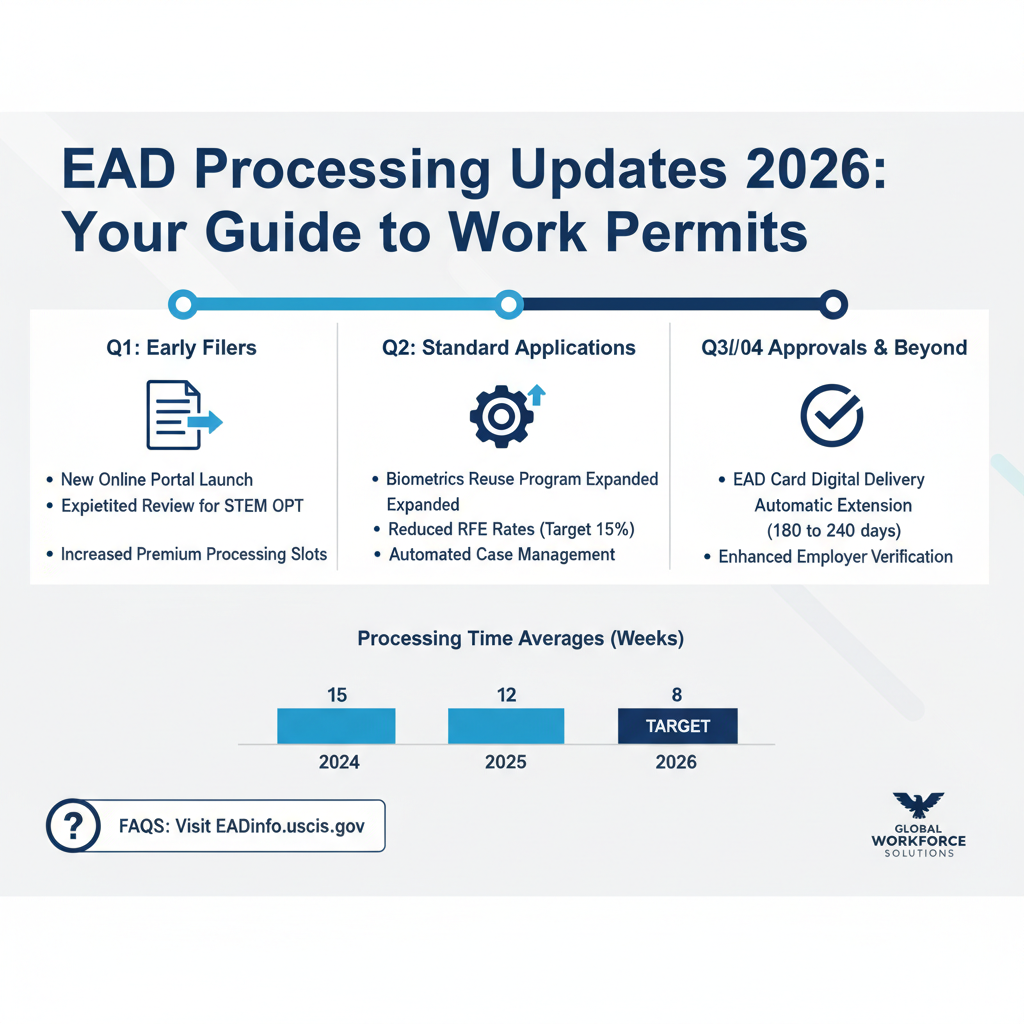
The conversation around EAD processing is perpetually "trending" because it’s an area where USCIS consistently strives for efficiency improvements, especially in response to evolving immigration patterns, economic needs, and historical backlogs. As of March 2026, USCIS continues to implement and refine strategies aimed at reducing processing times, enhancing application intake, and streamlining adjudication for EADs. These efforts are often driven by: * **Persistent Backlogs:** Despite significant efforts, certain EAD categories have historically faced substantial backlogs, leading to long waits for applicants. USCIS is under continuous pressure to address these. * **Policy Adjustments:** The agency frequently reviews and adjusts its policies, such as automatic extension periods for certain EAD categories, to provide relief and continuity of employment for applicants. These adjustments are often temporary but can become permanent if effective. * **Technological Enhancements:** USCIS is investing in digital transformation, including online filing options and improved case management systems, to accelerate processing. * **Economic Impact:** The ability of immigrants to work contributes significantly to the U.S. economy. Expediting EAD processing helps employers fill critical labor gaps and supports economic growth, making it a priority for various stakeholders. * **Humanitarian Concerns:** For asylum seekers and other vulnerable populations, timely EAD issuance is crucial for self-sufficiency and integration, prompting ongoing focus from advocacy groups and the agency. These ongoing efforts mean that while there might not always be a single, dramatic "new rule" breaking every week, there is a constant stream of updates, policy interpretations, and procedural changes that collectively shape the EAD processing landscape. This continuous evolution is the "news" that impacts everyone.How it can affect Florida residents
Florida is home to a diverse and growing immigrant population, with Orlando serving as a significant hub. Updates to EAD processing have direct and profound effects on Central Florida residents: * **Employment Opportunities:** Faster EAD processing means individuals can enter the workforce sooner, securing jobs in sectors vital to Florida’s economy, such as tourism, hospitality, agriculture, healthcare, and technology. Delays, conversely, can lead to financial hardship and instability. * **Local Economy:** When immigrants can work, they contribute to the local economy through taxes, spending, and entrepreneurship. Efficient EAD processing supports the economic vitality of cities like Orlando and counties like Orange, Seminole, and Osceola along the I-4 corridor. * **Community Stability:** The ability to work legally provides stability for families, allowing them to better integrate into their communities, secure housing, and access essential services. Prolonged waits for EADs can create significant stress and uncertainty. * **Orlando USCIS Field Office:** While EAD applications are generally processed by USCIS service centers, local field offices, like the one in Orlando, handle certain interviews and provide support, making local processing efficiency relevant. Understanding federal changes is key for anyone interacting with these local offices. * **Legal Compliance for Employers:** Florida employers rely on their employees having proper work authorization. Timely EADs ensure businesses can maintain compliant workforces without disruption. For those navigating these complexities in Orlando or anywhere across Florida, understanding the nuances of EAD processing is critical. Imigrar is dedicated to helping you stay informed and prepared.Need Help? Our Orlando immigration team is ready to assist. Navigating EAD applications can be complex, but you don't have to do it alone. Call +1 786-791-3106 for a free consultation, or message us online. Se Habla Español.
What Employment Authorization Documents (EADs) Are (and Why They Matter)
An Employment Authorization Document, or EAD, is a permit issued by U.S. Citizenship and Immigration Services (USCIS) that provides foreign nationals with legal authorization to work in the United States for a specific period. It is commonly referred to as a "work permit." For many immigrants, an EAD is the first step towards financial independence and integration into American society.A plain-English definition
Think of an EAD as your official permission slip from the U.S. government to be employed. If you are not a U.S. citizen or a lawful permanent resident (green card holder), but you are in a specific immigration status that allows you to work, you will likely need an EAD. It's a physical card, similar to a driver's license, that employers use to verify your eligibility to work when you complete Form I-9, Employment Eligibility Verification. **Important:** An EAD itself does not grant you immigration status, nor does it replace your visa or green card. It simply authorizes you to work based on your underlying immigration status or application.Key terms you need to know
Understanding these terms is crucial when discussing EADs: * **USCIS (U.S. Citizenship and Immigration Services):** The government agency responsible for processing EAD applications and other immigration benefits. * **Form I-765, Application for Employment Authorization:** This is the primary form you must file to apply for or renew an EAD. * **Eligibility Category:** USCIS groups EAD applicants into specific categories based on their immigration status or underlying application. Examples include categories for asylum seekers, individuals with pending Adjustment of Status applications, certain nonimmigrant visa holders (like H-4 spouses), and students on Optional Practical Training (OPT). * **Initial EAD:** Your first application for work authorization in a specific eligibility category. * **EAD Renewal:** An application to extend your work authorization after your current EAD expires. It's critical to apply for renewal well in advance. * **Automatic Extension:** For certain EAD categories, if you file your renewal application on time, your existing EAD and/or employment authorization may be automatically extended for a specific period (e.g., up to 540 days as per current temporary rules, though this can change). This prevents gaps in employment while USCIS processes your renewal. * **Adjustment of Status (AOS):** The process of applying for lawful permanent resident status (a Green Card) while physically present in the United States. Many individuals with pending Form I-485 applications are eligible for EADs. * **Asylum Seeker:** An individual who has applied for asylum in the U.S. and is awaiting a decision. After a certain waiting period (currently 150 days after filing the asylum application), they can apply for an EAD. * **Nonimmigrant Visa:** A visa for temporary stay in the U.S., such as an H-1B, L-1, F-1 (student), or J-1 (exchange visitor) visa. Certain dependents of these visa holders (e.g., H-4 spouses, L-2 spouses) may be eligible for EADs. * **Biometrics Appointment:** An appointment at a local Application Support Center (ASC) where USCIS collects your fingerprints, photograph, and signature for background checks. * **Request for Evidence (RFE):** A letter from USCIS asking for additional documents or information to support your application. * **Expedite Request:** A formal request to USCIS to process your application faster than the standard timeframe due to urgent circumstances.Current Immigration Law: The Foundation of Your EAD
The authority for USCIS to grant employment authorization stems from the Immigration and Nationality Act (INA) and is codified in the Code of Federal Regulations (CFR), specifically 8 CFR Part 274a. This regulatory framework defines who is eligible for work authorization and under what conditions.Federal requirements
Federal law outlines the specific categories of individuals eligible to apply for an EAD. These categories are detailed in 8 CFR § 274a.12. Some of the most common categories include: * **Asylum Applicants (c)(8):** Individuals with a pending asylum application who have waited at least 150 days since filing their Form I-589, Application for Asylum and for Withholding of Removal. * **Applicants for Adjustment of Status (c)(9):** Individuals who have a pending Form I-485, Application to Register Permanent Residence or Adjust Status. Often, they file Form I-765 concurrently with or after their Form I-485. * **Refugees (a)(3) and Asylees (a)(5):** Individuals granted refugee or asylum status. * **Certain Nonimmigrant Spouses (c)(26), (a)(17), (a)(18):** Spouses of certain nonimmigrant visa holders, such as H-4 spouses of H-1B workers, and L-2 spouses of L-1 intracompany transferees, provided the principal nonimmigrant meets certain criteria. * **Students on Optional Practical Training (OPT) (c)(3)(i), (c)(3)(ii), (c)(3)(iii):** F-1 students seeking work authorization related to their field of study, including STEM OPT extensions. * **Individuals Granted Temporary Protected Status (TPS) (a)(12):** Nationals of designated countries who cannot safely return home. * **Parolees (c)(11):** Individuals paroled into the U.S. for humanitarian reasons or significant public benefit. * **Individuals with Deferred Action (c)(14):** Including those granted Deferred Action for Childhood Arrivals (DACA). Each category has specific eligibility criteria and often requires the applicant to maintain a particular underlying status or have a specific application pending. **Key Forms Involved:** * Form I-765, Application for Employment Authorization: This is the core form for all EAD applications. * Form I-485, Application to Register Permanent Residence or Adjust Status: Often filed concurrently or before an EAD application for those seeking a Green Card. * Form I-131, Application for Travel Document: Many Adjustment of Status applicants file this concurrently with Form I-765 and Form I-485 to obtain "advance parole" for international travel. * Form I-912, Request for Fee Waiver: For those who meet specific poverty guidelines or receive certain public benefits, USCIS may waive the filing fee for Form I-765. For the most up-to-date information on forms, fees, and eligibility, always consult the USCIS official website.Florida-specific considerations
While EAD eligibility and processing are governed by federal law, there are some state-specific considerations for Florida residents: * **E-Verify Compliance:** Florida employers, particularly those with government contracts or in certain sectors, are subject to E-Verify requirements. An EAD is a valid document for the Form I-9 process, which E-Verify checks. Employers must verify the work authorization of all new hires. * **State Benefits and Licenses:** Having an EAD can enable you to obtain a Florida driver's license or state identification card, which is essential for daily life and employment. It may also be required for certain professional licenses (e.g., healthcare, real estate) if you are not a U.S. citizen or permanent resident. * **Local Support Systems:** Organizations and legal aid groups in Orlando and across Florida offer support for immigrants, which can be particularly helpful for vulnerable populations navigating the EAD process. * **Orlando USCIS Field Office:** While EAD applications are primarily processed by USCIS Service Centers, the Orlando Field Office handles other aspects of immigration cases, such as interviews for Adjustment of Status applications. Timely EAD processing is crucial to sustain individuals while their broader immigration cases are pending locally.How to Apply for or Renew Your EAD: A Complete Step-by-Step Guide
Applying for an EAD can seem daunting, but breaking it down into manageable steps makes the process clearer. Whether it's your initial application or a renewal, accuracy and thoroughness are paramount.1) Determine Your Eligibility Category
Before you do anything else, you must identify which EAD eligibility category applies to you. This is crucial because it dictates the specific evidence you need to provide and the fee you must pay (or if you qualify for a fee waiver). * **Action:** Review 8 CFR § 274a.12 and the instructions for Form I-765. * **Common Categories to Consider:** * **Pending Form I-485 (Adjustment of Status):** Category (c)(9) * **Asylum Applicant:** Category (c)(8) * **H-4 Spouse of H-1B:** Category (c)(26) * **F-1 Student on OPT:** Category (c)(3)(i) for pre-completion, (c)(3)(ii) for post-completion, (c)(3)(iii) for STEM OPT extension. * **TPS:** Category (a)(12) * **Refugee/Asylee:** Category (a)(3) or (a)(5) * **Required Documents for this Step (for self-assessment):** Your current immigration documents (visa, I-94 record, receipt notices for pending applications like Form I-485 or Form I-589).2) Gather Required Documents and Information
Once you know your category, compile all necessary supporting documents. This is often the most time-consuming part, so start early. * **Action:** Collect original documents and make clear photocopies. * **General Required Documents (may vary by category):** * **Two identical passport-style photos:** Taken within 30 days of filing. * **Copy of your last EAD (front and back):** If renewing. * **Copy of your government-issued photo identification:** E.g., passport biographic page, driver's license. * **Copy of Form I-94, Arrival/Departure Record:** If applicable, showing your lawful admission. * **Copy of your birth certificate:** With certified translation if not in English. * **Copies of all previous Form I-797, Notice of Action, approval notices for underlying petitions/applications:** E.g., Form I-130, Form I-140, Form I-485 receipt notice, Form I-589 receipt notice. * **Copy of visa page (if applicable).** * **Marriage certificate:** If applying as a spouse (e.g., H-4, L-2, or for AOS based on marriage). * **Proof of financial need (if requesting a fee waiver):** Form I-912 and supporting evidence. * **Additional category-specific documents:** For example, for F-1 OPT, you'll need your I-20 with the OPT recommendation. For H-4, you'll need the principal H-1B's Form I-797 approval notice. * **Reminder:** Never send original documents unless specifically requested by USCIS. Send clear copies.3) Complete Form I-765, Application for Employment Authorization
Fill out the form accurately and completely. Any errors or omissions can lead to delays or denials. * **Action:** Download the latest version of Form I-765 from the USCIS Forms page. * **Key Sections to Pay Attention To:** * **Part 1. Reason for Applying:** Clearly select whether you are applying for initial permission, a replacement, or a renewal. * **Part 2. Information About You:** Ensure all names, addresses, and dates of birth match your identification documents. * **Part 2. Your Eligibility Category:** Enter the correct category code (e.g., (c)(9), (c)(8)). Some categories require additional information in Part 2, Item 28. For example, H-4 spouses need to list the principal H-1B spouse's Form I-797 receipt number. * **Part 3. Applicant’s Statement:** Sign the form in blue ink. If someone helped you prepare it, they must also sign. * **Important:** Use black ink. If completing by hand, write legibly. Many applicants choose to type the form for clarity.4) Pay the Filing Fee (or Request a Fee Waiver)
Most EAD applications require a filing fee. Ensure you pay the correct amount and use an acceptable payment method. * **Action:** Check the current filing fee on the USCIS website for Form I-765. * **Payment Methods:** * **Check or Money Order:** Payable to "U.S. Department of Homeland Security." Write the full amount. * **Credit Card:** If filing at a Lockbox facility, you can use Form G-1450, Authorization for Credit Card Transactions. * **Online Payment:** If filing online (available for some categories). * **Fee Waiver:** If you cannot afford the fee, you may be eligible to apply for a fee waiver using Form I-912, Request for Fee Waiver. You must provide evidence of your inability to pay. Not all categories are eligible for fee waivers. Asylum applicants (c)(8) are often exempt from the EAD fee. * **Warning:** Incorrect fees or improper fee waiver requests are common reasons for applications to be rejected.5) Assemble and Mail Your Application Package
Organize your application meticulously before mailing. USCIS prefers a specific order for documents. * **Action:** Create a cover letter listing all contents, assemble the package, and mail it to the correct USCIS Lockbox or Service Center address. * **Assembly Order (General Guidance):** 1. Cover Letter 2. Payment (check/money order/Form G-1450 or Form I-912) 3. Form I-765 (signed) 4. Two passport-style photos in a small envelope or stapled to the form (as per instructions) 5. Copy of previous EAD (if renewing) 6. Copy of Form I-94 7. Copies of supporting documents (e.g., birth certificate, marriage certificate, approval notices, I-20, etc.) * **Mailing Address:** The mailing address depends on your eligibility category and whether you're filing concurrently with another form (e.g., Form I-485). Always check the "Where to File" section of the Form I-765 instructions on the USCIS Forms page. * **Reminder:** Use a mailing service that provides tracking (e.g., USPS Certified Mail, FedEx, UPS) to confirm delivery. Keep a complete copy of everything you send for your records.Overwhelmed by paper work? Let Imigrar handle the details. Our experienced Orlando team ensures your EAD application is complete and accurate, minimizing delays. Call us today at +1 786-791-3106 for a free consultation. Se Habla Español.


