

The reporting that sparked this guide: Employment Authorization Document Processing (USCIS)
What This News Means for Immigrants in Orlando and Across Florida
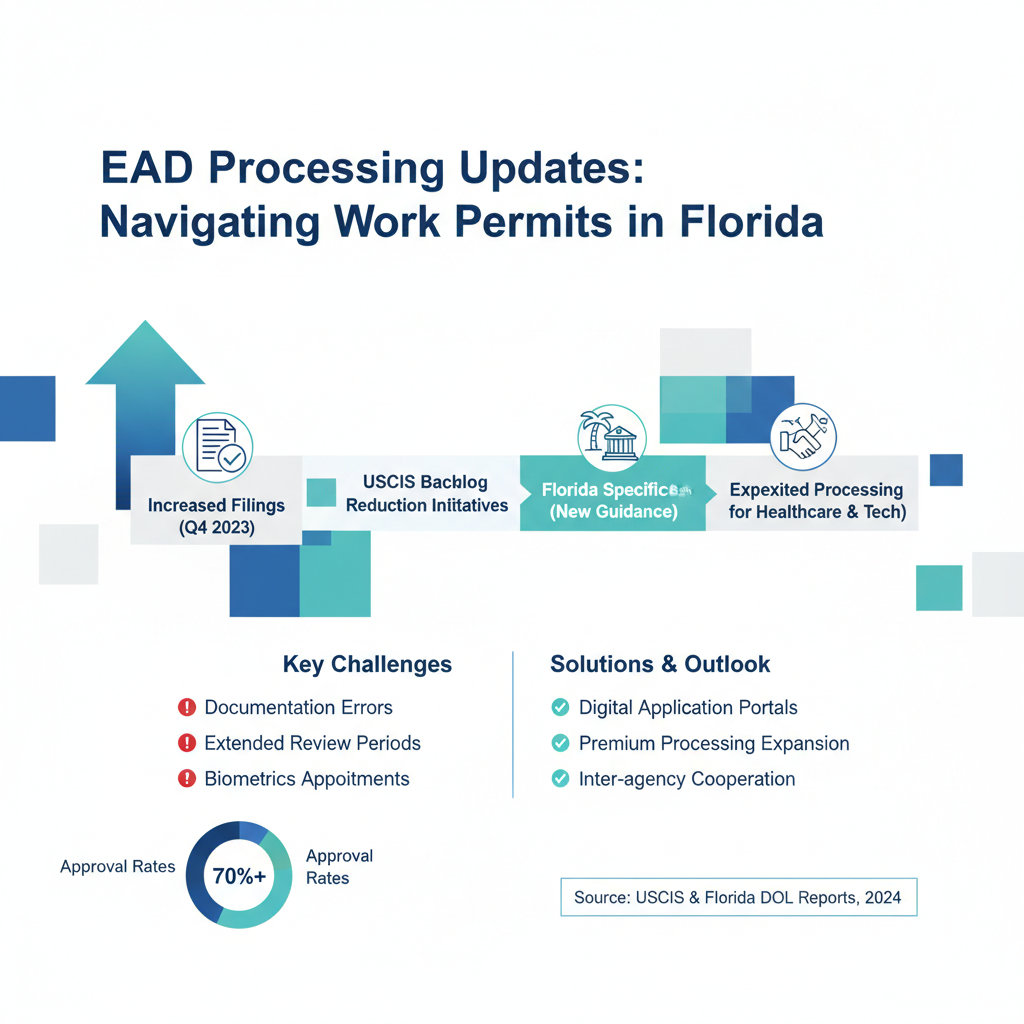
For many immigrants, the ability to work legally in the United States is not just a privilege, but a fundamental necessity for building a life, supporting a family, and contributing to their communities. An Employment Authorization Document (EAD), often called a "work permit," is the key to this opportunity. Recent updates and ongoing discussions from U.S. Citizenship and Immigration Services (USCIS) regarding EAD processing are a constant focus for our team at Imigrar, and they carry significant weight for thousands of individuals and families in Orlando, across Florida, and nationwide.
Why this news is showing up now
The immigration landscape is dynamic, and USCIS, the federal agency responsible for processing most immigration benefits, is continually adapting to new policies, technological advancements, and operational challenges. Over the past few years, applicants for EADs have faced unprecedented processing delays, leading to significant stress and financial hardship for many. These delays were exacerbated by factors such as increased application volumes, staffing shortages, and the complexities of remote work during global health crises.
In response to these challenges, USCIS has been implementing various measures aimed at improving efficiency, reducing backlogs, and providing relief to applicants. These efforts often involve policy changes, such as temporary extensions for certain EAD categories, or operational adjustments, like increasing staffing or optimizing processing workflows. News about these updates, whether they concern processing times, eligibility criteria, or application procedures, is critical because it directly impacts an applicant's ability to work, renew their authorization, and maintain their legal status. The agency's ongoing commitment to transparency, alongside public and congressional pressure, ensures that updates regarding EAD processing remain a trending topic, as they directly affect the daily lives of millions.
How it can affect Florida residents
Florida, a vibrant and diverse state, is home to a large immigrant population. For residents in Orlando, Central Florida, and beyond, changes in EAD processing can have immediate and profound effects. Many individuals rely on their EAD to secure or maintain employment, obtain a driver's license (which often requires proof of legal presence and work authorization), and access essential services. When EAD processing slows down, it can lead to:
- Job Loss or Inability to Work: If an EAD expires and a renewal is pending beyond the automatic extension period, individuals may lose their jobs or be unable to start new ones, leading to severe financial instability for their families.
- Disruption of Daily Life: Without a valid EAD, everyday tasks like renewing a driver's license at the Florida Department of Highway Safety and Motor Vehicles can become impossible, limiting mobility and independence, especially in areas like the I-4 corridor where personal transportation is often essential.
- Increased Stress and Uncertainty: The anxiety of not knowing when a work permit will arrive or be renewed can take a heavy toll on mental health and family well-being.
- Business Impact: Employers in Florida, from small businesses in Orange County to large corporations, depend on a stable workforce. Delays in EAD processing can disrupt business operations and staffing.
For those living in Orlando, the nearest USCIS Field Office is a critical point of contact for certain immigration matters, though EAD applications are primarily processed at USCIS Service Centers. Understanding the latest USCIS directives and processing trends is therefore not just about legal compliance; it's about maintaining stability, opportunity, and peace of mind for our community. At Imigrar, we understand these challenges intimately and are dedicated to guiding our clients through every update and every step of the process.
Need Help Navigating EAD Updates? Our Orlando immigration team is ready to assist. Call +1 786-791-3106 for a free consultation, or message us online. Se Habla Español.
What Employment Authorization Documents (EADs) Are (and Why They Matter So Much)
An Employment Authorization Document (EAD) is a crucial card issued by USCIS that provides temporary work authorization to non-U.S. citizens in the United States. It serves as proof that an individual is legally allowed to work for any employer in the U.S. for a specific period. This document is essential for many immigrants who are pursuing various paths to permanent residency or who are in certain nonimmigrant statuses that permit employment.
A plain-English definition
Think of an EAD as your official "work permit." It's a physical card, similar to a driver's license, that you present to an employer to prove you are authorized to work in the U.S. It doesn't grant you immigration status itself, but it allows you to legally hold a job while you are in a certain immigration status or while your application for a more permanent status (like a Green Card) is pending. Without an EAD (or another form of work authorization, such as a specific work visa), working in the U.S. is illegal and can have severe immigration consequences.
Key terms you need to know
Navigating the EAD process requires understanding several key terms:
- EAD (Employment Authorization Document): The official card issued by USCIS, also known as a work permit.
- Form I-765: The Application for Employment Authorization, which is the primary form used to apply for an EAD. You can find this and other forms on the USCIS Forms page.
- USCIS (U.S. Citizenship and Immigration Services): The federal agency responsible for processing immigration benefits, including EADs. You can visit their official website for more information.
- Petitioner: The U.S. citizen or lawful permanent resident (LPR) who files an immigration petition (e.g., family-based petition) on behalf of a beneficiary.
- Beneficiary: The foreign national for whom an immigration benefit is sought.
- Lawful Permanent Resident (LPR): An individual who has been granted the privilege of permanently residing in the United States as an immigrant, commonly referred to as a "Green Card" holder. LPRs generally do not need an EAD as their Green Card serves as proof of work authorization.
- Adjustment of Status (AOS): The process by which an eligible noncitizen already in the United States can apply for lawful permanent resident status without having to return to their home country to complete visa processing. Individuals with a pending Form I-485, Application to Register Permanent Residence or Adjust Status, are often eligible for an EAD.
- Nonimmigrant Visa: A visa issued to foreign nationals seeking to enter the U.S. temporarily for a specific purpose (e.g., F-1 student, H-1B skilled worker, L-1 intracompany transferee). Some nonimmigrant visa holders are eligible for EADs (e.g., certain F-1 students for Optional Practical Training (OPT), H-4 spouses of H-1B holders).
- Automatic Extension: A period during which certain EAD categories continue to be valid even after their expiration date, provided a renewal application has been filed on time. USCIS has periodically adjusted the length of these extensions.
- RFE (Request for Evidence): A notice from USCIS requesting additional information or documentation to support your application.
Understanding these terms is fundamental to successfully navigating the EAD application and renewal process. An EAD is more than just a piece of plastic; it's a bridge to economic stability and integration into American society for many immigrants and their families.
Current Immigration Law: The Foundation of Your Work Authorization
The ability to work legally in the U.S. is governed by a complex framework of federal immigration laws, primarily the Immigration and Nationality Act (INA), codified in Title 8 of the U.S. Code. While the INA broadly defines who can enter and remain in the U.S., specific regulations and policies outlined by USCIS determine eligibility for work authorization.
Federal requirements for EAD eligibility
Not everyone in the U.S. is eligible for an EAD. Eligibility is tied to specific immigration statuses or pending applications. The categories of foreign nationals eligible to apply for an EAD are detailed in 8 CFR § 274a.12. Some of the most common categories include:
- Asylees and Refugees: Individuals granted asylum or refugee status in the U.S.
- Applicants for Asylum or Withholding of Removal: Those with a pending asylum application.
- Individuals with Pending Adjustment of Status (AOS): Applicants for a Green Card (lawful permanent resident status) who have filed Form I-485. This is a very common category for EAD applicants.
- F-1 Students: Those authorized for Optional Practical Training (OPT) or Curricular Practical Training (CPT).
- J-2 Spouses and Dependents: Spouses and minor children of J-1 exchange visitors.
- H-4 Spouses: Certain spouses of H-1B nonimmigrants who are seeking lawful permanent resident status.
- K-1 Fiance(e)s: Individuals who have entered the U.S. on a K-1 visa and have filed for Adjustment of Status.
- Temporary Protected Status (TPS) Holders: Individuals granted TPS by the U.S. government.
- DACA Recipients: Individuals granted Deferred Action for Childhood Arrivals.
- U Nonimmigrant Status: Victims of certain crimes who have received U visa status.
Each category has specific requirements and documentation needs. For instance, an applicant for Adjustment of Status (filing Form I-485) can concurrently file Form I-765. The EAD granted in this scenario is often referred to as a "combo card" because it also serves as an advance parole document, allowing travel outside the U.S. without abandoning the pending Adjustment of Status application. It is crucial to correctly identify your eligibility category on Form I-765.
For detailed information on eligibility criteria and specific categories, always refer to the USCIS official website and the instructions for Form I-765.
Florida-specific considerations for EAD applicants
While EAD eligibility and processing are federal matters, there are practical considerations for applicants residing in Florida:
- Driver's Licenses: In Florida, to obtain or renew a driver's license or state identification card, you must provide proof of legal presence and, in most cases, work authorization. A valid EAD card is typically accepted by the Florida Department of Highway Safety and Motor Vehicles (FLHSMV). If your EAD expires and your renewal is pending, you may encounter issues renewing your license until the new EAD arrives.
- Employment Verification (E-Verify): Many employers in Florida use E-Verify, a federal online system that compares information from Form I-9, Employment Eligibility Verification, to data from DHS and Social Security Administration records to confirm employment eligibility. A valid EAD is key to passing this verification.
- Local Resources: While your EAD application is processed by USCIS Service Centers, if you need to attend a biometrics appointment, it will likely be at an Application Support Center (ASC) convenient to your residence, such as the one serving the Orlando area.
- State-Specific Programs: While less common for EADs directly, Florida may have state-level programs or resources that could be impacted by an individual's work authorization status. For example, access to certain professional licenses may require proof of work authorization.
It's vital for Florida residents to be aware of how their EAD status interacts with state-level requirements and services. Our team at Imigrar, based in Orlando, is well-versed in these local nuances and can provide tailored advice.
Confused by EAD Laws? Our expert Orlando immigration lawyers can clarify your eligibility and guide you. Call +1 786-791-3106 for a free consultation. Se Habla Español.
How to Apply for or Renew Your EAD: A Complete Step-by-Step Guide
Applying for or renewing an Employment Authorization Document (EAD) can seem daunting, but breaking it down into manageable steps makes the process clearer. This guide outlines the typical steps involved.
1) Determine Your Eligibility Category and Gather Information
Before doing anything else, you must confirm that you are eligible for an EAD and identify the correct eligibility category. This is crucial as it dictates the required supporting documents and can affect processing times. Review the instructions for Form I-765 to understand the various categories (e.g., (c)(9) for pending Adjustment of Status, (c)(3)(C) for F-1 OPT). If you are renewing, ensure you are still eligible under the same category or if your circumstances have changed.
Required Information:
- Your current immigration status.
- The basis of your eligibility (e.g., pending Form I-485, asylum application, H-4 spouse).
- Any relevant receipt numbers from previous applications (e.g., Form I-485, Form I-130).
2) Collect All Necessary Supporting Documents
This is arguably the most critical step. Incomplete applications are a primary cause of delays and denials. The specific documents you need will vary based on your eligibility category, but generally include:
- Passport-style photographs: Two identical, color, passport-style photos taken within 30 days of filing.
- Copy of your last EAD card (front and back): If you are renewing.
- Copy of your most recent I-94 Arrival/Departure Record: Proving your lawful admission and current status. You can usually retrieve this from CBP's website.
- Copy of your passport biographical page: Showing your photo, name, and date of birth.
- Copy of your visa (if applicable): The page in your passport with your U.S. visa stamp.
- Birth Certificate: A copy, often with a certified English translation if not in English.
- Marriage Certificate (if applicable): If applying based on a spouse's status.
- Evidence of your eligibility category:
- For Adjustment of Status (c)(9): Copy of Form I-797C, Notice of Action, showing receipt of your Form I-485.
- For F-1 OPT (c)(3)(C): Form I-20 endorsed for OPT, academic transcripts.
- For H-4 spouses (c)(26): Copy of H-1B spouse's Form I-797 approval notice, marriage certificate.
- For asylum applicants (c)(8): Copy of Form I-589, Application for Asylum and for Withholding of Removal, receipt notice.
- Proof of Identity: Government-issued ID (e.g., state ID, foreign national ID card).
Important: Always make photocopies of all documents. Do NOT send originals unless specifically requested by USCIS.
3) Complete Form I-765, Application for Employment Authorization
Fill out Form I-765 accurately and completely. You can download the latest version from the USCIS Forms page. Pay close attention to each question. If a question does not apply to you, write "N/A" (not applicable). If a numerical answer is zero, write "None."
- Part 1: Reason for Applying: Clearly indicate if you are applying for initial permission, replacement, or renewal.
- Part 2: Your Information: Provide your full legal name, address, date of birth, country of birth, country of citizenship, and A-Number (if you have one).
- Part 3: Your Employment Eligibility: This is where you specify your eligibility category (e.g., (c)(9)).
Reminder: Any discrepancies between your form and supporting documents can lead to delays or RFEs. Double-check all spellings and dates.
4) Calculate and Prepare Filing Fees (or Fee Waiver)
As of 2026-05-31, the filing fee for Form I-765 is typically $410, though it can change. Always check the latest fee on the USCIS website or the form instructions. Some categories, such as initial asylum applicants, may be exempt from the fee. If you cannot afford the fee, you may be eligible to apply for a fee waiver by filing Form I-912, Request for Fee Waiver. You must include the fee (or approved fee waiver) with your application.
Payment Options:
- Personal check, cashier's check, or money order payable to "U.S. Department of Homeland Security."
- Credit card using Form G-1450, Authorization for Credit Card Transactions (for applications filed at a USCIS Lockbox).
5) Assemble and Mail Your Application Package
Organize your documents in the order specified in the Form I-765 instructions. Place your check or money order on top, followed by Form I-765, photos, and then all supporting documents. Make a complete copy of the entire package for your records before mailing.
The mailing address depends on your eligibility category and the state you reside in (e.g., Florida applicants may send to a specific USCIS Lockbox). Check the "Where to File" section on the USCIS Form I-765 page for the correct address. Consider sending your package via certified mail with a return receipt requested so you have proof of delivery.
Online Filing Option: For some eligibility categories, USCIS allows online filing of Form I-765. Check the USCIS website to see if your category is eligible for online submission, as this can sometimes expedite the initial processing.
6) Attend Your Biometrics Appointment (if required)
After USCIS accepts your application, you may receive a notice to appear for a biometrics appointment at a local Application Support Center (ASC). This appointment is to capture your fingerprints, photograph, and signature. These biometrics are used for background checks. Attend this appointment as scheduled, taking your appointment notice and a valid photo ID. For Central Florida residents, this would typically be at the Orlando ASC.
7) Monitor Your Case Status and Respond to Notices
Once USCIS receives your application, they will send you a Form I-797C, Notice of Action, with a receipt number. Use this number to track your case online via the USCIS Case Status Online tool. You can also check average processing times for your service center at USCIS Processing Times.
Be prepared to respond promptly to any Request for Evidence (RFE) or other notices from USCIS. Failure to respond by the deadline can lead to denial. If your EAD renewal is pending, remember to check if you are eligible for an automatic extension, which can be up to 540 days for certain categories based on current policy (as of May 2026). Ensure you understand the conditions of this extension to maintain continuous work authorization.
Practical Steps You Can Take Today for Your EAD Application
Applying for or renewing an EAD demands careful planning and execution. Here are practical steps you can take right now to set yourself up for success:
Actionable Checklist:
- Start Early, Especially for Renewals: USCIS processing times can be lengthy. For renewals, file at least 6 months before your current EAD expires. This provides a buffer and increases the likelihood of continuous work authorization, especially with the automatic extension policies.
- Organize Your Documents: Create a dedicated folder (physical or digital) for all immigration-related documents. Categorize them clearly (e.g., "EAD Application," "Passport Copies," "I-94").
- Review Form I-765 Instructions: Download the latest instructions from the USCIS website. Read them thoroughly, highlighting sections relevant to your eligibility category.
- Verify Eligibility: Double-check that you still meet the eligibility criteria for your EAD category. If your circumstances have changed, consult with an immigration attorney.
- Check USCIS Processing Times: Regularly monitor the USCIS Processing Times page for the service center handling your application. This gives you a realistic expectation.
- Consult with an Attorney: If you have any doubts about your eligibility, required documents, or the application process, seek legal advice. A small investment upfront can prevent costly mistakes and delays.
Document Preparation Guidance:
- Clarity and Legibility: Ensure all copies of documents are clear and legible. If a document is faint or hard to read, try to obtain a better copy.
- Translations: If any supporting document is not in English, you must include a complete and accurate English translation, along with a certification by the translator that they are competent to translate and that the translation is accurate.
- Passport-Style Photos: Adhere strictly to USCIS photo requirements (2x2 inches, white background, no glasses, head facing forward). Minor deviations can lead to rejection.
- Keep Copies of Everything: Before mailing your application, make a complete copy of the entire package, including the filled-out Form I-765, payment, and all supporting documents. This record is invaluable if USCIS requests additional information or if your application is lost.
Timeline Expectations:
While USCIS strives to process applications efficiently, actual processing times can vary significantly. Factors influencing timelines include:
- Service Center Workload: Different service centers (e.g., Nebraska, Texas, California, Vermont, Potomac) have varying backlogs.
- Eligibility Category: Some categories may have faster or slower processing.
- Application Volume: General increases in applications can extend wait times.
- RFEs and Denials: If you receive an RFE, your processing time will be extended. A denial means starting over.
Important: As of May 2026, USCIS has implemented a temporary final rule increasing the maximum validity period for certain EADs from two years to five years, and extending the automatic extension period for expiring EADs for certain renewal applicants from up to 180 days to up to 540 days. This is a significant relief for many. However, always verify the latest policy on the USCIS official website, as these policies can change.
For Central Florida residents, while the Orlando USCIS Field Office handles interviews for certain cases, EAD processing is largely centralized at USCIS Service Centers. This means your processing time is primarily dictated by the national USCIS workload, not necessarily local office capacity.
Don't Risk Delays! Get personalized EAD application guidance from Imigrar. Call +1 786-791-3106 for your free consultation. Se Habla Español.
How Imigrar Helps Immigrants in Orlando and Beyond
At Imigrar, we understand that securing or renewing an Employment Authorization Document (EAD) is often a critical step in an immigrant's journey. It’s more than just a permit; it's the gateway to financial stability, self-sufficiency, and the ability to contribute meaningfully to the community here in Orlando and across Florida. Our firm, founded on the principle of "Keep Families Together," is dedicated to providing expert legal guidance and compassionate support through every stage of the immigration process.
Our experience and expertise
Our team of experienced immigration attorneys specializes in a wide range of immigration matters, including detailed knowledge of EAD applications and renewals. We stay current with the latest USCIS policy changes, processing updates, and legal precedents, ensuring our clients receive the most accurate and up-to-date advice. Whether you are applying for an EAD based on a pending Adjustment of Status (Form I-485), as an asylum applicant, an F-1 student on OPT, or an H-4 spouse, we have the expertise to guide you.
We assist clients with:
- Determining EAD eligibility and the correct filing category.
- Thorough preparation of Form I-765 and all supporting documentation.
- Responding to Requests for Evidence (RFEs) from USCIS.
- Understanding and leveraging the automatic extension rules for renewals.
- Navigating complex cases, including those with previous denials or unique circumstances.
- Monitoring case status and providing proactive updates.
For residents in Orlando and Central Florida, we are intimately familiar with local considerations and how federal immigration policies intersect with state-level requirements, such as obtaining a Florida driver's license. Our goal is to make the process as smooth and stress-free as possible, minimizing delays and maximizing the chances of a successful outcome.
Free consultation offer
We believe that everyone deserves access to quality legal advice, especially when their ability to work and support their family is at stake. That's why Imigrar offers a free consultation to discuss your EAD application or renewal. During this initial meeting, we will:
- Assess your specific situation and eligibility for an EAD.
- Answer your questions about the application process, required documents, and potential timelines.
- Provide an honest evaluation of your case and outline the steps we can take to help.
- Explain our services and transparent fee structure.
Don't face the complexities of immigration law alone. Let our dedicated team be your advocate. We are proud to serve clients not only in Orlando, Kissimmee, and throughout Orange County but also nationwide, providing consistent, high-quality legal representation.
Se Habla Español. We are committed to serving the diverse communities of Florida and beyond, and our bilingual staff ensures that language is never a barrier to receiving the legal help you need.
Contact Imigrar today. Let us help you keep your family together and secure your future in the United States.

Frequently Asked Questions About EADs
Q: Who is eligible for an EAD?
A: Eligibility for an EAD is tied to specific immigration statuses or pending applications. Common categories include individuals with pending


