

The ability to work legally in the United States is a cornerstone of building a new life for many immigrants. An Employment Authorization Document (EAD), often referred to as a work permit, is the key that unlocks this opportunity. Recent updates from U.S. Citizenship and Immigration Services (USCIS) regarding EAD application and renewal processing have significant implications for individuals and families across the nation, especially for those in Florida seeking to contribute their skills and talent.
Need Help? Our Orlando immigration team is ready to assist. Navigating EAD applications can be complex, but you don't have to do it alone. Call +1 786-791-3106 for a free consultation, or message us online. Se Habla Español.
At Imigrar, an immigration law firm based in Orlando, Florida, we understand the profound impact that delays or changes in EAD processing can have on an individual's livelihood and a family's stability. Our mission is to "Keep Families Together," and ensuring our clients can work legally is a vital part of that commitment. This comprehensive guide will break down the latest EAD processing news, explain the relevant legal frameworks, provide a step-by-step application guide, and offer practical advice to help you secure or renew your work authorization.
The reporting that sparked this guide
The information and guidance in this article are informed by ongoing developments and reports concerning USCIS processing of Employment Authorization Documents, which can be tracked via general immigration law news sources such as: Employment Authorization Document Processing (USCIS).
What This News Means for Immigrants in Orlando and Across Florida
Recent shifts in USCIS processing policies and operational adjustments have created a dynamic environment for EAD applicants. These changes are often aimed at addressing backlogs, improving efficiency, or responding to evolving immigration landscapes. Understanding these updates is crucial for anyone seeking to work legally in the U.S.
Why this news is showing up now
The past few years have seen unprecedented challenges for USCIS, including significant application backlogs exacerbated by the COVID-19 pandemic, staffing shortages, and fluctuating immigration policies. In response, USCIS has implemented various strategies to mitigate these issues, particularly for high-volume forms like the Form I-765, Application for Employment Authorization.
These strategies often include:
- Temporary EAD Validity Extensions: For certain categories, USCIS has temporarily extended the automatic validity period for EADs while renewal applications are pending. This prevents gaps in employment for many individuals.
- Policy Manual Updates: Adjustments to the USCIS Policy Manual clarify eligibility criteria, filing procedures, and processing priorities for different EAD categories.
- Increased Efficiency Measures: USCIS has been exploring and implementing technological improvements and process streamlining to speed up adjudication, such as waiving interviews for certain categories or expanding premium processing options.
- Resource Allocation: Shifting resources to address the most severe backlogs for specific form types, including EADs, is an ongoing effort.
The continuous reporting on these efforts reflects the agency's commitment to improving service delivery, even as it grapples with immense demand. For applicants, this means a constantly evolving landscape where staying informed is paramount.
How it can affect Florida residents
Florida is home to a vast and diverse immigrant population, making any changes in EAD processing particularly impactful. For residents of Orlando and the surrounding areas in Central Florida, these updates can directly affect their ability to work, support their families, and contribute to the local economy.
- Impact on Local Economy: A smoother EAD process means more individuals can enter or remain in the workforce, filling critical labor gaps in sectors vital to Florida, such as tourism, agriculture, healthcare, and hospitality.
- Orlando USCIS Field Office: While EAD applications are generally processed at service centers, local field offices like the Orlando USCIS Field Office play a role in related processes, such as Adjustment of Status interviews where EADs might be discussed. Understanding the interplay between service centers and local offices is key.
- Driving and Professional Licenses: In Florida, an EAD is often a necessary document for obtaining a driver's license or renewing certain professional licenses. Delays in EAD processing can therefore impact mobility and professional opportunities for individuals in Orange County and beyond.
- Family Stability: Many families in the I-4 corridor rely on EAD holders for financial stability. Prolonged processing times or uncertainty can cause significant stress and economic hardship.
- Diverse Communities: Florida’s diverse communities, including those with DACA, asylum seekers, and spouses of H-1B visa holders (H-4 EAD), are directly affected by EAD processing changes, as each category has specific rules and often experiences unique processing challenges.
Important: Staying current with USCIS announcements and understanding how they apply to your specific situation is crucial. Imigrar is here to help you navigate these complexities.
What Employment Authorization Document (EAD) Is (and Why It Matters)
The Employment Authorization Document (EAD) is a critical document for many non-U.S. citizens residing in the United States. It serves as proof that an individual is authorized by the U.S. government to work legally within the country for a specific period.
A plain-English definition
Think of an EAD as your official work permit. It's a card, similar to a driver's license, issued by USCIS, that confirms you are legally allowed to be employed in the U.S. It does not grant you immigration status, but rather permits employment based on an underlying immigration status or application. Without an EAD (or an underlying visa that permits employment, like an H-1B), most non-citizens are prohibited from working.
For many, particularly those awaiting a green card through Adjustment of Status, asylum applicants, or individuals with certain nonimmigrant visas, the EAD is indispensable. It allows them to earn a living, support their families, pay taxes, and integrate more fully into American society while their primary immigration application is pending.
Key terms you need to know
Navigating the EAD process requires understanding several key terms:
- Form I-765, Application for Employment Authorization: This is the official USCIS form you must file to request an EAD.
- Employment Authorization Document (EAD): The physical card issued by USCIS that proves your authorization to work. Often called a "work permit."
- USCIS (U.S. Citizenship and Immigration Services): The government agency responsible for processing immigration benefits, including EADs. You can find more information on the USCIS official website.
- Adjustment of Status (AOS): The process of applying for a green card (permanent residency) from within the United States. Many AOS applicants are eligible for an EAD while their green card application (Form I-485) is pending.
- Nonimmigrant Status: A temporary stay in the U.S. for a specific purpose (e.g., student, tourist, temporary worker). Certain nonimmigrant statuses allow for EAD eligibility (e.g., F-1 OPT, H-4 spouses).
- Asylum Seeker: An individual who has applied for asylum in the U.S. and is awaiting a decision. Asylum seekers are generally eligible to apply for an EAD 150 days after filing their asylum application.
- DACA (Deferred Action for Childhood Arrivals): A program that provides temporary protection from deportation and work authorization to eligible young immigrants who arrived in the U.S. as children. DACA recipients apply for EADs through Form I-765.
- Automatic Extension: A period during which an expiring EAD remains valid while a timely filed renewal application is pending. USCIS has recently expanded this period for certain categories.
- Category of Eligibility: The specific legal basis under which you are applying for an EAD (e.g., (c)(9) for AOS applicants, (c)(33) for DACA, (c)(8) for asylum applicants). This code is crucial for completing Form I-765 correctly.
Confused by the jargon? Imigrar's experienced immigration attorneys can clarify your eligibility and guide you through every step. Contact our Orlando office at +1 786-791-3106 for expert assistance. Se Habla Español.
Current Immigration Law: The Foundation
The authority to grant employment authorization stems from the Immigration and Nationality Act (INA) and subsequent regulations. While the specifics can be complex, understanding the general framework is helpful.
The INA broadly categorizes non-citizens into those who are authorized to work incident to their status (e.g., lawful permanent residents, certain nonimmigrants like H-1B visa holders working for their sponsoring employer) and those who must apply for employment authorization. The EAD falls into the latter category.
Federal requirements
Eligibility for an EAD is determined by specific categories outlined in federal regulations (8 CFR § 274a.12). These categories are diverse and depend on an individual's immigration status, pending applications, or other specific circumstances. Common categories include:
- Asylum Applicants: Individuals who have filed Form I-589, Application for Asylum and for Withholding of Removal, and whose application has been pending for at least 150 days without a decision. (Category (c)(8))
- Adjustment of Status Applicants: Individuals who have filed Form I-485, Application to Register Permanent Residence or Adjust Status. An EAD in this category is often filed concurrently with the green card application. (Category (c)(9))
- Certain Nonimmigrant Spouses: Spouses of certain nonimmigrant visa holders, such as H-4 spouses of H-1B visa holders (if the H-1B principal has an approved Form I-140 or has reached certain stages of their green card process). (Category (c)(26))
- F-1 Students with Optional Practical Training (OPT): F-1 students seeking employment directly related to their field of study after completing their academic program. (Categories (c)(3)(A), (c)(3)(B), (c)(3)(C) for STEM OPT)
- DACA Recipients: Individuals granted deferred action under DACA. (Category (c)(33))
- Temporary Protected Status (TPS) Beneficiaries: Individuals granted TPS by the Secretary of Homeland Security. (Category (a)(12) or (c)(19))
- Parolees: Individuals paroled into the U.S. for humanitarian reasons or significant public benefit. (Category (c)(11))
Each category has specific requirements and documentation. It's crucial to correctly identify your eligibility category on Form I-765 to avoid delays or denials. USCIS continuously updates its guidance, which can be found on the USCIS official website.
Florida-specific considerations
While EAD eligibility is determined by federal law, holding an EAD has practical implications at the state level in Florida:
- Florida Driver's License/ID Card: An EAD is a primary document accepted by the Florida Department of Highway Safety and Motor Vehicles (FLHSMV) to prove legal presence and obtain a Florida driver's license or state identification card. The validity of your EAD directly impacts the expiration date of your driver's license.
- Professional Licensing: Many professions in Florida require proof of legal work authorization for licensure (e.g., healthcare, teaching, real estate). An EAD is often essential for individuals seeking to practice these professions in Orlando, Orange County, and throughout the state.
- Employment Verification (E-Verify): Florida employers may use E-Verify to confirm the employment eligibility of new hires. An EAD is one of the documents used in this system.
For Central Florida residents, understanding these state-level implications is as important as understanding the federal requirements for the EAD itself. Ensuring your EAD is current and valid is vital for maintaining your ability to live and work effectively in the Sunshine State.
How to Apply for or Renew Your EAD: A Complete Step-by-Step Guide
Applying for or renewing an EAD involves careful attention to detail and adherence to USCIS procedures. This guide provides a general overview; however, specific requirements can vary based on your eligibility category.
1) Determine Your Eligibility Category and Gather Required Documents
Before you begin filling out Form I-765, you must accurately identify your specific eligibility category. This is the most critical first step, as it dictates the required supporting documentation and sometimes the filing fee. Consult the USCIS website for EAD eligibility or speak with an attorney.
Required Documents for This Step:
- Proof of your underlying immigration status (e.g., I-94 arrival record, visa stamp, asylum application receipt, I-485 receipt notice, DACA approval notice).
- Any prior EAD cards (for renewals).
- Marriage certificate (if applying as a spouse).
- Birth certificates of children (if applicable).
- Educational transcripts and I-20 (for F-1 OPT).
- Important: Ensure all documents are current and match your legal name.
2) Complete Form I-765, Application for Employment Authorization
This is the core of your application. Fill out Form I-765 completely and accurately. Pay close attention to every field. Any blank spaces or errors can lead to Requests for Evidence (RFEs) or even denial.
- Download the latest version of Form I-765 from the USCIS forms page.
- Read the instructions carefully.
- Provide your full legal name, address, date of birth, and country of birth.
- Crucially, select the correct eligibility category. This is usually a three-character code (e.g., (c)(9), (c)(33)).
- If renewing, indicate that you are applying for a renewal and provide information from your previous EAD.
- Sign the form. An unsigned form will be rejected.
- Reminder: If you are filing Form I-765 concurrently with Form I-485 for Adjustment of Status, indicate this on the form.
3) Assemble Supporting Documentation
Gather all necessary documents identified in Step 1. These documents prove your eligibility for an EAD under your chosen category. Do not send original documents unless specifically requested by USCIS. Always send clear photocopies.
General Required Documents (may vary by category):
- A copy of your Form I-94, Arrival/Departure Record (front and back, if paper; printout from CBP website if electronic).
- A copy of your last EAD card (front and back), if applicable.
- A copy of a government-issued identity document with your photograph (e.g., passport identity page, foreign national ID).
- Two identical passport-style photographs taken within 30 days of filing. Write your name and Alien Registration Number (A-Number) lightly on the back of each photo.
- Proof of your eligibility category (e.g., Form I-797C, Notice of Action for I-485 or asylum application, marriage certificate, I-20 for F-1 OPT, evidence of H-1B status for H-4 EAD).
- If your name has changed, include copies of legal name change documents (e.g., marriage certificate, court order).
4) Calculate and Pay the Filing Fee
The filing fee for Form I-765 can change, so always check the USCIS website or the form instructions for the current amount. Some categories are exempt from the fee (e.g., initial asylum applicants, certain TPS applicants). If you are filing Form I-765 based on a pending Form I-485, the EAD fee is often waived.
- Check the current fee on the USCIS website.
- Submit payment via money order, personal check, cashier's check, or credit card using Form G-1450, Authorization for Credit Card Transactions.
- Make checks payable to "U.S. Department of Homeland Security."
- Warning: Incorrect fees are a common reason for application rejection.
5) Mail Your Application Package
Once your application is complete, assembled, and includes the correct fee, mail it to the appropriate USCIS Lockbox facility. The correct address depends on your eligibility category and the state you reside in (e.g., Florida residents often send to specific Dallas or Chicago Lockbox addresses). Check the USCIS Direct Filing Addresses for Form I-765 page.
- Make a complete copy of your entire application package for your records.
- Use a reliable mailing service that provides tracking and delivery confirmation (e.g., USPS Certified Mail, FedEx, UPS).
- Mail to the specific USCIS Lockbox address for your eligibility category and state.
6) Attend Biometrics Appointment (If Required)
After USCIS receives your application, they will send you a Form I-797C, Notice of Action, acknowledging receipt and providing a receipt number. For many EAD categories, you will then receive a separate appointment notice for biometrics (fingerprints, photograph, signature) at an Application Support Center (ASC).
- Attend your biometrics appointment as scheduled.
- Bring the appointment notice and a valid photo ID.
- Failure to attend can lead to denial.
- For Central Florida residents, the closest ASC might be in Orlando or a nearby city.
7) Monitor Your Case Status and Respond to RFEs
You can track the status of your application online using the receipt number provided on your Form I-797C at the USCIS Case Status Online tool. USCIS may issue a Request for Evidence (RFE) if they need more information. Respond to RFEs promptly and completely within the specified deadline.
- Check your case status regularly.
- If you receive an RFE, read it carefully and provide all requested documentation.
- Consider consulting with Imigrar if you receive an RFE, as a proper response is critical.
8) Receive Your EAD
Once your application is approved, USCIS will mail your EAD card to the address provided on your application. The card will have a validity period, typically one or two years, depending on your eligibility category. For those in Orlando, expect delivery via standard mail.
- Upon receipt, verify all information on the card (name, date of birth, category, expiration date) is correct.
- Keep your EAD card safe, as it is a valuable identification and work authorization document.
- Important: Start the renewal process well in advance of your EAD expiration, ideally within the 180-day window before expiration.
Practical Steps You Can Take Today
Proactive preparation and understanding current processing expectations are vital for a smooth EAD application or renewal process.
Actionable Checklist:
- Verify Your Eligibility: Double-check your specific EAD category on the USCIS website or with an attorney.
- Gather Documents Early: Start collecting all necessary documents (birth certificates, marriage licenses, I-94, previous EADs, etc.) well in advance.
- Check Processing Times: Regularly review the USCIS Processing Times tool for Form I-765 at your specific service center.
- Renew On Time: If renewing, file your application within the recommended 180-day window before your current EAD expires to potentially benefit from automatic extensions.
- Keep Copies: Always make a complete copy of your entire application package before mailing it.
- Update Address: If you move, promptly update your address with USCIS using Form AR-11, Alien's Change of Address Card, and update any pending applications.
Document Preparation Guidance:
- Organization: Keep all original documents safe and provide only clear, legible photocopies to USCIS. Organize your application package logically, perhaps with tabs or separators for different sections.
- Translations: Any document not in English must be accompanied by a complete English translation and a certification by the translator that the translation is accurate and they are competent to translate.
- Photographs: Ensure your passport-style photos meet USCIS specifications (2x2 inches, white background, full-face view, taken within 30 days).
Timeline Expectations:
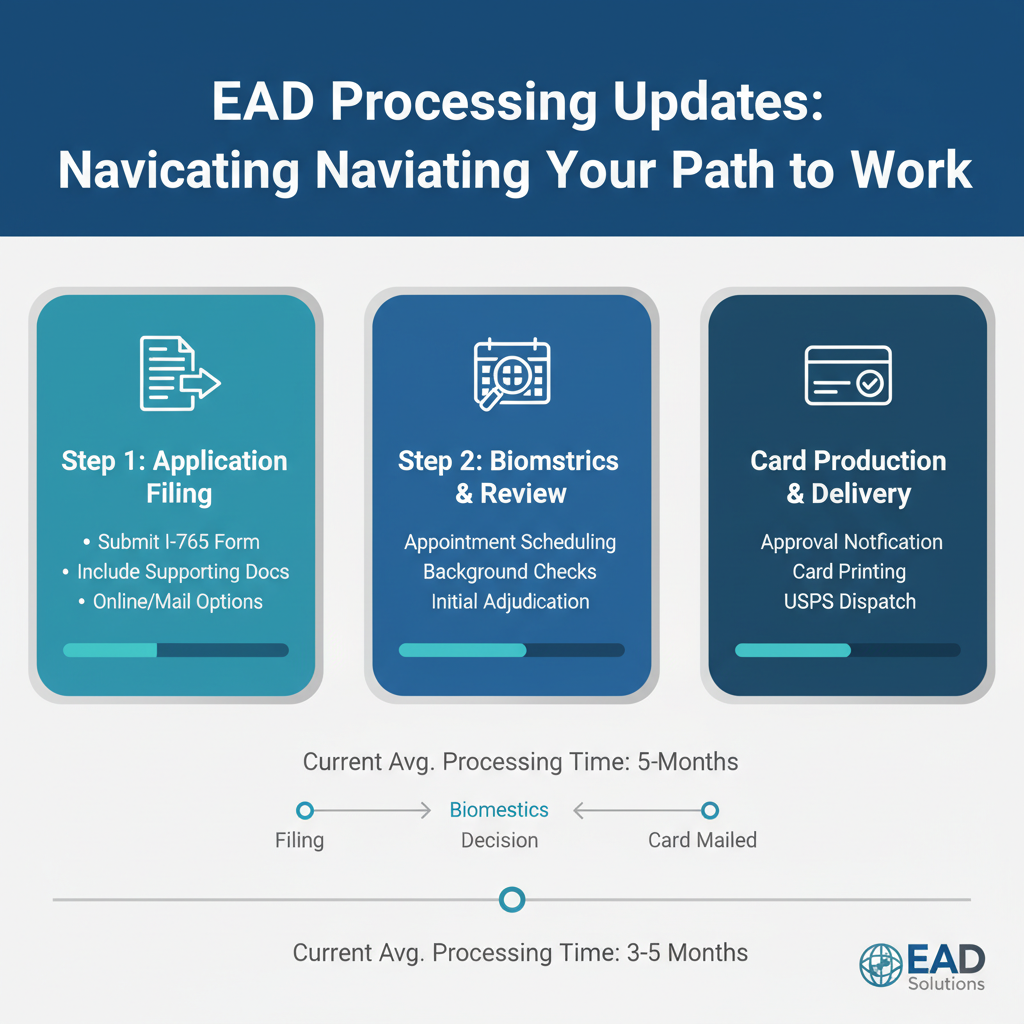
EAD processing times fluctuate significantly. While USCIS has made efforts to reduce backlogs, current processing times can still range from a few months to over a year, depending on the service center and your eligibility category. For example, some categories might see processing in 3-5 months, while others could be 10-15 months or more.
- Check Online: The USCIS Processing Times page is your best resource for current estimates. Select Form I-765 and your specific service center.
- Automatic Extensions: Be aware if your category is eligible for an automatic extension of your EAD while your renewal is pending. This is typically indicated on your Form I-797C receipt notice. For many categories, this extension is 540 days from the expiration date printed on the EAD card.
- Plan Ahead: Because of potential delays, it is critical to plan your EAD renewal well in advance of its expiration date. This will help prevent gaps in employment authorization.
How Imigrar Helps Immigrants in Orlando
The complexities of immigration law, especially with frequent updates from USCIS, can be overwhelming. At Imigrar, we specialize in simplifying this process for our clients, ensuring their applications are accurate, complete, and filed efficiently.
Our experienced legal team understands the nuances of EAD eligibility for various categories, from Adjustment of Status applicants to asylum seekers and DACA recipients. We are committed to providing personalized and compassionate legal representation to individuals and families in Orlando, Central Florida, and nationwide.
We assist with:
- Determining the correct EAD eligibility category.
- Accurately completing Form I-765 and all necessary supporting forms.
- Gathering and organizing all required documentation.
- Responding to Requests for Evidence (RFEs) from USCIS.
- Monitoring case status and providing updates.
- Strategizing for timely renewals to prevent gaps in employment.
Our expertise extends to navigating the local considerations for immigrants in the Orlando area, including understanding the processes at the Orlando USCIS Field Office and how EADs impact state-level benefits like driver's licenses.
We believe in keeping families together by ensuring every eligible member has the opportunity to work legally and build a stable future in the United States. We offer a free consultation to discuss your specific EAD needs and outline how we can help.
Se Habla Español. Our bilingual team is ready to serve the diverse communities of Florida.
Ready to secure your work authorization? Don't risk delays or denials. Contact Imigrar today for a free consultation. Call us at +1 786-791-3106 or reach out online. We are here to help you every step of the way. Se Habla Español.

Frequently Asked Questions
Q: Who is eligible to apply for an EAD?
A: Eligibility for an EAD depends on your specific immigration status or the type of immigration application you have pending. Common categories include applicants for Adjustment of Status (green card), asylum seekers, DACA recipients, certain nonimmigrant spouses (like H-4 spouses), F-1 students seeking Optional Practical Training (OPT), and individuals with Temporary Protected Status (TPS). Each category has distinct requirements. It's crucial to identify your correct eligibility category before filing Form I-765. Consulting an attorney can help clarify your specific eligibility.
Q: How does getting an EAD impact my immigration status?
A: An EAD itself does not grant you permanent immigration status. It merely authorizes you to work legally in the U.S. based on an underlying immigration status or application. For example, if you have an EAD because you are an asylum applicant, your EAD is tied to your pending asylum case. If you have an EAD based on a pending Adjustment of Status application, your EAD is valid as long as your green card application is pending. If your underlying application is denied, your EAD may be revoked or expire, and you would lose your work authorization unless you have another basis for it. It's essential to maintain your underlying status or application.
Q: What are the current processing times for EAD applications and renewals?
A: EAD processing times vary significantly based on the USCIS service center handling your application and your specific eligibility category. While USCIS has implemented measures to reduce backlogs, times can range from a few months to over a year. For the most up-to-date information, always check the USCIS Processing Times page online. You will need to select Form I-765 and the service center processing your case (which you can usually find on your receipt notice). For renewals, it's highly recommended to file within the 180-day window before your current EAD expires, as some categories may be eligible for an automatic extension of up to 540 days.
Q: What documents are typically required for an EAD application or renewal?
A: While specific documents vary by eligibility category, general requirements for Form I-765 typically include: a copy of your Form I-94 (Arrival/Departure Record), a copy of your most recent EAD (if renewing), copies of other government-issued photo identification (like a passport), two identical passport-style photographs taken recently, and specific evidence proving your eligibility for the EAD (e.g., receipt notice for Form I-485 or asylum application, marriage certificate, I-20 for F-1 OPT, H-1B approval for H-4 EAD). Always provide clear photocopies, not originals


