

Navigating the U.S. immigration system can be a complex journey, especially when it comes to securing the authorization needed to work legally. For countless immigrants across Florida and the nation, the Employment Authorization Document (EAD), often referred to as a work permit, is a critical component of building a stable life in the United States. Recent updates from U.S. Citizenship and Immigration Services (USCIS) regarding EAD application and renewal processing have brought both new challenges and opportunities for applicants.
At Imigrar, an immigration law firm based in Orlando, Florida, our mission is to Keep Families Together by providing expert legal guidance and support. We understand the profound impact that EAD processing times have on individuals and families, affecting everything from financial stability to mental well-being. This comprehensive guide delves into the latest developments, offering practical advice, detailed steps, and essential information to help you understand and successfully navigate the EAD process.
The reporting that sparked this guide
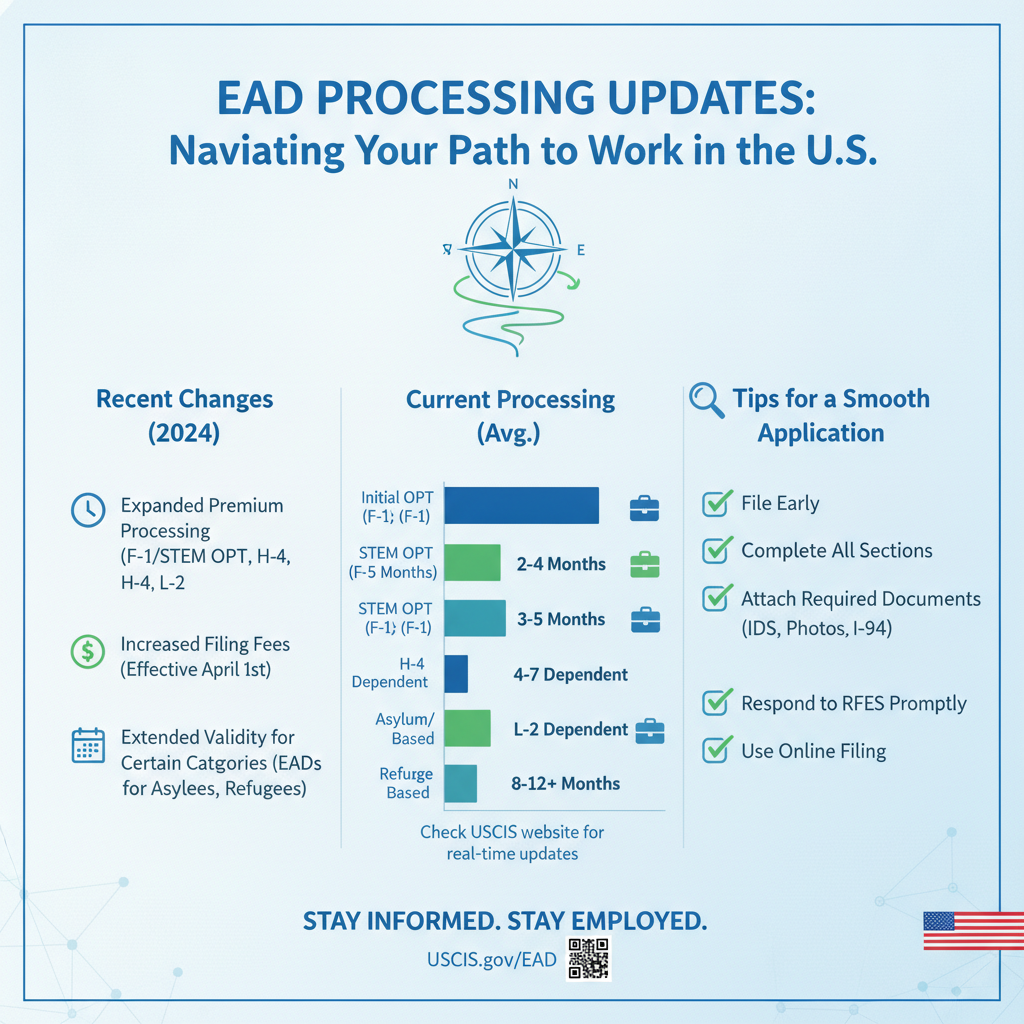
The information and insights provided in this article are inspired by ongoing discussions and updates concerning Employment Authorization Document Processing (USCIS), reflecting USCIS's continuous efforts to streamline processes and address backlogs. These updates are crucial for anyone seeking or renewing their work authorization in the United States.
What This News Means for Immigrants in Orlando and Across Florida
For immigrants residing in Orlando, Central Florida, and throughout the Sunshine State, the efficiency and predictability of the EAD processing system are paramount. The ability to work legally is often the cornerstone of financial independence and integration into American society.
Why this news is showing up now
USCIS, like many government agencies, is constantly evaluating and adjusting its operational strategies to improve service delivery. Recent news regarding EAD processing often highlights initiatives aimed at reducing backlogs, enhancing digital systems, and providing clearer guidance to applicants. These updates are a direct response to the persistent challenges of high application volumes, resource allocation, and the need for more efficient processing methods. Furthermore, policy changes or shifts in national priorities can also influence processing times and procedures, making it vital for applicants to stay informed about the latest USCIS announcements.
How it can affect Florida residents
For individuals living in Florida, especially those in bustling metropolitan areas like Orlando, Tampa, and Miami, EAD processing updates have direct and significant implications:
- Employment Opportunities: Faster processing means quicker access to legal employment, allowing individuals to secure jobs, support their families, and contribute to Florida's economy without undue delay. Conversely, prolonged processing times can lead to job loss, financial hardship, and uncertainty.
- Economic Stability: The ability to work legally provides economic stability, enabling families to pay bills, purchase homes, and invest in their future. Delays can disrupt this stability, forcing families to rely on limited resources or assistance.
- Planning and Certainty: Knowing what to expect regarding processing timelines allows individuals and families to plan their lives more effectively, from educational pursuits to long-term residency goals. Uncertainty can cause significant stress and hinder planning.
- Local USCIS Impact: While EAD applications are generally processed at service centers, local field offices, such as the Orlando USCIS Field Office, may be involved in related processes like biometrics appointments or interviews for underlying immigration benefits (e.g., Adjustment of Status). Any changes in USCIS policy or processing priorities can indirectly affect the caseloads and appointment availability at these local offices.
- Community Impact: A more efficient EAD system benefits the entire community by fostering economic growth and reducing the social and financial strain on individuals and support services. Florida's diverse immigrant population relies heavily on these work authorizations to thrive.
Need Help? Our Orlando immigration team is ready to assist. Call +1 786-791-3106 for a free consultation, or message us online. Se Habla Español.
What Employment Authorization Document (EAD) Is (and Why It Matters)
The Employment Authorization Document, commonly known as an EAD or work permit, is a crucial document issued by USCIS that grants non-citizens permission to work legally in the United States for a specific period. It is essentially a physical card that serves as proof of your authorization to be employed.
A plain-English definition
Think of the EAD as your official "permission slip" from the U.S. government to get a job. It's a photo ID card, similar to a driver's license, that explicitly states you are allowed to work in the U.S. for a certain timeframe. Without it, most non-citizens are prohibited from working, with severe penalties for both the employee and the employer.
Key terms you need to know
Understanding these terms is vital for navigating the EAD process:
- EAD (Employment Authorization Document): The official card issued by USCIS, also known as a work permit.
- Form I-765, Application for Employment Authorization: This is the primary form you must file with USCIS to request an EAD.
- USCIS (U.S. Citizenship and Immigration Services): The government agency responsible for processing EAD applications and other immigration benefits. You can find more information on the USCIS official website.
- Eligibility Category: USCIS assigns specific categories to different groups of non-citizens who are eligible for an EAD. Examples include asylum seekers, refugees, individuals with pending Adjustment of Status applications (Form I-485), certain nonimmigrant visa holders (e.g., F-1 students with OPT), and others. Your eligibility category determines the specific requirements and duration of your EAD.
- Processing Times: The amount of time USCIS takes to review and make a decision on your application. These times can vary significantly based on the service center, eligibility category, and current workload. Always check USCIS Processing Times for the most current information.
- Receipt Notice (Form I-797C): A notice sent by USCIS acknowledging that they have received your application. It contains your receipt number, which is essential for tracking your case.
- Biometrics Appointment: An appointment at an Application Support Center (ASC) where USCIS collects your fingerprints, photograph, and signature for background checks.
- Request for Evidence (RFE): A letter from USCIS asking for additional documents or information to support your application.
- Automatic Extension: In some cases, USCIS provides an automatic extension of an expiring EAD for certain eligibility categories, provided you filed a timely renewal application. This allows you to continue working legally while your renewal is pending.
Current Immigration Law: The Foundation
The authority for granting Employment Authorization Documents stems from various sections of the Immigration and Nationality Act (INA) and subsequent regulations. The ability to work in the U.S. is not a universal right for non-citizens; it is specifically granted based on one's immigration status or the filing of certain immigration applications.
Federal requirements
The primary legal framework for EADs is found in 8 CFR § 274a.12, which outlines the classes of aliens authorized to accept employment. This regulation details who is eligible for employment authorization, with or without specific USCIS authorization. For most applicants, particularly those with pending immigration benefits, an EAD is required. The key federal requirement is that an individual must fall into one of the designated eligibility categories to apply for an EAD using Form I-765.
Common eligibility categories include:
- (c)(9) – Adjustment of Status Applicants: Individuals who have filed Form I-485, Application to Register Permanent Residence or Adjust Status. This is one of the most common categories, allowing applicants to work while awaiting a decision on their green card.
- (a)(5) – Asylees and Refugees: Individuals granted asylum or refugee status.
- (c)(8) – Asylum Seekers: Individuals with a pending asylum application (Form I-589) who have waited at least 180 days since filing.
- (c)(3)(i) – F-1 Students with Optional Practical Training (OPT): International students authorized to work in their field of study after graduation.
- (c)(14) – Deferred Action for Childhood Arrivals (DACA): Individuals granted DACA status.
- (a)(11) – Parolees: Individuals paroled into the U.S. for humanitarian reasons or significant public benefit.
- (c)(18) – Certain Nonimmigrants: Spouses of E, L-1, or H-1B visa holders (e.g., EAD for L-2 spouses).
Each category has specific requirements regarding the underlying immigration status, the filing of other forms, and sometimes a waiting period. It is crucial to correctly identify your eligibility category on Form I-765.
The processing of these applications takes place at one of the USCIS Service Centers (e.g., Nebraska, Texas, California, Vermont), not typically at local field offices like the Orlando USCIS Field Office, unless there's an interview related to the underlying immigration benefit.
Florida-specific considerations
While EAD eligibility is determined by federal law, there are practical considerations for Florida residents:
- Local Resources: Immigrants in Central Florida can access various community organizations that offer assistance with immigration forms, although consulting with an attorney is always recommended.
- State ID and Driver's Licenses: Once you have your EAD, you can use it to apply for a Florida driver's license or state identification card, which is essential for daily life and travel within the state. The Florida Department of Highway Safety and Motor Vehicles (FLHSMV) will require proof of your legal presence and work authorization.
- Employer Compliance: Florida employers, like all U.S. employers, are legally required to verify the employment authorization of all new hires using Form I-9, Employment Eligibility Verification. Your EAD is one of the primary "List A" documents for this purpose.
- Economic Landscape: Florida's diverse economy, particularly in sectors like tourism, agriculture, and healthcare, relies on a workforce that includes many immigrants. Having a valid EAD allows individuals to fully participate in these vital industries, especially in areas along the I-4 corridor from Orlando to Tampa.
Always ensure you are consulting the most up-to-date information from the USCIS official website for forms and regulations. For specific legal advice tailored to your situation, an experienced immigration attorney like those at Imigrar can provide invaluable guidance.
How to Apply for or Renew Your EAD: A Complete Step-by-Step Guide
The process for applying for an initial EAD or renewing an existing one is largely similar, centered around filing Form I-765. Attention to detail and thorough preparation are key to a successful application.
1) Determine Your Eligibility and Category
Before you even touch Form I-765, you must confirm that you are eligible for an EAD and identify the correct eligibility category. This is arguably the most critical first step. Your eligibility is tied to your current immigration status or the immigration benefit you have applied for.
- Review USCIS Guidelines: Visit the USCIS website for Form I-765 and its instructions. Pay close attention to the "Who May File Form I-765" section, which lists all eligible categories.
- Identify Your Category Code: For example, if you have a pending Form I-485 (Adjustment of Status), your category is typically (c)(9). If you are an F-1 student applying for OPT, it's (c)(3)(i) or (c)(3)(ii). Incorrectly identifying your category can lead to delays or denial.
- Consult an Attorney: If you are unsure about your eligibility or category, especially for complex cases, seek legal advice. An attorney can help you understand your options and ensure you qualify.
2) Gather All Required Documents
Once you know your eligibility, start collecting all necessary supporting documents. This can take time, so begin early. The exact documents vary by eligibility category, but generally include:
- Proof of Identity and Nationality:
- Copy of your birth certificate with a certified translation (if not in English).
- Copy of your passport biographical page.
- Copies of any previous EAD cards (front and back).
- Copy of Form I-94, Arrival/Departure Record (front and back, or printout from CBP website).
- Copy of your visa (if applicable).
- Proof of Eligibility for the Specific Category:
- For (c)(9) Adjustment of Status applicants: Copy of your Form I-797C Receipt Notice for Form I-485.
- For (c)(8) Asylum applicants: Copy of your Form I-797C Receipt Notice for Form I-589 (Asylum Application).
- For F-1 OPT (c)(3) applicants: Copy of your Form I-20, Certificate of Eligibility for Nonimmigrant Student Status, with the OPT recommendation from your Designated School Official (DSO).
- For DACA (c)(33) applicants: Copy of your most recent Form I-797C Approval Notice for Form I-821D, Consideration of Deferred Action for Childhood Arrivals.
- For Spouses of Visa Holders (e.g., L-2, E): Copy of your spouse's visa, Form I-797 Approval Notice for their status, and your marriage certificate.
- Photographs: Two identical passport-style photos (2x2 inches) taken within the last 30 days. Write your name and A-number (if you have one) lightly on the back of each photo.
- Previous EAD (for renewals): A copy of the front and back of your most recent EAD card.
- Proof of Prior Employment Authorization (if applicable): Any previous EADs or documentation of work authorization.
- Translation Requirements: Any document not in English must be accompanied by a complete and accurate English translation and a certification by the translator that they are competent to translate and that the translation is accurate.
3) Complete Form I-765, Application for Employment Authorization
Fill out Form I-765 carefully and accurately. You can download the latest version from the USCIS Forms page. You can type directly into the PDF or print and fill it out neatly in black ink.
- Personal Information: Provide your full legal name, address (ensure it's current, as this is where your EAD will be mailed), date of birth, country of birth, and A-number (if you have one).
- Application Type: Check the box indicating whether you are applying for "Permission to accept employment," "Replacement of lost, stolen, or damaged EAD," or "Renewal of my permission to accept employment."
- Eligibility Category: Enter your correct eligibility category (e.g., (c)(9), (c)(8), (c)(3)(i)). For some categories, additional specific sub-categories or details may be required in Part 2, Item 27.
- Biographic Information: Provide details about your parents, marital status, and prior applications.
- Review and Sign: Double-check every field for accuracy. An unsigned form or one with errors can lead to rejection or delays. Make sure to sign in blue ink.
Need Help? Our Orlando immigration team is ready to assist. Call +1 786-791-3106 for a free consultation, or message us online. Se Habla Español.
4) Calculate and Prepare Your Filing Fee
As of 2026, the filing fee for Form I-765 is subject to change, so always check the USCIS website for the current fee. Some categories, such as asylum applicants, may be exempt from the fee. If you are filing Form I-765 concurrently with Form I-485, the EAD fee is often included in the Form I-485 filing fee.
- Payment Method: You can pay by money order, personal check, cashier's check, or by credit card using Form G-1450, Authorization for Credit Card Transactions.
- Make Payable To: "U.S. Department of Homeland Security." Do not abbreviate.
- Fee Waiver: If you are experiencing financial hardship, you may be eligible for a fee waiver by filing Form I-912, Request for Fee Waiver. This is typically available for certain categories, like asylum seekers.
5) Assemble and Mail Your Application Package
Organize your application package meticulously. USCIS receives thousands of applications daily, and a well-organized submission can help prevent delays.
- Order of Documents:
- Payment (check, money order, or Form G-1450) on top.
- Two passport-style photos in a small envelope clipped to the top left corner of Form I-765 (do not staple photos directly).
- Completed and signed Form I-765.
- Copies of all supporting documents as listed above, organized by type.
- Any other required forms (e.g., Form G-1145, E-Notification of Application/Petition Acceptance, if you want email/text notifications).
- Mailing Address: Send your application to the correct USCIS lockbox facility. The address depends on your eligibility category and where you reside (e.g., for Florida residents, it might be the Dallas Lockbox for certain categories). Always verify the correct "Where to File" address on the USCIS website for Form I-765.
- Send with Tracking: Use a service that provides tracking and delivery confirmation (e.g., USPS Certified Mail, FedEx, UPS). Keep a copy of the entire application package for your records.
6) Attend Your Biometrics Appointment (If Required)
After USCIS accepts your application, you will typically receive a Form I-797C, Appointment Notice, for a biometrics appointment at an Application Support Center (ASC) near you. For Orlando residents, this would likely be the ASC located in the greater Orlando area. This appointment is mandatory for most applicants.
- What to Bring: Your appointment notice, a valid photo ID (passport, state ID, driver's license), and any other documents specified in the notice.
- Purpose: USCIS collects your fingerprints, photograph, and signature to conduct background and security checks.
- Rescheduling: If you cannot attend your scheduled appointment, you must follow the instructions on the notice to request a reschedule. Delays in rescheduling can prolong your processing time.
7) Respond to Requests for Evidence (RFEs) and Await Decision
After your biometrics, your application will be adjudicated by USCIS. During this time, USCIS may send you an RFE if they need more information or clarification. Promptly and thoroughly respond to any RFE by the deadline provided.
- Check Processing Times: Regularly check the USCIS Processing Times tool online. Select Form I-765, your eligibility category, and the service center processing your case (indicated on your receipt notice).
- Online Case Status: Use your receipt number (from Form I-797C) to track your case status on the USCIS Case Status Online tool.
- Approval and Card Production: If approved, USCIS will send you an approval notice, followed by your EAD card in the mail.
- Denial: If your application is denied, USCIS will send a denial letter explaining the reasons. You may have options to appeal or refile, but consulting an attorney is crucial at this stage.
Practical Steps You Can Take Today
Proactive preparation and awareness can significantly smooth your EAD application process. Here's what you can do:
- Start Early for Renewals: If you need to renew your EAD, begin the process at least 120 to 180 days before your current card expires. USCIS typically recommends filing 6 months in advance due to fluctuating processing times. This is especially critical for those eligible for automatic extensions.
- Verify Eligibility for Automatic Extension: Check if your eligibility category qualifies for an automatic extension of your EAD. If so, filing a timely renewal allows you to continue working for up to 540 days (as of temporary rule updates) beyond your card's expiration date, while your renewal is pending. Keep your expiring EAD and the Form I-797C Receipt Notice for your renewal application as proof.
- Organize Your Documents: Create a dedicated file for all immigration-related documents. Make copies of everything you send to USCIS.
- Use the Latest Forms: Always download Form I-765 directly from the USCIS Forms page to ensure you are using the most current version. Outdated forms will be rejected.
- Check Filing Fees: Confirm the current filing fee on the USCIS website. Fees can change periodically.
- Set Up Online Accounts: Create a USCIS online account to track your case, receive notifications, and potentially file certain forms online (if applicable for EAD).
- Consult an Attorney: If you have any doubts about your eligibility, the correct category, or how to respond to an RFE, do not hesitate to contact an experienced immigration attorney.
- Update Your Address: If you move, promptly update your address with USCIS by filing Form AR-11, Alien's Change of Address Card, and by updating your address for any pending applications online. Failure to do so could result in missed notices or your EAD card being sent to the wrong address.
Document Preparation Guidance
- No Originals (Unless Requested): Never send original documents unless USCIS specifically requests them. Always send clear photocopies.
- High-Quality Copies: Ensure all copies are legible and complete. If a document has information on both sides, copy both sides.
- Translations: For any document not in English, provide a certified English translation. The translator must sign a statement certifying their competence and the accuracy of the translation.
- Keep a Copy: Always keep a complete copy of your entire application package, including the signed forms and all supporting documents, for your personal records.
Timeline Expectations
Warning: EAD processing times can fluctuate significantly and are highly dependent on your eligibility category and the service center handling your case. While USCIS strives to improve efficiency, delays are still possible.
- Initial Receipt Notice: You should receive a Form I-797C Receipt Notice within 2-4 weeks of filing.
- Biometrics Appointment: If required, an appointment notice typically arrives 3-8 weeks after the receipt notice. The actual appointment might be scheduled a few weeks after the notice.
- Adjudication: This is the longest phase. Check USCIS Processing Times for the most current estimates. Times can range from a few months to over a year, depending on the category and current backlogs.
- Card Production: Once approved, it usually takes 7-14 days for the EAD card to be produced and mailed.
- Automatic Extension Note: If eligible for an automatic extension, your timely filed renewal (and its receipt notice) plus your expired EAD card will serve as proof of continued work authorization for up to 540 days (as of late 2026, always verify current policy). This is a vital safeguard for many Florida workers.
How Imigrar Helps Immigrants in Orlando
At Imigrar, we understand the challenges and anxieties that come with navigating the U.S. immigration system. Our dedicated team of immigration attorneys in Orlando is committed to providing compassionate, comprehensive, and effective legal representation to individuals and families across Florida and nationwide.
Our experience and expertise
Our firm specializes in a wide range of immigration matters, including family-based petitions, employment visas, Adjustment of Status, EAD applications, and more. We stay up-to-date with the latest USCIS policies and immigration laws to provide accurate and timely advice. For Central Florida residents, our local presence means we are familiar with the specific needs and resources available in the community, including the procedures at the Orlando USCIS Field Office (for related matters) and local Application Support Centers.
We pride ourselves on clear communication, ensuring our clients understand every step of their immigration journey, whether they are in Orlando, along the I-4 corridor, or anywhere else in the country.
Free consultation offer
We believe that everyone deserves access to expert legal advice. That's why Imigrar offers a free initial consultation. This is an opportunity for you to discuss your EAD application or renewal concerns, understand your eligibility, and learn how our firm can assist you. We will assess your specific situation, explain the process, and outline a clear path forward.
Don't face the complexities of immigration law alone. Let our experienced team guide you. Se Habla Español. Our bilingual staff ensures that language is never a barrier to receiving the support you need.
Need Help? Our Orlando immigration team is ready to assist. Call +1 786-791-3106 for a free consultation, or message us online. Se Habla Español.
Frequently Asked Questions
Q: Who is eligible for an Employment Authorization Document (EAD)?
A: Eligibility for an EAD depends on your immigration status or the specific immigration benefit you have applied for. Common eligible categories include individuals with pending Adjustment of Status applications (Form I-485), asylum seekers (after 180 days), refugees, DACA recipients, F-1 students seeking Optional Practical Training (OPT), and spouses of certain visa holders (e.g., L-2, E). It's crucial to identify your specific eligibility category on Form I-765. Always check the USCIS website or consult an attorney to confirm your eligibility.
Q: How does my immigration status impact my EAD application?
A: Your current immigration status directly determines your eligibility category for an EAD. For example, if you are in the process of applying for a green card through Adjustment of Status, your EAD is typically tied to that pending application. If your underlying immigration status changes or is denied, it


