


The reporting that sparked this guide: Employment Authorization Document Processing (USCIS)
What This News Means for Immigrants in Orlando and Across Florida
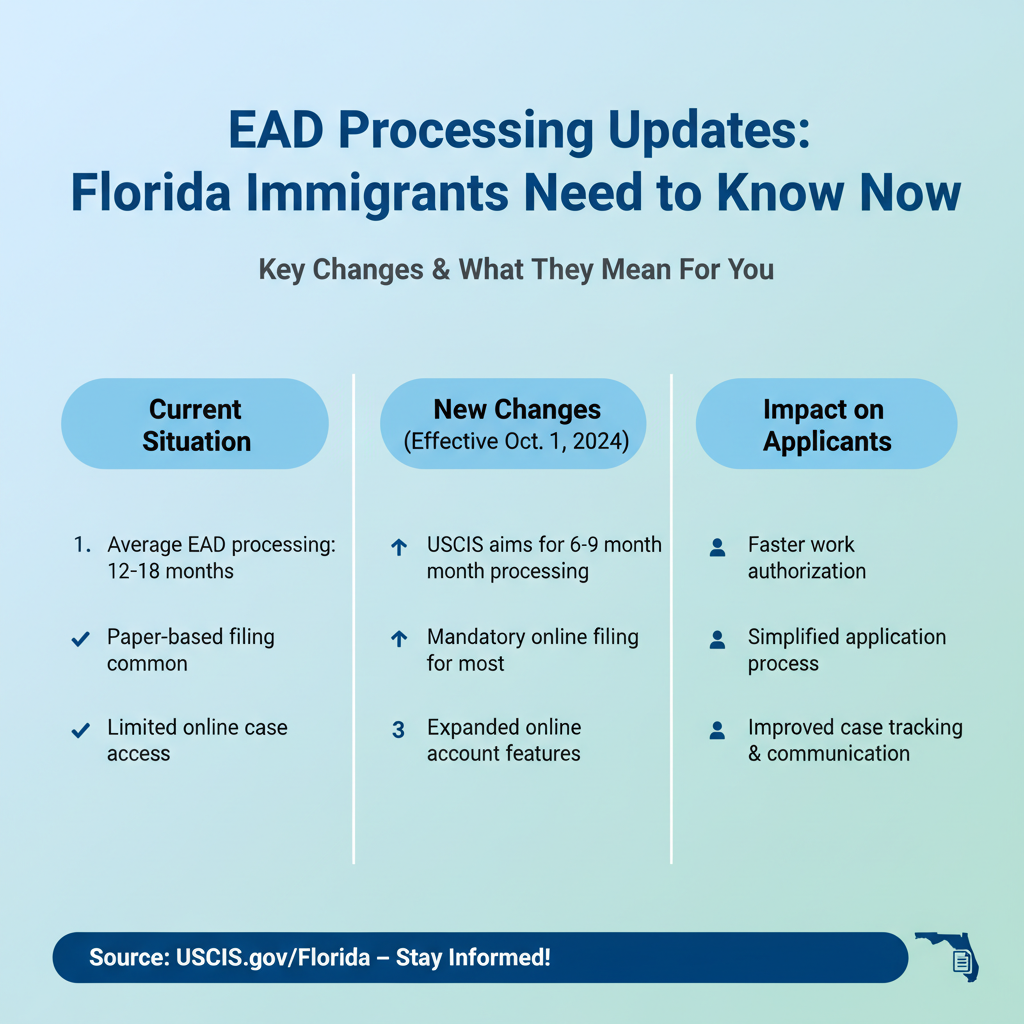
For many immigrants seeking to build a life in the United States, the ability to work legally is not just a privilege—it's a necessity. An Employment Authorization Document (EAD), often referred to as a "work permit," is the key to this opportunity. Recent updates and ongoing discussions from U.S. Citizenship and Immigration Services (USCIS) regarding EAD application and renewal processing are critical for thousands of individuals and families in Orlando, throughout Florida, and across the nation.
Why this news is showing up now
The landscape of immigration processing is constantly evolving, and EADs are no exception. Over the past few years, USCIS has faced unprecedented backlogs, leading to extended processing times for many immigration benefits, including EADs. In response, USCIS has implemented various strategies and policy adjustments aimed at improving efficiency, reducing wait times, and addressing specific challenges. These efforts include:
- Temporary Final Rules: USCIS has, at times, issued temporary final rules to extend the validity period of certain EAD categories and the automatic extension period for EAD renewals. These measures are designed to prevent eligible individuals from losing their work authorization while their renewal applications are pending.
- Increased Staffing and Technology: Investments in hiring new personnel and upgrading technological infrastructure are ongoing efforts to streamline operations and handle a higher volume of applications more efficiently.
- Focus on Backlog Reduction: USCIS has publicly committed to reducing backlogs across various form types, with EADs being a significant priority due to their direct impact on individuals' livelihoods.
- Policy Clarifications: Continuous updates and clarifications on eligibility criteria, required documentation, and filing procedures are common, reflecting USCIS's efforts to standardize and expedite processing.
These ongoing adjustments mean that what was true about EAD processing a year ago might not be entirely accurate today. Staying informed is paramount to ensuring your application is processed as smoothly as possible.
How it can affect Florida residents
Florida, with its vibrant and diverse immigrant communities, is particularly impacted by these EAD processing updates. Thousands of individuals in Orlando, Tampa, Miami, and other cities rely on their EADs to work, support their families, and contribute to the local economy. Here’s how these changes can specifically affect residents in the Sunshine State:
- Employment Stability: For those whose EADs are expiring, understanding automatic extension rules and current processing times is crucial to maintaining continuous employment. A lapse in work authorization can lead to job loss, financial hardship, and stress for families in Central Florida.
- Economic Contribution: Immigrants with valid EADs contribute significantly to Florida's workforce, filling essential roles in tourism, hospitality, agriculture, healthcare, and many other sectors. Efficient EAD processing helps maintain a stable labor force.
- Planning and Uncertainty: Longer processing times or unpredictable policy changes can create significant uncertainty for individuals planning their careers or financial futures. Knowing the current status and potential relief options is vital.
- Local USCIS Impact: The Orlando USCIS Field Office, while primarily handling interviews for certain applications, is part of the broader national system. Changes at the national level regarding EAD processing directly influence the experiences of applicants whose files are handled by service centers across the country. For Central Florida residents, understanding these national trends helps manage local expectations.
At Imigrar, we understand the profound impact these updates have on your life. Our team in Orlando is dedicated to helping you navigate these changes, ensuring you have the most accurate and up-to-date information to protect your right to work.
Need Help? Our Orlando immigration team is ready to assist. Call +1 786-791-3106 for a free consultation, or message us online. Se Habla Español.
What Employment Authorization Documents (EADs) Are (and Why They Matter)
An Employment Authorization Document, or EAD, is a permit issued by USCIS that grants non-citizens permission to work legally in the United States for a specific period. It is often referred to simply as a "work permit." For many immigrants, obtaining an EAD is a critical step towards financial independence and integrating into American society.
A plain-English definition
Simply put, an EAD is a card that proves you are allowed to work in the U.S. If you are not a U.S. citizen or a lawful permanent resident (Green Card holder), you generally need an EAD to accept employment legally. The card itself looks similar to a driver's license, containing your photo, name, birthdate, and an expiration date. It specifies that you are authorized to work.
It's crucial to understand that an EAD is not a green card and does not grant you permanent residency or a specific immigration status. Instead, it is a benefit granted to individuals who already hold a specific underlying immigration status or have a pending application that makes them eligible for work authorization.
Key terms you need to know
Navigating the EAD process involves understanding several specific terms:
- USCIS (U.S. Citizenship and Immigration Services): The government agency responsible for overseeing lawful immigration to the United States. They process EAD applications. You can find more information on the USCIS official website.
- EAD (Employment Authorization Document): The official term for a work permit.
- Form I-765, Application for Employment Authorization: The specific form you must file with USCIS to request an EAD. This form is central to the entire process. You can find this and other forms at USCIS Forms.
- Eligibility Category: USCIS assigns a specific category code (e.g., (c)(9) for Adjustment of Status applicants, (c)(3)(C) for F-1 OPT) to each EAD applicant based on their immigration status or pending application. Your eligibility category determines your right to work and the validity period of your EAD.
- Initial EAD: Your first EAD application based on a particular eligibility.
- EAD Renewal: An application to extend your existing EAD when it's nearing expiration.
- Automatic Extension: For certain eligibility categories, if you file a renewal application before your current EAD expires, USCIS may grant an automatic extension of your work authorization for a specific period (e.g., up to 540 days, though this period can change based on temporary rules).
- RFE (Request for Evidence): A notice from USCIS requesting additional documents or information to support your application. Promptly responding to an RFE is critical.
- Expedited Processing: In very limited circumstances, USCIS may agree to speed up the processing of an EAD application if certain criteria (e.g., severe financial loss, humanitarian reasons) are met.
- Adjustment of Status (AOS): The process of applying for a Green Card while physically present in the U.S. Many AOS applicants are eligible for an EAD while their application is pending.
- Advance Parole: A travel document that allows certain non-citizens to re-enter the U.S. after traveling abroad without abandoning their pending adjustment of status application. An EAD is often combined with Advance Parole on a "combo card."
Understanding these terms is the first step in successfully navigating the EAD application or renewal process. It empowers you to better understand the instructions, communicate with USCIS, and work effectively with your legal counsel.
Current Immigration Law: The Foundation of EADs
The authority for USCIS to grant employment authorization stems from various sections of the Immigration and Nationality Act (INA) and corresponding regulations in the Code of Federal Regulations (CFR). These laws define who is eligible to work in the U.S. and under what conditions.
Federal requirements
The primary federal regulation governing EAD eligibility is 8 CFR § 274a.12, "Classes of aliens authorized to accept employment." This regulation lists numerous categories of non-citizens who are eligible to apply for an EAD. These categories are diverse and include, but are not limited to:
- Asylees and Refugees: Individuals granted asylum or refugee status, and those with pending asylum applications.
- Spouses and Children of Certain Visa Holders: Dependents of certain nonimmigrant visa holders (e.g., L-2, E-2 spouses, H-4 spouses under specific conditions).
- F-1 Students: Those authorized for Optional Practical Training (OPT) or Curricular Practical Training (CPT).
- Applicants for Adjustment of Status: Individuals with a pending Form I-485, Application to Register Permanent Residence or Adjust Status. This is one of the most common categories for EAD applications.
- Individuals Granted Temporary Protected Status (TPS): Nationals of designated countries who cannot return safely to their home country.
- DACA Recipients: Individuals granted Deferred Action for Childhood Arrivals.
- Parolees: Individuals paroled into the U.S. for humanitarian reasons or significant public benefit.
- U-Visa and T-Visa Applicants: Victims of certain crimes or human trafficking.
Each category has specific requirements regarding the underlying status or pending application that must be met. The EAD itself is requested by filing Form I-765, Application for Employment Authorization. The instructions for this form detail the specific documentation required for each eligibility category.
Important: Eligibility for an EAD is tied to your underlying immigration status or application. If that underlying status or application is denied, revoked, or withdrawn, your EAD may also be affected or terminated.
Florida-specific considerations
While EAD eligibility and processing are governed by federal immigration law, there are some Florida-specific considerations that immigrants should be aware of:
- State ID and Driver's Licenses: Once you have your EAD, you can use it as proof of identity and work authorization to apply for a Florida driver's license or state identification card. This is crucial for daily life, transportation along the I-4 corridor, and many job requirements in Orlando and other areas.
- Employment Verification (E-Verify): Many employers in Florida, particularly larger ones or those with state contracts, use E-Verify to confirm the employment eligibility of their new hires. Your EAD will be used in this process.
- Local Economy and Job Market: The types of jobs available in Central Florida, particularly in the tourism, hospitality, and service industries, often require immediate proof of work authorization. Having a valid EAD is essential for securing employment in these sectors.
- Legal Counsel: While the law is federal, having local counsel familiar with the nuances of how USCIS processes applications affecting Florida residents can be invaluable. Imigrar, based in Orlando, is well-versed in assisting clients throughout the state.
Remember, an EAD allows you to work, but it does not dictate the terms of your employment. You are subject to Florida labor laws and employer requirements just like any other employee.
Need Help? Our Orlando immigration team is ready to assist. Call +1 786-791-3106 for a free consultation, or message us online. Se Habla Español.
How to Apply for or Renew Your EAD: A Complete Step-by-Step Guide
Applying for an initial EAD or renewing an expiring one requires careful attention to detail. Follow these steps to maximize your chances of a smooth process.
1) Determine Your Eligibility Category
Before you do anything else, you must confirm that you are eligible for an EAD and identify your specific eligibility category. This is the foundation of your application. Review the instructions for Form I-765 carefully, or consult with an experienced immigration attorney.
- Check your underlying status: Are you an asylee, refugee, DACA recipient, or have a pending Form I-485 for Adjustment of Status?
- Identify the correct category code: For example, if you have a pending Form I-485, your category is typically (c)(9). If you are an F-1 student on OPT, it's (c)(3)(C).
- Verify current requirements: USCIS sometimes updates eligibility rules or requirements for specific categories. Always check the latest instructions on the USCIS official website.
2) Gather Required Documents
The documents you need will vary depending on your eligibility category, whether it's an initial application or a renewal, and your personal circumstances. However, common documents include:
- Form I-765, Application for Employment Authorization: Completed and signed.
- Proof of Identity and Nationality: Copy of your birth certificate, passport, national ID card, etc.
- Previous EAD (if renewing): A copy of the front and back of your most recent EAD card.
- I-94 Arrival/Departure Record: Copy of your most recent Form I-94. You can retrieve this electronically from the CBP website.
- Two Passport-Style Photos: Taken within 30 days of filing, with a white background. Write your A-Number and name lightly on the back.
- Proof of Eligibility (Crucial!): This is where it varies significantly by category.
- For pending I-485 (c)(9): Copy of your Form I-485 receipt notice.
- For Asylees/Refugees: Copy of asylum grant letter or refugee status document.
- For F-1 OPT (c)(3)(C): Copy of your Form I-20 with the DSO's recommendation for OPT, and any previous EADs for OPT.
- For H-4 spouse (c)(26): Copy of spouse's Form I-797 approval notice for H-1B, marriage certificate, and spouse's most recent I-94.
- Previous immigration documents: Copies of any prior visas, approval notices (e.g., Form I-797), or other immigration benefits.
- Filing Fee: Check the current fee on the USCIS website. You may be eligible for a fee waiver in certain circumstances (Form I-912).
Reminder: Always provide copies of documents, not originals, unless specifically requested by USCIS. If documents are not in English, they must be accompanied by a certified English translation.
3) Complete Form I-765, Application for Employment Authorization
This form must be filled out accurately and completely. Any errors or omissions can lead to delays or denials. You can download the latest version from the USCIS Forms page.
- Read the instructions carefully: They provide detailed guidance for each question and eligibility category.
- Use black ink: If filling out by hand. Typed forms are preferred.
- Answer all questions truthfully: If a question does not apply, write "N/A" (Not Applicable).
- Pay close attention to Section 2 (Information About Your Application): Clearly indicate if you are applying for initial permission, a replacement, or a renewal.
- Specify your eligibility category: Enter the correct code (e.g., (c)(9)) in Part 2, Item 27.
- Sign the form: An unsigned form will be rejected.
4) Prepare Your Application Package
Once you have all your documents and the completed Form I-765, assemble your application package in the correct order. USCIS recommends organizing documents for easy review.
- Cover Letter: (Optional, but recommended) A cover letter listing all the contents of your package can be helpful.
- Form I-765: On top.
- Filing Fee: Check or money order, or Form G-1450 for credit card payment.
- Supporting Documents: Organized by type or as listed in your cover letter.
- Copies: Make a complete copy of the entire package for your records before mailing. This is a critical step for future reference or if USCIS requests additional information.
5) File Your Application
Mail your complete application package to the correct USCIS lockbox facility. The mailing address depends on your eligibility category and where you live. Check the "Where to File" section of the Form I-765 instructions on the USCIS website.
- Use a trackable mailing service: Such as USPS Certified Mail with return receipt, FedEx, or UPS. This provides proof of mailing and delivery.
- Electronic Filing (if available): Some EAD categories allow for online filing (e-filing). Check the USCIS website to see if your category is eligible. E-filing can sometimes lead to faster receipt notices.
- Receipt Notice: After USCIS receives your application, they will send you a Form I-797C, Notice of Action, acknowledging receipt and providing a receipt number (e.g., "SRC," "LIN," "WAC"). This number is essential for tracking your case.
6) Attend Biometrics Appointment (if required)
For many EAD applicants, especially those applying concurrently with Form I-485, USCIS will send an appointment notice for a biometrics (fingerprints, photos, signature) appointment. This typically occurs at an Application Support Center (ASC).
- Attend promptly: Bring your appointment notice and a valid photo ID.
- Don't miss it: Failure to attend can lead to delays or denial of your application. If you have an unavoidable conflict, follow the instructions on the notice to reschedule.
7) Monitor Your Case and Respond to RFEs
After filing, you can monitor the status of your application online using the receipt number provided on your Form I-797C. Visit USCIS Case Status Online.
- Check processing times: Use the USCIS Processing Times tool to get an estimate of how long your application may take. Select Form I-765 and your eligibility category.
- Respond to RFEs: If you receive an RFE, respond promptly and provide all requested information. Failure to do so will almost certainly result in a denial.
- Notify USCIS of address changes: If you move while your application is pending, notify USCIS immediately using Form AR-11, Alien's Change of Address Card, and update your pending case online. For Central Florida residents, maintaining an up-to-date address is crucial for receiving all official correspondence.
Following these steps carefully will help ensure your EAD application or renewal is processed correctly. However, given the complexities and frequent updates, seeking legal assistance from an experienced immigration attorney is highly recommended.
Practical Steps You Can Take Today
Don't wait until your EAD is about to expire or until you need one urgently. Proactive planning can save you stress, time, and potential loss of employment.
Actionable checklist
- Verify Your EAD Expiration Date: If you have an EAD, note its expiration date and mark your calendar for a reminder to apply for renewal at least 180 days (and ideally 6 months) before it expires.
- Understand Your Eligibility: Research your specific EAD eligibility category and the requirements for initial or renewal applications. USCIS instructions for Form I-765 are your primary resource.
- Start Gathering Documents Now: Don't wait until the last minute. Collect copies of passports, I-94s, previous EADs, marriage certificates, birth certificates, and any underlying petition receipts (e.g., Form I-485 receipt).
- Check USCIS Processing Times: Regularly monitor the USCIS Processing Times page for Form I-765 in your specific eligibility category. This helps set realistic expectations.
- Consult an Immigration Attorney: Even if you think your case is straightforward, a consultation can identify potential issues, ensure correct filing, and advise on strategies like expediting (if applicable).
- Set Aside Funds for Filing Fees: The EAD filing fee can change. Check the current fee on the USCIS website and plan accordingly.
Document preparation guidance
- Keep Originals Safe: Always send copies of supporting documents, not originals, unless USCIS specifically requests them.
- Organize Clearly: Arrange your documents in a logical order, perhaps with a cover letter outlining the contents. Use tabs or labels if sending a large package.
- Certified Translations: Any document not in English must be accompanied by a complete and accurate English translation, certified by the translator. The certification must state that the translator is competent to translate and that the translation is accurate.
- High-Quality Copies: Ensure all copies are clear, legible, and complete. Blurry or cut-off documents can lead to RFEs.
- Make a Full Copy for Your Records: This cannot be stressed enough. Keep an identical copy of everything you send to USCIS.
Timeline expectations
EAD processing times can vary significantly based on the filing service center, eligibility category, and current USCIS workload. While USCIS aims to process EADs within reasonable timeframes, delays are common.
- Automatic Extensions: For many renewal categories, if you file Form I-765 before your current EAD expires, you might be eligible for an automatic extension of your work authorization (currently up to 540 days for certain categories, but always check the latest USCIS guidance). This is a critical safety net.
- USCIS Processing Times Tool: This is your best resource for current estimates. Navigate to egov.uscis.gov/processing-times, select Form I-765, and then your specific eligibility category.
- Expedite Requests: While possible, these are rarely granted and require compelling evidence of severe financial loss to a company or person, urgent humanitarian reasons, or other specific criteria. Discuss this option with an attorney.
- Plan Ahead: Because processing times can be long, it’s imperative to file your renewal application well in advance—ideally 6 months before expiration, or at least within the 180-day window for automatic extensions.
How Imigrar Helps Immigrants in Orlando and Beyond with EADs
At Imigrar, we understand that navigating the complexities of EAD applications and renewals can be daunting, especially with constantly changing regulations. Our mission, "Keep Families Together," extends to ensuring individuals can work legally and support their loved ones.
Our experience and expertise
Imigrar is an Orlando-based immigration law firm with extensive experience helping immigrants across Florida and nationwide. Our legal team specializes in various immigration matters, including:
- EAD Applications and Renewals: We guide clients through every step of filing Form I-765, ensuring accuracy and completeness for all eligibility categories.
- Adjustment of Status: Many EAD applications are tied to pending Green Card applications. We expertly handle both concurrent and standalone filings.
- Family-Based Immigration: Assisting families in Orlando, Orange County, and beyond to unite and establish legal status.
- Asylum and Refugee Cases: Providing compassionate and skilled representation for those seeking protection.
- Navigating Complex Cases: From RFEs to appeals, we are equipped to handle challenging situations and advocate for your rights.
We stay up-to-date with the latest USCIS policy changes, temporary rules affecting EAD automatic extensions, and processing priorities. This allows us to provide the most current and effective advice to our clients in Central Florida and throughout the country.
Free consultation offer
We know that the first step can be the hardest. That's why Imigrar offers a free consultation to discuss your EAD eligibility, application strategy, or renewal concerns. During this consultation, we can:
- Assess your specific immigration situation and EAD eligibility.
- Explain the requirements and potential challenges for your case.
- Provide a clear roadmap for your application or renewal process.
- Answer your questions and alleviate your concerns.
Whether you're in Orlando, Miami, Jacksonville, or anywhere else in Florida or the U.S., our team is ready to provide the professional and personalized legal support you need.
Se Habla Español. Our bilingual team is here to serve the diverse needs of our community, ensuring clear communication and understanding throughout your immigration journey.
Need Help? Our Orlando immigration team is ready to assist. Call +1 786-791-3106 for a free consultation, or message us online. Se Habla Español.
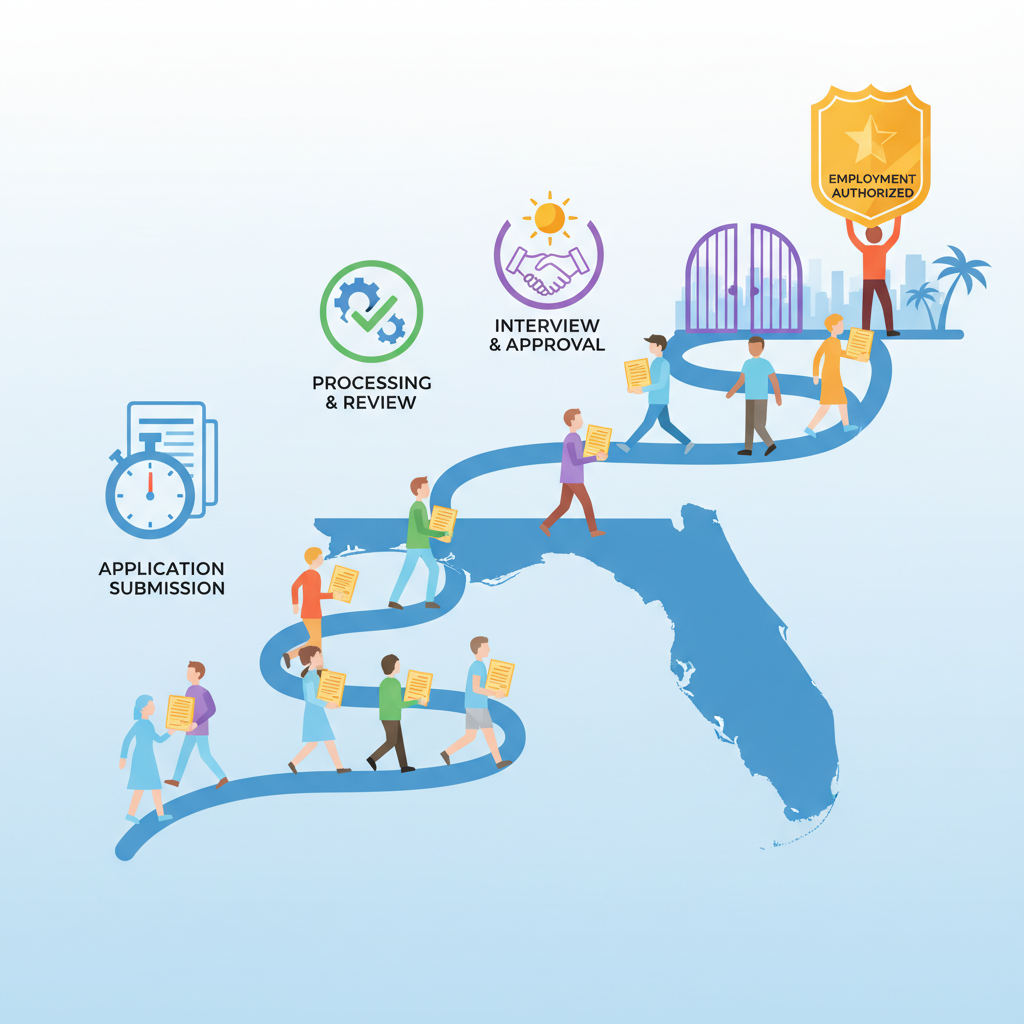
Frequently Asked Questions About EADs
Q: Who is eligible for an EAD?
A: Eligibility for an EAD is tied to specific immigration statuses or pending applications. Common eligible categories include individuals with pending Form I-485 (Adjustment of Status), asylees and asylum applicants, refugees, DACA recipients, certain nonimmigrant spouses (e.g., H-4 with an approved I-140, L-2), and F-1 students on Optional Practical Training (OPT). The full list is detailed in 8 CFR § 274a.12. It's crucial to identify your specific eligibility category before applying.


