


What This News Means for Immigrants in Orlando and Across Florida
Why this news is showing up now
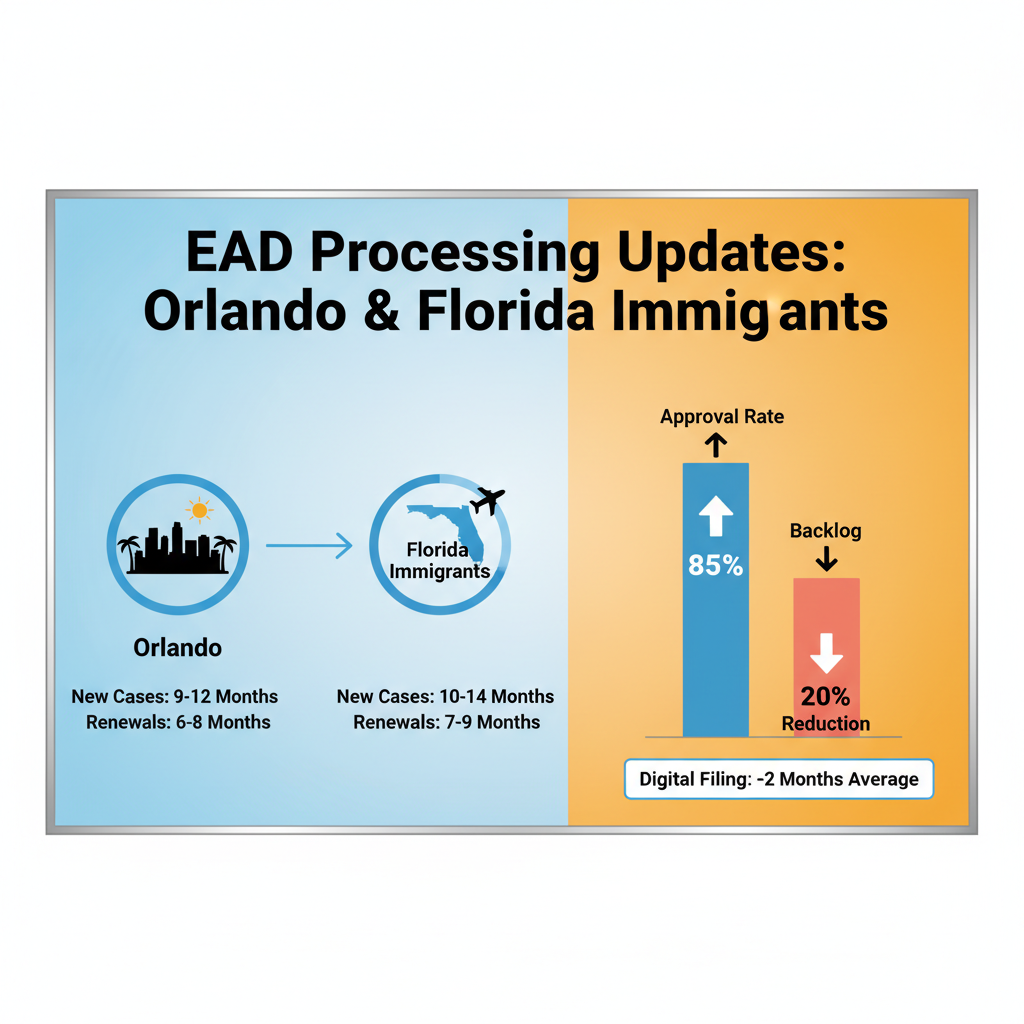
USCIS has been under significant pressure in recent years to address substantial backlogs across various application types, including the Form I-765, Application for Employment Authorization. In response, the agency has implemented several policy changes and operational efficiencies aimed at reducing processing times and providing greater flexibility for applicants. These efforts are frequently highlighted in immigration news, reflecting USCIS's ongoing commitment to improving service delivery and alleviating the burden on applicants whose livelihoods depend on their ability to work legally. Recently, USCIS has focused on: * **Expanding Automatic EAD Extensions**: Extending the period for which certain EAD categories automatically extend, allowing eligible individuals to continue working legally while their renewal application is pending. This has been a critical relief measure. * **Operational Efficiencies**: Implementing new strategies for adjudicating applications, including technology upgrades and streamlining internal processes to reduce the time it takes to process Form I-765. * **Transparency in Processing Times**: Regularly updating their online processing times tool, providing applicants with a more realistic expectation of when they might receive a decision. * **Prioritizing Certain Categories**: Sometimes prioritizing specific EAD categories, such as those tied to healthcare workers or other critical sectors, or those facing severe economic hardship. These ongoing adjustments mean that the landscape for EAD applicants is constantly evolving, making it essential to stay informed about the latest rules and guidelines.How it can affect Florida residents
For the vibrant immigrant communities in Orlando and across Florida, these EAD processing updates have direct and profound implications. Florida is home to a diverse population of immigrants, including those with pending Adjustment of Status applications, asylum seekers, DACA recipients, spouses of H-1B and L-1 visa holders, and Temporary Protected Status (TPS) beneficiaries, all of whom rely on EADs to work. * **Employment Stability**: Longer automatic extensions mean less anxiety about job loss due to an expired work permit. This is particularly crucial in a dynamic job market like Orlando's. * **Economic Impact**: Timely EAD processing ensures that individuals can contribute to Florida's economy without interruption, supporting their families and local businesses. Delays, conversely, can lead to significant financial hardship. * **Planning and Certainty**: Clearer processing times and consistent policies allow individuals and families in Central Florida to plan their lives with greater certainty, whether it's managing finances, applying for jobs, or pursuing educational opportunities. * **Local USCIS Impact**: While EAD applications are generally processed at service centers, the Orlando USCIS Field Office handles interviews for some underlying petitions (e.g., Form I-485, Application to Register Permanent Residence or Adjust Status), which can indirectly affect EAD timelines. Understanding the overall USCIS operational environment is key for anyone interacting with the immigration system in Orange County or along the I-4 corridor. Staying abreast of these changes is not just about compliance; it's about safeguarding your ability to live and work legally in the U.S. Imigrar is here to help you navigate these updates with confidence.Need Help? Our Orlando immigration team is ready to assist with your EAD application or renewal. Call +1 786-791-3106 for a free consultation, or message us online. Se Habla Español.
What Employment Authorization Document (EAD) Processing Is (and Why It Matters)
An Employment Authorization Document (EAD), commonly known as a work permit, is a plastic card issued by USCIS that grants certain non-citizens in the United States legal permission to work for a specific period. It is crucial for many immigrants as it allows them to pursue employment, support themselves and their families, and contribute to the U.S. economy while their underlying immigration case is pending or while they hold a specific non-immigrant status that permits work.A plain-English definition
Think of an EAD as your official permission slip from the U.S. government to get a job. It proves to employers that you are authorized to work in the country. Without it, most non-citizens are not allowed to be legally employed in the United States, with a few exceptions (such as those holding certain non-immigrant visas like H-1B, L-1, O-1, etc., which inherently grant work authorization with specific employers). For many, the EAD is the gateway to financial independence and stability while they await a more permanent immigration status.Key terms you need to know
Understanding the terminology surrounding EADs is essential for navigating the application process successfully: * **EAD (Employment Authorization Document)**: The official document itself, proving your authorization to work. * **Work Permit**: A common, informal term for an EAD. * **USCIS (U.S. Citizenship and Immigration Services)**: The government agency responsible for processing immigration benefits, including EAD applications. USCIS official website * **Form I-765, Application for Employment Authorization**: The specific form you must file with USCIS to request an EAD. * **Adjustment of Status (AOS)**: The process of applying for lawful permanent resident status (a Green Card) while physically present in the United States. Many individuals applying for AOS are eligible for an EAD while their application is pending. * **Asylum Seeker**: An individual who has applied for asylum in the U.S. and is awaiting a decision. After a certain period, asylum applicants can apply for an EAD. * **DACA (Deferred Action for Childhood Arrivals)**: An immigration policy that allows certain undocumented immigrants who entered the U.S. as minors to receive a renewable two-year period of deferred action from deportation and eligibility for an EAD. * **TPS (Temporary Protected Status)**: A temporary immigration status granted to eligible nationals of certain countries designated by the Secretary of Homeland Security due to conditions in their home country that prevent their safe return. TPS beneficiaries are eligible for EADs. * **H-4 Spouse**: Spouses of H-1B visa holders who are awaiting permanent residency can, in certain circumstances, be eligible for an EAD. * **L-2 Spouse**: Spouses of L-1 visa holders are generally authorized to work incident to their status and can apply for an EAD to document this authorization. * **Automatic Extension**: A provision that allows certain EAD categories to continue working legally for a specific period (e.g., 540 days, recently extended from 180 days in some cases) beyond their EAD expiration date, provided they filed a timely renewal application. This is a critical recent development. * **RFE (Request for Evidence)**: A letter from USCIS asking for additional documentation or information to support your application. * **Biometrics Appointment**: An appointment at a USCIS Application Support Center (ASC) to capture fingerprints, photographs, and signatures for background checks. Understanding these terms will empower you to better comprehend the EAD application and renewal process.Current Immigration Law: The Foundation of Employment Authorization
The authority for USCIS to grant employment authorization stems from various sections of the Immigration and Nationality Act (INA) and corresponding federal regulations (Title 8 of the Code of Federal Regulations). These laws define who is eligible for an EAD and under what conditions.Federal requirements
Eligibility for an EAD is not universal; it is tied to specific immigration statuses or applications. The primary legal framework for employment authorization is found in 8 CFR §274a.12, which categorizes eligible non-citizens into two main groups: 1. **Individuals authorized to work incident to their status**: These individuals do not need to apply for an EAD to be authorized to work, but they may choose to do so to have a convenient document proving their work authorization. Examples include lawful permanent residents (Green Card holders), K-1 fiancé(e) visa holders, and certain L-2 spouses. 2. **Individuals who must apply for an EAD to be authorized to work**: This is the larger group, encompassing many non-citizens whose immigration status or pending application makes them eligible for an EAD. Common categories eligible for an EAD include: * **Asylum Applicants (Category (c)(8))**: Those with a pending asylum application who have waited at least 150 days since filing their asylum application (or 180 days after filing if the "Asylum EAD Clock" has not been stopped). * **Refugees and Asylees (Categories (a)(3) and (a)(5))**: Individuals granted refugee or asylum status. * **Applicants for Adjustment of Status (Form I-485) (Category (c)(9))**: Those with a pending application for a Green Card based on family, employment, or other categories. * **DACA Recipients (Category (c)(33))**: Individuals granted Deferred Action for Childhood Arrivals. * **TPS Beneficiaries (Category (a)(12) and (c)(19))**: Individuals granted Temporary Protected Status. * **Spouses of Certain Nonimmigrant Visa Holders (Categories (c)(26) for H-4 and (a)(17) for L-2)**: Spouses of H-1B visa holders who are the principal beneficiaries of an approved Form I-140 (Immigrant Petition for Alien Worker) or have been granted H-1B status under AC21, and L-2 spouses. * **Students with Special Circumstances**: F-1 students seeking Optional Practical Training (OPT) or Curricular Practical Training (CPT) (Categories (c)(3)(i), (c)(3)(ii), (c)(3)(iii)), and those with severe economic hardship (Category (c)(3)(iii)). * **U-Visa and T-Visa Applicants (Categories (a)(14), (a)(16), (c)(14), (c)(16))**: Victims of certain crimes or trafficking. The specific legal basis for your EAD eligibility is crucial and will determine the "category" you select on Form I-765. It's essential to correctly identify your category to avoid processing delays or denials. You can find detailed information on eligibility categories on the USCIS website.Florida-specific considerations
While immigration law is federal, its impact is felt locally. Florida does not have its own state-specific immigration laws regarding EADs; the federal regulations apply uniformly. However, for residents of Orlando and Central Florida, understanding the local context can still be helpful: * **USCIS Field Office in Orlando**: While EAD applications are primarily processed at USCIS Service Centers (e.g., Texas, Nebraska, California, Potomac, Vermont), the Orlando USCIS Field Office plays a role in adjudicating other immigration benefits, such as Adjustment of Status interviews. A smooth process for your underlying petition can indirectly help with your EAD. * **State-Level Policies**: Florida has implemented state laws regarding employment verification, such as E-Verify mandates for certain employers. An EAD is a primary document used to demonstrate work authorization for E-Verify purposes. * **Access to Legal Assistance**: For immigrants along the I-4 corridor or in Orange County, having access to experienced local immigration attorneys is invaluable for navigating the federal EAD process, especially when considering the nuances of your specific immigration journey. Understanding these federal requirements and how they translate to your daily life in Florida is a critical first step. For official forms and instructions, always refer to the USCIS Forms page.Is Your EAD Expiring Soon? Don't risk your employment. Contact Imigrar in Orlando for expert guidance on renewal applications. Call +1 786-791-3106 for a free consultation. Se Habla Español.
How to Apply for or Renew Your Employment Authorization Document: A Complete Step-by-Step Guide
Applying for an initial EAD or renewing an existing one requires careful attention to detail. This guide outlines the essential steps to help you navigate the process effectively.1) Determine Your Eligibility Category
Before anything else, you must confirm that you are eligible for an EAD and identify the correct category under which you are applying. This is the most critical first step. * **Review USCIS Eligibility Categories**: Visit the USCIS website or consult with an immigration attorney to understand the specific criteria for each EAD category (e.g., (c)(9) for pending Adjustment of Status, (c)(8) for asylum applicants, (c)(26) for H-4 spouses, etc.). * **Gather Proof of Underlying Status**: Ensure you have documentation proving your eligibility, such as a pending Form I-485 receipt notice, asylum application receipt, DACA approval notice, or marriage certificate for a spouse-based application.2) Gather Required Documents and Information
Once your eligibility is confirmed, compile all necessary supporting documents. This step is crucial for preventing delays. * **Personal Identification**: * Copy of your last EAD (if renewing). * Copy of your passport photo page. * Copy of your birth certificate (with certified English translation if not in English). * Copy of Form I-94 (Arrival/Departure Record), front and back. * Copy of visa (if applicable). * Copy of any previous EADs, even if expired. * Two identical passport-style photos taken within 30 days of filing. * **Proof of Eligibility (Category Specific)**: * For Adjustment of Status (c)(9): Copy of Form I-485 receipt notice, copy of Form I-130/I-140 approval notice (if applicable). * For Asylum Applicants (c)(8): Copy of Form I-589 (Application for Asylum and Withholding of Removal) receipt notice. * For H-4 Spouses (c)(26): Copy of principal H-1B spouse's Form I-797 (Approval Notice), proof of relationship (marriage certificate), principal H-1B spouse's Form I-140 approval notice. * For DACA (c)(33): Copy of your latest DACA approval notice. * For TPS (a)(12) or (c)(19): Copy of your TPS approval notice or proof of TPS registration. * **Other Supporting Documents**: * Marriage certificate (if applying as a spouse). * Any previous immigration documents (e.g., previous approval notices, travel documents). * If you have ever been arrested or convicted of a crime, obtain certified court dispositions.3) Complete Form I-765, Application for Employment Authorization
Fill out the application form accurately and completely. * **Download the Latest Form**: Always download the most recent version of Form I-765 from the USCIS Forms page. * **Read Instructions Carefully**: Review the official instructions for Form I-765 thoroughly. * **Provide Accurate Information**: Ensure all information matches your other immigration documents. Pay close attention to your name, date of birth, country of birth, and Alien Registration Number (A-Number). * **Select Correct Eligibility Category**: Double-check that you have chosen the correct eligibility category (e.g., (c)(9), (c)(8)). This is a common source of delays. * **Sign the Form**: Important: Do not forget to sign the form in blue or black ink. An unsigned form will be rejected. * **Consider Fee Waiver**: If you meet specific poverty guidelines, you might be eligible for a fee waiver using Form I-912, Request for Fee Waiver.4) Prepare Your Application Package
Organize your application meticulously to ensure USCIS receives everything required. * **Application Fee**: Include the correct filing fee (check the USCIS website for current fees) in the form of a money order or personal check payable to "U.S. Department of Homeland Security." Write your A-Number on the check/money order. Some categories are exempt from fees. * **Photos**: Place the two passport-style photos in a small envelope and staple it to the top left corner of the application form, or follow USCIS instructions for photo placement. Lightly write your name and A-Number on the back of each photo. * **Assemble Documents**: Organize your supporting documents in the order listed in the Form I-765 instructions, typically with the form on top, followed by the fee, photos, and then supporting evidence. Make a copy of the entire package for your records. * **Cover Letter (Optional but Recommended)**: A simple cover letter listing the contents of your package can be helpful for USCIS to quickly verify they have received all documents.5) File Your Application with USCIS
Send your completed application to the correct USCIS filing address. * **Check Filing Address**: The filing address depends on your eligibility category and sometimes your state of residence. Always refer to the "Where to File" section of the Form I-765 instructions on the USCIS official website. For Central Florida residents, this might mean a service center in Texas, Nebraska, or another location. * **Send by Mail**: Use a reliable mail service that provides tracking (e.g., USPS Certified Mail with return receipt, FedEx, UPS). This provides proof of mailing and delivery. * **Online Filing (Limited Categories)**: USCIS offers online filing for some EAD categories. Check the USCIS website to see if your category is eligible for online submission, which can sometimes be faster.6) Attend Biometrics Appointment (if required)
After filing, many applicants will receive an appointment notice for biometrics. * **Biometrics Appointment Notice**: USCIS will send Form I-797C, Notice of Action, with the date, time, and location of your appointment at an Application Support Center (ASC). For Orlando residents, this would likely be the local ASC. * **Attend the Appointment**: Bring the appointment notice, a valid photo ID (e.g., passport, state ID), and any other documents requested. This appointment involves fingerprinting, photography, and signature collection for background checks. Missing this appointment can delay your application.7) Monitor Your Case and Respond to RFEs
Stay proactive in tracking your application status. * **Case Status Online**: Use the receipt number from your Form I-797C (receipt notice) to check your case status online on the USCIS Case Status website. * **Processing Times**: Regularly check the USCIS Processing Times page for the service center handling your application. * **Respond to RFEs**: If you receive a Request for Evidence (RFE), respond promptly and thoroughly with all requested information. Failure to respond on time or with complete information can lead to denial. * **Address Changes**: If you move, promptly update your address with USCIS using their online tool or by filing Form AR-11, Alien's Change of Address Card.Overwhelmed by Paperwork? Let Imigrar simplify your EAD application process. Our experienced team serves clients nationwide from our Orlando office. Call +1 786-791-3106 for a free consultation. Se Habla Español.
Practical Steps You Can Take Today for Your EAD Application
Preparing for your EAD application or renewal doesn't have to be a last-minute scramble. Taking proactive steps can significantly reduce stress and improve your chances of a smooth process.Actionable Checklist:
1. **Verify Your Eligibility Annually**: Even if you have an EAD, regularly confirm your eligibility category, especially if your underlying immigration status changes. 2. **Start Your Renewal Early**: For renewals, USCIS recommends filing approximately 180 days (or even earlier, up to 540 days, given recent automatic extension rules) before your current EAD expires. This allows ample time for processing, especially if an RFE is issued. 3. **Organize Your Documents Digitally and Physically**: Create a dedicated folder for all immigration documents. Scan copies of everything and save them securely. This makes it easy to retrieve information and prevents loss. 4. **Review Form I-765 Instructions Regularly**: USCIS forms and instructions can change. Always download the latest version and read through it carefully before starting. 5. **Check USCIS Processing Times**: Periodically monitor the USCIS Processing Times page for the service center relevant to your EAD category. This helps set realistic expectations. 6. **Understand the Automatic Extension**: If you're renewing in an eligible category, be fully aware of the automatic extension period (currently up to 540 days for certain categories, provided you filed on time). Keep your expired EAD, Form I-797C (receipt notice for the renewal), and your I-94 to show to employers. 7. **Consult an Immigration Attorney**: If you have any doubts about your eligibility, document requirements, or potential complications, seek legal advice. An attorney can help you avoid costly mistakes.Document Preparation Guidance:
* **Clarity and Legibility**: Ensure all documents are clear, legible, and submitted as copies (unless originals are specifically requested, which is rare for initial EAD filing). * **Translations**: Any document not in English must be accompanied by a complete and certified English translation. The translator must certify that they are competent to translate and that the translation is accurate. * **Photo Specifications**: Adhere strictly to USCIS passport photo requirements (2x2 inches, white background, no glasses, taken within 30 days). * **Consistency**: Ensure your name, date of birth, and other identifying information are consistent across all documents. Discrepancies can lead to RFEs.Timeline Expectations:
**Warning:** Processing times are highly variable and subject to change. * **Current USCIS Processing Times**: As of 2026-05-26, EAD processing times can range from a few months to over a year, depending on the category and the service center. Always check the USCIS Processing Times tool for the most up-to-date information. * **Receipt Notice**: You should receive a Form I-797C, Notice of Action (receipt notice), within 2-4 weeks of filing. This notice contains your receipt number, which is essential for tracking your case. * **Biometrics Appointment**: If required, your biometrics appointment notice typically arrives 4-8 weeks after filing, with the appointment usually scheduled 2-4 weeks after the notice date. * **Automatic Extension**: For eligible renewal applicants, the automatic extension begins on the "Card Expires" date on your current EAD and continues for up to 540 days (or the specific duration applicable to your category at the time of filing), or until USCIS adjudicates your renewal application, whichever comes first. This is a critical buffer. * **Expedited Processing**: In very limited circumstances (e.g., severe financial loss, urgent humanitarian reasons, critical government interest), you may request expedited processing. This is rarely granted and requires substantial proof. **Important:** Never assume your application will be processed quickly. Plan accordingly, especially for renewals, to prevent gaps in employment authorization.How Imigrar Helps Immigrants in Orlando and Beyond
At Imigrar, we understand that an Employment Authorization Document is more than just a piece of paper—it's your livelihood, your stability, and your ability to "Keep Families Together." Our firm is dedicated to guiding immigrants through the often-complex EAD application and renewal process, ensuring accuracy, compliance, and peace of mind.Our experience and expertise
Based in Orlando, Florida, Imigrar serves clients not just in Central Florida, Orange County, and along the I-4 corridor, but nationwide. Our team of experienced immigration attorneys possesses in-depth knowledge of USCIS regulations, policies, and the nuances of EAD eligibility across various categories. We stay meticulously updated on the latest USCIS announcements and processing changes, like the recent updates concerning automatic extensions and processing efficiencies. We provide comprehensive support, including: * **Eligibility Assessment**: Thoroughly evaluating your unique situation to determine the correct EAD category and confirm your eligibility. * **Document Preparation**: Assisting you in gathering and organizing all necessary supporting documents, ensuring everything is complete and accurate. * **Form I-765 Completion**: Meticulously filling out Form I-765 to avoid common errors that lead to delays or denials. * **Application Review**: Conducting a final, comprehensive review of your entire application package before submission. * **Submission and Tracking**: Guiding you on proper filing procedures and helping you monitor your case status, including responding to RFEs efficiently. * **Renewal Strategy**: Developing a proactive renewal strategy to prevent gaps in employment authorization. Our goal is to demystify the immigration process, providing clear, actionable advice tailored to your specific needs. We pride ourselves on our client-centered approach, treating each case with the personal attention and dedication it deserves.Free consultation offer
We know that taking the first step can be daunting. That’s why Imigrar offers a **free consultation** to discuss your EAD application or renewal. This is an opportunity for you to speak with an experienced immigration attorney, understand your options, and get clear answers to your questions without any obligation. Whether you're applying for the first time, renewing an existing EAD, or facing a complex situation, we are here to help. **Se Habla Español.** Our bilingual team is ready to assist our Spanish-speaking clients, ensuring clear communication and understanding throughout the entire process. We believe that language should never be a barrier to accessing crucial legal assistance. Your ability to work legally in the U.S. is vital. Let Imigrar be your trusted partner in securing your Employment Authorization Document.
Frequently Asked Questions About EAD Processing
Q: Who is eligible for an EAD?
A: Eligibility for an EAD is tied to specific immigration statuses or pending applications. Common categories include individuals with pending Adjustment of Status (Form I-485), asylum applicants, DACA recipients, Temporary Protected Status (TPS) beneficiaries, and certain spouses of nonimmigrant visa holders (like H-4 and L-2 spouses). It's crucial to identify your specific eligibility category based on your immigration situation. You can find a comprehensive list


