At Imigrar, our mission is to Keep Families Together by providing expert immigration legal services in Orlando and across the nation. Staying informed about the latest changes from U.S. Citizenship and Immigration Services (USCIS) is crucial for immigrants and their families. Today, we're diving into recent developments concerning Employment Authorization Documents (EADs), often referred to as work permits, and what these updates mean for your ability to work legally in the United States.
The ability to work is fundamental to building a life, supporting families, and contributing to the community. For many immigrants, an EAD is the key to unlocking this opportunity. Recent USCIS announcements and policy adjustments aim to address processing backlogs and improve efficiency, directly impacting how quickly you can get or renew your work authorization. Understanding these changes is vital, and Imigrar is here to guide you through every step.
The reporting that sparked this guide:
Employment Authorization Document Processing (USCIS)
Need Help? Our Orlando immigration team is ready to assist. Call +1 786-791-3106 for a free consultation, or message us online. Se Habla Español.
What This News Means for Immigrants in Orlando and Across Florida
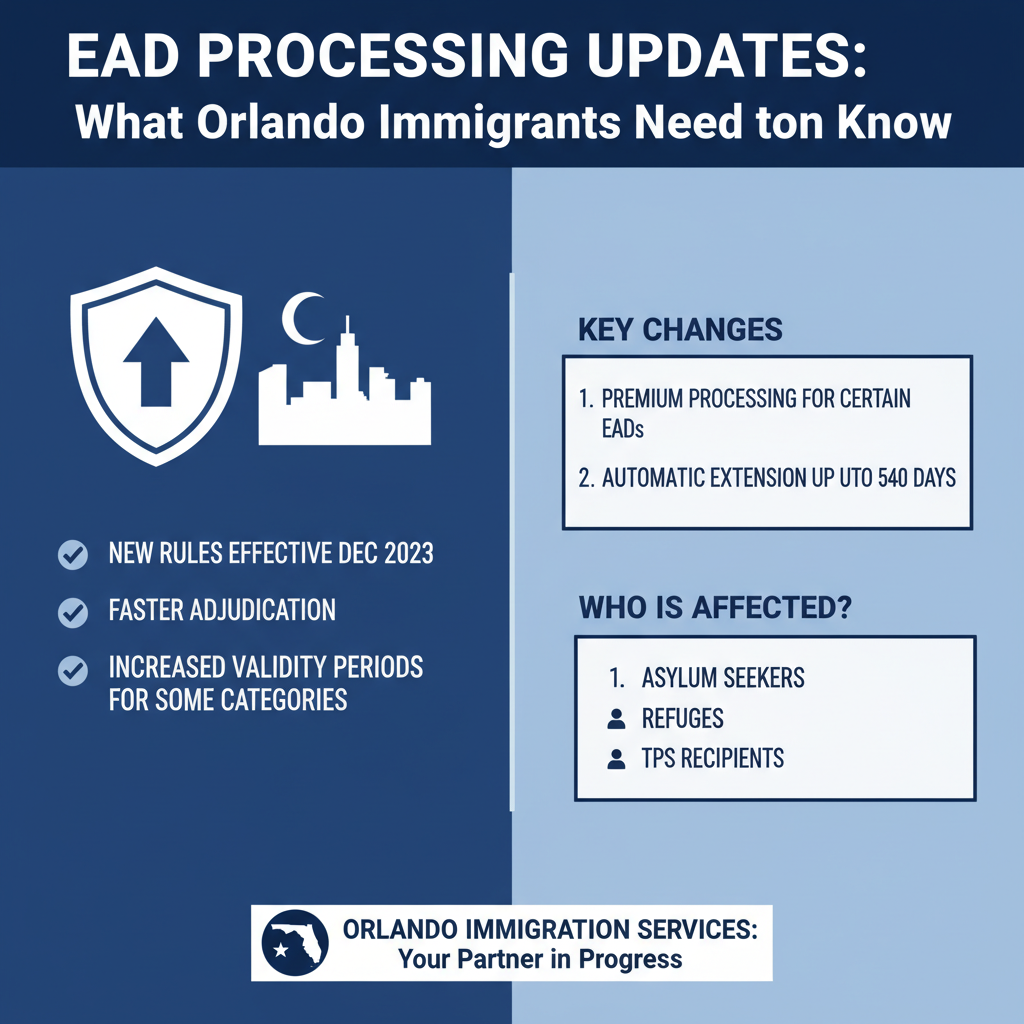
Recent shifts in USCIS policy and processing strategies for Employment Authorization Documents are more than just bureaucratic updates; they represent tangible changes in the lives of immigrants waiting to work. For those living in Orlando, Central Florida, and throughout the Sunshine State, these developments can directly impact your financial stability, career prospects, and overall peace of mind.
Why this news is showing up now
The immigration system, particularly USCIS, has faced unprecedented challenges in recent years, including significant backlogs exacerbated by the COVID-19 pandemic, staffing shortages, and increased application volumes. These factors led to frustratingly long processing times for many forms, especially the Form I-765, Application for Employment Authorization.
In response to widespread concerns and the urgent need for immigrants to work, USCIS has been actively implementing various measures to alleviate these delays. This includes a renewed focus on streamlining adjudication processes, temporarily extending the validity period for certain EAD categories, and prioritizing certain application types. The news you're seeing now reflects USCIS’s ongoing efforts to tackle these backlogs and improve efficiency, aiming to reduce the wait times that have left many individuals in limbo. These changes are part of a broader strategy to modernize the immigration system and make it more responsive to the needs of applicants.
Important: While these initiatives are positive, the immigration landscape is constantly evolving. It's crucial to stay updated on the latest official announcements from USCIS.
How it can affect Florida residents
Florida, a state with a vibrant and diverse immigrant population, is significantly impacted by EAD processing changes. For the countless individuals and families in Orlando, Tampa, Miami, and along the I-4 corridor who are awaiting work authorization, these updates bring both hope and new considerations:
- Economic Stability: Faster EAD processing means individuals can enter the workforce sooner, providing for their families and contributing to Florida's economy. Delays, conversely, can lead to severe financial hardship.
- Job Opportunities: Many industries in Florida, from hospitality and tourism to healthcare and agriculture, rely on a robust workforce. Quicker EAD approvals can help fill critical labor gaps.
- Community Integration: The ability to work is a cornerstone of integration into American society. It allows immigrants to build credit, secure housing, and participate more fully in their communities, from Orange County to the furthest corners of the state.
- Planning and Uncertainty: While improvements are welcome, the historical unpredictability of processing times can still create anxiety. Understanding the current status and potential timelines is key for planning your life in Central Florida.
- Orlando USCIS Field Office: While EAD applications are generally processed at national service centers, local field offices like the Orlando USCIS Field Office may handle certain aspects or provide specific information, particularly for interviews or biometrics appointments related to underlying applications (like Adjustment of Status) that trigger EAD eligibility.
For Central Florida residents, staying informed about EAD processing is not just about immigration law; it's about livelihood and the ability to thrive in one of the nation's most dynamic states. Imigrar is dedicated to helping our Orlando clients navigate these complexities.
What Employment Authorization Document (EAD) Is (and Why It Matters)
For many immigrants, the dream of living and working in the United States hinges on a critical document: the Employment Authorization Document, commonly known as an EAD or a work permit. This small card holds immense power, granting you the legal right to accept employment in the U.S. without fear of violating immigration laws.
A plain-English definition
An Employment Authorization Document (EAD) is a photo identification card issued by USCIS that proves you are authorized to work in the United States for a specific period. It is not a visa and does not grant you immigration status itself, but rather indicates that your current immigration status or pending application allows you to be employed. Think of it as your official permission slip to work while you are pursuing a more permanent immigration solution or are in a non-immigrant status that permits employment.
The EAD card looks similar to a driver's license, featuring your photo, name, birthdate, country of birth, fingerprint, and a category code that indicates the basis of your eligibility. It also has an expiration date, after which you must renew it if you wish to continue working.
Key terms you need to know
Navigating the EAD process involves understanding several key terms:
- Form I-765, Application for Employment Authorization: This is the official form you must file with USCIS to request an EAD. It's the central piece of the application process. You can find this and other forms on the USCIS Forms page.
- EAD Category: This refers to the specific eligibility classification under which you are applying for an EAD. There are many categories (e.g., (c)(9) for Adjustment of Status applicants, (a)(5) for asylum applicants, (c)(3)(C) for STEM OPT students). Your eligibility depends on your underlying immigration status or application.
- Adjustment of Status (AOS): This is the process of applying for a green card (lawful permanent residence) while physically present in the United States. Many individuals who have filed a Form I-485, Application to Register Permanent Residence or Adjust Status, are eligible to apply for an EAD.
- Advance Parole (AP): Often filed concurrently with an EAD for Adjustment of Status applicants (on Form I-131), Advance Parole allows you to travel outside the U.S. and return without abandoning your pending AOS application. When approved together, it's called a "combo card."
- Biometrics Appointment: A scheduled appointment at an Application Support Center (ASC) where USCIS collects your fingerprints, photograph, and signature for background checks. This is a standard part of the EAD application process for most categories.
- Request for Evidence (RFE): A letter from USCIS requesting additional documentation or information to support your application. Failing to respond to an RFE can lead to denial.
- Processing Times: The estimated time it takes for USCIS to process an application from the date of receipt. You can check current estimates on the USCIS Processing Times page.
- Automatic Extension: For certain EAD categories, a timely filed renewal application can provide an automatic extension of your expiring EAD for a specific period (currently up to 540 days for some categories, though this can change). This prevents gaps in employment authorization.
- STEM OPT: A 24-month extension of Optional Practical Training (OPT) available to F-1 students who have earned a STEM (Science, Technology, Engineering, and Mathematics) degree from an accredited U.S. institution and are employed by E-Verify employers.
Understanding these terms will empower you to navigate your EAD application more effectively and understand the communications you receive from USCIS.
Current Immigration Law: The Foundation for Your Work Authorization
The ability to obtain an Employment Authorization Document (EAD) is not a standalone right but is deeply rooted in U.S. immigration law, specifically the Immigration and Nationality Act (INA) and its associated regulations. These laws define who is eligible for an EAD and under what circumstances. While USCIS implements policy changes to improve processing, the underlying legal framework remains consistent.
Federal requirements
Eligibility for an EAD is determined by your immigration status or the specific immigration benefit you are seeking. There is no general "work permit" application available to everyone; you must fit into one of the designated EAD categories. The primary federal statute governing employment authorization is Section 274A of the INA, which prohibits employers from hiring individuals not authorized to work in the U.S. The regulations at 8 CFR 274a.12 detail the specific classes of aliens authorized to be employed in the United States, including those who require an EAD.
Common federal requirements and eligibility categories include:
- Asylum Seekers and Asylees: Individuals with a pending asylum application (who have waited 150 days) or those granted asylum are eligible. (Category (c)(8) or (a)(5)).
- Refugees: Individuals granted refugee status. (Category (a)(3)).
- Applicants for Adjustment of Status: Those who have filed Form I-485, Application to Register Permanent Residence or Adjust Status, and are awaiting a decision. (Category (c)(9)).
- Certain Non-immigrant Visa Holders: Spouses of E-1/E-2 treaty traders/investors, L-1A intra-company transferees (L-2 spouses), J-2 spouses of J-1 exchange visitors, and certain others.
- F-1 Students with OPT/STEM OPT: F-1 students authorized for Optional Practical Training (OPT) or the STEM OPT extension. (Category (c)(3)(A), (B), or (C)).
- U-Visa and T-Visa Applicants: Victims of certain crimes (U-visa) or human trafficking (T-visa) with pending applications. (Category (a)(15) or (a)(16)).
- Deferred Action Recipients: Such as those under Deferred Action for Childhood Arrivals (DACA). (Category (c)(33)).
- Temporary Protected Status (TPS) Recipients: Nationals of designated countries experiencing temporary conditions that prevent safe return. (Category (a)(12) or (c)(19)).
To apply, you must file Form I-765, Application for Employment Authorization, along with supporting documentation proving your eligibility for one of these categories. The filing fee is generally required, though fee waivers may be available for certain categories based on financial need.
Reminder: The specific requirements for each EAD category can vary significantly. It is crucial to identify your correct category and gather all necessary evidence to support your application. You can always refer to the USCIS official website for the most up-to-date information and instructions.
Florida-specific considerations
While immigration law is federal, meaning the requirements for an EAD are the same whether you apply from Orlando, Florida, or anywhere else in the U.S., there are some practical, state-level considerations for Florida residents:
- Driver's Licenses and State IDs: Once you have your EAD, it is a primary document used to obtain a Florida driver's license or state identification card from the Florida Department of Highway Safety and Motor Vehicles (FLHSMV). Your EAD's expiration date will typically determine the expiration date of your Florida ID.
- Employment Verification (E-Verify): Florida has specific requirements regarding E-Verify for public and private employers. While your EAD authorizes you to work, employers use systems like E-Verify to confirm your eligibility.
- Access to Services: An EAD, combined with a Social Security card, allows you to access various services and opportunities that require proof of work authorization, from opening bank accounts to securing leases in cities like Orlando and across Orange County.
- Local Resources: For Central Florida residents, understanding local community resources and support networks can be beneficial while awaiting EAD approval or seeking employment opportunities.
It's important to remember that Florida does not have its own immigration laws that override federal statutes concerning EADs. However, state-level policies can affect how your federal work authorization interacts with daily life and employment within the state. Imigrar ensures our Orlando clients understand both the federal legal framework and any relevant local implications.
Need Help? Navigating EAD applications can be complex. Our experienced Orlando immigration lawyers are here to simplify the process. Call +1 786-791-3106 for a free consultation, or message us online. Se Habla Español.
How to Apply for or Renew Your EAD: A Complete Step-by-Step Guide
Applying for or renewing your Employment Authorization Document (EAD) is a critical step for many immigrants seeking to work legally in the United States. While the process can seem daunting, breaking it down into manageable steps can make it much clearer. This guide outlines the essential stages, focusing on accuracy and completeness to minimize delays.
1) Determine Your Eligibility and EAD Category
Before you even touch a form, you must confirm that you are eligible for an EAD and identify the correct eligibility category. This is the foundation of your application. Your eligibility stems from your current immigration status or a pending immigration application.
- Check Your Status: Are you an asylum applicant, an Adjustment of Status applicant, a DACA recipient, a spouse of a certain visa holder, or in another eligible category?
- Identify Your Category Code: USCIS assigns a specific category code (e.g., (c)(9), (a)(5), (c)(3)(C)) to each type of EAD eligibility. This code must be accurately entered on Form I-765. Refer to the USCIS website for a comprehensive list of categories and their requirements.
- Renewal vs. Initial Application: The process is largely the same, but for renewals, you'll need to indicate that on the form and provide your previous EAD.
Required Documents/Information for this step:
- Your current immigration status or pending application details (e.g., Form I-485 receipt notice, asylum application receipt, visa type).
- Previous EAD card (if renewing).
2) Gather All Required Documents
A complete application package is essential. Missing documents are a leading cause of delays and Requests for Evidence (RFEs). The exact documents vary by EAD category, but common requirements include:
- Proof of Identity: Copy of your birth certificate, passport, national identity card.
- Proof of Immigration Status/Eligibility:
- For Adjustment of Status applicants: Copy of Form I-485 receipt notice.
- For asylum applicants: Copy of Form I-589, Application for Asylum and for Withholding of Removal, receipt notice.
- For DACA recipients: Copy of Form I-797, Notice of Action, for DACA approval.
- For certain non-immigrant spouses: Copy of spouse's visa, marriage certificate.
- For F-1 OPT/STEM OPT: Copies of I-20s, academic transcripts, degree.
- Previous EAD Card: Copy of the front and back of your most recent EAD (if renewing).
- Photos: Two identical passport-style photos taken within 30 days of filing. Write your name and A-Number (if applicable) lightly on the back.
- Copy of Form I-94: Your Arrival/Departure Record, proving your lawful entry.
- Copy of Government-Issued ID: Driver's license or state ID.
- Marriage Certificate: If applying as a spouse.
Warning: Always submit copies, not original documents, unless USCIS specifically requests an original. Keep a complete copy of your entire application package for your records.
3) Complete Form I-765, Application for Employment Authorization
This is the core of your application. Download the latest version of Form I-765 from the USCIS Forms page. Read the instructions carefully before filling it out. You can fill it out electronically and print it, or print it and fill it out neatly in black ink.
- Accuracy is Key: Double-check every field for accuracy. Typos, incorrect dates, or missing information can cause delays or denial.
- Part 2, Item 27: This is where you enter your specific EAD eligibility category code. Ensure it matches your situation.
- Signature: Do not forget to sign the form in blue or black ink. An unsigned form will be rejected.
- A-Number: If you have an Alien Registration Number (A-Number), ensure it's entered correctly.
Required Documents/Information for this step:
- Completed and signed Form I-765.
- Your A-Number (if applicable).
4) Pay Filing Fees (or Request Fee Waiver)
Most EAD applications require a filing fee. Check the USCIS website or the form instructions for the current fee amount. The fee can change, so verify it right before filing.
- Payment Method: You can pay by money order, personal check, cashier's check, or by credit card using Form G-1450, Authorization for Credit Card Transactions. Make checks payable to "U.S. Department of Homeland Security."
- Fee Waivers: Certain applicants may be eligible for a fee waiver if they can demonstrate financial inability to pay. You must submit Form I-912, Request for Fee Waiver, along with supporting documentation (e.g., proof of means-tested benefits, household income below 150% of federal poverty guidelines).
- Biometrics Fee: Some EAD categories may also require a separate biometrics services fee. Check the instructions for your specific category.
Required Documents/Information for this step:
- Check or money order for the correct fee amount, or completed Form G-1450.
- If requesting a fee waiver, completed Form I-912 and supporting documentation.
5) Submit Your Application
Once you have your completed Form I-765, all supporting documents, photos, and payment, assemble your package carefully. The filing address depends on your EAD category and where you live. Always refer to the "Where to File" section of the Form I-765 instructions on the USCIS website.
- Mailing Address: Send your application to the correct USCIS lockbox facility.
- Delivery Method: Use a reputable mail service that provides tracking (e.g., USPS Certified Mail with return receipt, FedEx, UPS). This provides proof of mailing and delivery.
- Online Filing: Some EAD categories allow for online filing. Check the USCIS website to see if your category is eligible. Online filing can sometimes be faster and provides immediate confirmation of receipt.
Required Documents/Information for this step:
- The complete application package.
- Proof of mailing/tracking number.
6) Attend Biometrics Appointment (if required)
After filing, most applicants will receive an appointment notice (Form I-797C, Notice of Action) for a biometrics appointment at a local Application Support Center (ASC). For Orlando residents, this would likely be the ASC located in Orlando. This is a mandatory step.
- What to Bring: Your appointment notice, a valid photo ID (passport or driver's license), and any other documents specified on the notice.
- Purpose: USCIS collects your fingerprints, photograph, and signature for background checks.
- Rescheduling: If you cannot attend, follow the instructions on the notice to reschedule, but be aware this can delay your application.
Required Documents/Information for this step:
- Biometrics appointment notice.
- Valid photo identification.
7) Monitor Your Case & Respond to RFEs
After your biometrics appointment, the waiting period begins. You can track your case status online using the receipt number provided on your Form I-797C, Notice of Action, which you receive after USCIS accepts your application.
- Case Status Online: Visit the USCIS Case Status Online tool regularly.
- RFEs: If you receive a Request for Evidence (RFE), respond promptly and thoroughly with all requested information. Failure to do so will likely result in a denial.
- Interview: While EADs generally don't require an interview, if your EAD is tied to an underlying application like Adjustment of Status, you may have an interview for that primary application.
- Approval & Card Production: If approved, USCIS will send an approval notice (Form I-797) and then mail your EAD card.
Important: Keep your mailing address updated with USCIS if you move. You can do this via your online account or by submitting Form AR-11, Alien's Change of Address Card.
This detailed guide provides a roadmap, but individual situations can vary. Consulting with an experienced immigration attorney, especially if you're in Orlando or Central Florida, can help ensure your application is strong and complete.
Practical Steps You Can Take Today for Your EAD Application
The waiting game for an EAD can be stressful, but being proactive can significantly improve your chances of a smooth process and a timely approval. Here are practical steps you can take right now to prepare and manage your EAD application or renewal.
Actionable Checklist:
- Confirm Your Eligibility and Category: Re-read the instructions for Form I-765 on the USCIS official website and verify your exact EAD category. This is the most common point of error.
- Gather Original Documents (for copying): Start collecting all necessary documents like your passport, birth certificate, Form I-94, previous EAD, marriage certificate, etc. Make sure they are current and valid.
- Obtain Passport-Style Photos: Get two identical, recent (within 30 days) passport-style photos. Many pharmacies or photo studios in Orlando offer this service.
- Check Filing Fees: Verify the current filing fee for Form I-765 and any associated biometrics fees. Fees can change, so check the USCIS website or the form instructions immediately before sending your application.
- Organize Your Documents: Create a checklist and file for all your documents. Keep originals safe and only submit copies unless specifically requested. Label everything clearly.
- Set Calendar Reminders for Renewals: If you have an existing EAD, mark your calendar 180 days before its expiration date. This provides ample time to file a renewal application and potentially benefit from the automatic extension.
- Consult an Attorney: If you have any doubts about your eligibility, the required documents, or the application process, schedule a consultation with an experienced immigration lawyer. This is especially helpful for complex cases or if you've had previous immigration issues.
Document Preparation Guidance:
- Copies, Not Originals: As a general rule, submit high-quality photocopies of all supporting documents. Only send originals if USCIS explicitly requests them. Keep all your original documents safe.
- Translations: If any document is not in English, you must provide a complete and accurate English translation, along with a certification by the translator that they are competent to translate and that the translation is accurate. The translator must sign and date the certification.
- Organize Your Application: Use fasteners or paper clips, not staples, to organize your documents. Place the check/money order on top, followed by Form I-765, and then supporting documents in the order listed in the instructions.
- Keep a Copy: Make a complete copy of your entire application package (including the signed form, all supporting documents, and the check/money order) before mailing it. This is your personal record.
Timeline Expectations:
USCIS processing times for EADs have historically varied widely, but recent efforts have aimed to reduce them. Here’s what to expect:
- Initial Receipt: You should receive a receipt notice (Form I-797C) within 2-4 weeks after USCIS receives your application.
- Biometrics Appointment: If required, an appointment notice typically arrives 3-8 weeks after USCIS accepts your application. The appointment itself usually follows 2-4 weeks after the notice.
- Adjudication: The actual processing time for adjudication can range from a few months to over a year, depending on your EAD category, the specific service center, and current USCIS backlogs. Always check the USCIS Processing Times page for the most current estimates for your EAD category and service center.
- Automatic Extensions: For certain renewal categories, a timely filed Form I-765 can grant an automatic extension of your existing EAD for up to 540 days (this specific duration has varied and is subject to change, so verify current policy). This is crucial to prevent gaps in employment authorization.
- Expedite Requests: In very limited circumstances (e.g., severe financial loss to a company or person, urgent humanitarian reasons, Department of Defense or national interest), you may be able to request an expedite. However, these are rarely granted and require strong evidence.
Reminder: USCIS processing times are estimates and can change without notice. Patience and proactive monitoring are key.