What This News Means for Immigrants in Orlando and Across Florida
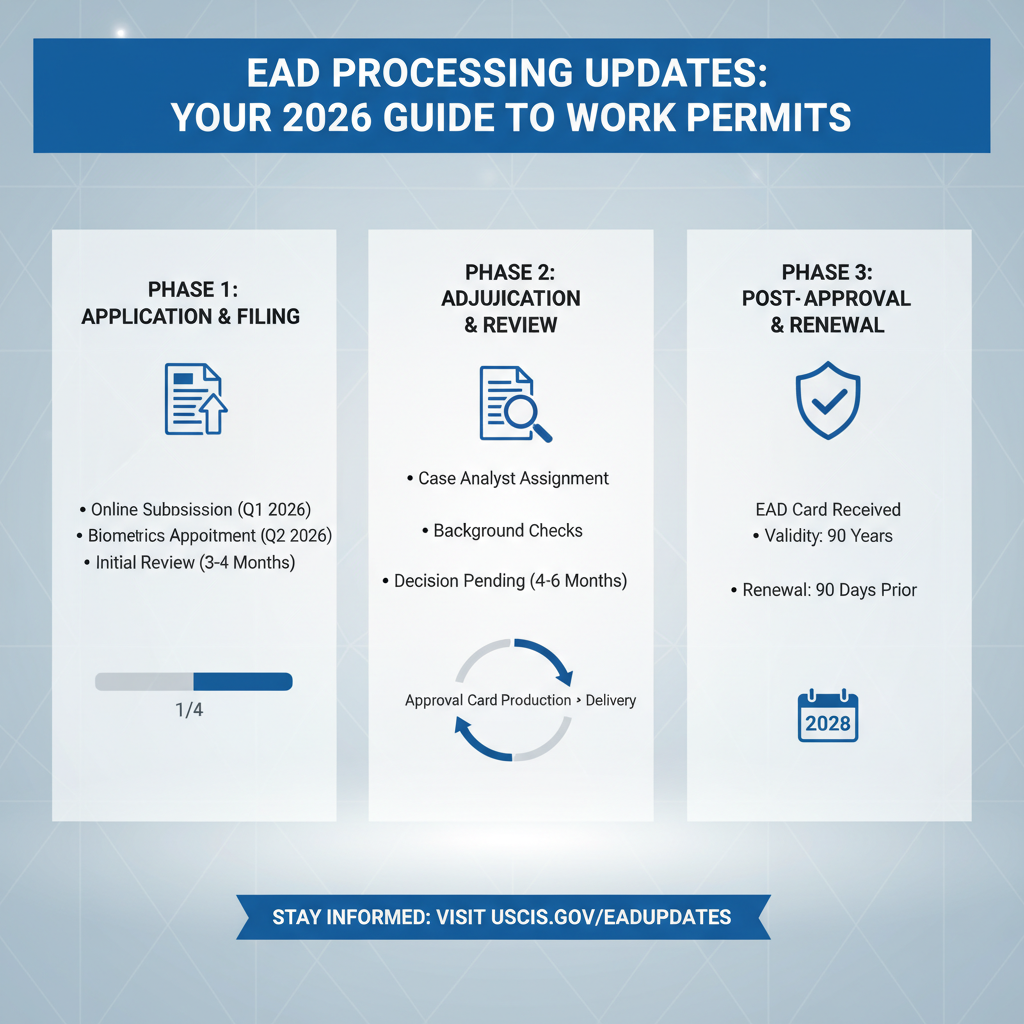
Why this news is showing up now
The immigration landscape is constantly evolving, and USCIS regularly implements new policies, procedures, and technological advancements aimed at improving efficiency, reducing backlogs, and enhancing the overall applicant experience. The news surrounding EAD processing updates in 2026 reflects these ongoing efforts. Historically, EAD processing times have fluctuated significantly, causing immense stress and financial hardship for applicants and their families. In response to these challenges, USCIS has been exploring various strategies, including expanding online filing options, streamlining internal review processes, and issuing policy memoranda to provide clarity and consistency. These updates are a direct result of public demand for faster processing, congressional oversight, and USCIS’s internal drive to modernize its operations. They represent a concerted effort to address the persistent delays that have plagued work permit applications, particularly for renewals, ensuring that eligible individuals can maintain their employment authorization without lengthy interruptions. The goal is to create a more predictable and efficient system, allowing immigrants to contribute to the economy and society more readily.How it can affect Florida residents
For the vibrant immigrant communities in Florida, especially those in and around Orlando, these EAD processing updates carry significant weight. Florida is home to a diverse population of immigrants from various backgrounds and countries, many of whom rely on their EADs to work in industries critical to the state's economy, such as tourism, agriculture, healthcare, and hospitality. Faster or more predictable EAD processing means: * **Reduced Financial Strain:** Lengthy delays in EAD renewals can lead to job loss, loss of income, and immense financial hardship for families. Improved processing times offer greater stability. * **Continued Employment:** Many employers require a valid EAD for continued employment. Timely processing ensures that individuals can maintain their jobs without interruption. * **Economic Contribution:** When immigrants can work legally, they contribute to Florida's economy through taxes, consumer spending, and filling essential labor gaps. Efficient EAD processing supports this vital contribution. * **Peace of Mind:** Knowing that an application or renewal will be processed within a reasonable timeframe alleviates a tremendous amount of stress for applicants and their families. If your case is handled through the Orlando USCIS Field Office or the National Benefits Center, understanding these updates is paramount. The changes could impact the specific procedures, timelines, and requirements you face. For Central Florida residents, staying informed ensures you can proactively manage your application, avoid common pitfalls, and secure your ability to work without unnecessary delays. Imigrar, based right here in Orlando, is uniquely positioned to guide you through these local and national changes.Need Help? Our Orlando immigration team is ready to assist. Call +1 786-791-3106 for a free consultation, or message us online. Se Habla Español.
What Employment Authorization Document (EAD) Processing Is (and Why It Matters)
The Employment Authorization Document (EAD) is a critical card issued by USCIS that provides non-U.S. citizens with official permission to work in the United States for a specific period. For many immigrants, especially those awaiting the outcome of a green card application, asylum claim, or other immigration benefits, the EAD is their lifeline to legal employment and financial independence. The process of applying for or renewing an EAD involves submitting a formal application to USCIS, along with supporting documentation, to demonstrate eligibility under specific immigration categories. The processing of these applications refers to the entire lifecycle from submission to decision, including initial review, background checks, biometric appointments (if required), and the final adjudication. Efficient processing means individuals can secure or maintain their legal employment status promptly, preventing gaps in employment and income. Delays, on the other hand, can lead to severe financial hardship, job loss, and disruption to family life. That's why updates to EAD processing are so significant – they directly affect the daily lives and long-term stability of countless immigrants.A plain-English definition
An Employment Authorization Document (EAD), often called a work permit, is a physical card that looks similar to a driver's license. It's issued by the U.S. government (specifically USCIS) and proves that you are legally authorized to work in the United States. It's not a visa or a green card, but rather a temporary permission to be employed. Many different categories of non-citizens are eligible for an EAD, including: * Individuals with a pending application for Adjustment of Status to lawful permanent resident (green card). * Asylees and refugees, or those with pending asylum applications. * Students seeking Optional Practical Training (OPT). * Certain nonimmigrant visa holders and their dependents (e.g., spouses of L-1 or E visa holders). * Individuals with Temporary Protected Status (TPS). * DACA recipients. * And many more specific categories. Without a valid EAD, most non-citizens are not permitted to work legally in the U.S. This document is essential for securing employment, opening bank accounts, obtaining a Social Security number, and generally participating fully in the American economy.Key terms you need to know
Understanding the jargon is crucial when dealing with EAD applications. Here are some fundamental terms: * **USCIS (U.S. Citizenship and Immigration Services):** The federal agency responsible for administering the country's lawful immigration system, including processing EAD applications. You can find more information on the USCIS official website. * **EAD (Employment Authorization Document):** The official card granting permission to work. * **Work Permit:** A common, informal term for an EAD. * **Form I-765, Application for Employment Authorization:** The primary form used to apply for an EAD. This form is central to the entire process. You can access the form and instructions on the USCIS Form I-765 page. * **Adjustment of Status (AOS):** The process by which an eligible foreign national already in the United States can apply for lawful permanent resident status (a green card) without having to return to their home country to complete visa processing. EADs are often filed concurrently with or based on a pending Form I-485, Application to Register Permanent Residence or Adjust Status. * **Renewal:** The process of reapplying for an EAD before your current one expires to avoid a lapse in work authorization. * **Automatic Extension:** A policy by USCIS that allows certain EAD categories to continue working for a specific period (currently 180 days or potentially longer for some categories) beyond their card’s expiration date, provided they filed a timely renewal application. * **Biometrics:** Fingerprints, photographs, and signature collected by USCIS to perform background checks and verify identity. This is typically done at an Application Support Center (ASC). * **RFE (Request for Evidence):** A notice from USCIS requesting additional information or documentation to support your application. * **Expedited Processing:** A request to USCIS to speed up the processing of an application due to urgent circumstances, such as severe financial loss, humanitarian reasons, or national interest.Current Immigration Law: The Foundation for Work Authorization
The ability to obtain an Employment Authorization Document (EAD) is rooted in federal immigration law, primarily the Immigration and Nationality Act (INA) and its associated regulations. These laws define who is eligible for work authorization, the conditions under which it can be granted, and the procedures for applying. Understanding this legal framework is essential for any applicant.Federal requirements
Eligibility for an EAD is not universal; it is granted to specific categories of non-citizens. These categories are outlined in 8 CFR § 274a.12, which details various groups authorized for employment in the United States. Some of the most common categories include: * **Asylum Seekers (Category C08):** Individuals with a pending application for asylum. * **Refugees and Asylees (Category A03, A05):** Those who have been granted asylum or refugee status. * **Applicants for Adjustment of Status (Category C09):** Individuals with a pending Form I-485, Application to Register Permanent Residence or Adjust Status. This is one of the most common categories, often filed concurrently with Form I-130, Petition for Alien Relative, or Form I-140, Immigrant Petition for Alien Worker. * **Spouses of Certain Nonimmigrant Visa Holders (Category C17, A17, A18):** For example, spouses of E-1/E-2 treaty investors/traders or L-1 intracompany transferees. * **Students with Optional Practical Training (OPT) (Category C03(a), C03(b), C03(c)):** F-1 students seeking work experience related to their field of study. * **Temporary Protected Status (TPS) Beneficiaries (Category A12, C19):** Individuals from designated countries facing temporary conditions preventing safe return. * **DACA Recipients (Category C33):** Individuals granted Deferred Action for Childhood Arrivals. * **Certain Parolees (Category C11):** Individuals granted parole into the U.S. Each category has specific requirements, and applicants must demonstrate that they meet all criteria for their chosen category. The application is submitted using Form I-765, Application for Employment Authorization. USCIS evaluates these applications based on federal statutes and regulations. It is crucial to correctly identify your eligibility category on the form to avoid delays or denials. The legal framework also dictates processing times and automatic extensions. For instance, certain categories of EAD renewals are eligible for an automatic extension of their work authorization for up to 180 days (or potentially longer, depending on the latest policy updates) from the expiration date of their previous EAD, provided they filed a timely renewal application before their current EAD expired. This provision is vital for preventing gaps in employment.Florida-specific considerations
While EAD eligibility and processing are governed by federal law, there are some Florida-specific considerations that immigrants should be aware of: * **No State-Specific EAD Laws:** Florida does not have its own state-level EAD laws. The requirements and processes are uniform nationwide, as set by USCIS. * **Local USCIS Field Offices:** For Central Florida residents, the Orlando USCIS Field Office may be involved in certain aspects of your immigration journey, such as interviews for underlying petitions (like Form I-485), though EAD applications are typically processed at USCIS service centers. However, biometric appointments are conducted at local Application Support Centers (ASCs), including one in Orlando. * **Employer Requirements:** Florida employers are legally obligated to verify an employee's authorization to work in the U.S. using systems like E-Verify. A valid EAD card is standard proof of this authorization. Understanding the 180-day automatic extension is crucial for both employees and employers in Florida to ensure continuous compliance. * **State ID and Driver's Licenses:** A valid EAD is often a key document for obtaining a Florida driver's license or state identification card, which are essential for daily life and work along the I-4 corridor and across Orange County. Staying informed about both federal regulations and how they apply to your life in Florida is key to a successful immigration journey. Always refer to the USCIS official website for the most up-to-date forms, instructions, and policy changes.How to Apply for or Renew Your EAD: A Complete Step-by-Step Guide
Applying for or renewing your Employment Authorization Document (EAD) can seem daunting, but breaking it down into manageable steps makes the process clearer. This guide will walk you through each stage, helping you prepare thoroughly.1) Determine Your EAD Eligibility Category
Before you even fill out a form, you must accurately identify which EAD eligibility category applies to you. This is the most crucial first step, as it dictates the required documentation and sometimes the filing fees. * **Action:** Review the USCIS eligibility categories on their website or consult with an immigration attorney. Common categories include: * **C09:** Based on a pending Form I-485, Adjustment of Status application. * **C08:** Based on a pending asylum application. * **A03/A05:** Granted refugee or asylee status. * **C33:** DACA recipient. * **C03(c):** F-1 student seeking OPT. * **Required Documents for this step:** * Your current immigration status documents (e.g., I-94, visa stamp, previous EAD). * Receipt notices for any underlying petitions (e.g., Form I-485, Form I-130, Form I-140, asylum application).2) Gather All Required Supporting Documents
Once you know your category, compile all necessary documents. This step requires meticulous attention to detail. Missing documents or submitting insufficient evidence is a leading cause of delays or Requests for Evidence (RFEs). * **Action:** Collect original documents and make clear copies. Do not send original documents unless specifically requested by USCIS. * **General Required Documents (may vary by category):** * Two identical passport-style photos (taken within 30 days of filing). * Copy of your last EAD (front and back), if renewing. * Copy of your Form I-94, Arrival/Departure Record (front and back, if applicable). * Copy of your passport biographical page(s). * Copy of your visa (if applicable). * Copy of your birth certificate (with certified translation if not in English). * Copy of government-issued identification (e.g., driver's license). * Proof of current immigration status. * Marriage certificate (if applying as a spouse). * **Important:** For category C09 (pending Form I-485), include a copy of the Form I-485 receipt notice. For C08 (pending asylum), include a copy of your asylum application receipt notice. For OPT, include your Form I-20 endorsed for OPT.3) Complete Form I-765, Application for Employment Authorization
The Form I-765 is the core of your application. Fill it out accurately and completely. * **Action:** Download the latest version of Form I-765 from the USCIS EAD Options page. Read the instructions carefully. * Pay close attention to Part 2, Item 27, where you select your eligibility category. * Ensure all fields are filled, or write "N/A" if not applicable. * Use black ink if filling by hand. * Sign the form. An unsigned form will be rejected. * **Reminder:** As of 2026, USCIS encourages online filing for many EAD categories. Check if your category is eligible for online filing via the USCIS official website. Online filing can sometimes lead to faster processing and immediate receipt notices.4) Prepare Your Filing Packet and Fees
Organize your application packet meticulously. This includes the completed form, supporting documents, and the correct filing fee. * **Action:** * **Filing Fee:** Check the current fee on the USCIS website for Form I-765. Fees can change, so verify this right before filing. Some categories are fee-exempt (e.g., asylum applicants after a certain waiting period). You can pay by money order, personal check, cashier's check, or credit card using Form G-1450, Authorization for Credit Card Transactions. * **Cover Letter (Optional but Recommended):** A cover letter listing all contents of your application can be helpful for USCIS officers. * **Assemble the Packet:** Typically, put the payment on top, then the Form I-765, then the supporting documents in a logical order (e.g., EAD copy, I-94, passport, photos, then other evidence). * **Documents for this step:** * Completed and signed Form I-765. * Filing fee (check, money order, or Form G-1450). * Cover letter (optional). * All supporting documents gathered in Step 2.5) File Your Application
The method of filing depends on your eligibility category and whether you choose paper or online submission. * **Action:** * **Online Filing:** If eligible, create a USCIS online account and submit your application electronically. This often provides an immediate receipt confirmation. * **Paper Filing:** If filing by mail, send your packet to the correct USCIS lockbox facility address. The address depends on your eligibility category and the state you reside in (e.g., Florida residents might send to a specific lockbox). **Warning:** Do NOT send to a USCIS Field Office unless specifically instructed. Use a trackable mail service (e.g., USPS Certified Mail, FedEx, UPS) so you have proof of delivery. * **Reminder:** The correct filing address is listed in the instructions for Form I-765 on the USCIS website. Double-check this before mailing.6) Attend Your Biometrics Appointment (If Required)
After USCIS accepts your application, you may receive an appointment notice for biometrics. * **Action:** Attend your scheduled biometrics appointment at the designated Application Support Center (ASC). For Central Florida residents, this will likely be at the Orlando ASC. * Bring your appointment notice, a valid photo ID (e.g., passport, driver's license), and any other documents specified in the notice. * Your fingerprints, photograph, and signature will be collected. This data is used for background checks. * **Important:** Failing to attend your biometrics appointment can lead to delays or denial of your application. If you cannot attend, follow the instructions on the notice to reschedule.7) Monitor Your Case and Receive Your EAD
After biometrics (if required), your application will be adjudicated. * **Action:** * **Track Your Case:** Use the receipt number provided by USCIS to track your case status online at USCIS Case Status Online. * **Respond to RFEs:** If you receive a Request for Evidence (RFE), respond promptly and thoroughly with the requested information. Failure to do so will result in denial. * **Interview (Rare for EADs):** While rare for EAD applications alone, if your EAD is tied to an underlying petition (like Form I-485), you may be called for an interview related to that petition. * **Approval:** If approved, USCIS will mail your EAD card to the address provided on your application. * **Denial:** If denied, USCIS will send a written explanation. You may have options to appeal or refile, depending on the reason for denial. * **Timeline:** Check current processing times for Form I-765 on the USCIS Processing Times page. Processing times can vary significantly by category and service center.Need Help? Our Orlando immigration team is ready to assist. Call +1 786-791-3106 for a free consultation, or message us online. Se Habla Español.