

The ability to work legally in the United States is a cornerstone of stability and opportunity for countless immigrants. For many, this right hinges on obtaining an Employment Authorization Document (EAD), often referred to as a work permit. As U.S. Citizenship and Immigration Services (USCIS) continuously refines its processes, staying informed about the latest updates to EAD applications and renewals is paramount. At Imigrar, we understand that these changes can seem daunting, but our mission is to simplify them for you.
Need Help? Our Orlando immigration team is ready to assist. Call +1 786-791-3106 for a free consultation, or message us online. Se Habla Español.
The reporting that sparked this guide:
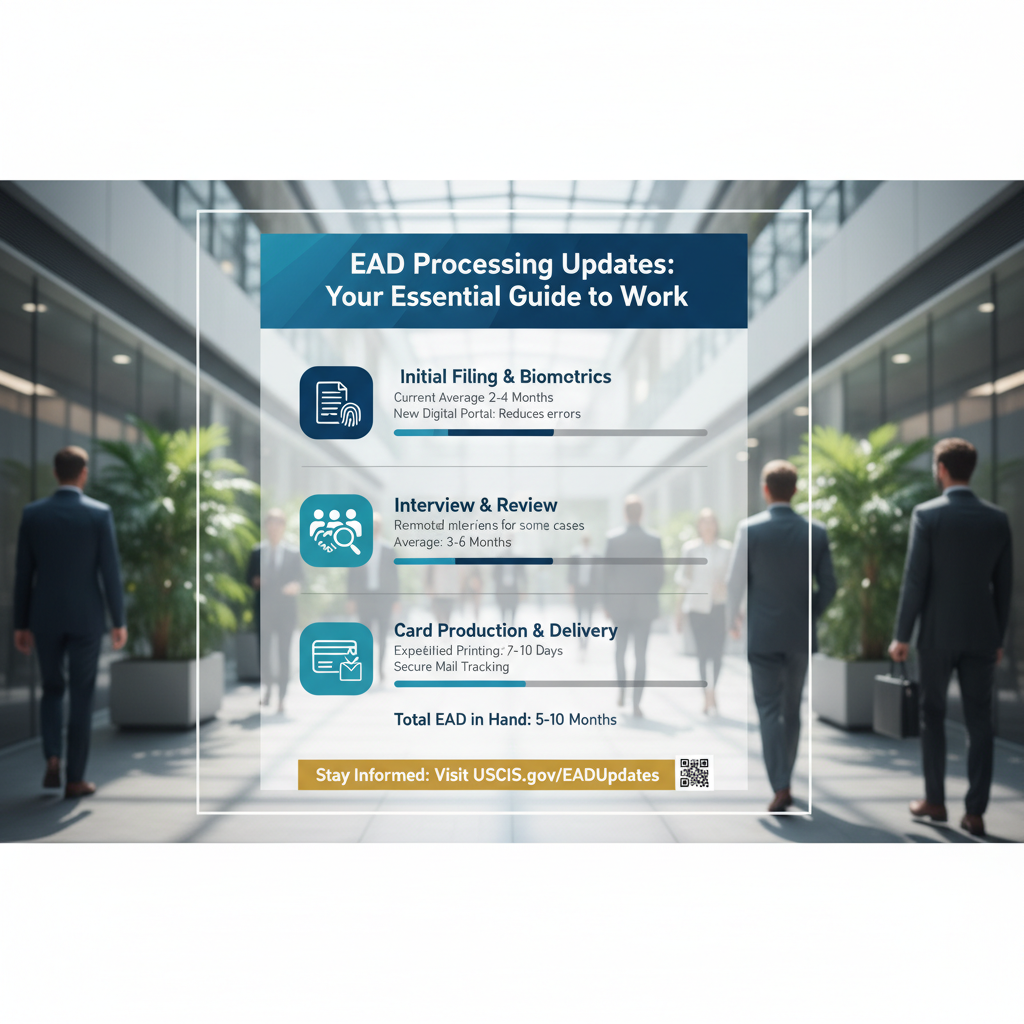
Recent discussions and policy adjustments at USCIS regarding the processing of Employment Authorization Documents have been a significant topic in immigration news. These ongoing efforts aim to address backlogs, streamline procedures, and improve efficiency for applicants across various eligibility categories. The continuous evolution of these processes directly impacts the lives and livelihoods of immigrants, making timely and accurate information essential for successful outcomes.
For more general news and updates on immigration law, you can refer to broad sources such as: Employment Authorization Document Processing (USCIS)
What This News Means for Immigrants in Orlando and Across Florida
For individuals and families residing in Orlando, across Florida, and throughout the nation, updates to EAD processing are not just administrative changes; they directly impact financial stability, career opportunities, and the very fabric of daily life. Understanding these shifts is crucial for anyone seeking to work legally in the U.S.
Why this news is showing up now
USCIS is an agency constantly adapting to fluctuating application volumes, technological advancements, and policy directives. The "trending news" around EAD processing reflects USCIS's ongoing commitment to address challenges like processing backlogs that intensified during and after the global pandemic. This includes initiatives to expand premium processing, increase staffing, and enhance digital capabilities. The goal is often to reduce wait times and provide more predictable outcomes for applicants. For example, recent policy memos and statements from USCIS have focused on improving efficiency for certain high-volume categories, recognizing the critical need for work authorization to sustain families and contribute to the U.S. economy. These efforts are part of a broader strategy to modernize the immigration system and ensure it functions more effectively for everyone involved.
How it can affect Florida residents
Florida, with its diverse economy and significant immigrant population, is particularly sensitive to changes in EAD processing. From the vibrant tourism and hospitality sectors in Orlando to the agricultural heartlands and burgeoning tech industries, immigrants play a vital role in the state's workforce. Delays in EAD processing can have profound consequences:
- Economic Stability: Lengthy waits for an initial EAD or renewal can lead to periods of unemployment, causing severe financial strain on families in Orlando and beyond. This impacts everything from rent and utilities to food and healthcare.
- Job Opportunities: Many Florida employers require proof of work authorization before hiring. Slow processing means lost opportunities, especially in fast-paced industries where demand for labor is high.
- Driver's Licenses and State IDs: In Florida, an EAD is often a key document used to obtain or renew a driver's license or state identification card, which is essential for daily life, commuting along the I-4 corridor, and accessing essential services.
- Community Integration: The ability to work and contribute fully to society fosters a sense of belonging and integration. Delays can hinder this, creating uncertainty and stress for individuals and their families.
- Business Impact: Florida businesses relying on immigrant labor can face workforce shortages and operational disruptions if employees cannot obtain or renew their work permits in a timely manner.
For Central Florida residents, particularly those in Orange County, these federal processing updates directly translate into local economic and social impacts. Understanding the nuances of EAD processing is not just about paperwork; it's about securing your future and contributing to the community you call home.
What Employment Authorization Document Processing Is (and Why It Matters)
The Employment Authorization Document (EAD), often referred to as a "work permit," is a crucial document for many non-citizens in the United States. It allows individuals who are not U.S. citizens or lawful permanent residents (Green Card holders) to legally work in the country for a specific period. The process of applying for or renewing an EAD involves submitting an application to USCIS, which then reviews your eligibility based on your underlying immigration status.
A plain-English definition
Imagine the EAD as your official permission slip from the U.S. government to get a job. If you're not a U.S. citizen or don't have a Green Card, but you're in the process of getting one, or you hold certain non-immigrant visas, or you're seeking protection, you often need an EAD to be legally employed. It's a physical card, similar to a driver's license, that proves your authorization to work to employers. Without it, most employers cannot legally hire you, regardless of your skills or qualifications.
Key terms you need to know
Navigating immigration processes requires understanding specific terminology. Here are some key terms related to EADs:
- Employment Authorization Document (EAD): The official document (Form I-766 card) issued by USCIS that grants permission to a foreign national to work in the U.S.
- Form I-765, Application for Employment Authorization: The specific USCIS form you must file to apply for an EAD, whether it's your initial application or a renewal.
- Eligibility Category: The specific legal reason or immigration status that allows you to apply for an EAD. Examples include individuals with a pending Form I-485 Adjustment of Status application, asylum seekers, certain spouses of visa holders, and students with Optional Practical Training (OPT).
- Pending Adjustment of Status (AOS): This refers to an application for a Green Card (lawful permanent residence) that is still being processed by USCIS. Many individuals with a pending AOS application are eligible for an EAD.
- Asylum Applicant: An individual who has applied for asylum in the U.S. and whose application has been pending for at least 150 days (with certain exceptions) may be eligible for an EAD.
- Optional Practical Training (OPT): A period during which F-1 nonimmigrant students can work in their field of study in the U.S. EADs are required for OPT.
- Temporary Protected Status (TPS): A temporary immigration status granted to eligible nationals of designated countries experiencing ongoing armed conflict, environmental disaster, or other extraordinary and temporary conditions. TPS holders are eligible for EADs.
- Automatic Extension: For certain EAD categories, when you file for an EAD renewal on time, your existing EAD may be automatically extended for a specific period (currently up to 540 days for many categories), allowing you to continue working while your renewal application is processed.
- Biometrics Appointment: An appointment at a USCIS Application Support Center (ASC) where fingerprints, photographs, and signatures are collected. This data is used for background checks and identity verification.
- Request for Evidence (RFE): A letter from USCIS requesting additional documents or information to support your application. Failing to respond to an RFE can lead to delays or denial.
Understanding these terms is your first step towards successfully navigating the EAD application or renewal process. It empowers you to communicate effectively with legal professionals and USCIS.
Current Immigration Law: The Foundation
The legal framework for employment authorization in the U.S. is primarily governed by the Immigration and Nationality Act (INA) and its implementing regulations, particularly those found in 8 Code of Federal Regulations (CFR) §274a.12. This regulation specifically outlines the various classes of foreign nationals who are authorized to be employed in the United States, as well as those who may apply for employment authorization.
Federal requirements
At the federal level, USCIS is the agency responsible for adjudicating EAD applications. The overarching principle is that non-citizens require specific authorization to work in the U.S. The INA broadly defines who can enter the U.S. and under what conditions they can remain and work. 8 CFR §274a.12 details a comprehensive list of eligibility categories for EADs, which include, but are not limited to:
- Applicants for Adjustment of Status (Green Card applicants) who have filed Form I-485.
- Asylum applicants whose Form I-589 has been pending for at least 150 days.
- Refugees and Asylees.
- Individuals granted Temporary Protected Status (TPS).
- Certain nonimmigrant visa holders, such as spouses of L-1 (L-2) or E (E-1/E-2) visa holders, and H-4 spouses of H-1B visa holders who meet specific criteria.
- F-1 students seeking Optional Practical Training (OPT).
- DACA (Deferred Action for Childhood Arrivals) recipients.
- Parolees.
Each category has specific requirements and documentation needed to prove eligibility. USCIS regularly updates its policies and guidance, which can influence how these regulations are interpreted and applied. It is critical to always refer to the most current instructions for Form I-765 on the USCIS official website.
Florida-specific considerations
While the laws governing EADs are federal, their practical implications resonate deeply at the state level, particularly in Florida. The state of Florida does not have its own separate EAD laws; rather, it adheres to federal immigration regulations regarding employment authorization. However, possessing a valid EAD is essential for life in Florida in several ways:
- Employment Verification: All Florida employers must comply with federal law requiring them to verify the employment eligibility of new hires using Form I-9, Employment Eligibility Verification. A valid EAD card is a primary document for this purpose.
- Driver's Licenses and State IDs: To obtain a Florida driver's license or state identification card, you must provide proof of legal presence in the U.S. A valid EAD, along with other documents, serves as acceptable proof of your temporary legal status and work authorization, allowing you to drive to work or navigate public transport in Orlando.
- Professional Licenses: Many professions in Florida require state-issued licenses (e.g., healthcare, real estate, cosmetology). While specific requirements vary, having legal work authorization is often a prerequisite for obtaining these licenses.
- Public Services: While EAD holders may not be eligible for all federal or state public benefits, having a legal work permit contributes to your ability to establish residency and access certain services, such as banking or educational opportunities, within Florida.
For individuals living in Orlando and across Florida, a valid EAD is more than just a work permit; it is a gateway to economic independence, mobility, and community participation. Staying informed about federal EAD processing updates is therefore directly relevant to your daily life and future prospects in the Sunshine State.
Need Help? Our Orlando immigration team is ready to assist. Call +1 786-791-3106 for a free consultation, or message us online. Se Habla Español.

How to Apply for or Renew Your EAD: A Complete Step-by-Step Guide
Applying for or renewing your Employment Authorization Document (EAD) is a critical process that requires meticulous attention to detail. This guide will walk you through each step, ensuring you have the information needed for a successful application. Remember, timely filing, especially for renewals, is key to avoiding gaps in employment authorization.
1) Determine Your Eligibility Category
Before you even begin filling out forms, you must confirm that you are eligible for an EAD and identify your specific eligibility category. This is the foundation of your entire application. Your eligibility is tied to your underlying immigration status or application.
- Common Categories Include:
- (c)(9): Adjustment of Status (AOS) applicants (Form I-485 pending).
- (c)(8): Asylum applicants (Form I-589 pending for at least 150 days).
- (c)(3)(C): F-1 students seeking Optional Practical Training (OPT).
- (a)(12): Temporary Protected Status (TPS) recipients.
- (c)(26): H-4 spouses of H-1B nonimmigrants who meet certain criteria.
- (a)(17): Spouses of E-1/E-2/E-3 nonimmigrants.
- (a)(18): Spouses of L-1 nonimmigrants (L-2).
- Action: Review the USCIS "Explore My Options" page or the instructions for Form I-765 to find the category that applies to you. This is a crucial step that can prevent delays or denials.
2) Gather All Required Documents and Evidence
Once you know your eligibility category, you can compile the necessary supporting documents. The specific documents will vary based on your category, but there are common requirements for almost everyone. All documents not in English must be accompanied by a certified English translation.
- General Required Documents:
- Two identical passport-style photos (taken within 30 days of filing).
- Copy of your last EAD card (if renewing).
- Copy of your government-issued photo identification (e.g., passport ID page, foreign birth certificate, or national ID with photo).
- Copy of Form I-94, Arrival/Departure Record (front and back, if applicable).
- Copy of your birth certificate (with certified English translation if not in English).
- Copy of any previous EAD cards (front and back).
- Copy of visa page from your passport (if applicable).
- Copy of any marriage certificate (if applying as a spouse, with certified English translation).
- Proof of eligibility for your specific category (e.g., Receipt Notice for Form I-485, a copy of your Form I-589, or Form I-20 for OPT).
- Action: Create a checklist based on your specific category and gather all original documents to make copies. Organize them neatly.
3) Complete Form I-765, Application for Employment Authorization
This is the core of your application. It is imperative to use the most current version of Form I-765, available on the USCIS Forms website. Read all instructions carefully. Accuracy and completeness are paramount.
- Key Considerations:
- Fill out every applicable field. If a field doesn't apply, write "N/A" (Not Applicable) or "None."
- Ensure your name, date of birth, and other personal information precisely match your other immigration documents.
- Double-check your chosen eligibility category code.
- Sign the form in blue or black ink. An unsigned form will be rejected.
- Consider attaching Form G-1145, E-Notification of Application/Petition Acceptance, to receive an email and/or text message when USCIS accepts your application.
- Action: Download the latest form, fill it out digitally if possible (then print and sign), or clearly handwrite all information. Review it multiple times for errors.
4) Prepare Supporting Evidence Specific to Your Category
Beyond the general documents, each eligibility category requires specific proof that you qualify. This is often the most complex part of the application.
- Examples of Category-Specific Evidence:
- For (c)(9) AOS applicants: Copy of your Form I-485 Receipt Notice.
- For (c)(8) Asylum applicants: Proof that your asylum application (Form I-589) has been pending for at least 150 days (e.g., Receipt Notice).
- For (c)(3)(C) F-1 OPT: Copy of your Form I-20 with the OPT recommendation from your Designated School Official (DSO), copies of previous EAD cards (if applicable), and academic transcripts.
- For (a)(12) TPS: Copy of your Form I-797, Notice of Action, showing your TPS approval or pending status.
- For (c)(26) H-4 EAD: Copy of your spouse's H-1B approval (Form I-797), proof of your marital relationship (marriage certificate), and evidence that your H-1B spouse has an approved Form I-140, Immigrant Petition for Alien Worker, or has been granted an H-1B status under AC21.
- Action: Refer to the specific instructions for Form I-765 and the USCIS website for your category to ensure you include all required evidence.
5) Calculate and Pay the Filing Fee (or Request a Fee Waiver)
Most EAD applications require a filing fee. The fee amount can change, so always check the current fee on the USCIS website or Form I-765 instructions. Some applicants may also need to pay a biometrics services fee.
- Payment Options:
- Personal check, cashier's check, or money order payable to "U.S. Department of Homeland Security."
- Credit card using Form G-1450, Authorization for Credit Card Transactions.
- Fee Waivers: If you are unable to pay the filing fee, you may be eligible for a fee waiver by submitting Form I-912, Request for Fee Waiver. Eligibility for a fee waiver is based on specific income guidelines or receipt of certain means-tested benefits.
- Action: Verify the exact fee. If paying by check, ensure it is correctly filled out. If requesting a fee waiver, submit Form I-912 and supporting documents along with your EAD application.
6) Mail Your Application Package to the Correct USCIS Lockbox Facility
The mailing address for Form I-765 depends on your eligibility category and where you reside. Sending your application to the wrong address can cause significant delays or even rejection.
- Important Mailing Tips:
- Check the "Where to File" section on the USCIS website for Form I-765.
- Organize your application package neatly, perhaps with tabs for different sections.
- Make a complete copy of your entire application package for your records before mailing.
- Send your package via certified mail with return receipt requested, or a courier service that provides tracking. This provides proof of mailing and delivery.
- Action: Confirm the correct filing address for your specific case. Package your application securely and mail it using a trackable service.
7) Attend Your Biometrics Appointment (If Required)
After USCIS receives your application, you will typically receive a Form I-797C, Notice of Action, confirming receipt and, for most applicants, a separate appointment notice for biometrics. This appointment is usually at a local Application Support Center (ASC).
- During the Biometrics Appointment:
- Fingerprints, photographs, and a signature will be collected.
- This data is used for background checks and to verify your identity.
- Bring your appointment notice and a valid photo ID (e.g., passport, driver's license).
- For Central Florida residents, your appointment might be at the Orlando ASC.
- Action: Do not miss your biometrics appointment. If you have an unavoidable conflict, follow the instructions on the notice to reschedule immediately.
8) Monitor Your Case Status and Respond to RFEs
After biometrics, your application will be pending adjudication. It is crucial to monitor its status and be prepared to respond to any requests from USCIS.
- Monitoring Your Status:
- Use the receipt number from your Form I-797C to check your case status online on the USCIS Case Status Online tool.
- Sign up for email updates.
- Check the USCIS Processing Times page for estimated wait times for your service center and form type.
- Responding to RFEs: If USCIS needs more information, they will send a Request for Evidence (RFE).
- Warning: Read the RFE carefully and provide *all* requested documents by the deadline. Failing to do so can lead to denial.
- Keep copies of everything you send in response to an RFE.
- Action: Regularly check your case status and promptly and thoroughly respond to any RFEs. Consult with an immigration attorney if you receive an RFE.


