

In the vibrant landscape of Florida, the ability to work legally is not just a right, but a cornerstone of stability and opportunity for countless immigrants and their families. At Imigrar, we understand that securing and maintaining an Employment Authorization Document (EAD), often referred to as a work permit, is critical to building a new life and contributing to our communities, especially here in Orlando and across the Sunshine State.
The processes overseen by U.S. Citizenship and Immigration Services (USCIS) are constantly evolving, and keeping abreast of these changes is essential. Recent updates regarding EAD applications and renewals have brought both challenges and relief, impacting how quickly and efficiently individuals can gain or maintain their authorization to work in the U.S.
Need Help Navigating EAD Applications or Renewals? Our experienced Orlando immigration team at Imigrar is ready to assist. Call +1 786-791-3106 for a free, confidential consultation, or message us online. Se Habla Español.
The reporting that sparked this guide
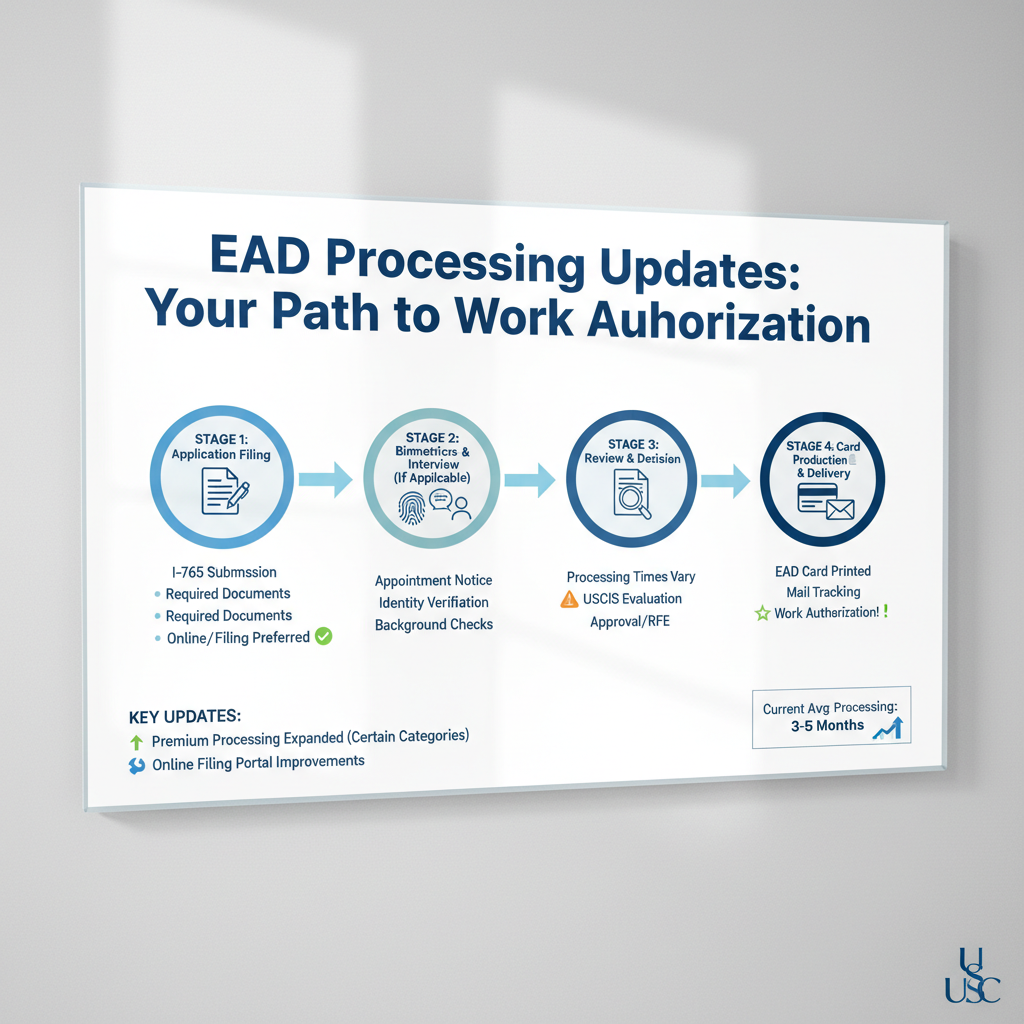
The landscape of immigration law is dynamic, with USCIS regularly issuing policy updates, adjusting processing times, and implementing new strategies to manage the millions of applications it receives annually. Our firm continuously monitors these developments, drawing insights from official USCIS announcements and reliable immigration news sources. The information presented in this guide is a direct response to ongoing discussions and recent reports concerning the processing of Employment Authorization Documents, reflecting USCIS's continuous efforts to streamline operations and address backlogs.
Employment Authorization Document Processing (USCIS)
What This News Means for Immigrants in Orlando and Across Florida
For individuals residing in Orlando, Central Florida, and throughout the state, updates to Employment Authorization Document (EAD) processing are not abstract policy discussions; they directly impact livelihoods, family stability, and future plans. Understanding the implications of these changes is paramount.
Why this news is showing up now
The focus on EAD processing, particularly application and renewal updates, is a recurring theme in immigration news for several compelling reasons:
- Post-Pandemic Backlogs: The COVID-19 pandemic severely disrupted USCIS operations, leading to unprecedented backlogs across almost all application types, including Form I-765 for EADs. USCIS has been actively implementing strategies to reduce these backlogs, and each new initiative or adjustment sparks news and discussion.
- Policy Changes and Regulatory Reform: The federal government periodically introduces new policies or regulations aimed at improving efficiency, addressing specific humanitarian concerns, or adapting to economic needs. For instance, temporary final rules extending EAD validity periods for certain categories have been a significant area of focus.
- High Demand: With a growing number of immigrants adjusting status, seeking asylum, or participating in various nonimmigrant programs (like F-1 OPT or H-4 dependent spouses), the demand for EADs remains consistently high. Any fluctuation in processing capacity or policy can have widespread effects.
- Technological Advancements: USCIS is continually working to modernize its systems, including expanding online filing options and improving case management. Updates often relate to these technological transitions and their impact on processing.
- Advocacy and Public Scrutiny: Immigration advocacy groups, legal professionals, and the public consistently monitor USCIS performance, especially concerning processing times. This scrutiny often brings EAD processing into the spotlight, prompting USCIS to provide updates or justify its operational approach.
How it can affect Florida residents
Florida, with its diverse population and significant immigrant communities, is particularly sensitive to EAD processing changes:
- Economic Stability: For many families in Orlando, Tampa, Miami, and beyond, an EAD is the gateway to legal employment, allowing them to support themselves and their dependents. Delays in processing can lead to job loss, financial hardship, and increased stress.
- Access to Essential Services: Beyond employment, an EAD often serves as a primary form of identification, crucial for obtaining a driver's license (especially important for navigating the I-4 corridor and Central Florida), opening bank accounts, and accessing other vital services.
- Specific Categories Impacted: Florida is home to large populations of asylum seekers, refugees, individuals with Temporary Protected Status (TPS), H-4 spouses, and those with pending Adjustment of Status applications. Each of these categories relies heavily on timely EAD processing, and any change can disproportionately affect them.
- Local Economy: A robust immigrant workforce contributes significantly to Florida's economy, from agriculture and tourism to healthcare and technology. Efficient EAD processing ensures this workforce remains stable and productive.
- Planning and Uncertainty: Long processing times or unpredictable updates create immense uncertainty for individuals trying to plan their lives, careers, and family futures. This is particularly true for those with expiring EADs needing renewals.
- Orlando USCIS Field Office: While many EAD applications are processed at service centers, local field offices like the Orlando USCIS Field Office play a role in interviews (if required) and providing support. Understanding how national processing trends affect local operations is key for Orlando residents.
At Imigrar, we are committed to keeping our community in Orlando and across Florida informed about these critical updates, helping you navigate the complexities and protect your ability to work and thrive.
What Employment Authorization Documents (EADs) Are (and Why They Matter)
An Employment Authorization Document (EAD) is often simply called a "work permit." It's a card issued by USCIS that provides temporary authorization for foreign nationals to work legally in the United States. For many immigrants, securing an EAD is a pivotal step towards self-sufficiency and integration into American society.
A plain-English definition
Think of an EAD as your official permission slip from the U.S. government to work. It's a physical card, similar to a driver's license, that confirms you are legally allowed to be employed in the U.S. for a specific period. It does not grant you permanent residency (a Green Card) or U.S. citizenship, but it allows you to earn a living while you pursue those or other immigration goals.
The EAD card will have your photo, name, date of birth, and an expiration date. Your employer will need to see this card (along with another form of ID) to verify your eligibility to work when you complete Form I-9, Employment Eligibility Verification.
Key terms you need to know
Understanding these terms will help you better comprehend the EAD process:
- USCIS (U.S. Citizenship and Immigration Services): The government agency responsible for overseeing lawful immigration to the United States. They process EAD applications. USCIS official website
- Form I-765, Application for Employment Authorization: This is the official form you must file with USCIS to request an EAD or renew an existing one.
- Eligibility Category: Not everyone is eligible for an EAD. USCIS defines specific categories of foreign nationals who can apply. These categories are crucial and are listed on Form I-765 (e.g., (c)(9) for Adjustment of Status applicants, (c)(33) for DACA recipients, (a)(5) for asylees).
- Initial EAD: Your very first EAD application in a specific eligibility category.
- Renewal EAD: An application to extend the validity of an existing EAD that is expiring or has already expired. It's critical to apply for renewal in a timely manner.
- Replacement EAD: An application to get a new EAD card if yours is lost, stolen, or damaged, or if it contains incorrect information.
- Processing Times: The amount of time USCIS estimates it will take to process your application from the date of submission to the date of decision. These times vary widely by form type and service center. You can check current estimates here: USCIS Processing Times.
- Adjustment of Status (AOS): The process of applying for lawful permanent resident status (a Green Card) while physically present in the United States. Many individuals applying for AOS also apply for an EAD (and often a travel document, Form I-131) concurrently.
- STEM OPT Extension: A 24-month extension of post-completion Optional Practical Training (OPT) available to F-1 students who majored in eligible science, technology, engineering, and mathematics (STEM) fields. This requires a specific EAD application.
An EAD is more than just a piece of plastic; it represents hope, independence, and the opportunity to build a stable future for yourself and your family in Orlando and beyond. Understanding these fundamentals is the first step in navigating the application process successfully.
Current Immigration Law: The Foundation for Work Authorization
The authority for granting employment authorization to non-citizens in the United States stems primarily from the Immigration and Nationality Act (INA) and its implementing regulations, found in Title 8 of the Code of Federal Regulations (8 CFR). These laws establish the framework under which USCIS operates and defines who is eligible for an EAD and under what conditions.
Federal requirements for EAD eligibility
Under federal law, specifically 8 CFR § 274a.12, there are various categories of foreign nationals who are eligible to apply for employment authorization. It's crucial to understand that EAD eligibility is not universal; it is tied to your underlying immigration status or application. Some of the most common categories include:
- Asylum Seekers and Asylees: Individuals with a pending asylum application (category (c)(8)) who have waited 150 days after filing their asylum application, or those who have been granted asylum (category (a)(5)).
- Refugees: Individuals admitted as refugees (category (a)(3)).
- Applicants for Adjustment of Status (Green Card Applicants): Those with a pending Form I-485, Application to Register Permanent Residence or Adjust Status (category (c)(9)). This is one of the most common EAD categories.
- Applicants for Temporary Protected Status (TPS): Individuals granted TPS (category (a)(12) or (c)(19)).
- Students with Optional Practical Training (OPT): F-1 nonimmigrant students authorized for Optional Practical Training (OPT) (categories (c)(3)(A), (c)(3)(B), (c)(3)(C)).
- Spouses of Certain Nonimmigrants: H-4 spouses of H-1B nonimmigrants who meet certain criteria (category (c)(26)), and L-2 spouses of L-1 nonimmigrants (category (a)(18)).
- DACA Recipients: Individuals granted Deferred Action for Childhood Arrivals (DACA) (category (c)(33)).
- U and T Visa Applicants: Victims of certain crimes (U visa applicants, category (a)(14) or (a)(16)) and victims of severe forms of trafficking (T visa applicants, category (a)(16)).
Each category has specific requirements and documentation needed to prove eligibility. The EAD itself is issued on Form I-766, Employment Authorization Document. For the most accurate and up-to-date information on eligibility categories and their specific requirements, always refer to the official USCIS website and the instructions for Form I-765.
Florida-specific considerations for working legally
While EAD eligibility is determined by federal law, there are practical considerations for working legally in Florida:
- Employer Verification: All employers in Florida, like those nationwide, are required to verify the employment eligibility of their new hires using Form I-9. An unexpired EAD is a primary document for this purpose.
- E-Verify: Many Florida employers, particularly those contracting with the state government, use E-Verify, an internet-based system that compares information from an employee's Form I-9 to data from U.S. Department of Homeland Security (DHS) and Social Security Administration (SSA) records to confirm employment eligibility. Having a valid EAD is essential for passing E-Verify checks.
- Professional Licenses: Certain professions in Florida require state-issued licenses (e.g., healthcare, teaching, cosmetology). While an EAD grants work authorization, you will also need to meet the specific educational, experience, and sometimes, immigration status requirements of the Florida licensing board.
- Driver's Licenses and State IDs: For many immigrants, an EAD is a crucial document for obtaining a Florida driver's license or state identification card. This is particularly important for navigating daily life in Central Florida, where public transportation options can be limited outside major urban centers like Orlando. The Florida Department of Highway Safety and Motor Vehicles (FLHSMV) accepts an EAD as proof of legal presence.
- Understanding State vs. Federal Law: It's important for Florida residents to distinguish between federal immigration law (which governs EADs) and state laws that might impact immigrants in other ways (e.g., access to certain benefits or educational opportunities). Your EAD is a federal document.
Navigating these federal and state intersections requires careful attention. Imigrar is deeply familiar with the nuances for Florida residents and can provide tailored advice.
Don't risk delays or denials on your EAD application. The immigration attorneys at Imigrar in Orlando can guide you through every step. Contact us today for a free consultation at +1 786-791-3106. ¡Hablamos Español!
How to Apply for or Renew Your EAD: A Complete Step-by-Step Guide
Applying for or renewing an Employment Authorization Document (EAD) involves careful preparation and adherence to USCIS guidelines. This step-by-step guide will walk you through the process, whether you're applying for the first time or seeking to extend your work authorization.
1) Determine Your Eligibility Category and Gather Core Documents
Before you even touch Form I-765, you must confirm that you are eligible for an EAD and identify your specific eligibility category. This is the most crucial first step, as it dictates the documents you'll need and the information you'll provide.
- Identify Your Category: Review the instructions for Form I-765 or consult an immigration attorney to find the category that applies to your situation (e.g., (c)(9) for pending Adjustment of Status, (c)(8) for pending asylum, (c)(26) for H-4 spouses).
- Proof of Identity and Nationality:
- Copy of your birth certificate (with certified translation if not in English).
- Copy of your passport biographical page.
- Copy of your visa (if applicable).
- Two identical passport-style photos (taken within the last 30 days).
- Proof of Immigration Status:
- Copy of your Form I-94, Arrival/Departure Record (front and back, if paper; printout if electronic).
- Copy of any previous EAD cards (front and back).
- Copy of your marriage certificate (if applying as a spouse of a primary applicant).
- Copy of your Form I-797, Notice of Action, for any underlying applications (e.g., Form I-485 receipt notice, asylum application receipt notice).
- Proof of Eligibility for Your Specific Category: This will vary widely. For example:
- For (c)(9) Adjustment of Status: Copy of your Form I-485 receipt notice.
- For (c)(8) Asylum Applicants: Copy of your Form I-589, Application for Asylum and for Withholding of Removal receipt notice, demonstrating your application has been pending for at least 150 days.
- For (c)(26) H-4 Spouses: Copy of your H-4 visa, your spouse's H-1B approval notice (Form I-797), and proof your spouse has an approved Form I-140, Immigrant Petition for Alien Worker, or has been granted an H-1B extension beyond the 6-year limit under AC21.
- Important: Do not send original documents unless specifically requested by USCIS. Always send high-quality copies.
2) Complete Form I-765, Application for Employment Authorization
This is the core of your application. Fill out Form I-765 accurately and completely. Read all instructions carefully, as even minor errors can lead to delays or rejection.
- Download the Latest Form: Always use the most current version of Form I-765 from the USCIS Forms page.
- Provide Accurate Information: Fill in every required field. If a question doesn't apply to you, write "N/A" (not applicable) unless instructions say otherwise. Do not leave blank spaces.
- Your Eligibility Category: Clearly write your specific eligibility category (e.g., (c)(9), (c)(8), (c)(26)) in Part 2, Item 27.
- Previous Applications: If you've previously applied for an EAD, provide the information requested in Part 2, Items 28-30, including any "A-Number" (Alien Registration Number) or USCIS Online Account Number.
- Signature: Ensure you sign the form in blue or black ink. An unsigned form will be rejected.
- Warning: Any false statements or omissions can have severe immigration consequences. If you are unsure about any question, seek legal advice.
3) Calculate and Pay the Filing Fee (or Request a Fee Waiver)
Most EAD applications require a filing fee. Check the USCIS website or the Form I-765 instructions for the current fee amount. As of 2026, fees are subject to change, so always verify.
- Current Fee: The fee for Form I-765 is typically paid by check, money order, or credit card (using Form G-1450, Authorization for Credit Card Transactions). Make sure the check or money order is payable to "U.S. Department of Homeland Security" and is for the exact amount.
- Biometrics Fee: In some cases, a separate biometrics fee might be required. Verify if your category requires it.
- Fee Waivers: Certain applicants may be eligible for a fee waiver if they can demonstrate inability to pay. This usually requires filing Form I-912, Request for Fee Waiver, along with supporting documentation (e.g., proof of receiving means-tested benefits, household income below 150% of the poverty line). Do not send a fee waiver request if you are not eligible, as it will delay your case.
- Reminder: Incorrect fees or improperly submitted fee waivers are common reasons for application rejection.
4) Assemble and File Your Application Package
Once you have all your documents and the completed form, it's time to assemble your package and mail it to the correct USCIS Service Center.
- Order of Documents: While not strictly mandated, a logical order helps USCIS officers process your application. A common order is:
- Check or Form G-1450 (on top)
- Form I-765
- Two passport-style photos in a small envelope, taped to a blank sheet of paper, labeled with your name and A-Number.
- Supporting documents (copies only), organized by type or chronologically.
- If applicable, Form G-1145, E-Notification of Application/Petition Acceptance (on top of the entire package).
- Mailing Address: The filing address depends on your eligibility category and sometimes your state of residence. Check the "Where to File" section of the Form I-765 instructions carefully. Sending it to the wrong address will cause significant delays. For many Florida residents, applications might go to the USCIS Lockbox in Dallas or Chicago.
- Tracking: Always send your application via certified mail with a return receipt or a courier service that provides tracking (e.g., FedEx, UPS). This provides proof of mailing and delivery.
5) Attend Biometrics Appointment (if required)
After USCIS accepts your application, they will send you a receipt notice (Form I-797C, Notice of Action) and, if required for your case, a biometrics appointment notice (Form I-797C). This appointment is usually at an Application Support Center (ASC).
- Notice: The notice will specify the date, time, and location of your appointment. For those in Central Florida, this will likely be at an ASC in Orlando or a nearby city.
- What to Bring: You must bring the appointment notice and a valid photo ID (e.g., passport, state ID, driver's license).
- Purpose: At the appointment, your fingerprints, photograph, and signature will be taken. This information is used for background checks.
- Important: Do not miss your biometrics appointment. If you have an unavoidable conflict, follow the instructions on the notice to request a rescheduling, but be aware that rescheduling can cause delays.
6) Receive a Decision and Your EAD Card
Once USCIS has processed your application and completed all necessary background checks, they will issue a decision.
- Approval: If approved, USCIS will mail your EAD card (Form I-766) to the address on your application. This card will show your photo, validity dates, and employment eligibility category.
- Request for Evidence (RFE): USCIS might send an RFE if they need more information or clarification. Respond promptly and completely to avoid denial.
- Denial: If your application is denied, USCIS will send a denial notice explaining the reasons. You may have options to appeal, refile, or seek legal counsel to understand your next steps.
- Track Your Case: You can track the status of your application online using the receipt number provided on your Form I-797C at the USCIS website.
Reminder: EAD processing times can vary significantly. Some categories might be processed in a few months, while others could take over a year. Always check the USCIS Processing Times page for the most current estimates.
Practical Steps You Can Take Today to Secure Your Work Authorization
Navigating the EAD application or renewal process can be daunting, but proactive steps can significantly improve your chances of a smooth and timely approval. Here's what you can do today:
Actionable Checklist (Start Now!):
- Verify Your Eligibility: Reconfirm your specific EAD eligibility category by reviewing the official Form I-765 instructions or consulting with an immigration attorney. Don't assume your past eligibility still holds or that you're in the right category.
- Check Your Current EAD's Expiration Date: If you have an existing EAD, note its expiration date. USCIS recommends filing a renewal application 120 to 180 days before your current EAD expires. However, due to recent processing delays, many experts now advise filing even earlier, perhaps 6 months or more, if your category allows.
- Gather Required Documents: Start compiling all necessary supporting documents immediately. This includes identity proofs, immigration status documents, and evidence specific to your eligibility category. Don't wait until the last minute.
- Download the Latest Forms: Always obtain Form I-765 and any other required forms (like Form G-1450 or Form I-912) directly from the official USCIS Forms page to ensure you are using the most current version.
- Review Filing Fees: Check the current filing fee for Form I-765 on the USCIS website. Fees can change, so verify the exact amount before preparing your payment.
- Consider Legal Counsel: If your case is complex, you have a history of immigration issues, or you simply want peace of mind, schedule a free consultation with an immigration attorney at Imigrar. This can prevent costly mistakes and delays.
- Set Up a Filing System:


