


Date: 2026-06-10
For immigrants across the United States, especially here in Orlando and throughout Florida, an Employment Authorization Document (EAD), often called a work permit, is more than just a piece of plastic – it's a gateway to self-sufficiency, stability, and integration into American society. It allows individuals to legally work, support their families, and contribute to the local economy. However, the path to obtaining or renewing an EAD can be complex, and processing times have been a significant concern for many years.
At Imigrar, our mission is to "Keep Families Together," and we understand that the ability to work is fundamental to achieving that goal. With ongoing updates and evolving processing strategies from U.S. Citizenship and Immigration Services (USCIS), staying informed is crucial. This comprehensive guide will break down the latest developments in EAD processing, provide a clear roadmap for applicants, and offer practical advice to help you navigate this vital process.
Need Help? Our Orlando immigration team is ready to assist. Call +1 786-791-3106 for a free consultation, or message us online. Se Habla Español.
The reporting that sparked this guide
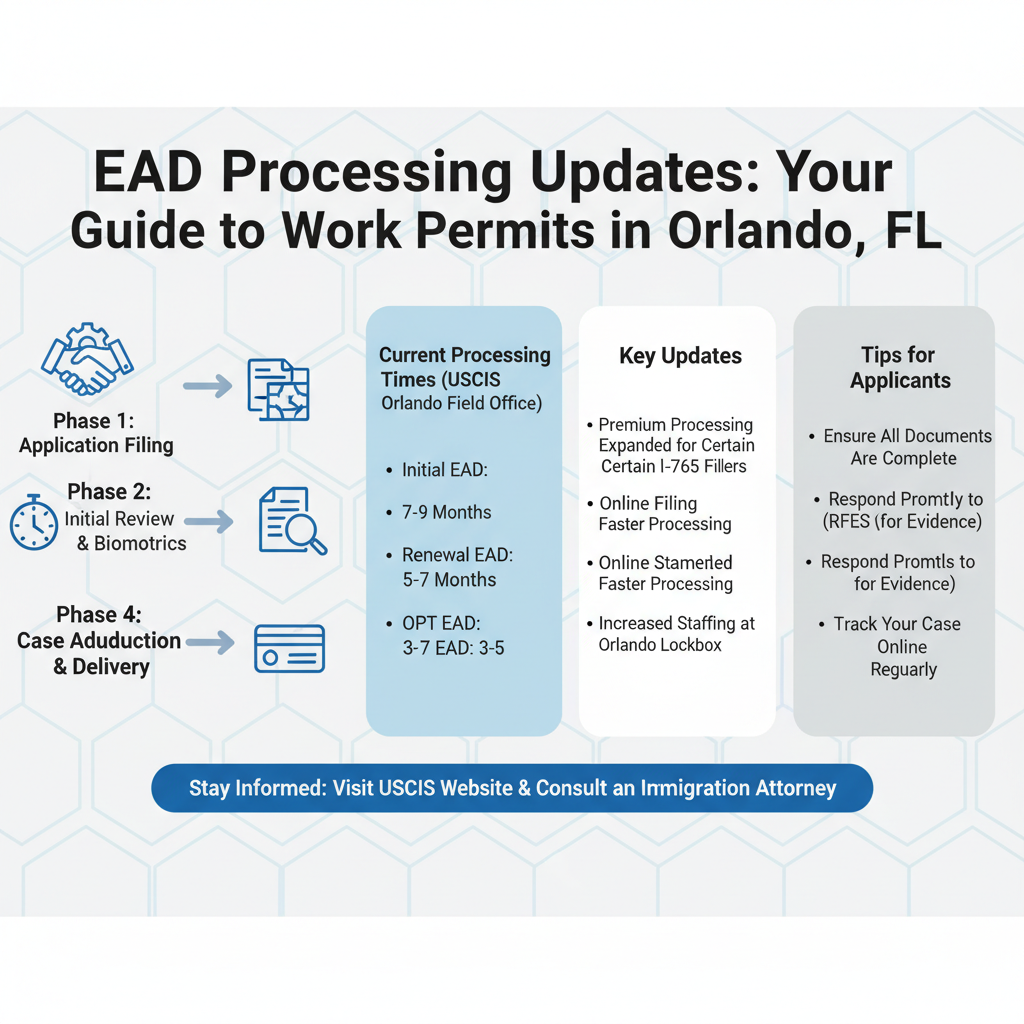
Recent reports from various immigration news outlets and official USCIS announcements highlight the agency's continued efforts to address backlogs and improve efficiency in processing Employment Authorization Documents. While the challenges of high demand and resource constraints persist, USCIS has been implementing strategies such as temporary EAD validity extensions, internal process streamlining, and increased staffing to alleviate the pressure on applicants. These ongoing updates, aimed at reducing processing times and providing relief to those awaiting work authorization, underscore the dynamic nature of immigration procedures and the importance of staying current. For continuous updates, we monitor sources like: Employment Authorization Document Processing (USCIS)
What This News Means for Immigrants in Orlando and Across Florida
The fluctuating landscape of EAD processing directly impacts thousands of immigrants and their families here in Orlando and across the Sunshine State. Understanding these changes isn't just about legal compliance; it's about planning your life, your career, and your family's future.
Why this news is showing up now
The discussion around EAD processing is always active, but it has intensified in recent years due to several factors:
- Pandemic-Related Backlogs: The COVID-19 pandemic significantly disrupted USCIS operations, leading to unprecedented backlogs across almost all application types, including EADs. While operations have largely resumed, the agency is still working through the accumulated caseload.
- Increased Demand: A rise in various immigration benefit applications, including asylum seekers, parolees, and those adjusting status, has naturally led to higher volumes of EAD requests.
- USCIS Efficiency Initiatives: In response to public and governmental pressure, USCIS has been actively rolling out initiatives to improve processing efficiency. This includes temporary final rules extending EAD validity periods for certain categories and efforts to digitize processes. These "updates" are continuous, and what's true today might be refined tomorrow.
- Economic Impact: Delays in EAD processing have a tangible economic impact, preventing individuals from working, contributing taxes, and utilizing their skills, which affects both individual families and the broader economy in places like Central Florida.
How it can affect Florida residents
For individuals and families living in Orlando, Tampa, Miami, and other parts of Florida, these EAD processing updates have direct consequences:
- Employment Opportunities: Delays mean a longer wait to start a new job or, critically, to continue an existing one. In a vibrant economic hub like Orlando, with its growing hospitality, tech, and healthcare sectors, the ability to work legally is paramount.
- Financial Stability: Without work authorization, families face severe financial hardship. The ability to earn a living wage is essential for rent, food, healthcare, and education for children.
- Driver's Licenses and State IDs: In Florida, obtaining or renewing a driver's license or state identification card often requires proof of valid immigration status and work authorization. A delayed EAD can halt this process, impacting daily life and mobility, especially for those in Orange County and along the I-4 corridor who rely on personal transportation.
- Mental Health and Stress: The uncertainty and stress associated with waiting for an EAD can take a significant toll on mental well-being, affecting individuals and entire families.
- Planning for the Future: Delays make it difficult to plan for housing, education, and long-term career goals, creating a state of limbo for many.
Understanding these impacts is the first step. The next is to arm yourself with accurate information and a clear strategy, which is precisely what Imigrar is here to help you achieve.
What Employment Authorization Documents (EADs) Are (and Why They Matter)
The Employment Authorization Document, commonly known as an EAD or a work permit, is a critical document for many non-citizens in the United States. It provides explicit permission from the U.S. government to work legally within the country for a specific period.
A plain-English definition
Simply put, an Employment Authorization Document (EAD) is a card issued by USCIS that proves you are authorized to work in the United States. It looks similar to a driver's license and contains your photo, name, date of birth, country of birth, and a category under which you were granted employment authorization. This card is your official proof that an employer can legally hire you.
Without an EAD (or other specific work authorization, such as certain nonimmigrant visas like H-1B), it is generally illegal for a non-citizen to be employed in the U.S. Working without authorization can have severe immigration consequences, including jeopardizing future immigration benefits or even leading to deportation.
Key terms you need to know
To navigate the EAD process effectively, it's helpful to understand some key terms:
- USCIS (U.S. Citizenship and Immigration Services): The government agency responsible for administering immigration and naturalization benefits, including EADs.
- EAD (Employment Authorization Document): The official card authorizing you to work.
- Form I-765: The specific application form, titled "Application for Employment Authorization," that you must file with USCIS to request an EAD.
- Work Permit: A common, informal term for the EAD card.
- Adjustment of Status (AOS): The process of applying for lawful permanent resident status (a Green Card) while physically present in the United States. Many individuals applying for AOS are eligible for an EAD while their Green Card application is pending.
- Asylum Seeker: An individual seeking protection in the U.S. who has applied for asylum and typically becomes eligible for an EAD after a certain waiting period.
- DACA (Deferred Action for Childhood Arrivals): A program that provides eligible undocumented youth with deferred action from deportation and work authorization. DACA recipients apply for EADs.
- TPS (Temporary Protected Status): A temporary immigration status granted to eligible nationals of designated countries experiencing armed conflict, environmental disaster, or other extraordinary conditions. TPS recipients are eligible for EADs.
- Renewal: The process of reapplying for an EAD before your current one expires to continue your work authorization without interruption.
- Initial Application: Your first application for an EAD under a specific eligibility category.
Understanding these terms will empower you to better comprehend the process and communicate effectively with USCIS or your legal representative.
Current Immigration Law: The Foundation for EADs
The authority for granting Employment Authorization Documents stems from federal immigration law, primarily the Immigration and Nationality Act (INA) and its implementing regulations found in the Code of Federal Regulations (CFR), specifically 8 CFR §274a.12. These laws define who is eligible for an EAD and under what circumstances.
Federal requirements
The INA and its regulations establish various eligibility categories for EADs. It's crucial to understand that not all non-citizens are eligible for an EAD. Eligibility is tied to a specific immigration status or application. Some of the most common categories include:
- Applicants for Adjustment of Status (AOS): Individuals who have filed Form I-485, Application to Register Permanent Residence or Adjust Status, are typically eligible for an EAD while their Green Card application is pending. This is often filed concurrently with Form I-130 (Petition for Alien Relative) or Form I-140 (Immigrant Petition for Alien Workers).
- Asylum Applicants: Individuals who have filed Form I-589, Application for Asylum and for Withholding of Removal, and whose application has been pending for at least 150 days (and not been denied) are eligible.
- Refugees and Asylees: Those granted refugee or asylum status.
- Deferred Action for Childhood Arrivals (DACA) Recipients: Individuals granted deferred action under DACA.
- Temporary Protected Status (TPS) Recipients: Nationals of countries designated for TPS.
- Certain Nonimmigrant Visa Holders: Spouses of certain visa holders (e.g., L-2 spouses, E-1/E-2 spouses) or fiancés of U.S. citizens (K-1 visa holders) upon marriage and filing for adjustment.
- Students with Specific Employment Needs: F-1 students seeking Optional Practical Training (OPT) or Curricular Practical Training (CPT) for specific employment related to their field of study.
Each category has specific requirements and document needs. USCIS provides detailed instructions for Form I-765, which lists all eligible categories and their corresponding codes. It’s imperative to select the correct category on your application.
Official Reference: For the most up-to-date information on eligibility and regulations, always refer to the USCIS official website.
Florida-specific considerations
While immigration law is federal, there are some Florida-specific considerations that indirectly relate to EADs:
- State ID and Driver's License: As mentioned, a valid EAD is often a prerequisite for obtaining or renewing a Florida driver's license or state identification card. The Florida Department of Highway Safety and Motor Vehicles (FLHSMV) requires proof of lawful presence and work authorization for many non-citizens. This is a crucial practical aspect for residents of Orlando and Central Florida, where driving is essential.
- Local Economy and Job Market: Florida's diverse economy means various job opportunities, but all legal employment requires proper authorization. An EAD allows individuals to tap into these opportunities, whether in tourism, agriculture, healthcare, or technology, and contribute to local economies in Orange County and beyond.
- Community Resources: Florida has numerous immigrant communities and organizations that can offer support, but legal advice regarding EADs should always come from an accredited attorney or BIA-accredited representative.
It's important to remember that Florida does not have its own specific EAD laws; the process is entirely federal through USCIS. However, the practical implications of having or not having an EAD are deeply felt at the state and local levels.
Need Help? Our Orlando immigration team is ready to assist. Call +1 786-791-3106 for a free consultation, or message us online. Se Habla Español.
How to Apply for or Renew Your EAD: A Complete Step-by-Step Guide
Applying for or renewing an EAD involves careful attention to detail. This step-by-step guide will walk you through the process, but remember that individual circumstances can vary. Professional legal guidance is always recommended.
1) Determine Your Eligibility Category
Before you do anything else, you must confirm that you are eligible for an EAD and identify the correct eligibility category. This is paramount, as selecting the wrong category will lead to denial.
- Action: Review the instructions for Form I-765 or consult with an immigration attorney to identify your specific eligibility category (e.g., (c)(9) for Adjustment of Status applicants, (c)(33) for DACA recipients, (c)(8) for asylum applicants).
- Documents Needed: None at this stage, but understanding your underlying immigration status is key.
2) Gather Required Documents
Once you know your eligibility, start collecting all necessary supporting documents. This is often the most time-consuming part of the process.
- Action: Compile all documents according to your eligibility category.
- Documents Needed (General Examples, specific to your category):
- Two identical passport-style photos (taken within 30 days of filing).
- Copy of your last EAD (if renewing).
- Copy of your Form I-94, Arrival/Departure Record (front and back, if applicable).
- Copy of your birth certificate.
- Copy of your government-issued identification (e.g., passport biographic page).
- Copy of your visa (if applicable).
- Proof of your underlying immigration status or application (e.g., Form I-485 receipt notice, Form I-589 receipt notice, I-797 approval notice for DACA/TPS).
- Marriage certificate (if applying as a spouse).
- Any other documents specifically required for your category (e.g., school transcript for OPT, medical exam results for AOS).
- For renewal, proof of previous EAD (copy of front and back).
3) Complete Form I-765, Application for Employment Authorization
This is the core of your application. Fill out the form meticulously and truthfully.
- Action: Download the latest version of Form I-765 from the USCIS Forms page. Read all instructions carefully.
- Important:
- Use black ink.
- Type or print legibly.
- Answer all questions. If a question doesn't apply, write "N/A" (Not Applicable).
- Sign the form with a wet signature. Electronic signatures are generally not accepted unless specified by USCIS.
- Ensure your eligibility category (e.g., (c)(9)) is correctly entered in Part 2, Item 27.
- Documents Needed: Completed and signed Form I-765.
4) Prepare Your Application Package
Organize all your documents into a neat, secure package for submission. USCIS receives millions of applications, and a well-organized package can prevent delays.
- Action:
- Assemble your completed Form I-765, all supporting documents, and the filing fee (or fee waiver request).
- Make a complete copy of the entire package for your records. This is a critical step for future reference.
- Place documents in the order specified by USCIS instructions, or in a logical order (e.g., form on top, then photos, then supporting documents).
- Use paper clips or binder clips – avoid staples unless explicitly required.
- Documents Needed:
- Completed Form I-765.
- All supporting documents (copies, not originals, unless USCIS specifically requests originals).
- Filing fee (check or money order payable to "U.S. Department of Homeland Security" or Form I-912, Request for Fee Waiver). As of 2026, be aware of updated fee schedules which USCIS frequently adjusts.
- Two passport-style photos.
5) File Your Application with USCIS
The filing location depends on your eligibility category and whether you are filing concurrently with other forms.
- Action:
- Check the "Where to File" section on the USCIS website for Form I-765. It will direct you to a specific USCIS Lockbox facility.
- For Central Florida residents, this usually means mailing to a Lockbox in Texas or Arizona, not directly to the Orlando USCIS Field Office.
- Consider using certified mail with a return receipt or a courier service (like FedEx or UPS) to track delivery.
- Some EAD categories, particularly for renewals, might be eligible for online filing. Check the USCIS website for this option.
- Documents Needed: Your complete application package.
6) Attend Biometrics Appointment (If Required)
Many EAD applicants are required to attend a biometrics appointment at an Application Support Center (ASC).
- Action:
- After filing, USCIS will send you a Form I-797C, Notice of Action, scheduling your biometrics appointment.
- Attend the appointment on time, bringing the notice, your government-issued photo ID, and any other requested documents.
- Your fingerprints, photograph, and signature will be collected.
- Documents Needed: Appointment notice, valid photo ID.
7) Receive Your EAD Card
After your application is processed and approved, USCIS will mail your EAD card.
- Action:
- Monitor your case status online using the receipt number provided on your Form I-797C. You can check USCIS Case Status Online.
- Once approved, your EAD card will be mailed to the address you provided. Ensure your address is current with USCIS.
- If you are renewing, apply within the recommended 180-day (or sometimes longer, depending on USCIS policy for your category) window before your current EAD expires to potentially qualify for an automatic extension of your work authorization.
- Documents Needed: None at this stage, just patience!
Practical Steps You Can Take Today for Your EAD Application
The EAD application process can be lengthy, but proactive steps can significantly improve your chances of success and minimize delays. Here’s a checklist of actions you can take right now:
- Verify Eligibility: Double-check your eligibility category and ensure your underlying immigration status supports an EAD application. If unsure, consult with an attorney.
- Gather Documents Early: Don't wait until the last minute. Start collecting birth certificates, passports, previous EADs, I-94s, and other supporting evidence immediately. For Central Florida residents, this means having everything ready before mailing.
- Check USCIS Processing Times: Visit the USCIS Processing Times page regularly. Understand that these are estimates and can change, but they provide a general expectation. Look for the processing times for Form I-765 based on your service center and eligibility category.
- Use the Latest Forms: Always download Form I-765 directly from the USCIS website. Forms are frequently updated, and using an outdated version will lead to rejection.
- Make Copies of Everything: Before mailing your application, make a complete copy of the entire package for your records. This is invaluable if documents are lost or if USCIS requests additional information.
- Plan for Renewals: If you currently have an EAD, mark your calendar for its expiration date. USCIS typically recommends filing for renewal within 180 days before expiration, and for some categories, this window has been temporarily extended to 540 days by USCIS to mitigate processing delays. Check current USCIS policy for your specific category.
- Update Your Address: If you move, promptly update your address with USCIS by filing Form AR-11, Alien's Change of Address Card, online or by mail. Failing to do so can result in missed notices and delays.
- Seek Legal Counsel: Especially if your case is complex, you have a criminal history, or you've had previous immigration issues, consult an experienced immigration attorney. They can help you avoid common pitfalls and ensure a robust application.
Document preparation guidance
- Clarity and Legibility: Ensure all copies are clear and legible. If a document is in a foreign language, it must be accompanied by a certified English translation.
- Organize: Use cover sheets to separate different types of documents (e.g., "Exhibit A: Birth Certificate," "Exhibit B: I-94").
- Avoid Originals: Unless specifically requested, never send original documents. USCIS rarely returns originals.
Timeline expectations
EAD processing times vary significantly based on your eligibility category, the service center processing your application, and current USCIS workloads. As of 2026, while USCIS has made efforts to reduce backlogs, some categories still experience lengthy waits. Expect anywhere from a few months to over a year. Always check the official USCIS processing times tool for the most current estimates for your specific category and filing location.
Reminder: Automatic EAD extensions for certain renewal categories can provide a lifeline during long processing times. Ensure you understand if your category qualifies and for how long the extension is valid, typically marked on your Form I-797C receipt notice.
Need Help? Our Orlando immigration team is ready to assist. Call +1 786-791-3106 for a free consultation, or message us online. Se Habla Español.
How Imigrar Helps Immigrants in Orlando Keep Families Together
At Imigrar, we understand that navigating the U.S. immigration system can be overwhelming, especially when your ability to work and support your family is on the line. Our firm, based right here in Orlando, Florida, is dedicated to providing compassionate, expert legal representation to immigrants and their families nationwide.
Our experience and expertise
Our team of experienced immigration attorneys brings a wealth of knowledge to every case. We specialize in family-based immigration, adjustment of status, asylum, DACA, TPS, and, critically, Employment Authorization Documents. We stay abreast of the latest USCIS policy updates, processing changes, and legal precedents to ensure our clients receive the most current and effective advice.
When you work with Imigrar, you gain a partner who will:
- Assess Your Eligibility: We will meticulously review your unique situation to determine the correct EAD eligibility category and identify any potential issues.
- Prepare Your Application: We will assist you in accurately completing Form I-765 and gathering all necessary supporting documents, ensuring your application is complete and well-organized. This includes understanding what specific documentation the Orlando USCIS Field Office or relevant service center may prefer.
- Track Your Case: We will help you monitor your case status with USCIS and respond promptly to any Requests for Evidence (RFEs) or other notices.
- Advocate for You: Should any complications arise, we are prepared to advocate on your behalf with USCIS, addressing delays or denials.
- Provide Peace of Mind: Our goal is to alleviate your stress by handling the complexities of the immigration process, allowing you to focus on your family and future.
For Central Florida residents, our local presence means we understand the specific challenges and resources available in Orange County and the surrounding areas. We are deeply committed to the community and to helping our neighbors achieve their American dreams.
Free consultation offer
We believe that everyone deserves access to quality legal advice. That's why Imigrar offers a free consultation to discuss your EAD application or renewal. This is your opportunity to speak with an experienced attorney, understand your options, and get clear answers to your questions without any obligation.
Don't face the immigration system alone. Let Imigrar be your guide. Se Habla Español – our bilingual team is ready to assist you in the language you are most comfortable with.

Frequently Asked Questions About EADs
Q: Who is eligible to apply for an EAD?
A: Eligibility for an EAD is tied to specific immigration statuses or applications. Common eligible categories include applicants for Adjustment of Status (Green Card), asylum seekers (after a certain waiting period), DACA recipients, TPS recipients, and certain nonimmigrant visa holders' spouses. It's crucial to identify your specific category, which is usually found on the USCIS Form I-765 instructions. If you're in Orlando and unsure about your eligibility,


