

Date: 2026-09-13
Securing the right to work in the United States is a critical step for many immigrants, allowing them to build a new life, support their families, and contribute to their communities. For those navigating the complex landscape of U.S. immigration, understanding the Employment Authorization Document (EAD), often called a work permit, is essential. At Imigrar, we understand the immense importance of an EAD, particularly for families striving to stay together and thrive in places like Orlando and across Florida.
Recent developments and ongoing processing adjustments by U.S. Citizenship and Immigration Services (USCIS) have brought EAD applications and renewals into sharper focus. These updates can significantly impact waiting times, application procedures, and the overall experience for aspiring workers. This comprehensive guide, informed by the latest information and our deep expertise, aims to demystify the EAD process, providing you with the accurate, actionable information you need.
Whether you're applying for the first time, seeking to renew your existing EAD, or simply trying to understand the implications of current USCIS processing trends, Imigrar is here to help. Our commitment is to "Keep Families Together," and ensuring our clients have the ability to legally work is a cornerstone of that mission.
The reporting that sparked this guide: Employment Authorization Document Processing (USCIS)
What This News Means for Immigrants in Orlando and Across Florida
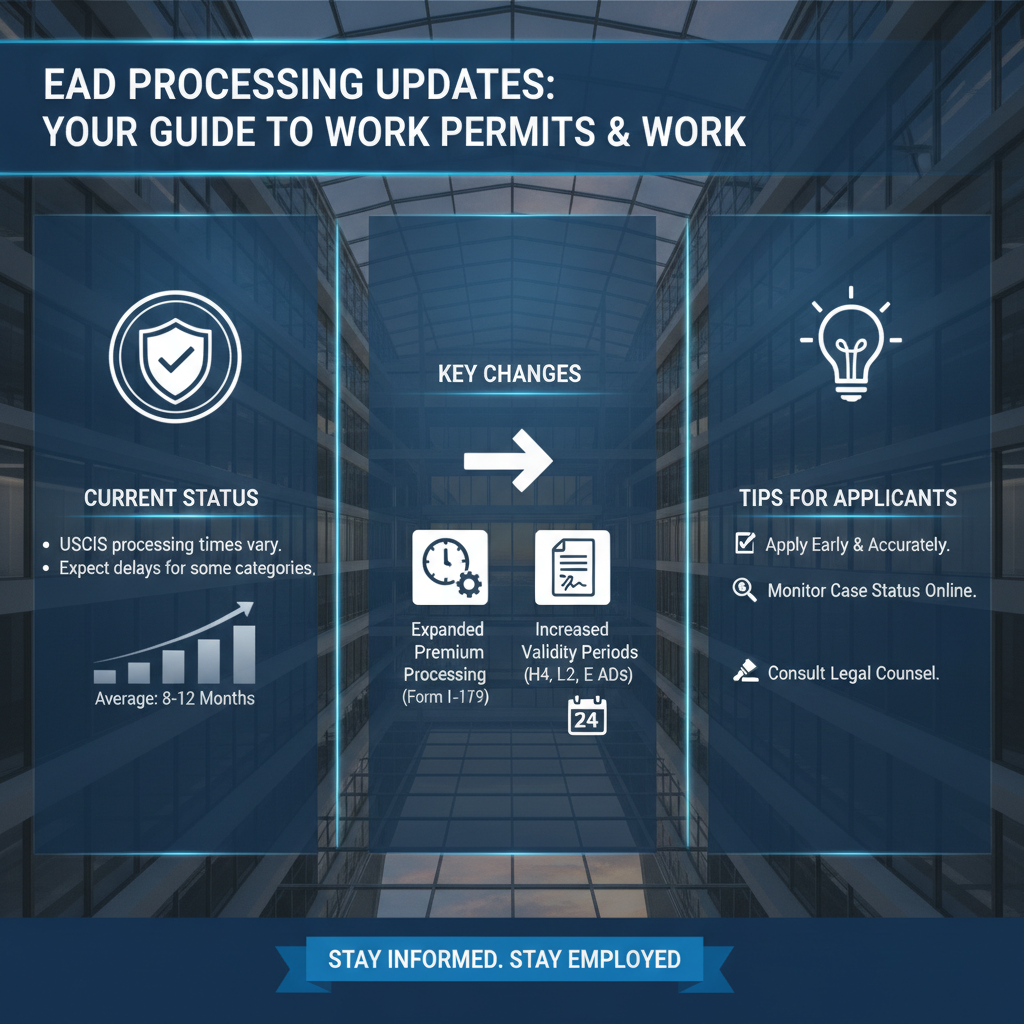
The landscape of U.S. immigration law is constantly evolving, and the processing of Employment Authorization Documents (EADs) is no exception. Recent reports from USCIS highlight ongoing efforts to manage application backlogs, streamline procedures, and address the high volume of applications. For immigrants living in Orlando, Central Florida, and throughout the Sunshine State, these updates carry significant implications for their ability to work, support their families, and plan for their future.
Why this news is showing up now
Immigration agencies, particularly USCIS, are in a perpetual state of adjustment, responding to fluctuating application volumes, changes in policy, and technological advancements. The current focus on EAD processing stems from several factors:
- Increased Demand: A growing number of individuals from various immigration categories – including asylum seekers, Temporary Protected Status (TPS) holders, Adjustment of Status applicants, and DACA recipients – require EADs, leading to higher application volumes.
- Processing Backlogs: The COVID-19 pandemic significantly impacted USCIS operations, contributing to extensive backlogs across many form types, including Form I-765, Application for Employment Authorization. USCIS has since implemented strategies to reduce these backlogs, and the news often reflects the progress or ongoing challenges in these efforts.
- Policy Changes: Periodic policy adjustments, such as those related to the automatic extension period for certain EAD renewals or specific eligibility criteria, necessitate public awareness and adaptation by applicants.
- Technological Improvements: USCIS is continually exploring and implementing new technologies, including online filing options and digital processing, which can influence timelines and procedures. News often highlights these shifts as they are rolled out.
- Economic Impact: The ability for immigrants to work legally has a direct impact on the U.S. economy, making EAD processing a topic of national interest and frequent discussion.
For Imigrar, staying abreast of these developments is crucial to provide our clients with the most current and effective legal strategies. We monitor USCIS announcements closely to understand how these dynamics will affect our clients' cases.
How it can affect Florida residents
For individuals residing in Florida, especially in the vibrant and diverse community of Orlando and surrounding Orange County, these EAD processing updates have direct and tangible effects:
- Employment Opportunities: Delays in EAD processing can mean prolonged periods of unemployment or underemployment, impacting financial stability for individuals and families along the I-4 corridor. Conversely, improvements can open doors to new job opportunities sooner.
- Economic Contribution: Florida's economy benefits significantly from its immigrant workforce. Faster EAD processing means more individuals can legally enter the workforce, contributing taxes and spending power to local economies.
- Family Stability: An EAD is often a lifeline for families, enabling them to pay bills, afford housing, and provide for their children. Processing fluctuations directly affect this stability, aligning with Imigrar's mission to "Keep Families Together."
- Planning and Uncertainty: Long and unpredictable processing times can make it difficult for immigrants in Central Florida to plan their lives, whether it's renting an apartment, securing a loan, or simply budgeting for the future.
- Local USCIS Impact: While EAD applications are processed by various USCIS service centers, local field offices like the Orlando USCIS Field Office play a role in biometrics appointments and sometimes interviews related to underlying immigration petitions that grant EAD eligibility. Updates can affect the scheduling and efficiency of these local touchpoints.
Important: Staying informed and taking proactive steps is vital. Imigrar is dedicated to guiding our Orlando and Florida-based clients through these changes, ensuring their applications are robust and submitted in a timely manner to mitigate potential delays.
Need Help? Navigating EAD processing can be complex, especially with ongoing updates. Our Orlando immigration team is ready to assist. Call +1 786-791-3106 for a free consultation, or message us online. Se Habla Español.
What Employment Authorization Document (EAD) Is (and Why It Matters)
For many immigrants, the dream of living and working legally in the United States is paramount. The Employment Authorization Document, or EAD, is the key that unlocks this dream for countless individuals. Understanding what an EAD is, why it's crucial, and the terminology surrounding it is the first step toward securing your ability to work.
A plain-English definition
An Employment Authorization Document (EAD) is a permit issued by USCIS that grants non-citizens legal authorization to work in the United States for a specific period. It is often referred to simply as a "work permit." This physical card, similar in appearance to a driver's license, proves to employers that you are legally authorized to be employed in the U.S. It does not, by itself, grant immigration status, but rather allows individuals who already have a certain immigration status or are in a specific immigration process to be employed.
Without an EAD, most non-citizens are prohibited from working in the U.S., with severe penalties for both the unauthorized worker and the employer. Therefore, for those seeking to earn a living, build a career, and contribute to the economy in places like Orlando, securing an EAD is not just a convenience, but a necessity.
Key terms you need to know
Navigating immigration processes requires familiarity with specific terminology. Here are some key terms related to EADs:
- USCIS (U.S. Citizenship and Immigration Services): The federal agency responsible for administering the country's lawful immigration system, including processing EAD applications.
- Form I-765, Application for Employment Authorization: This is the primary form used to apply for an EAD, whether it's an initial application or a renewal.
- Adjustment of Status (AOS): The process by which an eligible non-citizen already in the United States can apply for lawful permanent resident status (a Green Card) without having to return to their home country. Many individuals with pending Form I-485, Application to Register Permanent Residence or Adjust Status, are eligible for an EAD.
- Asylum Seeker: An individual who has applied for asylum in the U.S. and is awaiting a decision. Asylum seekers are typically eligible for an EAD after their asylum application has been pending for 180 days.
- Temporary Protected Status (TPS): A temporary immigration status granted to eligible nationals of designated countries who are unable to return safely to their home countries due to conditions such as armed conflict or environmental disaster. TPS beneficiaries are eligible for EADs.
- DACA (Deferred Action for Childhood Arrivals): An immigration policy that allows certain undocumented immigrants who entered the U.S. as minors to receive a renewable two-year period of deferred action from deportation and eligibility for a work permit.
- Optional Practical Training (OPT): A period during which F-1 nonimmigrant students can work in a field directly related to their major area of study. OPT students require an EAD.
- Receipt Notice: A document issued by USCIS acknowledging that they have received your application. It contains your receipt number, which you can use to track your case status online.
- Request for Evidence (RFE): A letter from USCIS requesting additional documents or information to support your application. Failing to respond to an RFE can lead to denial.
- Biometrics: The process of collecting fingerprints, photographs, and signatures for background checks. This appointment is often required for EAD applicants.
- Automatic Extension: Certain EAD categories are eligible for an automatic extension of their expiring EAD for up to 180 days (and sometimes longer, depending on policy updates) while their renewal application is pending.
Understanding these terms will empower you to navigate your EAD journey more effectively and communicate clearly with legal professionals. Imigrar is here to translate the legal jargon into plain English, ensuring you fully grasp every aspect of your case.
Current Immigration Law: The Foundation of Employment Authorization
The ability to obtain an Employment Authorization Document (EAD) is rooted in federal immigration law, primarily the Immigration and Nationality Act (INA) and subsequent regulations. These laws define who is eligible for work authorization and under what conditions. While the EAD itself is a federal document, understanding the legal framework is crucial for any applicant, including those in Orlando and across Florida.
Federal requirements
Work authorization in the U.S. is not universally granted; it is tied to specific immigration statuses or pending applications. The categories of individuals eligible for an EAD are outlined in federal regulations at 8 CFR § 274a.12. Some of the most common categories include:
- Asylum Seekers and Asylees: Individuals who have filed for asylum (category c(8)) and whose application has been pending for at least 180 days are eligible. Those granted asylum (category a(5)) are also eligible.
- Refugees: Individuals granted refugee status (category a(3)) are eligible.
- Adjustment of Status Applicants: Individuals who have a pending Form I-485, Application to Register Permanent Residence or Adjust Status (category c(9)), are eligible for an EAD. This is a very common pathway for those seeking green cards.
- Temporary Protected Status (TPS) Holders: Nationals of designated countries granted TPS (category a(10) or c(19)) are eligible.
- Fiancé(e)s of U.S. Citizens (K-1 nonimmigrants): K-1 visa holders can apply for an EAD upon arrival (category a(6)).
- Students (F-1) with Optional Practical Training (OPT): International students authorized for OPT (category c(3)(i), c(3)(ii), c(3)(iii)) require an EAD.
- Spouses of Certain Visa Holders: Spouses of E, L-1, and J-2 visa holders are often eligible for EADs (categories a(17), a(18), c(26), a(15)).
- DACA Recipients: Individuals who have received Deferred Action for Childhood Arrivals (category c(33)) are eligible.
- Certain Battered Spouses, Children, and Parents (VAWA): Victims of abuse under the Violence Against Women Act (VAWA) may be eligible (category c(31)).
Each category has specific requirements and documentation needed to prove eligibility. It is vital to correctly identify your eligibility category when filing Form I-765. Incorrect categorization is a common reason for RFEs or denials.
For detailed information on eligibility categories and current regulations, always refer to the USCIS official website and the instructions for Form I-765.
Florida-specific considerations
While EAD eligibility is determined by federal law, there can be state-level considerations for immigrants in Florida:
- Employer Compliance: Florida employers are subject to federal and state laws regarding verifying employment eligibility. The presence of a valid EAD is crucial for satisfying these requirements, typically through the **Form I-9, Employment Eligibility Verification** process. Employers in Florida must ensure their workforce is legally authorized to work, and an EAD is the primary document for many non-citizens.
- Local Resources: For Central Florida residents, understanding where to access resources, such as the Orlando USCIS Field Office for biometrics appointments, is important. While EAD applications are filed centrally, local offices are part of the overall process.
- State ID and Driver's Licenses: A valid EAD can be used as a primary document to obtain a Florida driver's license or state identification card, which is essential for daily life, including travel along the I-4 corridor and other necessities. The Florida Department of Highway Safety and Motor Vehicles (FLHSMV) has specific requirements for non-citizens, and a valid EAD is often a key piece of identification.
Reminder: Always keep your EAD card current and carry it with you when necessary. An expired EAD means your work authorization has ceased, even if your underlying immigration case is still pending (unless you are covered by an automatic extension).
Concerned about eligibility or current laws? Imigrar's experienced attorneys are here to provide clarity and ensure your EAD application meets all federal requirements. Call +1 786-791-3106 for a free consultation. Se Habla Español.
How to Apply for or Renew Your Employment Authorization Document (EAD): A Complete Step-by-Step Guide
Applying for or renewing an EAD can seem daunting, but by breaking it down into manageable steps, the process becomes clearer. This guide provides a detailed walkthrough to help you successfully navigate your Form I-765 application.
1) Determine Your Eligibility Category and Gather Required Information
Before you begin, you must confirm that you are eligible for an EAD and identify the correct eligibility category (e.g., c(9) for Adjustment of Status applicants, c(8) for asylum seekers). This is perhaps the most critical first step, as an incorrect category can lead to delays or denial. Review the instructions for Form I-765 carefully, or consult with an immigration attorney.
Required Information to Know:
- Your specific eligibility category (e.g., c(9), c(8), c(33)).
- Your current immigration status.
- Any pending immigration applications (e.g., Form I-485, asylum application).
- Your A-Number (Alien Registration Number) if you have one.
- Your USCIS Online Account Number (if applicable).
2) Gather All Necessary Supporting Documents and Evidence
The documents you need will vary based on your eligibility category. However, some documents are universally required. Organize everything meticulously.
General Required Documents:
- Two identical, passport-style photos (taken within 30 days of filing, with a white background). Write your A-Number (if any) and full name lightly on the back of each photo.
- Copy of your last EAD (front and back), if applicable, for renewals.
- Copy of your **Form I-94, Arrival/Departure Record** (both sides, if applicable), or printout from CBP website.
- Copy of your passport biographical page.
- Copy of your visa (if applicable).
- Copy of another government-issued photo identification (e.g., driver's license, state ID).
- Copy of your birth certificate (with certified translation if not in English).
- Copy of marriage certificate (if applicable, with certified translation).
Category-Specific Documents (Examples):
- For Adjustment of Status (c(9)): Copy of your Form I-485 Receipt Notice.
- For Asylum Seekers (c(8)): Copy of your Form I-589, Application for Asylum and for Withholding of Removal **Receipt Notice**. Proof that your application has been pending for at least 180 days.
- For TPS (c(19)): Copy of your TPS approval notice (Form I-797).
- For DACA (c(33)): Copy of your most recent Form I-797, Notice of Action for DACA approval.
- For OPT (c(3)(i), c(3)(ii), c(3)(iii)): Copy of your **Form I-20, Certificate of Eligibility for Nonimmigrant Student Status** with the OPT recommendation.
Important: Always make copies of ALL documents you submit for your records. Do not send original documents unless specifically requested by USCIS.
3) Complete Form I-765, Application for Employment Authorization
Fill out **Form I-765** accurately and completely. You can download the latest version from the USCIS Forms page. Read the instructions carefully for each question. If a question does not apply to you, write "N/A" (not applicable).
- Section-by-Section Accuracy: Pay close attention to your name, date of birth, country of birth, and A-Number. Ensure consistency with other immigration documents.
- Part 2, Item 27 (Eligibility Category): This is where you enter your specific eligibility code (e.g., c(9)). Double-check this.
- Sign and Date: Do not forget to sign the form in blue ink. An unsigned form will be rejected.
4) Calculate and Pay the Filing Fee (or Request a Fee Waiver)
As of 2026-09-13, the filing fee for **Form I-765** is generally $410, plus an $85 biometrics fee if required, totaling $495 for most applicants. However, certain categories are exempt from the fee, and some applicants may be eligible for a fee waiver (Form I-912, Request for Fee Waiver).
Payment Methods:
- Personal check, money order, or cashier's check payable to "U.S. Department of Homeland Security."
- Credit card via **Form G-1450, Authorization for Credit Card Transactions** (if filing by mail).
- Online payment if filing electronically (only available for certain categories).
Warning: Ensure the fee amount is correct. Incorrect fees will result in your application being rejected.
5) Assemble and Mail Your Application Package to the Correct USCIS Lockbox Facility
Once you have all documents and the completed Form I-765, assemble your package. The order of documents can matter, so follow USCIS instructions or your attorney's guidance.
- Cover Letter: (Optional, but recommended) A cover letter listing the contents of your application package.
- Payment: Place your check/money order or Form G-1450 on top.
- Form I-765: Place the completed and signed form next.
- Supporting Documents: Organize these logically, typically by category or chronologically.
Mailing Address: The correct filing address depends on your eligibility category and the state you reside in (e.g., Florida residents may send to a specific Dallas or Phoenix lockbox). Always check the "Where to File" section on the USCIS Form I-765 webpage: USCIS Form I-765. Send your application via certified mail with a return receipt or a courier service that provides tracking.
6) Attend Your Biometrics Appointment (if Required)
After USCIS accepts your application, you will receive a Form I-797C, Notice of Action, confirming receipt. If required, USCIS will then send you an appointment notice (Form I-797C) for a biometrics services appointment at an Application Support Center (ASC). For Central Florida residents, this often means visiting the Orlando USCIS Field Office's ASC.
- What to Bring: Your appointment notice, a valid photo ID (e.g., passport, Florida driver's license).
- Purpose: Fingerprints, photograph, and signature are collected for background checks.
Important: Do not miss your biometrics appointment. If you cannot attend, follow the instructions on the notice to reschedule immediately.
7) Monitor Your Case Status and Respond to RFEs
After your biometrics, the waiting period begins. You can track your case status online using the receipt number provided on your Form I-797C, Notice of Action at USCIS Case Status Online. USCIS may send you a Request for Evidence (RFE) if they need more information. Respond promptly and thoroughly to any RFE to avoid delays or denial.
Once approved, your EAD card will be mailed to you. Remember to notify USCIS of any address changes using **Form AR-11, Alien's Change of Address Card**.
Feeling overwhelmed by the steps? Imigrar provides comprehensive legal support for EAD applications and renewals. Let our Orlando team guide you through each stage. Call +1 786-791-3106 for a free consultation. Se Habla Español.
Practical Steps You Can Take Today for Your EAD Application
Navigating the EAD application or renewal process requires diligence and organization. Here are practical steps you can take right now to set yourself up for success and minimize potential delays.
Actionable Checklist:
- Verify Eligibility and Category: Re-read the instructions for Form I-765 and confirm your precise eligibility category. If unsure, contact an attorney.
- Check Your EAD Expiration Date (for renewals): If you have an existing EAD, note its expiration date. USCIS recommends filing for renewal within the **180-day automatic extension** period before your current card expires, but ideally even earlier, within a **90-day window** to six months before expiration, especially with current processing times.
- Gather Key Personal Documents: Start collecting copies of your passport, birth certificate, marriage certificate (if applicable), previous EADs, and any immigration notices (e.g., Form I-797 for pending Form I-485 or asylum case).


