

At Imigrar, we understand that having the legal ability to work in the United States is not just about a job; it's about stability, dignity, and building a future for your family. For many immigrants in Orlando, across Florida, and nationwide, the Employment Authorization Document (EAD), often called a work permit, is a critical step towards achieving that stability.
USCIS, the U.S. Citizenship and Immigration Services, regularly updates its policies and processing procedures, and these changes can significantly impact individuals waiting for their EADs. Staying informed is crucial, and that's why we've compiled this comprehensive guide.
The reporting that sparked this guide:
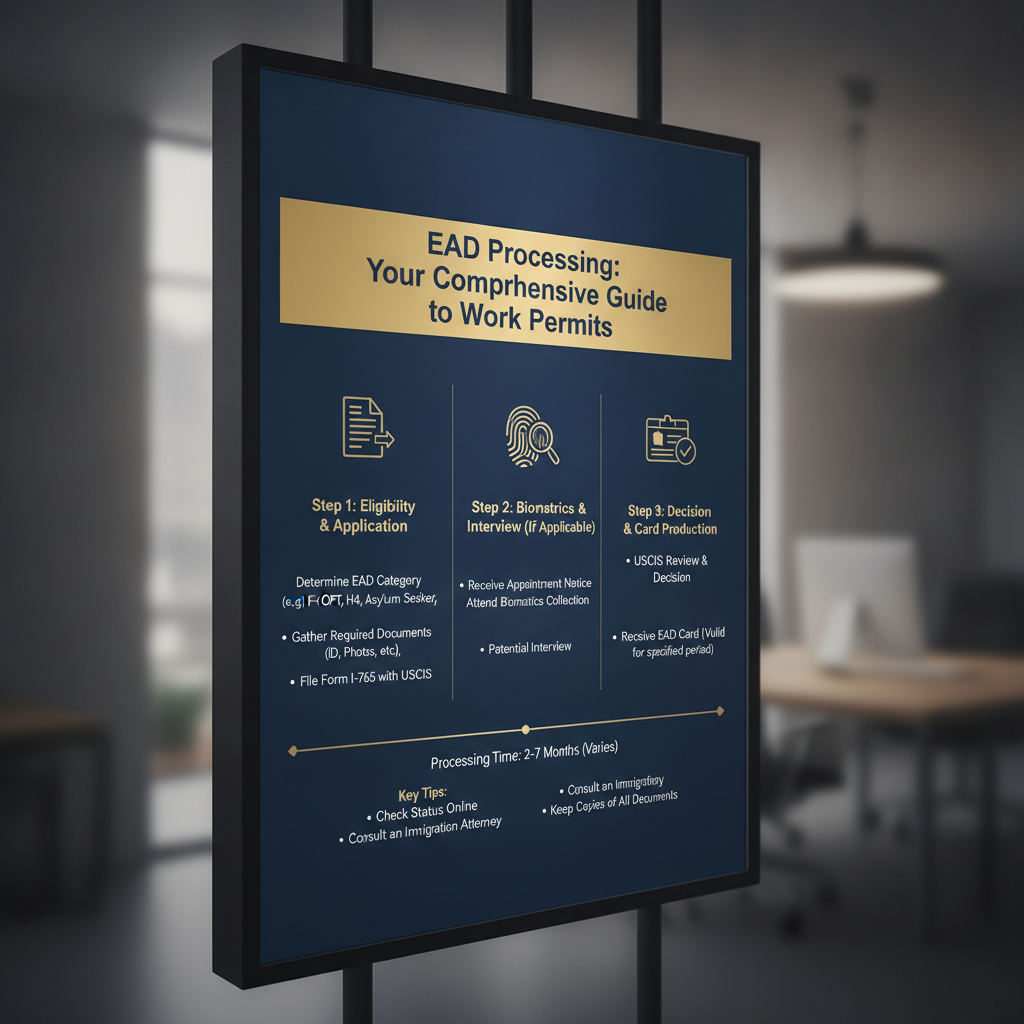
Employment Authorization Document Processing (USCIS)
What This News Means for Immigrants in Orlando and Across Florida
Recent reports and ongoing discussions from USCIS highlight a continuous effort to address processing backlogs and streamline the application and renewal processes for Employment Authorization Documents (EADs). These updates are a direct response to challenges faced by applicants, including lengthy waiting times and the critical need to maintain work authorization.
Why this news is showing up now
The immigration system has experienced unprecedented challenges over the past few years, leading to significant processing delays across various application types, including Form I-765, Application for Employment Authorization. USCIS has been under immense pressure to reduce these backlogs, which have left many individuals unable to work or facing uncertainty about their continued employment.
This "news" isn't a single, sudden announcement but rather a reflection of USCIS's ongoing initiatives and policy adjustments aimed at improving efficiency. These efforts often include temporary rule changes, policy memos, technology upgrades, and increased staffing. For instance, USCIS has previously implemented temporary increases to the automatic extension period for certain EAD categories and has focused on prioritizing the adjudication of renewal applications to prevent lapses in work authorization.
The continuous dialogue around EAD processing times underscores the agency's acknowledgment of the problem and its commitment to finding solutions. For you, this means an environment where policies are evolving, and staying current with official USCIS guidance is more important than ever.
How it can affect Florida residents
For immigrants residing in Orlando, Central Florida, and throughout the state, these EAD processing updates have direct and profound implications. Florida is home to a large and diverse immigrant population, many of whom rely on their EADs to support their families and contribute to the local economy.
- Employment Stability: If you are waiting for an initial EAD or a renewal, processing delays can directly impact your ability to start or continue working. An expired EAD without a valid extension can lead to job loss, financial hardship, and stress for families in cities like Orlando, Kissimmee, and Tampa.
- Economic Contribution: A swift and efficient EAD process means immigrants can enter or re-enter the workforce faster, contributing to Florida's economy, paying taxes, and filling essential labor gaps. Delays hinder this vital contribution.
- Planning and Uncertainty: For those on specific visas or immigration pathways (e.g., asylum seekers, Adjustment of Status applicants, DACA recipients), the EAD is a bridge to further stability. Uncertainty in processing times makes long-term planning for housing, education, and family difficult.
- Local Impact: The Orlando USCIS Field Office, while not processing EAD applications directly (these are handled by service centers), plays a role in related processes like biometrics appointments. Efficiency at all levels of USCIS impacts the overall timeline for Central Florida residents.
- Need for Timely Filing: With potential for long processing times, the importance of filing EAD renewal applications well in advance of expiration dates becomes paramount for Florida residents to avoid gaps in employment authorization.
At Imigrar, we serve clients nationwide, but our roots are firmly planted in Orlando. We see firsthand how these national policy shifts ripple through our community along the I-4 corridor and beyond. Our goal is to help you navigate these complexities, minimize stress, and keep your family together and financially secure.
Need Help? Our Orlando immigration team is ready to assist. Call +1 786-791-3106 for a free consultation, or message us online. Se Habla Español.
What Employment Authorization Documents (EADs) Are (and Why They Matter)
An Employment Authorization Document, or EAD, is a crucial immigration benefit that allows foreign nationals to legally work in the United States for a specific period. It is often referred to simply as a "work permit." Without an EAD, most non-U.S. citizens are not authorized to work in the U.S., and doing so can have severe immigration consequences.
A plain-English definition
Think of an EAD as your official permission slip from the U.S. government to work. It's a card, similar to a driver's license, that proves you are allowed to be employed in the U.S. It's not a visa itself, nor does it grant permanent residency. Instead, it's a benefit typically granted to individuals who are already in the process of seeking an immigration benefit (like a Green Card or asylum) or who hold certain non-immigrant statuses that permit work.
The EAD card will have your photo, name, birthdate, country of birth, fingerprint, and an expiration date. Your employer will need to see this card (along with other identity documents) when you complete Form I-9, Employment Eligibility Verification, to confirm your eligibility to work in the U.S.
Key terms you need to know
- EAD (Employment Authorization Document): The official name for the work permit card.
- Form I-765: The specific application form you must file with USCIS to request an EAD.
- USCIS (U.S. Citizenship and Immigration Services): The government agency responsible for adjudicating immigration benefits, including EAD applications.
- Adjustment of Status (AOS): The process of applying for a Green Card while physically present in the United States. Many AOS applicants are eligible for an EAD while their Green Card application (Form I-485) is pending.
- Renewal Application: An application filed to extend an existing EAD before it expires.
- Initial Application: The first time an individual applies for an EAD in a particular eligibility category.
- Eligibility Category: USCIS defines specific categories of non-citizens who are eligible for an EAD. Your eligibility category will be noted on your EAD card. Examples include asylum applicants, DACA recipients, spouses of certain visa holders, and individuals with pending Adjustment of Status applications.
- Biometrics: The collection of fingerprints, photographs, and signatures from applicants, used for background checks and identity verification. This is often required for EAD applications.
- RFE (Request for Evidence): A notice from USCIS requesting additional information or documentation to support your application.
- Automatic EAD Extension: For certain eligibility categories, USCIS provides an automatic extension of an expiring EAD when a timely renewal application is filed. The length of this extension can vary based on current USCIS policy.
Understanding these terms is fundamental to navigating the EAD application process effectively. An EAD is more than just a piece of plastic; it's a gateway to economic self-sufficiency and a vital component of many immigrants' journeys toward permanent residency in Orlando and beyond.
Current Immigration Law: The Foundation for Work Authorization
The ability to work legally in the United States is governed by complex federal immigration laws, primarily found in the Immigration and Nationality Act (INA). An Employment Authorization Document (EAD) is issued under specific provisions of these laws to various categories of non-citizens.
Federal requirements
Eligibility for an EAD is not universal; it is granted to specific groups of individuals who meet certain criteria established by federal law and regulations. The primary regulation governing EAD eligibility is 8 CFR §274a.12, which lists numerous categories. Some of the most common categories include:
- Asylum Seekers and Asylees: Individuals who have filed Form I-589, Application for Asylum and for Withholding of Removal, and whose application has been pending for at least 150 days (asylum applicants) or who have been granted asylum.
- Refugees: Individuals who have been granted refugee status.
- Applicants for Adjustment of Status: Individuals with a pending Form I-485, Application to Register Permanent Residence or Adjust Status, based on an approved immigrant petition (e.g., Form I-130, Petition for Alien Relative, or Form I-140, Immigrant Petition for Alien Worker).
- Recipients of Deferred Action for Childhood Arrivals (DACA): Individuals who have been granted deferred action under the DACA policy.
- Spouses of E-1/E-2 Treaty Traders/Investors and L-1 Intracompany Transferees: Certain spouses (E-1S, E-2S, L-2S) are eligible for work authorization based on their spouse's nonimmigrant status.
- Students with Optional Practical Training (OPT) or STEM OPT: F-1 students seeking to gain practical experience in their field of study.
- Certain Battered Spouses, Children, and Parents: Under the Violence Against Women Act (VAWA), certain self-petitioners may be eligible.
- Temporary Protected Status (TPS) Beneficiaries: Individuals granted TPS for certain designated countries.
Each category has specific requirements, and it's essential to correctly identify your eligibility category when filing Form I-765. USCIS provides detailed instructions for each category on its official website. Failure to meet the specific requirements for your category will likely result in a denial.
Reminder: The EAD does not grant immigration status; it merely authorizes employment for those who already have a specific immigration status or a pending application for one. The duration of the EAD is typically tied to the underlying status or application.
For official guidance and detailed eligibility criteria, always refer to the USCIS official website.
Florida-specific considerations
While EAD eligibility is determined by federal law, there are practical considerations for residents of Florida, particularly in the Orlando area:
- State Identification: While your EAD allows you to work, you will likely need a Florida driver's license or state identification card for daily life. Your EAD can be used as a primary document to obtain these, but you will still need to meet Florida Department of Highway Safety and Motor Vehicles (FLHSMV) requirements.
- Local Employment Market: Orlando's diverse economy offers various employment opportunities, from tourism and hospitality to tech and healthcare. An EAD opens doors to these jobs, allowing immigrants to contribute meaningfully to the local workforce.
- Legal Support in Orlando: Navigating federal immigration law can be challenging. Having access to experienced immigration attorneys in Orlando, like those at Imigrar, who understand both national regulations and local nuances, is invaluable. We can help ensure your application meets all federal requirements and is prepared correctly for submission to the appropriate USCIS Service Center.
- Biometrics Appointments: If a biometrics appointment is required for your EAD application, you will typically be scheduled at an Application Support Center (ASC) near your residence. For Central Florida residents, this could be the ASC in Orlando or a nearby city, depending on USCIS's scheduling.
Understanding the federal framework and how it applies to your life in Florida is key to a successful EAD application. The team at Imigrar is here to provide that clarity and support.
Don't risk delays or denials on your EAD application. Our expert team at Imigrar understands the complexities of USCIS requirements. Call us today at +1 786-791-3106 for a free consultation. Se Habla Español.
How to Apply for or Renew Your EAD: A Complete Step-by-Step Guide
Applying for an initial Employment Authorization Document (EAD) or renewing an existing one requires careful attention to detail. This step-by-step guide will walk you through the process, ensuring you understand each crucial stage. Remember, the specific documents and nuances can vary slightly depending on your eligibility category.
1) Determine Your Eligibility Category
Before you do anything else, you must accurately identify the category under which you are eligible to apply for an EAD. This is arguably the most critical first step, as selecting the wrong category will lead to a denial. Refer to the USCIS EAD Eligibility Categories page or the instructions for Form I-765.
- Example: Are you applying based on a pending Adjustment of Status (c)(9) category, an asylum application (c)(8), or DACA (c)(33)?
- Action: Review the USCIS website or consult with an Imigrar attorney to confirm your correct eligibility category.
2) Gather Required Documents and Evidence
Once your eligibility category is confirmed, compile all necessary supporting documents. This stage requires meticulous organization to avoid delays from RFEs.
-
Proof of Identity and Nationality:
- Copy of your birth certificate (with certified English translation if applicable).
- Copy of your passport biographical page.
- Copy of your national identity card (if applicable).
- Copy of your visa (if applicable).
-
Proof of Current Immigration Status:
- Copy of your most recent Form I-94, Arrival/Departure Record.
- Copy of your last EAD card (for renewals).
- Copies of previous EAD cards (if any).
- Copies of any other immigration documents (e.g., I-797 approval notices for underlying petitions like Form I-130, Form I-140, or Form I-589 receipt notice).
-
Two Passport-Style Photos:
- Must be taken within 30 days of filing.
- White background, unretouched, full front view of face.
- Write your name and Alien Registration Number (A-Number) lightly in pencil on the back of each photo.
-
Evidence Specific to Your Eligibility Category:
- For AOS applicants (c)(9): Copy of Form I-485 receipt notice.
- For asylum applicants (c)(8): Copy of Form I-589 receipt notice and proof that it has been pending for at least 150 days.
- For DACA recipients (c)(33): Copy of your most recent Form I-797 approval notice for Form I-821D.
- For spouses of E/L visa holders (AOS/L2S): Copy of spouse's E or L visa, Form I-94, and marriage certificate.
- Refer to the specific Form I-765 instructions for your category.
- Previous EAD Card (for Renewals): Submit a copy of your current EAD card, front and back.
Important: Always provide copies of documents, not originals, unless USCIS specifically requests them. Ensure all foreign language documents are accompanied by a certified English translation.
3) Complete Form I-765, Application for Employment Authorization
Fill out Form I-765 completely and accurately. This form is critical and any errors or omissions can lead to delays or rejection. You can complete it electronically and print it, or fill it out by hand in black ink.
- Personal Information: Provide your full legal name, address (ensure it's current for mail delivery in Orlando or wherever you reside), date of birth, country of birth, and A-Number (if you have one).
- Eligibility Category: Enter the correct eligibility category code in Part 2, Item 27. For example, (c)(9) for AOS applicants.
- Prior Applications: Disclose if you have previously filed Form I-765.
- Signature: Do not forget to sign the form! An unsigned application will be rejected.
- Tip: If you are unsure about any section, leave it blank and discuss it with your attorney. Do not guess.
4) Prepare Your Application Package
Once you have the completed Form I-765 and all supporting documents, assemble your application package in the correct order.
- Payment: Include the correct filing fee for Form I-765. This can be paid by check, money order, or credit card using Form G-1450, Authorization for Credit Card Transactions. Check the USCIS website for current fees, as they can change. Some applicants may be eligible for a fee waiver (e.g., asylum applicants).
-
Organize Documents:
- Place your payment on top.
- Then, Form I-765.
- Next, your two passport-style photos in a small, clear envelope attached to the front of Form I-765, or as instructed by USCIS.
- Finally, all supporting documents in a logical order (e.g., identity, status, category-specific evidence).
- Cover Letter: While not strictly required, a cover letter listing the contents of your package can be helpful for USCIS and for your own records.
5) File Your Application with USCIS
The filing address depends on your eligibility category and sometimes your state of residence. Always refer to the "Where to File" section of the Form I-765 instructions page on the USCIS website.
- Mailing Address: Send your complete package to the correct USCIS Service Center (e.g., Texas Service Center, Nebraska Service Center).
- Delivery Confirmation: Use a reputable mail service that provides tracking and delivery confirmation (e.g., USPS Certified Mail with Return Receipt, FedEx, UPS). This provides proof of timely filing.
- Online Filing: USCIS is increasingly allowing certain EAD categories to file Form I-765 online. Check if your category is eligible on the USCIS website. Online filing can sometimes lead to faster processing and provides immediate confirmation of receipt.
Warning: Ensure you send it to the correct address. Sending to the wrong address will cause significant delays.
6) Attend Biometrics Appointment (If Required)
After USCIS receives your application, you will typically receive a receipt notice (Form I-797C, Notice of Action). For many EAD categories, you will then receive a separate appointment notice for biometrics (fingerprints, photos, signature) at a local Application Support Center (ASC).
- Location: For Central Florida residents, this will likely be at the Orlando ASC.
- Punctuality: Arrive on time with your appointment notice and a valid photo ID.
- Purpose: Biometrics are used for background checks and identity verification. This step is crucial for your application to proceed.
7) Monitor Your Case Status and Respond to RFEs
Once your application is filed, you can monitor its status online using the receipt number provided on your Form I-797C.
- USCIS Case Status Tool: Visit USCIS Case Status Online.
- Processing Times: Check USCIS Processing Times for your specific form and Service Center. These times can fluctuate significantly, especially with current backlogs.
- RFEs: If USCIS needs more information, they will send an RFE. It is critical to respond fully and by the deadline provided. Failure to do so will likely result in a denial.
- Interviews: While EAD applications generally do not require an interview, if your EAD is tied to an underlying application like Adjustment of Status, you may have an interview for that underlying process.
Upon approval, USCIS will mail your new EAD card to the address on file. Ensure your address is always current with USCIS. If your address changes while your application is pending, file Form AR-11, Alien's Change of Address Card, online immediately.
Practical Steps You Can Take Today for Your EAD Application
Navigating the EAD application or renewal process can feel overwhelming, but taking proactive steps can significantly improve your chances of a smooth process and avoid unnecessary delays. Here’s a practical checklist to help you get started:
- Review Your Current EAD: If you have an existing EAD, check its expiration date today. For most categories, USCIS recommends filing a renewal application 120-180 days before your current EAD expires. Given current processing times, filing even earlier (up to 6 months) is often advisable.
- Confirm Eligibility: Re-verify your eligibility category for Form I-765. Policies can change, and it’s crucial to ensure you still qualify under the correct category. Use the USCIS official website as your primary resource or consult with an Imigrar attorney.
- Gather Documents Proactively: Start collecting all required documents listed in Step 2 of our guide. This includes identity proofs, immigration status documents, and category-specific evidence. Don't wait until the last minute, especially for documents that might take time to obtain (e.g., birth certificates from abroad, certified translations).
- Check USCIS Filing Fees: Fees for Form I-765 can change. Always confirm the current fee on the USCIS website before preparing your payment.
- Update Your Address with USCIS: If you’ve moved, ensure your address is updated with USCIS by filing Form AR-11 online. Incorrect addresses are a common reason for missed notices and delayed EAD cards, especially for those in busy metropolitan areas like Orlando.
- Understand Automatic Extensions: If you are renewing an EAD, research if your category is eligible for an automatic extension. This can provide peace of mind and allow you to continue working while your renewal is pending. Print out the relevant USCIS policy guidance on automatic extensions to show your employer if needed.
- Create a Copy of Everything: Before mailing your application, make a complete copy of the entire package for your records. This includes the filled-out form, all supporting documents, photos, and proof of payment. This is your safeguard if anything gets lost or if USCIS requests further information.
- Consult with an Attorney: Even if you feel confident, a brief consultation with an experienced immigration attorney can catch potential issues before they become major problems. An attorney can help confirm your eligibility, review your documents, and ensure your application is submitted correctly.
Document preparation guidance
- Clarity and Legibility: Ensure all copies of documents are clear and easy to read.
- Translations: Any document in a foreign language must be accompanied by a complete and accurate English translation, certified by the translator as competent to translate and that the translation is accurate.
- Organization: Use fasteners (paper clips, not staples) to keep related documents together. A cover sheet can help USCIS quickly identify what’s included.
- No Originals: Unless specifically requested, never send original documents. USCIS rarely returns originals.
Timeline expectations
Warning: EAD processing times can vary dramatically based on your eligibility category, the USCIS Service Center handling your case, and current agency workloads. While USCIS aims for efficiency, backlogs are common. Always check the USCIS Processing Times page for the most current estimates.
- Initial Receipt: Expect to receive a receipt notice (Form I-797C) within 2-4 weeks of filing.
- Biometrics Appointment: If required, an appointment notice usually arrives 3-8 weeks after the receipt notice. The actual appointment is typically 2-4 weeks after the notice.
- Adjudication: This is the longest and most variable part. It can range from a few months to over a year, depending on the category and current backlogs. Many categories now see processing times exceeding 6-12 months.
- EAD Card Delivery: Once approved, the card is usually mailed within 1-2 weeks.


