

The reporting that sparked this guide: Employment Authorization Document Processing (USCIS)
What This News Means for Immigrants in Orlando and Across Florida
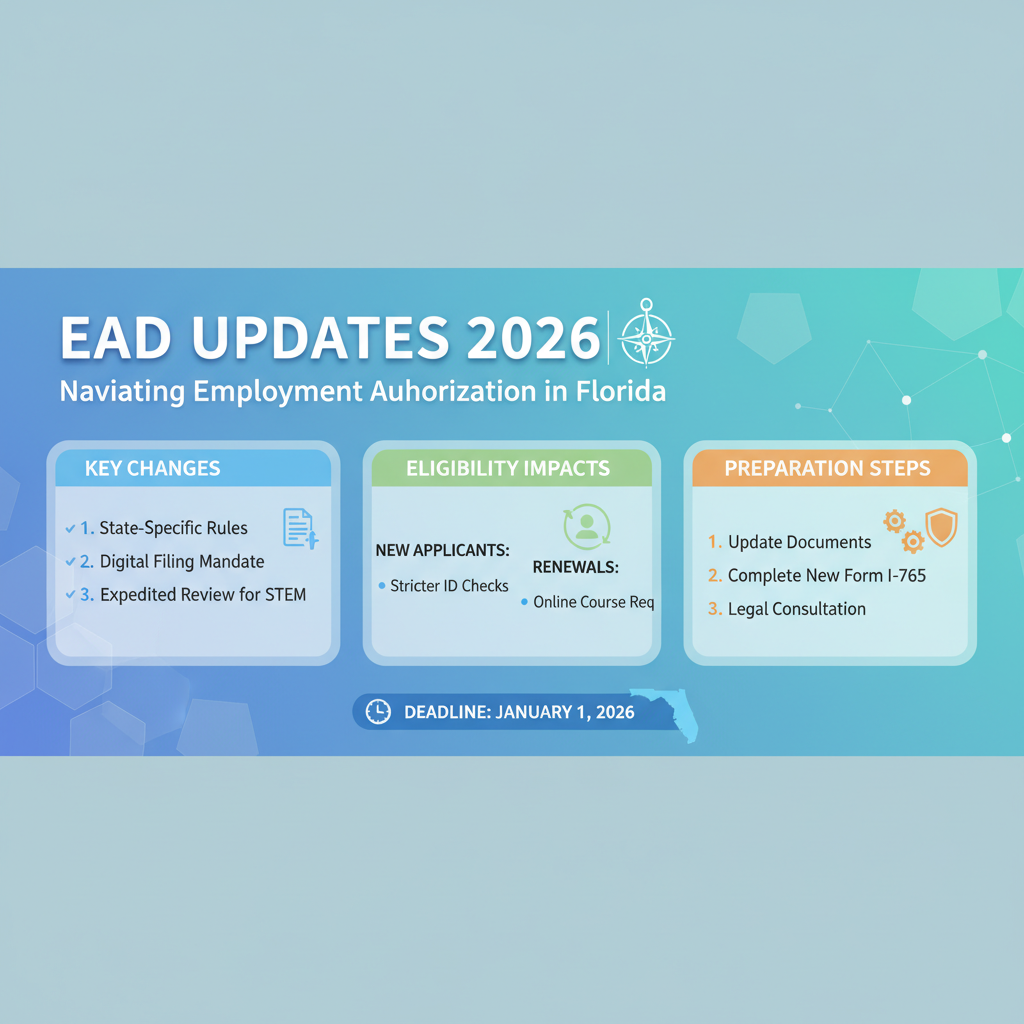
Why this news is showing up now
The ongoing focus on EAD processing stems from several factors that have significantly impacted immigration services over the past few years. The COVID-19 pandemic introduced unprecedented operational challenges, leading to extensive backlogs across nearly all USCIS forms. While USCIS has made strides in reducing these backlogs, the sheer volume of applications and the complexity of processing various EAD categories mean that updates and adjustments are a constant necessity. Recent USCIS announcements and policy changes are a direct response to:- **Persistent Backlogs:** Despite efforts, many applicants still face lengthy processing times, causing significant stress and economic hardship.
- **Policy Adjustments:** USCIS regularly reviews and modifies its policies to improve efficiency, clarify eligibility, or respond to new legislative mandates. For instance, the **180-day automatic extension** rule for certain EAD categories has been a critical topic, with ongoing discussions about its scope and duration.
- **Increased Demand:** The growing immigrant population and the increasing number of individuals eligible for EADs (e.g., asylum seekers, Adjustment of Status applicants, TPS holders) naturally lead to a higher volume of applications.
- **Technological Enhancements:** USCIS is continuously working to modernize its systems, including online filing options and digital processing, which can lead to procedural updates.
How it can affect Florida residents
Florida is one of the most diverse states in the nation, home to a large and diverse immigrant population. From the agricultural workers in South Florida to the tech professionals in Orlando and the tourism industry employees throughout the state, a vast number of individuals rely on EADs to secure and maintain employment. For Central Florida residents and those whose cases are processed through the Orlando USCIS Field Office or other service centers, these updates can have direct, tangible effects:- **Employment Continuity:** Delays in EAD renewals can lead to job loss or inability to start new employment, impacting families and local economies in Orange County and beyond.
- **Economic Stability:** An EAD allows immigrants to earn a living, pay taxes, and support their families, contributing to the economic vitality of Florida. Processing delays can disrupt this stability.
- **Driving and State ID:** In Florida, a valid EAD is often required to obtain or renew a driver's license or state identification card, which is essential for daily life, commuting along the I-4 corridor, and accessing services.
- **Planning and Uncertainty:** The unpredictable nature of processing times makes it difficult for individuals and families to plan their futures, from housing to education. Understanding current trends helps manage expectations.
Need Help? Our Orlando immigration team is ready to assist. Call +1 786-791-3106 for a free consultation, or message us online. Se Habla Español.
What Employment Authorization Document (EAD) Is (and Why It Matters)
The **Employment Authorization Document (EAD)** is a photo identification card issued by U.S. Citizenship and Immigration Services (USCIS) that provides temporary permission to work in the United States to non-citizens who are not U.S. citizens or lawful permanent residents (green card holders). It is often referred to simply as a "work permit."A plain-English definition
Think of an EAD as your official permission slip from the U.S. government to legally hold a job. It's a physical card, similar to a driver's license, that proves you are authorized to work for any employer in the U.S. for a specific period. This document is distinct from a visa that allows you to enter the U.S. or a green card that grants permanent residency. An EAD is specifically about your ability to be employed.Key terms you need to know
Navigating EAD applications involves understanding several key terms. Here are some of the most important ones:- Form I-765, Application for Employment Authorization: This is the primary form you must file with USCIS to request an EAD.
- EAD Category: This refers to the specific reason you are eligible for an EAD. Examples include categories for asylum applicants (c)(8), Adjustment of Status applicants (c)(9), Temporary Protected Status (TPS) beneficiaries (a)(12), students on Optional Practical Training (OPT) (c)(3)(A)/(B)/(C), or spouses of certain visa holders. Your eligibility and processing times often depend heavily on your category.
- Initial EAD: Your very first application for an EAD.
- EAD Renewal: An application to extend the validity of an existing EAD that is expiring or has already expired.
- Adjustment of Status (AOS): The process of applying for lawful permanent resident (green card) status while physically present in the United States. Many individuals applying for AOS are eligible for an EAD while their green card application (Form I-485) is pending.
- Asylum Seeker: An individual who has applied for asylum in the U.S. and meets certain criteria (e.g., 150 days after filing asylum application) may be eligible for an EAD.
- Temporary Protected Status (TPS): A temporary immigration status granted to eligible nationals of certain countries designated by the Secretary of Homeland Security due to conditions that prevent their safe return, such as armed conflict or environmental disaster. TPS beneficiaries are eligible for EADs.
- Optional Practical Training (OPT): A period during which F-1 nonimmigrant students can work in a field directly related to their major area of study. OPT requires an EAD.
- Automatic EAD Extension: A policy that allows certain EAD categories to continue working for a limited period (currently up to **540 days** for applications filed on or before October 26, 2023, and up to **180 days** for those filed after that date) beyond their EAD's expiration date, provided they filed a timely renewal application and remain eligible.
- Receipt Notice: A document sent by USCIS acknowledging receipt of your application. This notice is critical for demonstrating a timely filed renewal and benefiting from the automatic extension.
Current Immigration Law: The Foundation for EADs
The authority for USCIS to grant employment authorization stems from various sections of the Immigration and Nationality Act (INA) and federal regulations. While the process involves a single form, Form I-765, the underlying legal basis for eligibility is complex and depends entirely on an individual's specific immigration status or application.Federal requirements
The primary legal framework for EADs is found in **8 CFR § 274a.12**, which lists the categories of non-citizens who are authorized to work in the United States. This regulation distinguishes between two main groups:- **Aliens authorized for employment incident to status:** These individuals are automatically authorized to work by virtue of their immigration status (e.g., lawful permanent residents, asylees, refugees). They do not need to apply for an EAD to work, but may choose to do so to have a convenient document proving their work authorization.
- **Aliens who must apply for employment authorization:** This group includes a wide range of non-citizens who must file Form I-765 and receive an EAD card before they can legally work. This is the category most people think of when they refer to a "work permit."
- Applicants for Adjustment of Status (8 CFR § 274a.12(c)(9))
- Asylum applicants (8 CFR § 274a.12(c)(8))
- Individuals granted Temporary Protected Status (TPS) (8 CFR § 274a.12(a)(12))
- F-1 students seeking Optional Practical Training (OPT) (8 CFR § 274a.12(c)(3))
- Certain spouses of H-1B, L-1, and E visa holders (e.g., H-4 spouses under 8 CFR § 274a.12(c)(26))
- Applicants for suspension of deportation or cancellation of removal (8 CFR § 274a.12(c)(10))
- U-visa applicants (8 CFR § 274a.12(c)(14))
Florida-specific considerations
While the eligibility for an EAD is determined by federal law, the practical implications of having or not having an EAD can vary slightly at the state level, particularly concerning identification and employment. * **Driver's Licenses and State IDs:** In Florida, a valid EAD is generally accepted by the Florida Department of Highway Safety and Motor Vehicles (FLHSMV) as proof of lawful presence for obtaining a driver's license or state identification card. If your EAD renewal is pending and you qualify for the **automatic EAD extension**, your **Form I-797C, Notice of Action**, for your **Form I-765** combined with your expired EAD card may be sufficient. However, FLHSMV rules can be specific, so always check their current requirements. This is particularly important for individuals living in Orlando and commuting throughout Central Florida. * **Employment Verification (E-Verify):** Most Florida employers are subject to federal E-Verify mandates, which require them to confirm the employment eligibility of new hires. A valid EAD card is a primary document for this process. Delays in EAD processing can therefore directly impact an individual's ability to be hired or to continue working if their EAD expires without a valid extension. * **Professional Licenses:** Some professions in Florida require specific state licenses (e.g., healthcare, real estate). While an EAD grants work authorization, it does not automatically grant professional licensure. Applicants may need to provide proof of lawful presence and work authorization to state licensing boards.Need Help? Our Orlando immigration team is ready to assist. Call +1 786-791-3106 for a free consultation, or message us online. Se Habla Español.
How to Apply for or Renew Your EAD: A Complete Step-by-Step Guide
Applying for an initial EAD or renewing an existing one requires careful attention to detail. Follow this comprehensive guide to ensure a smooth process.1) Determine Your Eligibility and EAD Category
Before anything else, you must confirm that you are eligible for an EAD and identify the correct category under which you are applying. Your eligibility is linked to your underlying immigration status or application.- Action: Review the USCIS website's "Who May File Form I-765" section for a complete list of categories and their specific requirements.
- Documents/Information Needed:
- Your current immigration status.
- Any pending immigration applications (e.g., Form I-485, asylum application).
- Your eligibility category code (e.g., (c)(9) for Adjustment of Status, (c)(8) for asylum applicant).
2) Gather All Required Supporting Documents
This is a critical step where many applications encounter delays. The exact documents vary by category, but generally include:- Action: Create a checklist based on your specific EAD category and gather everything meticulously.
- Common Required Documents (always verify for your category):
- Two identical passport-style photos (taken within **30 days** of filing).
- Copy of your last EAD card (for renewals).
- Copy of your **Form I-94, Arrival/Departure Record** (front and back, if applicable).
- Copy of your passport biographical page.
- Copy of any previous visas.
- Copy of your birth certificate (and certified translation if not in English).
- Evidence of your eligibility category (e.g., copy of **Form I-797C** for your pending Form I-485, asylum interview notice, TPS designation letter).
- Marriage certificate (if applying based on a spouse's status).
- Proof of identity and nationality (e.g., national ID, civil identity document).
- If applying for a fee waiver, **Form I-912, Request for Fee Waiver**, and supporting financial documents.
3) Complete Form I-765, Application for Employment Authorization
Fill out **Form I-765** accurately and completely. You can download the latest version from the USCIS Forms page.- Action: Fill out every section, even if it's "N/A." Use black ink if filling by hand. If typing, ensure all fields are correctly populated.
- **Key Sections to Pay Attention To:**
- **Part 1. Reason for Applying:** Carefully select "Initial permission to accept employment," "Replacement of lost, stolen, or damaged EAD," or "Renewal of my permission to accept employment."
- **Part 2. Information About You:** Ensure your name, address, date of birth, country of birth, and **Alien Registration Number (A-Number)** (if applicable) are correct.
- **Part 2. Eligibility Category:** This is crucial. Enter the correct **3-character code** (e.g., (c)(9), (c)(8), (a)(12)). Refer to the form instructions.
- Reminder: Review your form multiple times for any errors or omissions. A single mistake can cause significant delays.
4) Calculate and Pay the Filing Fee (or Request a Fee Waiver)
Most EAD applications require a filing fee.- Action: Check the current fee on the USCIS Form I-765 page. The fee can change, so always verify the amount before sending.
- Payment Options:
- Money order, personal check, cashier's check payable to "U.S. Department of Homeland Security."
- Credit card using **Form G-1450, Authorization for Credit Card Transactions** (for mailed applications).
- Online payment if filing electronically.
- Fee Waiver: If you cannot afford the fee, you may be eligible to apply for a fee waiver by submitting **Form I-912, Request for Fee Waiver**, along with supporting documentation demonstrating financial hardship. Note that not all EAD categories are eligible for a fee waiver.
5) File Your Application
Once your form is complete, signed, and all supporting documents are gathered, it's time to file.- Action: Assemble your application package carefully. Place your payment on top, followed by **Form I-765**, then your supporting documents.
- **Mailing Address:** The filing address depends on your EAD category and sometimes your state of residence. Use the "Direct Filing Addresses for Form I-765" page on the USCIS website. For many Orlando residents, this means sending to a USCIS Lockbox facility.
- **Online Filing:** Some EAD categories are eligible for online filing. Check the USCIS website for current options. Online filing can sometimes lead to faster receipt notices.
- **Important:** Make a complete copy of your entire application package (form, documents, payment) for your records before mailing it. Send it via certified mail with return receipt requested to track delivery.
6) Attend Biometrics Appointment (If Required)
After filing, USCIS may send you an appointment notice for biometrics (fingerprints, photos, and signature).- Action: Attend your biometrics appointment at the designated Application Support Center (ASC). For those in Central Florida, this could be the Orlando ASC.
- What to Bring:
- The appointment notice.
- A valid photo ID (e.g., passport, driver's license, state ID).
- Note: Not all EAD applicants require biometrics, especially for renewals if USCIS can reuse previous biometrics.
7) Monitor Your Case Status and Respond to RFEs
After filing, you can track your application's progress online.- Action: Use the **receipt number** from your **Form I-797C, Notice of Action**, to check your case status on the USCIS Case Status Online tool.
- **Request for Evidence (RFE):** USCIS may send an RFE if they need more information or clarification. Respond promptly and thoroughly by the deadline provided. Failure to respond can lead to denial.
- **Interview:** While most EAD applications do not require an interview, it is possible, particularly if your EAD is tied to another application like Adjustment of Status.
Practical Steps You Can Take Today
Navigating the EAD process can feel overwhelming, but taking proactive steps can significantly improve your chances of a smooth application.Actionable Checklist:
- **Verify Your Eligibility:** Double-check your specific EAD category and its requirements on the USCIS website. Do not assume eligibility based on a friend's experience.
- **Start Gathering Documents Early:** Don't wait until the last minute. Some documents, like birth certificates or marriage certificates from abroad, might take time to obtain or translate.
- **Review Form I-765 Instructions Thoroughly:** The instructions provide crucial details often overlooked. Read them from beginning to end before filling out the form.
- **Make Copies of Everything:** Before mailing your application, make a complete, organized copy of every single page. This is your safeguard against lost mail or future RFEs.
- **Track USCIS Processing Times:** Regularly check the USCIS website for processing times relevant to your EAD category and filing service center. This helps manage expectations.
- **Understand the Automatic Extension Rule:** If you are renewing, know if your category qualifies for the **180-day** or **540-day automatic extension**. File your renewal application **before your current EAD expires** to qualify.
- **Seek Legal Counsel:** If you have any doubts about your eligibility, the correct category, or how to fill out the forms, consult with an experienced immigration attorney.
Document Preparation Guidance:
* **Organization:** Keep all your documents neatly organized. Use folders or binders. * **Legibility:** Ensure all photocopies are clear and readable. If a document is faint, obtain a better copy. * **Translations:** Any document not in English must be accompanied by a certified English translation. The translator must provide a statement certifying their competency and the accuracy of the translation. * **Photo Requirements:** Ensure your passport-style photos meet USCIS specifications (2x2 inches, white background, no glasses, taken within **30 days**). Write your name and A-Number lightly on the back of each photo.Timeline Expectations:
* **Filing Window for Renewals:** USCIS recommends filing your EAD renewal application **120 to 180 days** before your current EAD expires. This allows sufficient time for processing and helps you avoid gaps in employment authorization, especially if you qualify for the **automatic extension**. * **Processing Times:** As of **April 4, 2026**, EAD processing times can range from a few months to over a year, depending on the service center and category. The USCIS Processing Times page is your best resource. * **Automatic Extension:** If you qualify, the **180-day** or **540-day automatic extension** begins on the "Card Expires" date printed on your EAD and continues for the specified period or until USCIS adjudicates your renewal application, whichever comes first. You must have a valid **Form I-797C** receipt notice for your **Form I-765** renewal application.Need Help? Our Orlando immigration team is ready to assist. Call +1 786-791-3106 for a free consultation, or message us online. Se Habla Español.
How Imigrar Helps Immigrants in Orlando
At Imigrar, we understand the profound impact that employment authorization has on the lives of immigrants and their families here in Orlando and across the nation. Our tagline, "Keep Families Together," underscores our commitment to supporting you through every step of your immigration journey, including securing and renewing your EAD.Our experience and expertise
Based in Orlando, Florida, Imigrar has extensive experience navigating the complexities of U.S. immigration law. Our dedicated team of immigration attorneys and legal professionals is well-versed in the latest USCIS policies, processing updates, and legal requirements for EAD applications. We regularly assist clients from Orange County and surrounding areas with:- **Eligibility Assessment:** We help you understand if you qualify for an EAD and identify the correct filing category to avoid common pitfalls.
- **Comprehensive Application Preparation:** We meticulously prepare and review **Form I-765** and all supporting documentation, ensuring accuracy and completeness.
- **Strategic Guidance:** We provide tailored advice on filing timelines, potential challenges, and how to best present your case.
- **RFE Response Assistance:** If USCIS issues a Request for Evidence, we help you prepare a timely and thorough response.
- **Case Monitoring:** We help you track your case status and communicate with USCIS on your behalf.
- **Understanding Automatic Extensions:** We clarify if you qualify for the **180-day** or **540-day automatic extension** and what documents you need to present to your employer or FLHSMV.
Free consultation offer
We believe that access to legal advice should not be a barrier. That's why Imigrar offers a **free consultation** to discuss your EAD application or renewal. This is an opportunity for you to speak directly with an experienced immigration attorney, understand your options, and get personalized advice without any upfront cost. Don't let the complexities of immigration law prevent you from securing your right to work. Our team is here to guide you. Call us today at +1 786-791-3106 to schedule your free consultation. **Se Habla Español.** We are proud to serve our Spanish-speaking community, ensuring clear communication and understanding throughout the legal process.
Frequently Asked Questions About EADs
Q: Who is eligible for an Employment Authorization Document (EAD)?
A: Eligibility for an EAD is tied to specific immigration statuses or pending applications. Common categories include applicants for **Adjustment of Status** (green card), asylum seekers, individuals with **Temporary Protected Status (TPS)**, certain nonimmigrant visa holders' spouses (e.g., H-4, L-2, E spouses), and F-1 students on **Optional Practical Training (OPT)**. There are many other categories as well. It's crucial to identify your specific category, which determines the supporting documents and eligibility criteria. Always check the **Form I-765** instructions on the USCIS official website for the most up-to-date list.
Q: How does getting an EAD impact my overall immigration status?
A: Obtaining an EAD itself does not change


