

For countless immigrants across the United States, an Employment Authorization Document (EAD), often called a work permit, is the key to financial stability, career growth, and ultimately, building a life in America. At Imigrar, we understand that delays or confusion in EAD processing can cause immense stress and uncertainty for families in Orlando, Central Florida, and nationwide. That's why we’re constantly monitoring updates from U.S. Citizenship and Immigration Services (USCIS) to provide you with the most current and actionable information.
Today, we delve into the latest developments concerning EAD applications and renewals, offering a comprehensive guide to help you navigate this critical process with confidence.
The reporting that sparked this guide

The news cycle frequently brings updates and shifts in immigration policy and processing, directly impacting the lives of our clients. This guide is informed by recent trends and reports highlighting USCIS's ongoing efforts to address processing backlogs and implement new efficiencies for employment authorization documents. Staying current with these developments is paramount for anyone seeking to work legally in the U.S.
Employment Authorization Document Processing (USCIS)
What This News Means for Immigrants in Orlando and Across Florida
Recent USCIS announcements and operational adjustments regarding EAD processing are more than just bureaucratic updates; they are vital pieces of information that can directly influence your ability to work, support your family, and plan your future in the United States. For immigrants in Orlando, Florida, and beyond, understanding these changes is crucial.
Why this news is showing up now
The ongoing discussion around EAD processing reflects a concerted effort by USCIS to tackle persistent backlogs that emerged and grew significantly in recent years. The COVID-19 pandemic, coupled with increased application volumes and staffing challenges, led to unprecedented delays in processing times for many immigration benefits, including EADs. These delays left many individuals in limbo, unable to work or facing job loss due to expired work permits.
In response, USCIS has been implementing a series of policy changes and operational improvements. These include:
- Temporary Final Rules: Extending the automatic validity period for certain EAD renewal applications to help prevent gaps in employment authorization.
- Increased Efficiency: Streamlining internal processes, leveraging technology, and adjusting staffing to expedite case reviews.
- Focus on Backlog Reduction: Prioritizing certain categories of EAD applications to address the most severe delays.
- Public Transparency: USCIS frequently updates its processing times page and issues alerts to keep the public informed about these efforts.
The current news reflects these ongoing initiatives and their evolving impact. While the goal is to improve processing times, the reality on the ground can still vary, making it essential to remain informed and prepared.
How it can affect Florida residents
Florida is home to a vibrant and diverse immigrant population, with Orlando acting as a significant hub for new arrivals and established communities. Changes in EAD processing directly impact thousands of individuals and families across the state, particularly in populous areas like Orange County and along the I-4 corridor.
- Employment Opportunities: Faster EAD processing means quicker access to legal employment, allowing individuals to contribute to Florida's economy and provide for their families without undue delay. Conversely, delays can lead to job loss or an inability to start new employment.
- Family Stability: For many, an EAD is the foundation of family stability. The ability to work directly impacts housing, healthcare, education for children, and overall financial security. Timely EADs mean fewer disruptions and less stress for families striving to keep together.
- Local Economy: A healthy flow of authorized workers strengthens Florida's labor market, benefiting various sectors from tourism and hospitality (prominent in Orlando) to agriculture, healthcare, and technology. Delays can create labor shortages and economic uncertainty.
- Orlando USCIS Field Office: While EAD applications are primarily processed at USCIS service centers, local field offices like the one in Orlando play a role in biometrics appointments and sometimes interviews related to underlying immigration applications (like Adjustment of Status) that grant EAD eligibility. Local processing efficiency can sometimes be influenced by broader national trends.
- State-Specific Needs: While EADs are federal documents, Florida residents often need them to obtain state-issued driver's licenses, professional licenses, and access certain state services. Processing delays can create cascading problems in these areas.
Important: These updates underscore the need for vigilance and proactive planning. Whether you're applying for your first EAD or renewing an existing one, understanding the current landscape is your best defense against potential setbacks.
Need Help? Our Orlando immigration team is ready to assist. Call +1 786-791-3106 for a free consultation, or message us online. Se Habla Español.
What Employment Authorization Documents (EADs) Are (and Why They Matter)
An Employment Authorization Document, or EAD, is a permit issued by USCIS that allows foreign nationals to work legally in the United States. It's often referred to simply as a "work permit." For many immigrants, especially those awaiting a final decision on their immigration status, the EAD is a lifeline, providing the legal right to earn a living and contribute to American society.
A plain-English definition
Imagine the EAD as your official permission slip from the U.S. government to get a job. It's a physical card, similar to a driver's license, that proves you are authorized to work for any employer in the U.S. (unless your underlying immigration status or category has specific employer restrictions, which is rare for most EAD holders). This card is crucial because U.S. law strictly prohibits employers from hiring individuals who do not have legal work authorization.
It's important to understand that an EAD is *not* a visa, nor does it grant you permanent residency (a Green Card) or U.S. citizenship. Instead, it's a temporary benefit tied to your specific immigration status or application, allowing you to work while you pursue a more permanent immigration solution, or while you are in a specific nonimmigrant status that qualifies for work authorization.
Key terms you need to know
Navigating the EAD process involves understanding a few key terms:
- EAD (Employment Authorization Document): The official card issued by USCIS, proving your eligibility to work.
- USCIS (U.S. Citizenship and Immigration Services): The federal agency responsible for processing immigration petitions and applications, including EADs. You will interact with USCIS for your application.
- Form I-765, Application for Employment Authorization: This is the specific application form you must file with USCIS to request an EAD or renew an existing one.
- Eligibility Category: USCIS assigns a specific category code to your EAD based on your underlying immigration status or application. Examples include:
- (c)(9): For individuals with a pending Adjustment of Status application (Form I-485).
- (c)(8): For asylum applicants who have waited at least 150 days since filing their asylum application.
- (a)(5): For asylees.
- (c)(33): For recipients of Deferred Action for Childhood Arrivals (DACA).
- (c)(26): For certain H-4 spouses of H-1B nonimmigrants.
- (a)(12) or (c)(12): For Temporary Protected Status (TPS) applicants/recipients.
- Automatic Extension: For certain EAD categories, if you file a renewal application before your current EAD expires, USCIS may grant an automatic extension of your work authorization for a specific period (e.g., up to 540 days, as per recent rules) while your renewal is pending. This is vital to prevent gaps in employment.
- Biometrics Appointment: A scheduled appointment where USCIS collects your fingerprints, photograph, and signature. This data is used for background checks and to verify your identity. Not all EAD applications require a separate biometrics appointment if they are tied to another application (like Form I-485) where biometrics have already been collected.
- RFE (Request for Evidence): If USCIS needs more information or clarification to process your application, they will send an RFE. Responding promptly and thoroughly is critical.
Understanding these terms will empower you to navigate the EAD process more effectively and communicate clearly with legal professionals like the team at Imigrar.
Current Immigration Law: The Foundation for Work Authorization
The ability to work in the United States is governed by a complex web of federal immigration laws and regulations. While there are no Florida-specific laws dictating EAD eligibility, the federal framework is what determines who can apply for and receive an Employment Authorization Document.
Federal requirements
The primary legal authority for employment authorization stems from the Immigration and Nationality Act (INA) and its associated regulations found in the Code of Federal Regulations (CFR), specifically 8 CFR § 274a.12. This section outlines the various categories of foreign nationals who are eligible to receive an EAD. These categories are broad and encompass a wide range of situations, reflecting different stages of the immigration process:
- Nonimmigrants with Specific Work Authorization: Certain nonimmigrant visa holders, such as L-2 spouses, E-1/E-2 spouses, and H-4 spouses (under specific conditions), are eligible for EADs.
- Individuals with Pending Applications: Many individuals who have applied for an immigration benefit that could lead to permanent residency are eligible for an EAD while their underlying application is pending. This includes applicants for Adjustment of Status (Form I-485), asylum applicants (after a certain waiting period), and those seeking Temporary Protected Status (TPS).
- Parolees: Individuals paroled into the U.S. for humanitarian reasons or significant public benefit may be eligible.
- Refugees and Asylees: Those granted refugee or asylum status are eligible for EADs.
- DACA Recipients: Individuals granted Deferred Action for Childhood Arrivals (DACA) are eligible to apply for an EAD.
- Other Specific Categories: This includes certain fiancés of U.S. citizens (K-1 nonimmigrants), NACARA beneficiaries, and others.
Each category has its own specific requirements, which USCIS outlines in the instructions for Form I-765. For example, an applicant for Adjustment of Status (category (c)(9)) must have a pending Form I-485. An asylum applicant (category (c)(8)) must have their asylum application pending for at least 150 days. The specific category you fall under dictates the documents and evidence you need to submit.
Reminder: It is crucial that you accurately identify your eligibility category on Form I-765. An incorrect category can lead to delays or even denial of your application.
For detailed information on eligibility categories and the latest forms, always consult the USCIS Forms page on the USCIS official website.
Florida-specific considerations
While the requirements for obtaining an EAD are federal, living in Florida does bring some practical considerations:
- Local Employment Market: Florida's diverse economy, particularly the tourism and hospitality sectors in Orlando, provides numerous employment opportunities that an EAD can unlock. Having your EAD allows you to legally pursue these jobs.
- State-Issued Identification: Once you receive your EAD, you can use it to apply for a Florida driver's license or state identification card, which are essential for daily life, travel, and demonstrating legal presence within the state.
- Notary Public Services: Many documents required for your EAD application may need to be notarized. Florida has an extensive network of notary publics available.
- Legal Support: For Central Florida residents, having access to experienced immigration attorneys in Orlando, like Imigrar, is invaluable for navigating the federal process effectively.
Florida does not impose additional state-level requirements for EAD applications beyond what federal law mandates. However, understanding the practical implications of having an EAD within the state's context is beneficial.
Confused about your EAD eligibility? Don't risk delays. Imigrar can clarify your options and guide you through the process. Call +1 786-791-3106 for a free consultation. Se Habla Español.
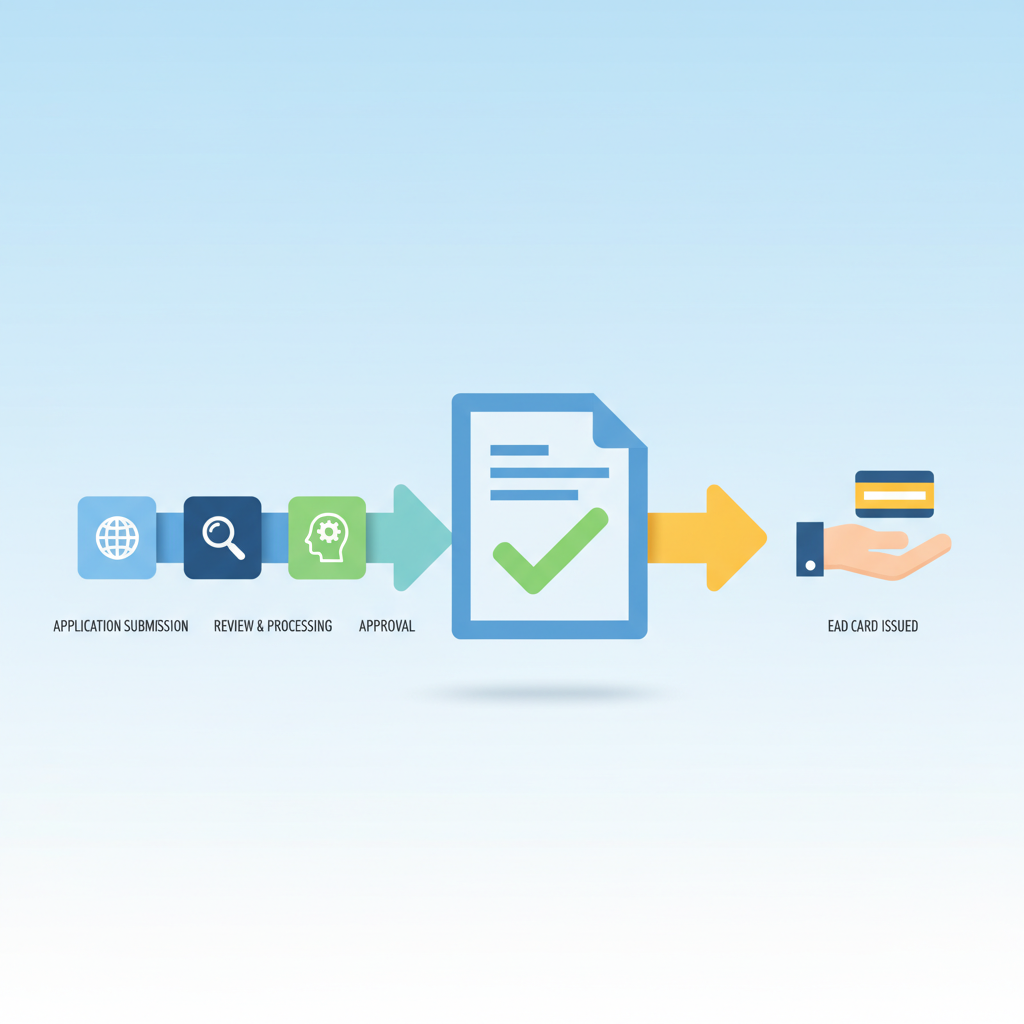
How to Apply for or Renew Your EAD: A Complete Step-by-Step Guide
Applying for or renewing your Employment Authorization Document (EAD) is a critical process that requires meticulous attention to detail. Follow this comprehensive guide to ensure your application is as strong as possible.
1) Determine Your Eligibility and Category
Before you even touch a form, you must confirm that you are eligible for an EAD and identify the correct eligibility category. This is the foundation of your application.
- Review USCIS Guidelines: Carefully read the instructions for Form I-765 on the USCIS official website. These instructions detail all eligible categories.
- Consult with an Attorney: This is arguably the most crucial step. An experienced immigration attorney can assess your specific immigration status (e.g., pending Adjustment of Status (Form I-485), asylum applicant, DACA recipient, H-4 spouse, TPS recipient, etc.) and confirm your eligibility and the correct category code (e.g., (c)(9), (c)(8), (c)(33)). Incorrect categorization is a common reason for RFE or denial.
- For Renewals: Ensure you still meet the underlying eligibility for your previous EAD category. For example, if your EAD was based on a pending Form I-485, make sure that application is still active. File your renewal application well in advance of your current EAD's expiration date, ideally within the 180-day window before expiration, to take advantage of potential automatic extensions.
2) Gather Required Documents
Once your eligibility is confirmed, begin collecting all necessary supporting documentation. This typically includes:
- Proof of Identity and Nationality:
- Copy of your birth certificate (with certified English translation if applicable).
- Copy of your passport biographical page.
- Copy of your national identity card (if applicable).
- Proof of Immigration Status:
- Copy of your most recent Form I-94, Arrival/Departure Record.
- Copies of previous EAD cards (front and back), if renewing.
- Copies of all previous U.S. visas and entry stamps.
- Copy of your Green Card (if applicable, for certain categories).
- Copy of your I-797 Approval Notice for your underlying petition (e.g., I-130, I-140, asylum grant, DACA approval).
- Evidence Supporting Your Eligibility Category:
- For (c)(9) (Adjustment of Status): Copy of your Form I-485 receipt notice.
- For (c)(8) (Asylum Applicant): Copy of your Form I-589 (Application for Asylum and for Withholding of Removal) receipt notice.
- For (c)(33) (DACA): Copy of your Form I-797 approval notice for DACA.
- For H-4 Spouse: Copy of your H-4 Form I-797 approval notice, your spouse's H-1B Form I-797 approval notice, and evidence that your spouse is the principal beneficiary of an approved Form I-140 or has reached the maximum 6-year H-1B limit.
- Photographs: Two identical passport-style photos taken within 30 days of filing. Write your name and A-Number (if you have one) lightly on the back of each photo.
- Previous EAD (for Renewals): Copy of the front and back of your current or most recently expired EAD.
- Marriage Certificate: If your eligibility is based on a spouse (e.g., H-4 spouse), include a copy of your marriage certificate.
Warning: Always submit copies, not original documents, unless USCIS specifically requests originals. Keep a complete set of all submitted documents for your records.
3) Complete Form I-765, Application for Employment Authorization
This form must be filled out accurately and completely. USCIS often denies applications or issues RFEs due to incomplete or incorrect information.
- Download the Latest Version: Always use the most current version of Form I-765 from the USCIS Forms page.
- Read Instructions Carefully: Follow the instructions meticulously. Pay close attention to how to answer each question.
- Type or Print Clearly: If handwriting, use black ink and print legibly. Typing is highly recommended.
- Provide All Requested Information: Do not leave any fields blank. If a question doesn't apply to you, write "N/A" (not applicable).
- Select Correct Eligibility Category: As discussed in Step 1, this is critical. Enter the correct three-character code (e.g., (c)(9), (c)(8)).
- Sign the Form: An unsigned form will be rejected. Ensure your signature is within the designated box.
4) Pay the Filing Fee (or Request a Fee Waiver)
Most EAD applications require a filing fee. Check the USCIS website for the current fee amount. As of 2026-03-23, fees are subject to change, so always verify.
- Check Current Fees: Visit the USCIS Fee Schedule page.
- Payment Method: You can pay by money order, personal check, cashier's check, or by credit card using Form G-1450, Authorization for Credit Card Transactions. Make checks/money orders payable to "U.S. Department of Homeland Security."
- Fee Waivers: If you cannot afford the filing fee, you may be eligible for a fee waiver. You must submit Form I-912, Request for Fee Waiver, along with supporting documentation proving your inability to pay. Not all EAD categories are eligible for fee waivers. Consult with an attorney to see if you qualify.
5) Assemble and Mail Your Application Package
Organizing your application package correctly can prevent delays.
- Order of Documents: While USCIS doesn't always mandate a specific order, a common practice is:
- Cover Letter (optional, but recommended by attorneys).
- Payment (check/money order or Form G-1450).
- Form I-765.
- Two passport-style photos (placed in a small envelope and stapled to the application).
- Supporting documents in a logical order (e.g., identity, immigration status, eligibility evidence).
- Where to File: The filing address depends on your eligibility category and sometimes your state of residence. Refer to the "Where to File" section in the Form I-765 instructions. For many categories, applications are sent to a USCIS Lockbox facility.
- Mail with Tracking: Always send your application via certified mail with a return receipt or a courier service that provides tracking (e.g., FedEx, UPS). This provides proof of mailing and delivery.
6) Attend Biometrics Appointment (If Required)
After filing, USCIS will send you a Form I-797C, Notice of Action, confirming receipt of your application. If a biometrics appointment is required, you will receive a separate appointment notice (Form I-797C) with the date, time, and location of your appointment at an Application Support Center (ASC).
- Be Punctual: Arrive on time for your appointment.
- Bring Required Documents: Bring your appointment notice, a valid photo ID (e.g., passport, driver's license), and any other documents specified in the notice.
- Cooperate: Follow the instructions of the ASC staff for fingerprinting and photography.
Note: If you previously submitted biometrics for an associated application (e.g., Form I-485), USCIS may reuse them, and you might not receive a separate biometrics appointment notice for your EAD.
7) Monitor Your Case and Respond to RFEs
The waiting period can be anxious, but it's important to stay proactive.
- Track Your Case Online: Use the receipt number from your Form I-797C to track your case status on the USCIS Case Status Online tool.
- Check Processing Times: Regularly review the USCIS Processing Times page for your specific form (Form I-765) and service center.
- Respond to RFEs Promptly: If you receive an RFE, read it carefully and understand exactly what additional evidence USCIS is requesting. Gather the requested documents and submit them well before the deadline. Failure to respond, or an incomplete response, can lead to denial. Consider seeking legal help to draft your RFE response.
- Address Name/Address Changes: If your name or address changes while your application is pending, notify USCIS immediately by filing Form AR-11, Alien's Change of Address Card, and updating your case online.
Don't navigate complex EAD applications alone. Imigrar's Orlando team provides personalized support to ensure your application is complete and accurate. Call +1 786-791-3106 for a free consultation. Se Habla Español.
Practical Steps You Can Take Today to Secure Your Work Authorization
Securing your Employment Authorization Document is a proactive process. Here are actionable steps you can take right now to prepare and strengthen your EAD application or renewal.
Actionable Checklist (5+ items)
- Confirm Your Eligibility & Category: Re-read the instructions for Form I-765 on the USCIS website. If unsure, schedule a consultation with an immigration attorney to definitively determine your eligibility and the correct category code (e.g., (c)(9), (c)(8), (c)(33)).
- Start Gathering Documents Early: Don't wait until the last minute. Begin collecting all required identity, immigration status, and category-specific evidence immediately. Create a dedicated folder for these documents.
- Check Your Current EAD's Expiration Date: If renewing, mark your calendar for at least 180 days before its expiration. USCIS strongly recommends filing within this window to potentially benefit from automatic extensions and avoid gaps in employment.
- Verify Filing Fees: Visit the USCIS Fee Schedule page to confirm the current filing fee for Form I-765. Ensure you have the funds available or explore fee waiver eligibility.
- Review Your Personal Information: Ensure your name, date of birth, and other identifying information are consistent across all your immigration documents. Any discrepancies can cause delays.
- Update Your Address with USCIS: If you've moved, ensure your address is current with USCIS by filing Form AR-11 online or by mail. This ensures you receive all crucial notices, including RFEs and approval notices.
- Consult an Immigration Attorney: This is the most practical step. An attorney can help you with all the above, ensuring accuracy and completeness, greatly reducing the risk of delays or denials.
Document Preparation Guidance
Proper document preparation is paramount for a smooth EAD application:
- Make Copies: Always submit copies of your supporting documents, not originals, unless specifically requested. Keep a complete, organized set of copies for your own records.
- Organize Clearly: Arrange your documents logically. A cover letter listing the contents of your package can be very helpful for USCIS officers. Use tabs or dividers for different sections (e.g., "Identity Documents," "Immigration Status," "Eligibility Evidence").
- Translations: If any document is not in English, you must provide a complete and accurate English translation, certified by the translator. The certification must state that the translator is competent to translate from the foreign language into English and that the translation is complete and accurate.
- Photos: Ensure your passport-style photos meet USCIS specifications (2x2 inches, white background, no


