

The reporting that sparked this guide: Employment Authorization Document Processing (USCIS)
What This News Means for Immigrants in Orlando and Across Florida
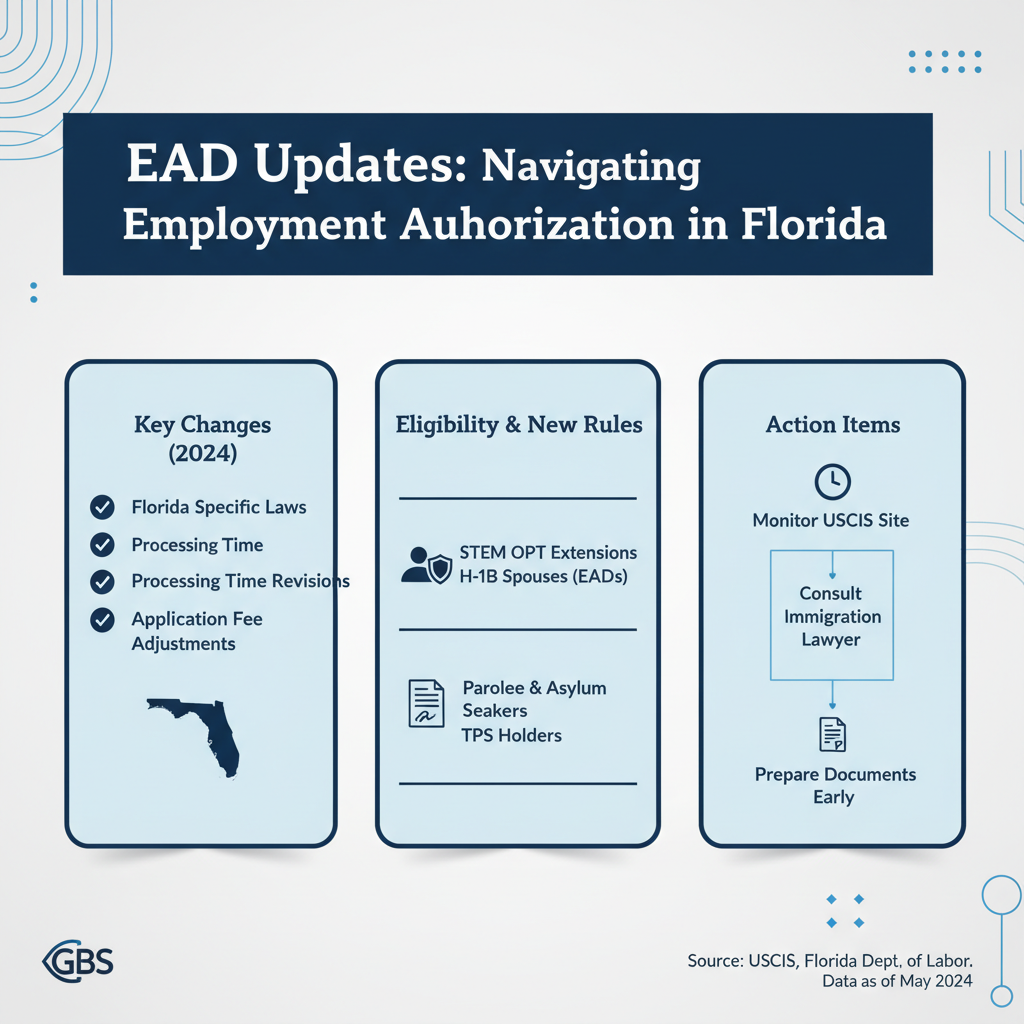
For countless immigrants across the United States, an Employment Authorization Document (EAD), often called a "work permit," is the key to legal employment, financial stability, and building a new life. Recent updates from U.S. Citizenship and Immigration Services (USCIS) regarding EAD application and renewal processing are therefore of paramount importance. These changes reflect USCIS's ongoing efforts to streamline processes, address backlogs, and provide clearer guidance, directly impacting the ability of individuals to work legally while their underlying immigration cases are pending.
Why this news is showing up now
The immigration system has faced significant challenges in recent years, including unprecedented processing delays exacerbated by the pandemic and surges in application volumes. In response, USCIS has been actively implementing various initiatives to improve efficiency, reduce backlogs, and enhance the overall applicant experience. These efforts often involve policy adjustments, technological upgrades, and revised operational procedures for high-volume forms like **Form I-765**, Application for Employment Authorization. The current news regarding EAD processing is a direct outcome of these ongoing strategic shifts, aiming to provide more predictable and timely outcomes for applicants. It signals a continued focus on ensuring that eligible immigrants can obtain or renew their work authorization without undue delay, which is critical for both individual livelihoods and the national economy.
How it can affect Florida residents
Florida, with its vibrant economy and diverse population, is home to a significant immigrant community. From the bustling tourism sector of Orlando to the agricultural heartlands and burgeoning tech industries, immigrants contribute substantially to the state’s workforce. Updates to EAD processing directly impact thousands of Florida residents who are asylum seekers, applicants for Adjustment of Status, Temporary Protected Status (TPS) holders, DACA recipients, and certain nonimmigrant visa holders and their dependents. Faster or more predictable EAD processing means less anxiety for families, reduced risk of employment gaps, and greater economic stability. Conversely, any slowdowns or complexities can lead to severe hardship, including job loss, inability to pay bills, and disruption to family life. For those living along the **I-4 corridor** or in Orange County, relying on the Orlando USCIS Field Office, these federal changes translate into tangible local effects on daily life and future prospects. Keeping abreast of these updates is not just about understanding policy; it’s about protecting your ability to work and thrive in Florida.
Need Help Navigating EAD Updates? Our Orlando immigration team at Imigrar is ready to assist. Call +1 786-791-3106 for a free consultation, or message us online. Se Habla Español.
What Employment Authorization Documents Are (and Why They Matter)
An Employment Authorization Document, widely known as an EAD, is a critical immigration benefit that allows foreign nationals to legally work in the United States for a specific period. It is a physical card, similar to a driver's license, issued by USCIS, and it serves as proof that the holder is authorized to accept employment in the U.S.
A plain-English definition
Think of an EAD as your official "permission slip" to work in the U.S. If you are an immigrant or a foreign national living in the United States, and you don't already have a green card or a specific work visa (like an H-1B or L-1), you will likely need an EAD to be employed legally. This document proves to employers that you are allowed to work, enabling you to secure jobs, earn income, and contribute to your community and family. It's often granted to individuals who are in the process of applying for a green card, seeking asylum, holding Temporary Protected Status (TPS), or falling into other specific categories. Without an EAD, working without authorization can lead to serious immigration consequences, including deportation and bars to future immigration benefits. Therefore, understanding your EAD status and keeping it current is paramount.
Key terms you need to know
Navigating the EAD process requires familiarity with several key terms:
- EAD (Employment Authorization Document): The official card proving your eligibility to work.
- Form I-765, Application for Employment Authorization: The specific USCIS form you must file to request an EAD.
- USCIS (U.S. Citizenship and Immigration Services): The government agency responsible for processing immigration benefits, including EADs. You can find more information on their USCIS official website.
- Adjustment of Status (AOS): The process of applying for a green card while physically present in the United States. Many individuals applying for AOS are eligible for an EAD while their green card application (**Form I-485**) is pending.
- Asylum Seeker: An individual who has applied for asylum in the U.S. and is waiting for a decision. After a certain waiting period, asylum seekers can apply for an EAD.
- TPS (Temporary Protected Status): A humanitarian immigration benefit granted to nationals of certain countries experiencing armed conflict, environmental disaster, or other extraordinary conditions. TPS holders are eligible for EADs.
- DACA (Deferred Action for Childhood Arrivals): An administrative relief from deportation for certain undocumented immigrants who came to the U.S. as children. DACA recipients are eligible for EADs.
- Nonimmigrant Visa Holder: Certain categories of nonimmigrant visa holders, such as spouses of L-1 (L-2) or E (EAD for E spouses) visa holders, are also eligible for EADs.
- Renewal vs. Initial Application: An initial application is for your first EAD. A renewal is filed when your current EAD is nearing expiration to extend your work authorization.
- Receipt Notice (Form I-797C): A notice sent by USCIS confirming they have received your application. This notice is crucial for tracking your case and, in some instances, for proving eligibility for the **180-day automatic extension** for renewals.
- Request for Evidence (RFE): A letter from USCIS asking for additional documents or information to support your application.
Understanding these terms is the first step toward successfully navigating your EAD application or renewal process.
Current Immigration Law: The Foundation for Work Authorization
The authority for granting employment authorization to foreign nationals in the United States stems primarily from the Immigration and Nationality Act (INA), the bedrock of U.S. immigration law. While there isn't a single, overarching "work permit law," various sections of the INA and corresponding regulations in the Code of Federal Regulations (CFR) specify who is eligible for work authorization and under what circumstances. The general principle is that foreign nationals must have specific authorization from the Department of Homeland Security (DHS) to work in the U.S., as outlined in INA § 274A.
Federal requirements
USCIS, an agency within the DHS, is responsible for adjudicating applications for employment authorization. Eligibility for an EAD is categorized into specific classes, each defined by regulations found in 8 CFR § 274a.12. These categories are diverse and cover a wide range of immigration statuses and situations. Some of the most common federal requirements and eligibility categories include:
- Applicants for Adjustment of Status (AOS): Individuals who have filed **Form I-485**, Application to Register Permanent Residence or Adjust Status, are typically eligible to apply for an EAD while their green card application is pending. This is codified under 8 CFR § 274a.12(c)(9). Often, the EAD application (**Form I-765**) is filed concurrently with the **Form I-485** and **Form I-131** (Application for Travel Document, for Advance Parole), leading to a "combo card" that serves as both an EAD and an Advance Parole document.
- Asylum Applicants: Individuals who have filed **Form I-589**, Application for Asylum and for Withholding of Removal, are eligible for an EAD if their application has been pending for at least 150 days and has not been denied. This falls under 8 CFR § 274a.12(c)(8).
- Refugees and Asylees: Those granted refugee or asylum status are immediately eligible for employment authorization.
- Temporary Protected Status (TPS) Holders: Individuals granted TPS are authorized to work in the U.S. and receive an EAD as part of their status, as per 8 CFR § 274a.12(a)(12) and (c)(19).
- Deferred Action for Childhood Arrivals (DACA) Recipients: While DACA itself is not a legal status, recipients are eligible for employment authorization.
- Spouses of Certain Nonimmigrant Visa Holders: Spouses of E-1/E-2 treaty traders/investors, L-1 intracompany transferees, and certain J-1 exchange visitors (J-2 spouses) are often eligible for EADs under categories like 8 CFR § 274a.12(a)(17) and (c)(5).
- Students with Optional Practical Training (OPT) or Curricular Practical Training (CPT): F-1 students can engage in employment directly related to their field of study, requiring an EAD for OPT.
- Other Categories: This includes individuals with pending **Form I-130** (Petition for Alien Relative) who meet certain criteria, parolees, and those in removal proceedings who have been granted specific forms of relief.
These federal regulations are uniformly applied nationwide by USCIS. Any updates or policy changes related to EAD processing, such as those regarding processing times or automatic extensions, are issued by USCIS and apply across all states. For the most current forms and regulations, always refer to the USCIS Forms page and the USCIS official website.
Florida-specific considerations
While EAD eligibility and application processes are federal, their impact is deeply felt at the state and local levels. Florida’s economy, driven by tourism, agriculture, and a growing technology sector, heavily relies on a diverse workforce. For residents in Orlando, Tampa, Miami, and throughout Central Florida, timely EAD processing is not merely a bureaucratic detail; it’s a matter of economic survival and integration. The Orlando USCIS Field Office and other local USCIS offices are the points of contact for many individuals residing in Florida, handling interviews and certain localized aspects of immigration processing, though EAD applications are typically filed at designated USCIS Lockbox facilities based on the eligibility category.
Florida does not have state-specific laws that govern EAD eligibility or application procedures. However, state laws concerning employment verification (e.g., E-Verify requirements for employers) underscore the critical importance of having a valid EAD for legal employment. Employers in Florida are bound by federal law to verify the employment eligibility of all new hires, and a valid EAD is a primary document used for this purpose. Therefore, any delays in EAD processing can have direct consequences for job seekers and current employees in Orange County and surrounding areas. Imigrar, located in Orlando, understands these local pressures and provides tailored guidance to ensure our clients navigate the federal process effectively while considering their specific circumstances in Florida.
How to Apply for or Renew Your EAD: A Complete Step-by-Step Guide
Applying for or renewing an Employment Authorization Document (EAD) is a crucial step for many immigrants seeking to work legally in the U.S. The process, while seemingly straightforward, requires meticulous attention to detail. This guide outlines the essential steps to ensure a smooth application or renewal.
1) Determine Your Eligibility Category
Before you even begin filling out forms, you must confirm your specific eligibility category for an EAD. This is arguably the most important first step, as it dictates which documents you need, where you send your application, and sometimes even the filing fee. USCIS lists numerous categories under 8 CFR § 274a.12. Common categories include:
- (c)(9) - Adjustment of Status Applicants: If you have a pending **Form I-485** to adjust your status to a lawful permanent resident.
- (c)(8) - Asylum Applicants: If you have a pending **Form I-589**, Application for Asylum, and it has been pending for at least 150 days.
- (a)(12) or (c)(19) - TPS Beneficiaries: If you have been granted Temporary Protected Status.
- (c)(33) - DACA Recipients: If you have been granted Deferred Action for Childhood Arrivals.
- (a)(17) or (c)(5) - Spouses of certain nonimmigrants: For example, L-2 spouses of L-1 visa holders, or E-2 spouses of E-1/E-2 visa holders.
- (c)(3)(C) - F-1 Optional Practical Training (OPT): For F-1 students seeking work authorization post-graduation.
Reminder: Your eligibility category is usually tied to your underlying immigration status or application. You cannot apply for an EAD unless you fall into one of the designated categories. If you're unsure, consulting with an immigration attorney from Imigrar can clarify your options.
Required documents (to confirm eligibility):
- A copy of your **Form I-797C** receipt notice for your pending **Form I-485** or **Form I-589**.
- A copy of your **Form I-797** approval notice for TPS or DACA.
- A copy of your marriage certificate and your spouse's visa/status documents (for dependent spouses).
- Proof of student status and Designated School Official (DSO) recommendation (for OPT).
2) Gather Required Documents
Once you know your category, collect all necessary supporting documents. This list can vary slightly based on your specific eligibility, but generally includes:
- Completed **Form I-765**: Always use the latest edition available on the USCIS Forms page.
- Two identical passport-style photos: Taken within 30 days of filing, unmounted, color, with a white to off-white background. Lightly write your name and Alien Registration Number (A-Number) on the back of each photo with a pencil.
- Copy of your most recent **Form I-94** Arrival/Departure Record: Obtainable from CBP's website.
- Copy of any previous EAD (front and back): If you are renewing your EAD or have held one previously.
- Copy of a government-issued identification document: Such as your passport identity page, birth certificate with photo ID, or a foreign national identity card.
- Copies of supporting documents for your eligibility category:
- For **(c)(9) Adjustment of Status:** Copy of your **Form I-485** receipt notice.
- For **(c)(8) Asylum Applicants:** Copy of your **Form I-589** receipt notice or proof of pending asylum application.
- For **TPS:** Copy of your **Form I-797** TPS approval notice.
- For **DACA:** Copy of your **Form I-797** DACA approval notice.
- For dependent spouses: Copy of your marriage certificate and spouse's visa/status documents.
- Copy of your birth certificate.
- Copy of your visa (if applicable).
- Copy of all previous **Form I-765** approval notices.
- Fee payment: A check or money order payable to "U.S. Department of Homeland Security" for the correct filing fee. Alternatively, you can pay by credit card using **Form G-1450**, Authorization for Credit Card Transactions. Check the USCIS I-765 page for current fees.
- **Form I-912, Request for Fee Waiver:** If you qualify based on specific income or hardship criteria.
Important: Always make clear, legible photocopies of all documents. Do not send original documents unless specifically requested by USCIS.
3) Complete Form I-765 Accurately
Fill out **Form I-765** completely and truthfully. Every question must be answered. If a question does not apply to you, write "N/A" (Not Applicable). Pay close attention to:
- Part 1: Information About You: Ensure your name, address, and date of birth match your identification documents exactly.
- Part 2: Application Type: Select "Permission to accept employment" if you're applying for the first time, or "Renewal of my permission to accept employment" if you're extending an existing EAD.
- Part 2, Item 27: Eligibility Category: This is critical. Enter the correct code (e.g., (c)(9), (c)(8), (a)(12)). Entering the wrong code can lead to denial or delays.
- Part 3: Applicant's Statement, Contact Information, Declaration, Certification, and Signature: Double-check your contact information. Your signature is mandatory. If someone helped you prepare the form, their information must also be included.
Warning: Incomplete forms or forms with errors are a leading cause of delays and denials. Proofread everything carefully.
4) Prepare Your Application Package
Organize your documents neatly. A common practice is to create a cover letter listing all the documents included in your package. Arrange the documents in the order listed in your cover letter, typically with the **Form I-765** and fee payment on top, followed by supporting documents. Use a paper clip or binder clip for the entire package; avoid staples for individual documents.
Recommendation: Make a complete copy of your entire application package before mailing it. This serves as your record and is invaluable if USCIS requests additional information or if your application is lost.
5) Mail Your Application
The filing address for **Form I-765** depends on your eligibility category and sometimes your state of residence. USCIS uses specific Lockbox facilities to process applications. You can find the correct filing address on the USCIS Direct Filing Addresses for Form I-765 page.
- Always use a mailing service that provides tracking and delivery confirmation (e.g., USPS Certified Mail, FedEx, UPS). This provides proof of mailing and receipt.
- For Orlando and Central Florida residents, ensure you are sending your application to the correct Lockbox based on your category, not the local USCIS field office.
Important: Filing your application to the wrong address will cause significant delays.
6) Biometrics Appointment (If Required)
After USCIS receives your application, you will receive a **Form I-797C** receipt notice. For some EAD categories, particularly those linked to pending green card applications (**Form I-485**) or asylum, USCIS may send a separate appointment notice for biometrics (fingerprints, photos, and signature). This appointment will typically be at an Application Support Center (ASC) near your Orlando or Florida residence.
- Attend your biometrics appointment as scheduled.
- Bring the appointment notice and a valid photo ID (e.g., passport, driver's license).
- This data is used for background checks. Missing this appointment without rescheduling can delay your application.
7) Monitor Your Case Status and Respond to RFEs
Once USCIS receives your application, you can track its progress online using the receipt number found on your **Form I-797C**. Visit USCIS Case Status Online. You may also receive updates via mail.
- Request for Evidence (RFE): USCIS may send an RFE if they need more information or documents. Respond promptly and completely to RFEs by the deadline provided. Failure to respond can lead to denial.
- Processing Times: Check the USCIS Processing Times page for estimated wait times for your specific form and field office/service center. While these are estimates, they provide a general idea of when to expect a decision.
- Contact USCIS: If your case is outside normal processing times, you may be able to submit an "outside normal processing time" inquiry through the USCIS website.
Applying for an EAD
Schedule a free consultation with our attorney-reviewed team todayHave Questions About Your Case?


