


The Reporting That Sparked This Guide

The information and guidance in this article are inspired by ongoing discussions and updates from USCIS regarding the processing of Employment Authorization Documents (EADs). For the latest official announcements, please refer to:
Employment Authorization Document Processing (USCIS)What This News Means for Immigrants in Orlando and Across Florida
For many immigrants, the ability to work legally in the United States is not just a right, but a necessity that provides stability, independence, and the opportunity to build a new life. The Employment Authorization Document (EAD), often called a work permit, is the key to this opportunity. Recent updates and ongoing discussions from U.S. Citizenship and Immigration Services (USCIS) regarding EAD application and renewal processing are therefore incredibly significant for individuals and families across the nation, including the vibrant immigrant communities of Orlando and throughout Florida.
Why this news is showing up now
USCIS, the federal agency responsible for processing most immigration benefits, has been under immense pressure in recent years due to unprecedented application volumes, staffing challenges, and the implementation of new policies. This has led to fluctuating processing times and significant backlogs for various forms, including Form I-765, Application for Employment Authorization. The "news" around EAD processing isn't necessarily a single, dramatic policy shift, but rather a continuous effort by USCIS to address these challenges, streamline operations, and provide clarity to applicants.
In response to stakeholder feedback and the operational realities, USCIS has implemented several measures:
- Temporary Final Rules (TFRs): In the past, USCIS has issued TFRs to automatically extend the validity of certain EAD categories beyond the standard 180 days, sometimes up to 540 days, for those who filed their renewal applications on time. These extensions aim to prevent gaps in employment authorization while applications are pending. While these specific TFRs may expire, the underlying need for efficient processing remains a constant focus.
- Increased Efficiency Efforts: USCIS has committed to improving processing times by hiring more staff, optimizing technology, and reallocating resources. These efforts are ongoing and can lead to shifts in how quickly certain EAD categories are processed.
- Guidance on Expedite Requests: While not a new policy, USCIS frequently clarifies its criteria for expediting EAD applications, which typically require demonstrating severe financial loss, urgent humanitarian reasons, or other compelling circumstances.
- Specific Category Adjustments: Sometimes, processing priorities or procedures are adjusted for particular EAD categories, such as those for asylum seekers, Temporary Protected Status (TPS) beneficiaries, or certain nonimmigrant spouses (e.g., H-4 EADs).
These ongoing adjustments and the persistent challenge of processing backlogs mean that EAD processing is a dynamic area of immigration law, constantly warranting attention and updated guidance. For anyone awaiting a work permit, staying informed is crucial.
How it can affect Florida residents
Florida is one of the most diverse states in the U.S., home to a large and growing immigrant population. For residents in Orlando and across the Sunshine State, EAD processing updates have direct and significant implications:
- Employment Stability: Delays in EAD processing or renewals can lead to job loss, financial hardship, and immense stress for individuals and families. Florida's economy relies heavily on its workforce, and disruptions to employment authorization impact communities directly.
- Local Economy Impact: When immigrants can work legally, they contribute to the local economy through taxes, consumer spending, and filling vital labor gaps. Smooth EAD processing supports Florida's economic growth.
- Planning and Uncertainty: For those in Orlando planning their careers, education, or family future, unpredictable EAD processing times create significant uncertainty. Knowing the current trends and potential changes helps in making informed decisions.
- Orlando USCIS Field Office: While EAD applications are generally processed at USCIS service centers, local field offices like the one in Orlando may be involved in related processes, such as biometrics appointments or interviews for underlying immigration benefits (like Adjustment of Status) that grant EAD eligibility. Delays at service centers can indirectly impact the workload and timelines at local offices.
- Diverse Communities: Florida is home to many communities heavily reliant on EADs, including asylum seekers, TPS beneficiaries (e.g., from Venezuela, Haiti, Nicaragua, El Salvador, Honduras, Sudan), and individuals adjusting status from various countries. Any changes to EAD processing directly affect these groups.
Understanding these updates is not just about legal compliance; it's about safeguarding livelihoods and ensuring the continued integration and contribution of immigrants to Florida's vibrant society.
Navigating EAD changes can be complex. Don't face it alone. Our experienced Orlando immigration team at Imigrar understands the latest USCIS updates and can guide you through the application or renewal process. Call +1 786-791-3106 for a free consultation. Se Habla Español.
What Employment Authorization Documents (EADs) Are (and Why They Matter)
An Employment Authorization Document, or EAD, is a permit issued by USCIS that grants foreign nationals temporary authorization to work legally in the United States. It's a physical card, similar to a driver's license, that proves your eligibility to be employed. For many, an EAD is a critical bridge to self-sufficiency and stability while they pursue a more permanent immigration status or while their temporary status allows for work.
A plain-English definition
Think of an EAD as your official "permission slip" to work in the U.S. If you're not a U.S. citizen or a lawful permanent resident (Green Card holder), but you have an immigration status that allows you to work, you'll likely need an EAD. It's not a visa, and it's not a Green Card; it's specific authorization to accept employment from any employer in the U.S. (unless your EAD is tied to a specific employer, like for certain nonimmigrant categories).
The EAD is typically valid for a specific period, usually one or two years, and must be renewed to maintain work authorization. It's proof that you can legally accept a job, get a Social Security number, and file taxes as an employee.
Key terms you need to know
- EAD (Employment Authorization Document): The official card issued by USCIS proving your authorization to work.
- Form I-765: The specific application form you must file with USCIS to request an EAD or renew an existing one.
- USCIS: U.S. Citizenship and Immigration Services, the government agency that processes immigration applications, including EADs. You can find more information on the USCIS official website.
- Adjustment of Status: The process of applying for a Green Card (lawful permanent residence) while physically present in the United States. Applicants often file Form I-765 concurrently with their Form I-485, Application to Register Permanent Residence or Adjust Status.
- Asylum Seeker: An individual who has applied for asylum in the U.S. and is awaiting a decision. After a certain waiting period (currently 150 days from the filing date of the asylum application), asylum seekers can apply for an EAD.
- TPS (Temporary Protected Status): A temporary immigration status granted by the Secretary of Homeland Security to eligible nationals of certain countries designated due to ongoing armed conflict, environmental disaster, or other extraordinary and temporary conditions. TPS beneficiaries are eligible for EADs.
- OPT (Optional Practical Training): A period during which F-1 nonimmigrant students can work in a field directly related to their major area of study. OPT requires an EAD.
- Nonimmigrant Visa Holder: Individuals in various temporary visa categories (e.g., H-4 spouses of H-1B workers, J-2 spouses of J-1 exchange visitors) who may be eligible for an EAD based on their dependent status.
- Biometrics: The collection of fingerprints, photographs, and signatures by USCIS, typically at an Application Support Center (ASC), used for background checks and identity verification. Most EAD applicants are required to attend a biometrics appointment.
- Processing Times: The estimated duration it takes USCIS to process a specific application. These times can vary significantly by form type, service center, and application category. You can check current processing times on the USCIS Processing Times page.
- RFE (Request for Evidence): A letter from USCIS asking for additional documents or information to support your application.
- NOID (Notice of Intent to Deny): A letter from USCIS indicating that they intend to deny your application unless you provide specific information or evidence to overcome the grounds for denial.
Current Immigration Law: The Foundation of Employment Authorization
The ability to work in the United States without being a U.S. citizen or lawful permanent resident is not an inherent right but a privilege granted under specific provisions of federal immigration law. The framework for employment authorization is primarily found in the Immigration and Nationality Act (INA) and its corresponding regulations in Title 8 of the Code of Federal Regulations (8 CFR).
Federal requirements
The INA and 8 CFR outline who is eligible for an EAD and under what conditions. There are numerous categories of foreign nationals who may apply for an EAD, generally falling into two broad groups:
- Individuals with pending applications for an immigration benefit that, if granted, would allow them to live and work permanently in the U.S. This includes applicants for Adjustment of Status (Green Card applicants) based on family-sponsored or employment-sponsored petitions (e.g., Form I-130, Petition for Alien Relative, or Form I-140, Immigrant Petition for Alien Worker, followed by Form I-485). It also includes applicants for asylum or refugee status.
- Individuals in certain nonimmigrant statuses or temporary programs that specifically permit employment. Examples include:
- Spouses of certain nonimmigrants (e.g., H-4 spouses of H-1B workers who have an approved Form I-140).
- F-1 students seeking Optional Practical Training (OPT) or STEM OPT extensions.
- J-2 spouses of J-1 exchange visitors.
- Beneficiaries of Temporary Protected Status (TPS).
- Applicants for certain humanitarian benefits, such as VAWA (Violence Against Women Act) self-petitioners or U-visa applicants.
- Individuals with Deferred Action for Childhood Arrivals (DACA).
The specific eligibility criteria for each EAD category are detailed in 8 CFR §274a.12. For instance, an individual with a pending Form I-485 (Adjustment of Status) is eligible under category (c)(9), while an asylum applicant whose case has been pending for over 150 days is eligible under category (c)(8).
All applicants for an EAD must file Form I-765, Application for Employment Authorization, along with supporting documentation demonstrating their eligibility under one of the specified categories. The application must be filed with the correct fee (or a fee waiver request, Form I-912) and biometric services fee, if applicable.
Florida-specific considerations
While immigration law is federal, applying uniformly across all states, there are practical considerations for Florida residents:
- Federal Law Supersedes State Law: No Florida state law can grant or deny employment authorization that conflicts with federal immigration law. Your eligibility for an EAD is determined solely by federal statutes and regulations.
- Local Economic Landscape: Florida's diverse job market, from tourism and hospitality in Orlando to agriculture and tech across the I-4 corridor, means that maintaining work authorization is crucial for many different industries. Delays in EAD processing can severely impact individuals working in these sectors.
- Access to Services: For Central Florida residents, the Orlando USCIS Field Office serves as a resource for certain immigration matters, though EAD applications are sent to USCIS Service Centers. Biometrics appointments for EAD applicants will typically be scheduled at a local Application Support Center (ASC) in Orlando or a nearby city.
- State ID and Driver's License: An approved EAD is often required to obtain a Florida driver's license or state identification card, which are essential for daily life and employment.
It is paramount for Florida immigrants to understand these federal requirements and how they apply to their specific situation. Consulting with an experienced immigration attorney, like those at Imigrar, can help ensure compliance and maximize the chances of a successful EAD application.
For more detailed information on immigration laws and regulations, visit the Executive Office for Immigration Review and the U.S. Department of State websites.
How to Apply for or Renew Your Employment Authorization Document: A Complete Step-by-Step Guide
Applying for or renewing your EAD can seem daunting, but breaking it down into manageable steps can simplify the process. This guide covers the general procedure; remember that specific requirements can vary based on your eligibility category.
1) Determine Your Eligibility and EAD Category
Before you do anything else, you must confirm that you are eligible for an EAD and identify the correct eligibility category. This is the most crucial step, as filing under the wrong category will lead to denial.
- Review USCIS Guidelines: Carefully read the "Who May File Form I-765" section in the official Form I-765 Instructions.
- Common Categories:
- (c)(9): Pending Adjustment of Status (Form I-485)
- (c)(8): Asylum applicant (pending for 150+ days)
- (a)(12) or (c)(19): Temporary Protected Status (TPS)
- (c)(3)(C): F-1 student seeking STEM OPT extension
- (c)(26): H-4 spouse of certain H-1B nonimmigrant
- (c)(35) & (c)(36): E-3, H-1B, L-1, O-1 nonimmigrant nonimmigrant in compelling circumstances
- Consult an Attorney: If you are unsure about your eligibility or category, seek legal advice. An incorrect category can lead to significant delays or denial.
2) Gather All Required Documents and Information
The documents you need will depend on your specific EAD category. However, some documents are universally required.
- Mandatory Documents for All Applicants:
- Two identical passport-style photos (taken within 30 days of filing, white background, unretouched).
- Copy of your last EAD (front and back), if applicable.
- Copy of your passport identity page (with photo and biographic information).
- Copy of your birth certificate (with certified English translation, if applicable).
- Copy of your visa (if applicable, e.g., F-1, J-1, H-4).
- Copy of your Form I-94, Arrival/Departure Record (print from CBP website).
- Proof of previous EADs or work authorization (if any).
- Category-Specific Documents (Examples):
- For (c)(9) Adjustment of Status: Copy of your Form I-485 receipt notice.
- For (c)(8) Asylum Applicants: Copy of your Form I-589, Application for Asylum and for Withholding of Removal, receipt notice or filing date confirmation.
- For (c)(26) H-4 Spouses: Copy of your spouse's Form I-797 Approval Notice for Form I-140, and your marriage certificate.
- For TPS Applicants: Copy of your Form I-821, Application for Temporary Protected Status, receipt or approval notice.
- For F-1 OPT/STEM OPT: Copy of your Form I-20 endorsed for OPT/STEM OPT, academic transcripts, and degree.
- Financial Documents (for Fee Waivers): If applying for a fee waiver (Form I-912), gather proof of income, public benefits, or financial hardship.
- Translations: Any document not in English must be accompanied by a complete and accurate English translation and a certification by the translator that they are competent to translate and that the translation is accurate.
3) Complete Form I-765, Application for Employment Authorization
Fill out Form I-765 completely and accurately. Pay close attention to every field. You can download the latest version from the USCIS Forms page.
- Read Instructions: Always refer to the most current USCIS instructions for Form I-765.
- Personal Information: Provide your full legal name, address, date of birth, country of birth, country of citizenship, and A-Number (if you have one).
- Eligibility Category: Enter the correct eligibility category code (e.g., (c)(9), (c)(8)) in Part 2, Item 27.
- Renewal vs. Initial: Clearly indicate if this is an initial application or a renewal.
- Signatures: Ensure you sign the form in blue or black ink. Unsigned forms will be rejected.
- Online Filing: For certain categories, USCIS allows online filing of Form I-765. Check the USCIS website for eligibility for online filing, as this can sometimes expedite processing.
Worried about making a mistake on your EAD application? Imigrar provides meticulous review and preparation services to ensure your application is accurate and complete. Contact us at +1 786-791-3106 for peace of mind. Se Habla Español.
4) Calculate and Prepare the Correct Filing Fee
The filing fee for Form I-765 can change, so always check the USCIS website for the most current fee. Some categories may require an additional biometrics fee, or you might be exempt from fees.
- Check Fee Schedule: Verify the current fee for Form I-765 and any associated biometrics fee.
- Payment Method: You can pay by money order, personal check, cashier's check, or by credit card using Form G-1450, Authorization for Credit Card Transactions. Make checks/money orders payable to "U.S. Department of Homeland Security."
- Fee Waivers: If you cannot afford the fee, you might be eligible for a fee waiver using Form I-912, Request for Fee Waiver. Include strong evidence of your inability to pay.
- Important: Submitting the wrong fee is a common reason for application rejection.
5) Assemble Your Application Package and File
Organize your documents neatly and mail your application to the correct USCIS filing address.
- Order of Documents:
- Check or money order (or Form G-1450 or Form I-912).
- Two passport-style photos in a small envelope stapled to the upper left front of the application.
- Completed and signed Form I-765.
- All supporting documents (copies, not originals unless specifically requested).
- Cover letter (optional, but recommended for clarity, especially if you have complex circumstances).
- Filing Address: The filing address depends on your EAD category and the state you live in. Use the "Where to File" section of the Form I-765 instructions or the USCIS Direct Filing Addresses for Form I-765 page. For Florida residents, applications are typically sent to specific USCIS Service Centers (e.g., Texas Service Center, Nebraska Service Center).
- Mailing Tips:
- Use a reputable mail service (USPS Priority Mail, FedEx, UPS) that provides tracking and delivery confirmation.
- Keep a complete copy of your entire application package for your records.
6) Attend Your Biometrics Appointment (If Required)
After filing, USCIS will send you a receipt notice (Form I-797C). For most EAD applicants, the next step is a biometrics appointment.
- Appointment Notice: You will receive Form I-797C, Appointment Notice, with the date, time, and location of your biometrics appointment, typically at a local Application Support Center (ASC). For Orlando residents, this would likely be the Orlando ASC.
- What to Bring:
- The appointment notice.
- A valid photo identification (e.g., passport, driver's license, state ID).
- Purpose: USCIS collects your fingerprints, photograph, and signature for background checks and identity verification.
- Rescheduling: If you cannot attend, you must request to reschedule the appointment by following the instructions on the notice, but this can delay processing.
7) Monitor Your Case Status and Respond to RFEs
The waiting period can be long, so regularly check your case status.
- Online Case Status: Use the receipt number from your Form I-797C (e.g., SRC, LIN, WAC, EAC) to check your status online at USCIS Case Status Online.
- Processing Times: Keep an eye on the USCIS Processing Times page for the service center handling your application.
- RFEs or NOIDs: If USCIS sends an RFE or NOID, respond promptly and thoroughly with the requested information. Failure to do so can lead to denial.
- Approval: If approved, you will receive an approval notice and your EAD card will be mailed to you.
Reminder: For EAD renewals, it is critical to file well in advance of your current EAD's expiration date. USCIS recommends filing approximately 120-180 days before expiration, especially with current processing backlogs. For certain categories, filing on time may grant you an automatic extension of your work authorization.
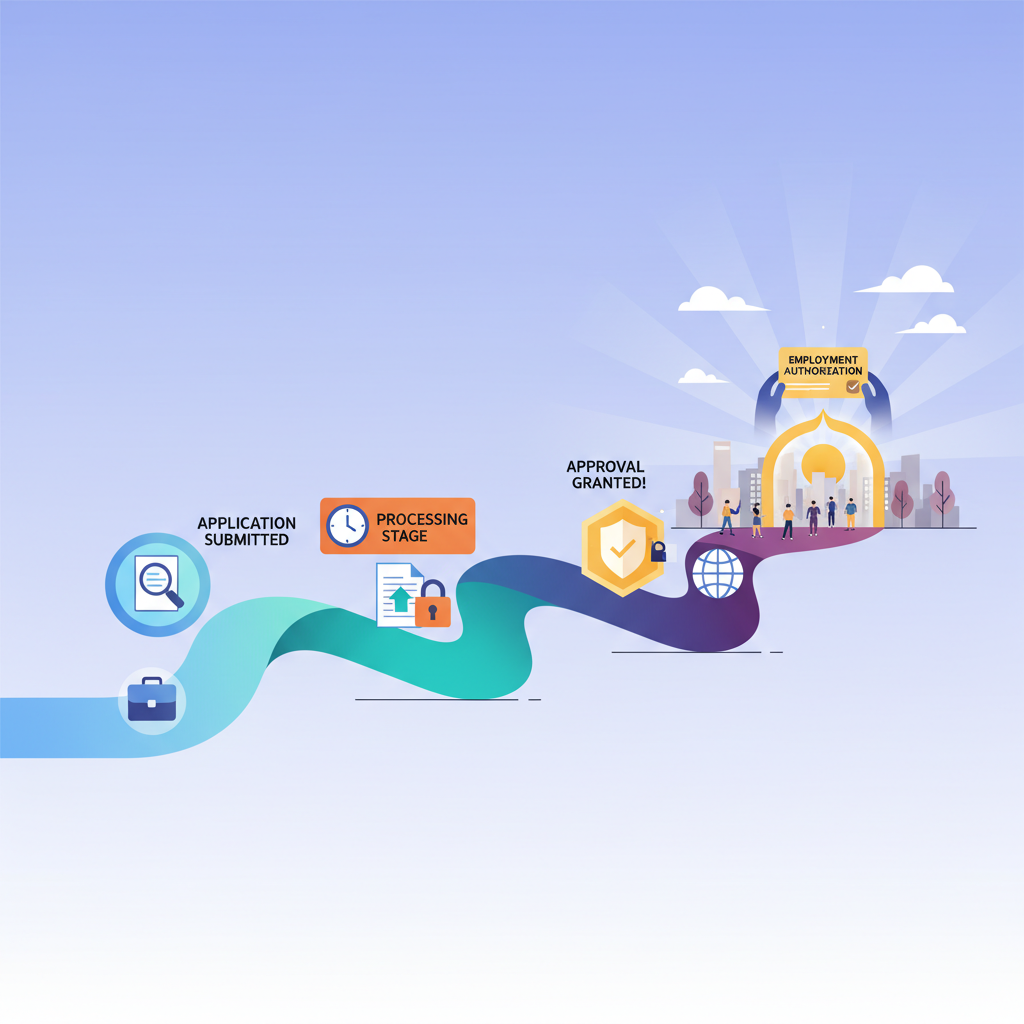
Practical Steps You Can Take Today to Navigate EAD Processing
While EAD processing times can be unpredictable, there are proactive steps you can take to prepare and minimize potential delays.
Actionable Checklist:
- Verify Your Eligibility: Double-check your specific EAD eligibility category and ensure you meet all requirements.
- Gather Documents Early: Start collecting all necessary supporting documents immediately. Don't wait until the last minute. This includes obtaining certified translations if required.
- Complete Form I-765 Accurately: Fill out the form carefully, ensuring all information is correct and consistent with other immigration documents. Use the latest form version.
- Track Processing Times: Regularly check the USCIS processing times for Form I-765 at the relevant service center to set realistic expectations for your application.
- Renew On Time (or Early): If you are renewing, file your application well in advance of your current EAD's expiration. Aim for the 180-day window before expiration to potentially benefit from automatic extensions.
- Keep Copies of Everything: Maintain a complete copy of your entire application package, including all forms, supporting documents, and payment receipts.
- Update Your Address: If you move, immediately update your address with USCIS by filing Form AR-11, Alien's Change of Address Card, and updating your address on any pending applications.
- Consult with Imigrar: If you have questions, concerns, or simply want to ensure your application is perfect, schedule a consultation with our experienced immigration attorneys.
Document Preparation Guidance:
- Organize: Use tabs, labels, or a cover letter to clearly delineate sections of your application package.
- Copies, Not Originals: Unless USCIS specifically requests an original document, always send copies. Keep your originals safe.
- Certified Translations: For any document not in English, provide a full English translation along with a translator's certification statement.
- Passport Photos: Ensure photos meet USCIS specifications: 2x2 inches, white background, no glasses, no head coverings (unless for religious reasons and a signed statement is provided), taken within 30 days.
Timeline Expectations:
EAD processing times are highly


