

In the dynamic landscape of U.S. immigration, obtaining and maintaining work authorization is a critical step for many individuals and families seeking to build new lives. The Employment Authorization Document (EAD), often referred to as a work permit, is the key to legal employment for eligible non-citizens. At Imigrar, an immigration law firm based in Orlando, Florida, we understand the profound impact that EAD processing times and policy changes have on our clients and their ability to provide for their loved ones.
Today, with the date being 2026-07-13, we are closely tracking recent USCIS updates regarding EAD application and renewal processes. These changes, often designed to address backlogs and streamline procedures, carry significant implications for immigrants across the nation, especially those residing in Central Florida.
Need Help Navigating EAD Changes? Our Orlando immigration team is ready to assist. Call +1 786-791-3106 for a free consultation, or message us online. Se Habla Español.
The reporting that sparked this guide
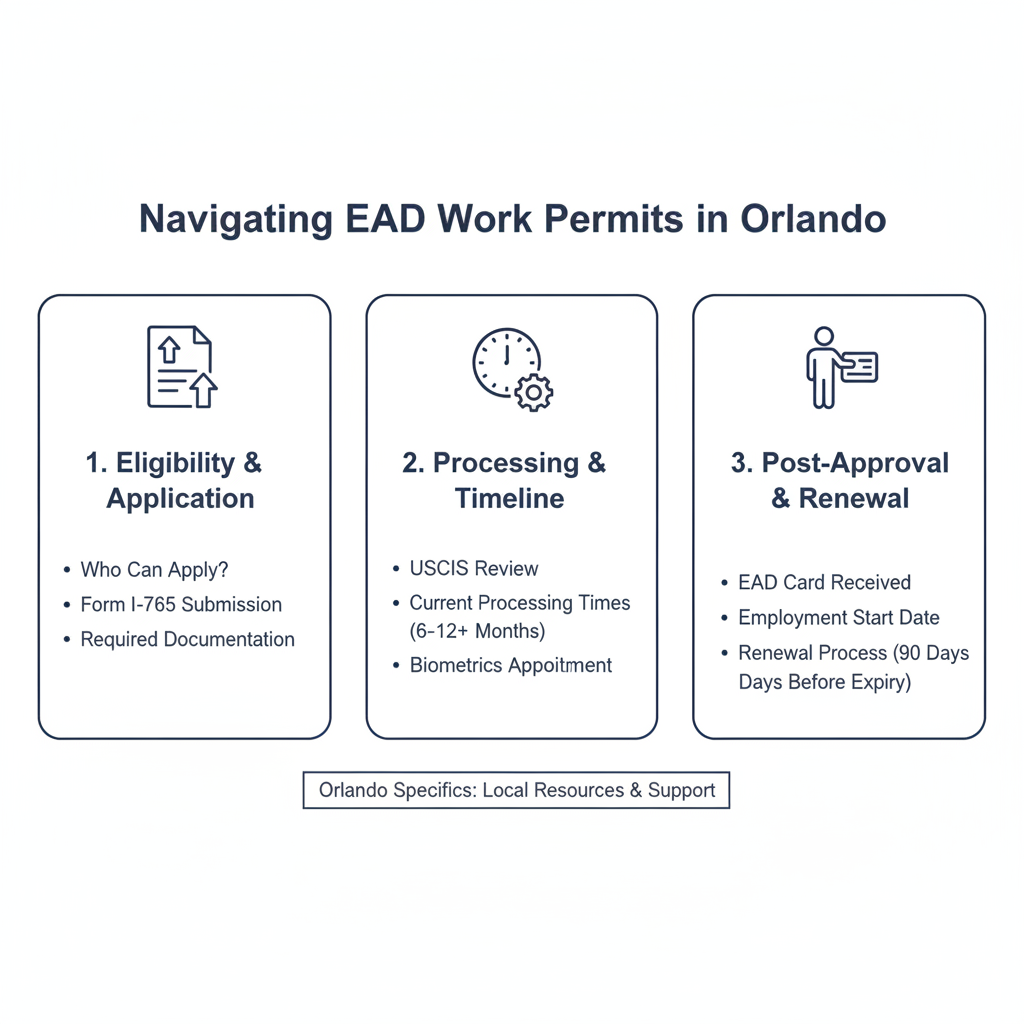
Our commitment to keeping families together means staying ahead of the curve on all immigration developments. The information and guidance in this comprehensive article are inspired by recent discussions and announcements from USCIS regarding EAD processing, highlighted by news sources:
Employment Authorization Document Processing (USCIS)
What This News Means for Immigrants in Orlando and Across Florida
For individuals and families in Orlando and throughout Florida, news about Employment Authorization Document (EAD) processing is always significant. An EAD is more than just a piece of paper; it represents the ability to work legally, support a family, pursue a career, and contribute to the local economy. Changes in how USCIS processes these vital documents can profoundly impact daily lives and long-term planning.
Why this news is showing up now
The current focus on EAD processing stems from a combination of factors that have been evolving over the past few years, leading to a concerted effort by USCIS to address efficiency and backlogs. Here’s why this news is particularly relevant today in mid-2026:
- Persistent Backlogs and USCIS Initiatives: Despite previous efforts, USCIS has continued to grapple with significant backlogs in various application types, including Form I-765, Application for Employment Authorization. This has prompted ongoing internal reviews and public announcements of new strategies aimed at reducing processing times.
- Temporary Final Rules and Policy Adjustments: In response to the backlogs and labor market demands, USCIS has implemented (and continues to evaluate and adjust) temporary final rules (TFRs) and policy memoranda. These often include provisions for extended automatic extensions for certain EAD categories, or the prioritization of specific categories of applications (e.g., healthcare workers, asylum seekers, or those whose underlying green card applications are nearing approval).
- Technological Advancements and Online Filing: USCIS is continually expanding its online filing capabilities and digital processing initiatives. Updates often include announcements about which EAD categories are now eligible for online filing, or improvements to the online case status tools, all aimed at improving efficiency.
- Impact of Economic and Social Factors: Global events, economic shifts, and ongoing humanitarian crises continue to influence migration patterns and the volume of applications. USCIS must adapt its processing capacities to these fluctuating demands.
- Stakeholder Advocacy: Immigration advocates, legal professionals, and community organizations, including firms like Imigrar, consistently highlight the need for faster EAD processing. This sustained advocacy often prompts USCIS to release updates and commit to new timelines.
These ongoing developments mean that the rules and expectations around EADs are not static. It’s crucial for applicants and their families to stay informed about the most current policies and procedures.
How it can affect Florida residents
Florida, with its diverse population and thriving economy, is home to a significant number of immigrants who rely on EADs. The impact of USCIS EAD processing updates on Florida residents can be felt in several key areas:
- Employment Opportunities: Faster EAD processing means eligible individuals can enter or re-enter the workforce more quickly, contributing their skills to Florida’s economy, whether in Orlando’s burgeoning tech and tourism sectors, or agricultural industries across the state. Delays, conversely, lead to job loss, financial hardship, and stress.
- Economic Stability for Families: For many families in Orange County and surrounding areas, an EAD allows the primary earner (or even a secondary earner) to secure stable employment, pay bills, and avoid relying on public assistance. Timely processing ensures this stability.
- Local Business and Labor Market: Florida businesses, from small enterprises to large corporations, depend on a reliable workforce. Expedited EADs help fill critical labor gaps, particularly in industries experiencing worker shortages.
- Planning and Uncertainty: For those awaiting EADs or renewals, long processing times create immense uncertainty. This impacts everything from signing a lease to planning for education or healthcare. Updates that provide clearer timelines or faster processing bring much-needed relief.
- Orlando USCIS Field Office: While many EAD applications are processed at USCIS service centers, local field offices like the one in Orlando may handle certain aspects, such as biometrics appointments or interviews related to underlying immigration benefits (like Adjustment of Status) that concurrently provide EAD eligibility. Efficiency at all levels of USCIS directly affects Central Florida residents.
At Imigrar, we are acutely aware of these local impacts. Our mission to "Keep Families Together" is directly tied to ensuring our clients can work legally and provide for their loved ones without undue delay. Understanding these national changes and their local ramifications is why our Orlando immigration team remains vigilant and proactive.
What Employment Authorization Documents (EADs) Are (and Why They Matter)
An Employment Authorization Document, commonly known as an EAD or a work permit, is a plastic card issued by U.S. Citizenship and Immigration Services (USCIS) that provides temporary authorization for certain foreign nationals to work legally in the United States. It's a crucial document that allows individuals who are not U.S. citizens or lawful permanent residents (green card holders) to be lawfully employed in the U.S. for a specified period.
A plain-English definition
Think of an EAD as your official permission slip from the U.S. government to get a job. If you're not a U.S. citizen or don't already have a green card, but you're in the U.S. under certain circumstances (like waiting for your green card, seeking asylum, or holding a specific type of visa), an EAD is what allows you to legally earn a living. It proves to employers that you are authorized to work and helps you secure employment to support yourself and your family.
Key terms you need to know
Navigating the EAD process requires understanding several key terms:
- Employment Authorization Document (EAD): The official name for the work permit card.
- USCIS (U.S. Citizenship and Immigration Services): The government agency responsible for processing immigration applications, including EADs. USCIS official website
- Form I-765, Application for Employment Authorization: The specific application form you must file with USCIS to request an EAD.
- EAD Categories: Specific classifications that determine eligibility for an EAD. These are denoted by codes (e.g., (c)(9) for Adjustment of Status applicants, (c)(8) for asylum applicants, (a)(12) for Temporary Protected Status).
- Adjustment of Status (AOS): The process of applying for a green card (lawful permanent residency) while physically present in the United States. Applicants often file Form I-765 concurrently with Form I-485, Application to Register Permanent Residence or Adjust Status.
- Nonimmigrant Visa Holder: An individual admitted to the U.S. for a specific purpose and a temporary period (e.g., H-1B, L-1, F-1 student). Some nonimmigrant visa holders (like spouses of H-1B or L-1 visa holders, or certain F-1 students with Optional Practical Training) may be eligible for EADs.
- Asylum Seeker: An individual who has applied for asylum in the U.S. and is awaiting a decision on their case. Asylum applicants are generally eligible for an EAD 180 days after filing their asylum application.
- Refugee: An individual who has been granted refugee status in the U.S. Refugees are automatically authorized to work and receive an EAD upon admission.
- Temporary Protected Status (TPS): A temporary immigration status granted to eligible nationals of certain countries designated by the Secretary of Homeland Security due to conditions in the country that prevent their safe return. TPS holders are eligible for EADs.
- DACA (Deferred Action for Childhood Arrivals): A program that allows certain undocumented immigrants who entered the U.S. as children to receive a renewable two-year period of deferred action from deportation and eligibility for an EAD.
- Automatic Extension: A policy that allows certain EAD renewals to remain valid for an extended period (currently up to 540 days for many categories) beyond their expiration date, provided the renewal application was filed on time. This is critical for preventing gaps in employment authorization.
- Request for Evidence (RFE): A notice from USCIS requesting additional documents or information to support your application.
Understanding these terms is the first step toward successfully navigating the EAD application or renewal process. The ability to work legally provides not only financial stability but also a sense of purpose and integration into American society. For families striving to build a future in Orlando or anywhere in Florida, the EAD is truly a cornerstone of their journey.
Current Immigration Law: The Foundation for Work Authorization
The authority for the U.S. government to grant employment authorization to non-citizens is rooted in the Immigration and Nationality Act (INA), specifically various sections that define eligibility categories. While the INA sets the broad framework, U.S. Citizenship and Immigration Services (USCIS) implements these laws through regulations, policy memoranda, and forms.
Federal requirements
Under federal immigration law, not every non-citizen is eligible for an EAD. Eligibility is strictly limited to specific categories defined in the regulations. The primary form used to apply for an EAD is Form I-765, Application for Employment Authorization.
Key federal requirements and eligibility categories include:
- Applicants for Adjustment of Status (Green Card): Individuals who have filed Form I-485, Application to Register Permanent Residence or Adjust Status, are generally eligible to apply for an EAD concurrently. They fall under category (c)(9). This is one of the most common pathways to an EAD for those seeking lawful permanent residency.
- Asylum Seekers and Asylees: Individuals who have filed Form I-589, Application for Asylum and for Withholding of Removal, are eligible for an EAD 180 days after their application is filed (category (c)(8)). Those granted asylum (asylees) are automatically work-authorized and can apply for an EAD under category (a)(5).
- Refugees: Individuals granted refugee status are authorized to work immediately upon admission to the U.S. and can apply for an EAD under category (a)(3).
- Temporary Protected Status (TPS) Holders: Individuals granted TPS are eligible for an EAD under category (a)(12) or (c)(19).
- Certain Nonimmigrant Visa Holders and Dependents:
- Spouses of E-1/E-2 treaty traders/investors (category (a)(17) or (a)(18)).
- Spouses of L-1 intracompany transferees (category (a)(18)).
- Spouses of H-1B skilled workers (H-4 dependents), if the H-1B principal has an approved Form I-140, Immigrant Petition for Alien Worker, or has been granted an H-1B extension beyond the six-year limit (category (c)(26)).
- Certain F-1 students with Optional Practical Training (OPT) or STEM OPT extensions (categories (c)(3)(A), (c)(3)(B), (c)(3)(C)).
- DACA Recipients: Individuals granted Deferred Action for Childhood Arrivals (DACA) are eligible for an EAD under category (c)(33).
- Other Specific Categories: The list is extensive and includes parolees, individuals with withholding of removal, certain victims of trafficking (T visa) and crime (U visa), and others.
It is crucial to correctly identify your eligibility category when filing Form I-765, as an incorrect selection can lead to delays or denial. For the most up-to-date information and to download forms, always refer to the USCIS official website.
Florida-specific considerations
While immigration law, including EAD eligibility and processing, is federal, there are practical considerations for Florida residents:
- Employer Verification (E-Verify): Many employers in Florida, particularly those with government contracts or a certain number of employees, are required to use E-Verify, an internet-based system that allows businesses to determine the eligibility of their employees to work in the United States. A valid EAD is essential for passing E-Verify checks.
- Orlando USCIS Field Office: While EAD applications are primarily processed at USCIS Service Centers, the Orlando USCIS Field Office may handle related matters for Central Florida residents, such as biometrics appointments or interviews for the underlying immigration benefit (like Adjustment of Status) that makes you eligible for an EAD.
- Local Economic Impact: The ability to work legally in Florida directly impacts the state’s economy. Immigrants with EADs contribute to various sectors, from tourism in Orlando to agriculture across the state, enriching our communities and tax base.
- Access to Legal Services: Given the complexities, having access to experienced immigration attorneys in Orlando, like Imigrar, is vital for Florida residents to ensure their EAD applications are filed correctly and efficiently, minimizing delays.
Understanding these foundational legal requirements and local nuances is essential for anyone seeking or renewing an EAD in Florida. Imigrar is dedicated to guiding you through this intricate legal framework.
Confused about EAD eligibility or the application process? Don't risk delays or denials. Contact Imigrar for expert guidance. Call +1 786-791-3106 today for a free consultation. Se Habla Español.

How to Apply for or Renew Your EAD: A Complete Step-by-Step Guide
Applying for or renewing your Employment Authorization Document (EAD) is a critical process that requires careful attention to detail. Follow this comprehensive guide to ensure your application is complete and accurate.
1) Determine Your Eligibility and Category
Before doing anything else, you must confirm that you are eligible for an EAD and identify the correct eligibility category. This is paramount, as filing under the wrong category will lead to denial. Review the instructions for Form I-765 carefully.
- Review Eligibility Criteria: Your eligibility for an EAD is tied to your underlying immigration status or application. For example:
- If you have a pending Form I-485 (Adjustment of Status), you are likely eligible under category (c)(9).
- If you have a pending Form I-589 (Asylum), you are likely eligible under category (c)(8) after 180 days.
- If you are an H-4 spouse of an H-1B who meets certain criteria, you might be eligible under category (c)(26).
- If you are a DACA recipient, your category is (c)(33).
- Consult Official USCIS Resources: Always refer to the USCIS website for the most current eligibility information and category definitions.
- Seek Legal Advice: If you are unsure about your eligibility or the correct category, consult with an experienced immigration attorney like those at Imigrar.
2) Gather Required Documents and Information
The documents you need will vary slightly based on your eligibility category, but a core set of documents is almost always required. Start collecting these well in advance.
- Mandatory Documents for All Applicants:
- Two identical, passport-style photos (taken within 30 days of filing).
- Copy of a government-issued identity document with your photograph (e.g., passport ID page, birth certificate with photo ID, national ID from your country).
- Copy of your last EAD (front and back), if renewing.
- Copy of Form I-94, Arrival/Departure Record (front and back if paper, or printout from CBP website).
- Copy of any previous EADs.
- Copies of all previous U.S. visas.
- Category-Specific Documents (Examples):
- For AOS (c)(9): Copy of Form I-797C, Notice of Action, for your pending Form I-485.
- For Asylum (c)(8): Copy of Form I-797C for your pending Form I-589 and proof that it has been pending for at least 180 days.
- For H-4 (c)(26): Copy of your spouse’s H-1B approval notice (Form I-797), copy of your marriage certificate, and evidence that your H-1B spouse meets the criteria (e.g., approved Form I-140 or H-1B extension beyond 6 years).
- For DACA (c)(33): Copy of your previous DACA approval notice.
- Proof of Relationship/Status: Marriage certificates, birth certificates, court orders, or other documents demonstrating your relationship to a principal applicant or your current immigration status.
Reminder: Make clear, legible copies of all documents. Do NOT send original documents unless specifically requested by USCIS.
3) Complete Form I-765, Application for Employment Authorization
This is the core of your application. Accuracy and completeness are crucial.
- Download the Latest Version: Always download Form I-765 directly from the USCIS Forms page to ensure you are using the most current edition.
- Read Instructions Carefully: The instructions booklet provides detailed guidance for each section and eligibility category.
- Fill Out Completely: Answer every question truthfully and accurately. If a question does not apply, write "N/A" (not applicable) or "None." Do not leave blanks.
- Enter Correct Category: Double-check that you have entered the correct eligibility category (e.g., (c)(9), (c)(8), (c)(26)) in Part 2, Item 27.
- Sign the Form: An unsigned form will be rejected. Sign and date in Part 5. If an attorney is assisting, they will complete Part 6.
- Consider Online Filing: For certain categories, USCIS offers online filing for Form I-765. This can sometimes be faster and reduces common errors. Check the USCIS website to see if your category is eligible for online submission.
4) Prepare Your Application Package and Pay Fees
Once your form is complete and documents are gathered, prepare your package for submission.
- Calculate the Filing Fee: The filing fee for Form I-765 is subject to change. As of the time of this writing, it is typically $410, but always verify the current fee on the USCIS Fee Schedule page or the form instructions.
- Payment Methods: You can pay by money order, personal check, cashier’s check, or credit card (using Form G-1450, Authorization for Credit Card Transactions). Make checks payable to "U.S. Department of Homeland Security."
- Fee Waivers: Certain applicants may be eligible for a fee waiver if they can demonstrate inability to pay. File Form I-912, Request for Fee Waiver, if applicable.
- Assemble Your Package: Organize your documents in the order specified in the Form I-765 instructions or as recommended by your attorney. Generally, this means:
- Payment (check/money order or Form G-1450)
- Form I-765
- Supporting documents (photos, ID, I-94, previous EAD, status documentation)
- Make Copies: Make a complete copy of the entire application package for your records before mailing.
5) File Your Application with USCIS
Where you send your application depends on your eligibility category and whether you are filing other forms concurrently.
- Direct Filing Addresses: USCIS has specific "direct filing addresses" based on the form you are filing and your eligibility category. Check the "Where to File" section of the Form I-765 instructions or the USCIS Direct Filing Addresses page.
- Important: If you are filing Form I-765 concurrently with another application, such as Form I-485, you typically send both to the filing address for the primary application (e.g., Form I-485).
- Online Filing: If eligible, submitting online can be more secure and


