


The dream of reuniting with loved ones is a powerful motivator for many individuals navigating the U.S. immigration system. Family-based immigration petitions are the cornerstone of this dream, offering a structured pathway for U.S. citizens and Lawful Permanent Residents (LPRs) to bring eligible family members to the United States. However, the process is often intricate, filled with specific requirements, forms, and waiting periods that can be daunting without expert guidance.
At Imigrar, an immigration law firm based in Orlando, Florida, we understand the profound importance of keeping families together. Our mission is to demystify this journey, providing clear, actionable advice to help you successfully navigate the complexities of family-based petitions. This comprehensive guide, informed by the latest immigration trends and legal frameworks, aims to be your trusted resource.
The reporting that sparked this guide:
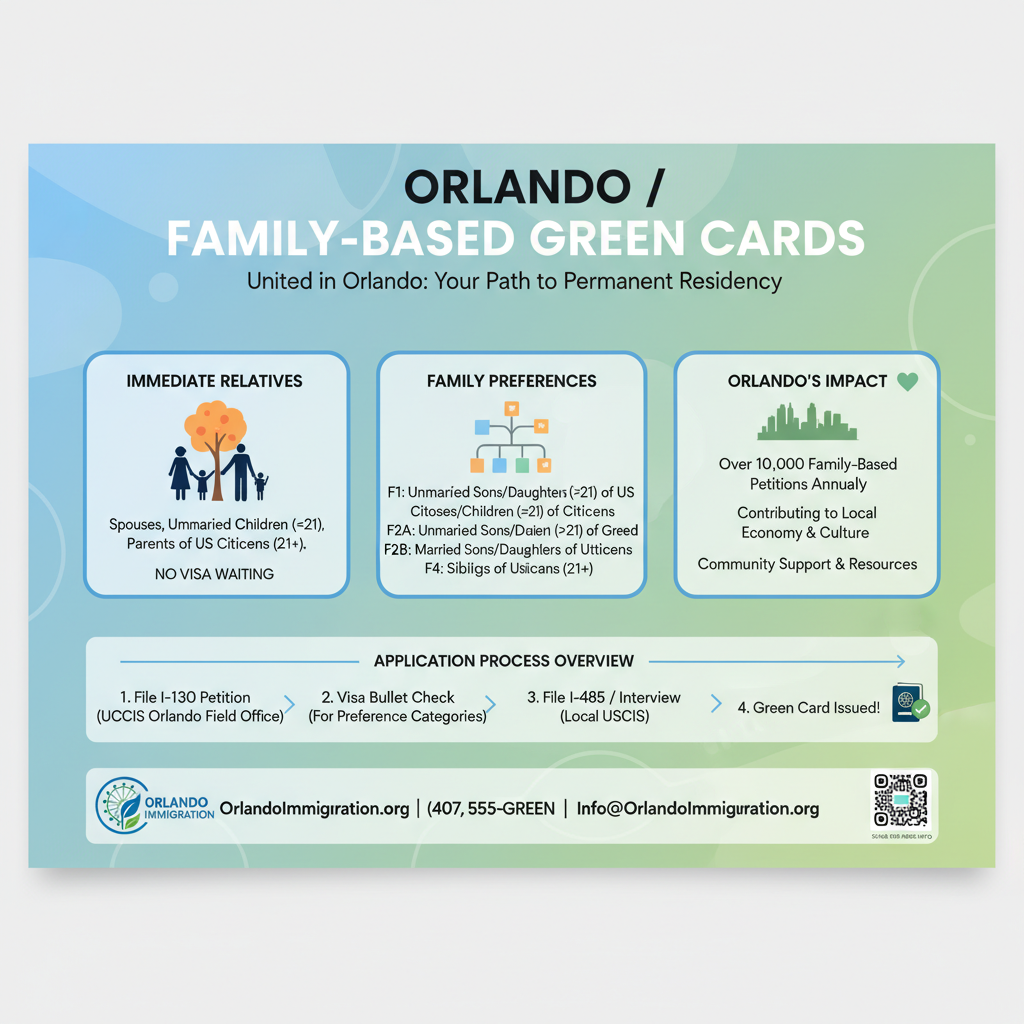
Family-Based Immigration Petition Guide (Immigration)
What This News Means for Immigrants in Orlando and Across Florida
As of 2026-05-27, the landscape of U.S. immigration law continues to evolve, yet the fundamental principles of family-based immigration remain a constant. The ongoing discussion and occasional policy shifts around immigration often highlight the need for clarity and reliable information regarding established legal pathways. For families in Orlando and throughout Florida, understanding these processes is not just beneficial—it's essential.
Why this news is showing up now
Family-based immigration is a foundational pillar of U.S. immigration policy, consistently drawing attention due to its direct impact on countless lives. News about family petitions frequently arises from several factors:
- Processing Backlogs and Times: USCIS and the U.S. Department of State continually update processing times, and any significant changes or persistent backlogs often become news. These updates directly affect how long families must wait to be reunited.
- Policy Discussions: While the core laws for family petitions are stable, there are always ongoing debates and potential legislative proposals that could impact aspects like visa quotas, eligibility criteria, or financial sponsorship requirements.
- Increased Demand: The consistent desire for family reunification means that family petitions are always a high-volume area for immigration agencies, making their procedures and efficiency a recurring topic of interest.
- Guidance Updates: USCIS regularly refines its forms, instructions, and policies. When these updates occur, it's crucial for the public to be informed, prompting guides like this one to clarify the latest requirements.
How it can affect Florida residents
Florida is home to one of the largest and most diverse immigrant populations in the United States. For residents of Orlando and the wider Central Florida region, understanding family-based immigration is particularly pertinent:
- High Demand in the State: With vibrant immigrant communities across cities like Orlando, Miami, and Tampa, Florida sees a significant number of family-based petitions filed annually. This high volume can sometimes contribute to localized processing times at state-specific USCIS field offices.
- Access to Resources: Florida has multiple USCIS Field Offices (including one in Orlando) and immigration courts. This means many adjustment of status interviews or other crucial appointments for Florida residents will occur within the state, making local legal representation invaluable.
- Diverse Communities: Our state is a melting pot, with large populations from Latin America, the Caribbean, and other global regions. Family-based immigration provides critical pathways for these communities to grow and thrive, aligning with Imigrar's mission to "Keep Families Together."
- Local Legal Expertise: The complexities of immigration law, combined with specific local procedures (e.g., at the Orlando USCIS Field Office), underscore the importance of consulting with an Orlando-based immigration attorney who understands both federal law and local practicalities.
Need Help? Our Orlando immigration team is ready to assist. Navigating family petitions can be overwhelming, but you don't have to do it alone. Call +1 786-791-3106 for a free consultation, or message us online. Se Habla Español.
What Family-Based Immigration Petitions Are (and Why It Matters)
At its heart, U.S. immigration law prioritizes family unity. Family-based immigration petitions are the legal mechanism designed to allow eligible U.S. citizens and Lawful Permanent Residents (LPRs) to sponsor certain family members for permanent residency, commonly known as a green card.
A plain-English definition
Simply put, a family-based immigration petition is a formal request filed with U.S. Citizenship and Immigration Services (USCIS) by a U.S. citizen or LPR (the "petitioner") on behalf of a qualifying relative (the "beneficiary") to establish a legal family relationship. This petition is the first step toward that relative obtaining a green card, which grants them the right to live and work permanently in the United States.
This process is crucial because it embodies the principle of family reunification, allowing families to live together and contribute to American society, strengthening communities like those here in Orlando and throughout Florida. It's about more than just paperwork; it's about upholding the human right to be with loved ones.
Key terms you need to know
Understanding the jargon is vital for navigating this process. Here are some essential terms:
- Petitioner: The U.S. citizen or Lawful Permanent Resident who files the immigration petition for their relative.
- Beneficiary: The foreign national family member for whom the petition is filed, seeking a green card.
- Form I-130, Petition for Alien Relative: The initial form filed by the petitioner to establish the qualifying relationship between the petitioner and the beneficiary. This is the cornerstone of almost all family-based green card cases.
- Green Card: Official document (Form I-551) evidencing Lawful Permanent Resident status, granting permanent authorization to live and work in the U.S.
- Adjustment of Status (AOS): The process for eligible beneficiaries who are already physically present in the United States to apply for their green card without leaving the country. This typically involves filing Form I-485.
- Consular Processing: The process for beneficiaries who are outside the United States to obtain an immigrant visa at a U.S. embassy or consulate in their home country. Once they enter the U.S. with this visa, they become a Lawful Permanent Resident.
- Priority Date: The date USCIS officially receives your properly filed Form I-130. This date is critical for "preference categories" as it determines the beneficiary's place in line for an available visa.
- Visa Bulletin: A monthly publication by the U.S. Department of State that lists the "cut-off dates" for immigrant visas in the family-sponsored and employment-based preference categories. A visa becomes available when a beneficiary's priority date is "current" according to the Visa Bulletin. You can find the latest bulletin at U.S. Department of State.
- Immediate Relatives: This special category includes spouses of U.S. citizens, unmarried children under 21 of U.S. citizens, and parents of U.S. citizens (if the citizen is 21 or older). There are no annual visa limits for Immediate Relatives, meaning they do not typically have to wait for a priority date to become current.
- Preference Categories: All other family-sponsored relationships fall into preference categories (F1, F2A, F2B, F3, F4) which have annual visa quotas and often involve significant waiting periods based on the priority date and country of chargeability.
- Affidavit of Support (Form I-864): A legally binding contract signed by the petitioner (and sometimes a joint sponsor) to accept financial responsibility for the beneficiary, ensuring they do not become a "public charge."
Current Immigration Law: The Foundation
The legal framework for family-based immigration is primarily established under the Immigration and Nationality Act (INA), particularly sections 201, 203, and 204. These statutes define who can petition, for whom, and under what conditions. Understanding these foundational laws is crucial for navigating the process successfully.
Federal requirements
The INA distinguishes between two main categories of family relationships for immigration purposes:
- Immediate Relatives of U.S. Citizens:
- Spouses of U.S. citizens.
- Unmarried children under 21 years of age of U.S. citizens.
- Parents of U.S. citizens (if the U.S. citizen petitioner is 21 years of age or older).
Key Feature: There are no numerical limits (visa quotas) for Immediate Relatives, meaning they do not have to wait for a visa to become available based on a priority date. Their process is generally faster once the Form I-130 is approved.
- Family Preference Categories: These categories are subject to annual numerical limits and often involve waiting periods.
- First Preference (F1): Unmarried sons and daughters (21 years of age or older) of U.S. citizens.
- Second Preference (F2A): Spouses and children (unmarried, under 21) of Lawful Permanent Residents (LPRs).
- Second Preference (F2B): Unmarried sons and daughters (21 years of age or older) of LPRs.
- Third Preference (F3): Married sons and daughters of U.S. citizens.
- Fourth Preference (F4): Brothers and sisters of U.S. citizens (if the U.S. citizen petitioner is 21 years of age or older).
Key Feature: Beneficiaries in these categories must wait for their Priority Date to become current in the Visa Bulletin before they can apply for their green card.
Beyond the relationship, federal law also requires:
- Admissibility: Beneficiaries must be admissible to the U.S., meaning they cannot have certain criminal records, immigration violations, health issues, or be deemed a national security risk. Waivers may be available for some grounds of inadmissibility.
- Financial Sponsorship: The petitioner must file Form I-864, Affidavit of Support, demonstrating they can financially support the beneficiary(ies) at a level at or above 125% of the federal poverty guidelines for their household size. If the petitioner's income is insufficient, a joint sponsor may be required. This is a crucial step to prevent beneficiaries from becoming a public charge.
- Proper Documentation: All petitions and applications must be accompanied by comprehensive supporting documentation to prove the asserted relationship, financial capability, and eligibility.
Official forms frequently used in this process include Form I-130, Form I-485, Form I-864, Form I-765 (Application for Employment Authorization), and Form I-131 (Application for Travel Document, often known as Advance Parole). You can find all official forms and instructions on the USCIS Forms page.
Florida-specific considerations
While immigration law is federal, the practical application often has local nuances. For those in Orlando and Central Florida:
- Orlando USCIS Field Office: If your beneficiary is adjusting status within the U.S., their interview will likely be scheduled at the Orlando USCIS Field Office. Understanding the local office's procedures and common interview styles can be beneficial. Our team at Imigrar is highly familiar with this office.
- Medical Examinations: For adjustment of status, a medical examination (Form I-693) must be completed by a USCIS-approved civil surgeon. There are numerous approved civil surgeons throughout the Orlando and Orange County area.
- Immigration Courts: In cases where a beneficiary may have prior immigration violations or is in removal proceedings, the presence of immigration courts in Orlando and Miami means local legal counsel is crucial to navigate complex waivers or defense strategies with the Executive Office for Immigration Review (EOIR).
- Community Support: Florida's extensive network of immigrant communities often provides informal support, but for legal matters, always rely on licensed attorneys.

How to File a Family-Based Immigration Petition: A Complete Step-by-Step Guide
Filing a family-based immigration petition is a multi-stage process that requires meticulous attention to detail. This guide outlines the typical steps involved, whether your family member is applying from within the U.S. (Adjustment of Status) or from abroad (Consular Processing).
1) Determine Eligibility and Category
Before any forms are filed, you must clearly establish who can petition for whom and under what category. This is the most critical first step, as it dictates the forms, required documents, and potential timelines.
- Who is the Petitioner? Are you a U.S. Citizen or a Lawful Permanent Resident (LPR)? Your status determines which relatives you can sponsor.
- U.S. Citizens can sponsor: Spouses, unmarried children under 21 (Immediate Relatives); unmarried sons/daughters over 21, married sons/daughters, and siblings (Preference Categories).
- LPRs can sponsor: Spouses and unmarried children (under or over 21) (Preference Categories F2A and F2B).
- What is the Relationship? Clearly define the exact relationship (e.g., biological child, stepchild, adopted child, spouse). USCIS has strict definitions for these relationships.
- Immediate Relative vs. Preference Category: This distinction is paramount for understanding waiting times. Immediate Relatives of U.S. citizens (spouses, unmarried children under 21, parents) have visas immediately available. All other categories are subject to annual quotas and waiting lists, as indicated by the Visa Bulletin.
Required Information/Documents for Step 1:
- Proof of Petitioner's U.S. Citizenship (e.g., U.S. birth certificate, naturalization certificate, U.S. passport) or LPR status (e.g., green card - Form I-551).
- Information about the Beneficiary (full legal name, date of birth, country of birth, current address).
- Basic documentation to establish the relationship (e.g., birth certificate for parent-child, marriage certificate for spouse).
2) File Form I-130, Petition for Alien Relative
This is the foundational step. The purpose of Form I-130 is for the petitioner to legally establish a qualifying family relationship with the beneficiary. This form, along with supporting documentation, is filed with USCIS.
- Complete Form I-130 Accurately: Fill out every section completely and truthfully. Missing information or errors can lead to delays or Requests for Evidence (RFEs).
- Gather Supporting Documents: The type of documents depends on the relationship.
- For Spouses: Marriage certificate, proof of termination of prior marriages (divorce decrees, death certificates), passport-style photos of both petitioner and beneficiary, and extensive evidence of a bona fide marriage (e.g., joint bank statements, joint leases/mortgages, utility bills in both names, insurance policies, photos together, affidavits from friends/family, birth certificates of any children


