

Date: 2026-07-30
At Imigrar, we understand that keeping families together is not just our tagline—it's our mission. For countless individuals and families in Orlando, across Florida, and nationwide, the dream of uniting with loved ones in the United States is a profound and often complex journey. Family-based immigration petitions are the cornerstone of this dream, offering a pathway to permanent residency for eligible relatives of U.S. citizens and lawful permanent residents.
Need Help? Our Orlando immigration team is ready to assist. Call +1 786-791-3106 for a free consultation, or message us online. Se Habla Español.
The reporting that sparked this guide
Recent discussions and ongoing public interest in immigration law have brought the topic of family-based petitions to the forefront, as highlighted by continuous reporting on Family-Based Immigration Petition Guide (Immigration). These reports underscore the perpetual relevance and critical importance of understanding the mechanisms that allow families to reunite and build new lives together in the United States.
What This News Means for Immigrants in Orlando and Across Florida
Why this news is showing up now
Family-based immigration is not a new concept; it has been a fundamental pillar of U.S. immigration policy for decades. The reason it continues to be a trending topic, year after year, is simple: it affects millions of lives. Every day, families seek to navigate the intricate legal framework to bring their loved ones to the U.S. or adjust their status here. Changes in processing times, policy nuances, and the sheer volume of applications mean that the process is constantly evolving, making up-to-date guidance invaluable. This consistent need for information ensures that topics like family petitions remain evergreen in immigration news cycles.
How it can affect Florida residents
Florida, and particularly Central Florida, is a vibrant hub for diverse immigrant communities. For residents of Orlando, Kissimmee, Sanford, and throughout Orange County and the I-4 corridor, family reunification is a deeply personal and often urgent matter. The implications of family-based immigration policies directly impact their ability to live, work, and thrive alongside their relatives. Understanding the requirements and procedures is critical for:
- Planning Futures: Families can make informed decisions about their long-term residency, educational pursuits, and career paths.
- Avoiding Pitfalls: Knowledge helps prevent common mistakes that can lead to delays or denials, saving significant time, money, and emotional distress.
- Accessing Opportunities: A clear path to legal status opens doors to employment, education, healthcare, and full participation in society.
- Local Impact: The success of family petitions contributes to the social and economic fabric of Florida's communities, including the Orlando metropolitan area, by fostering stable households and contributing to the local economy.
For Central Florida residents, staying informed about these processes means taking proactive steps toward securing their family's future, right here in the Sunshine State.
What Family-Based Immigration Petitions Are (and Why They Matter)
A plain-English definition
At its core, a family-based immigration petition is a formal request filed with U.S. Citizenship and Immigration Services (USCIS) by a U.S. citizen or a lawful permanent resident (Green Card holder) to sponsor certain eligible family members for a Green Card. This process is designed to allow families to reunite in the United States, granting the sponsored relative permanent residency, which means they can live, work, and study in the U.S. indefinitely.
Key terms you need to know
Navigating immigration law requires understanding specific terminology. Here are some essential terms related to family petitions:
- Petitioner: The U.S. citizen or lawful permanent resident who files the immigration petition for their relative.
- Beneficiary: The foreign national family member for whom the petition is filed.
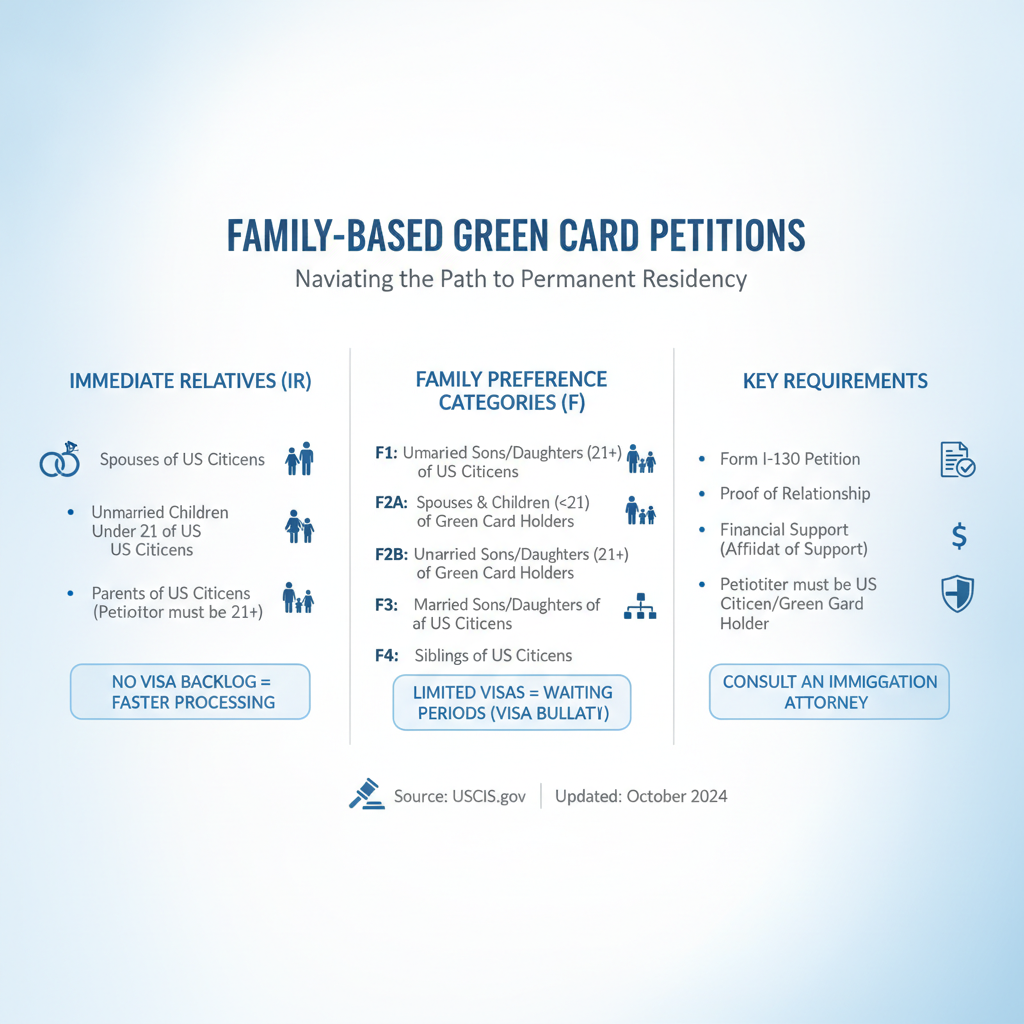
- Immediate Relatives: This is a highly favorable category that includes spouses of U.S. citizens, unmarried children under 21 of U.S. citizens, and parents of U.S. citizens (if the U.S. citizen is 21 or older). There are an unlimited number of visas available for Immediate Relatives, meaning they do not have to wait for a visa number to become available based on an annual quota.
- Family Preference Categories: Other family relationships fall into these categories, which are subject to annual visa quotas and often involve longer waiting periods. These include:
- First Preference (F1): Unmarried sons and daughters (21 years of age or older) of U.S. citizens.
- Second Preference (F2A): Spouses and children (unmarried and under 21) of lawful permanent residents.
- Second Preference (F2B): Unmarried sons and daughters (21 years of age or older) of lawful permanent residents.
- Third Preference (F3): Married sons and daughters of U.S. citizens.
- Fourth Preference (F4): Brothers and sisters of U.S. citizens (if the U.S. citizen is 21 or older).
- Priority Date: This is the date USCIS officially receives your Form I-130 petition. For Family Preference Categories, this date determines your place in the waiting line for a visa number.
- Visa Bulletin: A monthly publication by the U.S. Department of State that provides updated information on visa availability for different preference categories and countries. It indicates which Priority Dates are current, meaning a visa number is available for those applicants. You can check the U.S. Department of State Visa Bulletin.
- Adjustment of Status (AOS): The process by which an eligible foreign national already present in the U.S. can apply for a Green Card without having to leave the country. This typically involves filing Form I-485.
- Consular Processing: The process by which an eligible foreign national living outside the U.S. applies for an immigrant visa at a U.S. embassy or consulate in their home country. Once approved, they enter the U.S. as a lawful permanent resident.
- Affidavit of Support (Form I-864): A legally binding document filed by the petitioner (sponsor) to show they can financially support the intending immigrant(s) and that the immigrant will not become a public charge.
Understanding these terms is the first step toward successfully navigating the family-based immigration process. It clarifies who can petition for whom, the potential waiting times, and the two main pathways to obtaining a Green Card.
Current Immigration Law: The Foundation
The framework for family-based immigration is primarily established under the Immigration and Nationality Act (INA), specifically sections 201, 203, and 204. These sections define who can be sponsored, the categories of relatives, and the annual limits on immigrant visas.
Federal requirements
Federal law dictates the core requirements for all family-based petitions:
- Eligible Relationship: The petitioner and beneficiary must prove a qualifying family relationship (e.g., spouse, parent, child, sibling) as defined by the INA. This is a strict requirement, and only certain relationships are recognized.
- Petitioner's Status: The petitioner must be either a U.S. citizen or a lawful permanent resident (Green Card holder).
- Financial Sponsorship: The petitioner must demonstrate the financial ability to support the beneficiary at 125% of the federal poverty guidelines by filing Form I-864, Affidavit of Support. This ensures the immigrant will not become a "public charge." If the petitioner's income is insufficient, a joint sponsor may be required.
- Admissibility: The beneficiary must be admissible to the U.S., meaning they must not have any grounds of inadmissibility, such as certain criminal convictions, past immigration violations, or health-related issues. Waivers may be available in some cases.
- Proper Documentation: All required forms and supporting documents must be accurately completed and submitted to USCIS.
The primary form for initiating a family-based petition is Form I-130, Petition for Alien Relative. This form establishes the qualifying relationship between the petitioner and the beneficiary. For beneficiaries already in the U.S. who are eligible to adjust their status, Form I-485, Application to Register Permanent Residence or Adjust Status, is crucial. You can find all official forms and detailed instructions on the USCIS official website.
Florida-specific considerations
While immigration law is federal, certain aspects touch upon state-level considerations for Florida residents:
- Local USCIS Field Office: If your case involves an Adjustment of Status interview, it will likely be conducted at the Orlando USCIS Field Office, located at 6650 Tussing Rd, Orlando, FL 32807. Preparing for this interview is crucial, and having local legal representation can be invaluable.
- State ID and Driver's Licenses: Once a Green Card is obtained, Florida residents can apply for a Florida driver's license or state identification card through the Florida Department of Highway Safety and Motor Vehicles (FLHSMV).
- Community Resources: Orlando and Central Florida offer a wealth of community resources and support networks for immigrants, which can be helpful during the process.
- Notary Public Services: Many documents require notarization, and access to notary services is widely available throughout Orange County and the greater Orlando area.
Reminder: While some state-specific resources exist, the vast majority of family-based immigration requirements and processes are governed by federal law and USCIS regulations. Consulting with an experienced Orlando immigration attorney is vital to ensure compliance with all federal and local nuances.
Need Help? Our Orlando immigration team is ready to assist. Call +1 786-791-3106 for a free consultation, or message us online. Se Habla Español.
How to Secure Your Family's Future: A Complete Step-by-Step Guide to Family Petitions
The family-based immigration process can seem daunting, but breaking it down into manageable steps makes it clearer. Here's a detailed guide:
1) Determine Eligibility and Gather Initial Documents
Before filing anything, confirm that your relationship qualifies and that the petitioner meets the requirements. This involves identifying whether the beneficiary falls under the "Immediate Relative" or a "Family Preference" category, as this significantly impacts processing times.
- Required Documents for Eligibility Assessment:
- Petitioner's proof of U.S. citizenship (U.S. birth certificate, passport, naturalization certificate) or Green Card (Form I-551).
- Proof of relationship (e.g., marriage certificate for spouses, birth certificates for parent-child relationships).
- Any previous divorce decrees or death certificates for prior marriages of either party.
- Beneficiary's birth certificate and passport information.
Important: Ensure all foreign language documents are accompanied by a certified English translation.
2) File Form I-130, Petition for Alien Relative
This is the foundational step. The U.S. citizen or lawful permanent resident petitioner files Form I-130 with USCIS to establish the qualifying relationship with their foreign national relative (the beneficiary).
- Required Documents for Form I-130 Submission:
- Completed and signed Form I-130.
- Proof of petitioner's U.S. citizenship or lawful permanent residency (e.g., copy of U.S. passport, birth certificate, naturalization certificate, or Green Card).
- Proof of the qualifying relationship (e.g., marriage certificate, birth certificate, adoption decree).
- Passport-style photos of both petitioner and beneficiary (specific requirements apply).
- Any official name change documents, if applicable.
- Filing fee (check USCIS Forms for current fees).
Tip: For spouses of U.S. citizens, additional evidence of a bona fide marriage (joint bank accounts, photos, affidavits from friends/family) is crucial. If your case is in Orlando, ensure your mailing address is correct for all USCIS communications.
3) Wait for I-130 Approval and Priority Date (if applicable)
After filing, USCIS will send a receipt notice (Form I-797C) confirming they received your petition. They will then review the petition. If approved, you'll receive an approval notice (Form I-797). For Immediate Relatives, a visa number is immediately available. For Family Preference categories, the approval establishes your Priority Date, and you must wait for a visa number to become available according to the Visa Bulletin.
- What to Expect During This Stage:
- Receipt notice within a few weeks of filing.
- Potential Requests for Evidence (RFEs) if USCIS needs more information.
- Processing times vary significantly based on the relationship and USCIS workload. Check USCIS Processing Times for current estimates.
Warning: Do not travel internationally without consulting an attorney if the beneficiary is in the U.S. and plans to adjust status, as this could jeopardize their application.
4) Pursue Adjustment of Status or Consular Processing
Once the Form I-130 is approved and a visa number is available (if applicable), the beneficiary can apply for their Green Card. The path depends on whether the beneficiary is physically present in the U.S. or abroad.
Option A: Adjustment of Status (for beneficiaries in the U.S.)
If the beneficiary is in the U.S. and meets eligibility criteria (e.g., lawful entry, no bars to adjustment), they can apply to adjust their status to a lawful permanent resident.
- Required Documents for Adjustment of Status (Form I-485):
- Completed and signed Form I-485, Application to Register Permanent Residence or Adjust Status.
- Medical examination report (Form I-693) from a USCIS-approved civil surgeon in Orlando or elsewhere.
- Completed and signed Form I-864, Affidavit of Support, with supporting financial documents (tax returns, employment letters, pay stubs).
- Completed and signed Form I-765, Application for Employment Authorization (optional, for work permit while waiting).
- Completed and signed Form I-131, Application for Travel Document (optional, for advance parole to travel abroad).
- Copy of birth certificate.
- Copy of passport pages with nonimmigrant visa and admission stamp.
- Two U.S. passport-style photos.
- Copy of Form I-94, Arrival/Departure Record.
- Criminal history records (if applicable).
- Filing fees for all forms.
For Central Florida residents: Your medical exam must be performed by a USCIS-approved civil surgeon. There are several in the Orlando area. Ensure you choose one from the official USCIS list.
Option B: Consular Processing (for beneficiaries outside the U.S.)
If the beneficiary is outside the U.S., their approved Form I-130 is sent to the National Visa Center (NVC). The NVC will then collect additional documents and fees before scheduling an interview at a U.S. embassy or consulate in the beneficiary's home country.
- Required Documents for Consular Processing (NVC Stage):
- Form I-864, Affidavit of Support, and supporting financial documents.
- Beneficiary's civil documents (birth certificate, marriage certificate, police certificates, military records).
- Passport-style photos.
- Completed DS-260, Immigrant Visa Application.
- Visa fees.
Reminder: For both AOS and Consular Processing, strict adherence to document requirements and deadlines is paramount. Delays can be significant if forms are incomplete or incorrect.
5) Attend Interview
This is a critical step for both Adjustment of Status and Consular Processing. The beneficiary (and petitioner, often for spousal cases) will attend an interview with an immigration officer or consular officer.
- What to Bring to the Interview:
- Originals of all documents submitted with your application.
- Any additional documents requested by USCIS or the NVC.
- For spousal petitions: further evidence of a bona fide marriage (new photos, utility bills, shared lease, etc.).
- For AOS: your interview notice from the Orlando USCIS Field Office.
- For Consular Processing: your interview letter from the U.S. Embassy/Consulate.
The officer will review your application, verify your identity, and ask questions to confirm the validity of your relationship and your eligibility for a Green Card. Honesty and consistency are key.
6) Receive Green Card or Immigrant Visa
If your interview is successful, and all requirements are met:
- For Adjustment of Status: USCIS will mail your Green Card to your address in Orlando or elsewhere in Florida.
- For Consular Processing: The U.S. Embassy/Consulate will issue an immigrant visa stamp in your passport. You will then travel to the U.S. and be admitted as a lawful permanent resident. Your physical Green Card will be mailed to your U.S. address after entry.
Congratulations! You have successfully navigated the family-based immigration process.
Need Help? Our Orlando immigration team is ready to assist. Call +1 786-791-3106 for a free consultation, or message us online. Se Habla Español.
Practical Steps You Can Take Today
Taking proactive steps can significantly improve your chances of a smooth family-based immigration process.
Here’s an actionable checklist:
- Gather Your Documents Early: Start collecting birth certificates, marriage certificates, passports, and financial records well in advance. Organize them meticulously.
- Check Your Eligibility: Double-check the relationship categories and ensure both petitioner and beneficiary meet all criteria. Consult the USCIS official website for the latest requirements.
- Review the Visa Bulletin Monthly: If you are in a preference category, monitor the U.S. Department of State Visa Bulletin to track your Priority Date and anticipate when a visa number might become available.
- Understand Financial Requirements: Ensure the petitioner can meet the income requirements for the Affidavit of Support (Form I-864). If not, start looking for a qualified joint sponsor.
- Keep Copies of Everything: Make clear copies of every single document and form you submit. Maintain a well-organized file for your records.
- Stay Informed: Immigration laws and policies can change. Regularly check official government websites for updates.
- Seek Professional Legal Counsel: This is perhaps the most crucial step. An experienced immigration attorney can guide you through every stage, prevent errors, and represent you if issues arise.
Document preparation guidance
- Originals vs. Copies: Generally, USCIS requires copies of supporting documents with the initial filing. However, always bring the originals to any interview.
- Translations: Any document not in English must be accompanied by a complete and accurate English translation, along with a certification by the translator that they are competent to translate and that the translation is accurate.
- Affidavits: If certain documents (like a birth certificate) are unavailable, you may need to submit affidavits from individuals who have personal knowledge of the event.
- Photos: Ensure passport-style photos meet USCIS specifications (size, background, no glasses, etc.).
Timeline expectations
The processing time for family-based petitions can range from several months to over a decade, depending on several factors:
- Relationship Category: Immediate Relatives typically have much shorter waiting times (often 12-18 months total) because no visa quotas apply. Preference categories, however, can involve waiting periods of several years, or even over a decade for some categories and countries.
- Country of Origin: Some countries have higher demand for visas, leading to longer waits within preference categories.
- USCIS Workload: Processing times at USCIS and NVC fluctuate. Always check the USCIS Processing Times tool for the most current estimates.
- Completeness of Application: Errors or missing documents will lead to RFEs and significant delays.
Warning: Be wary of anyone promising unreasonably fast processing times. The immigration process requires patience and meticulous attention to detail.
How Imigrar Helps Immigrants in Orlando
At Imigrar, we are dedicated to helping families in Orlando, Central Florida, and across the nation navigate the complexities of U.S. immigration law. Our tagline, "Keep Families Together," is at the heart of everything we do. We understand the emotional weight and critical importance of family petitions, and we are here to provide compassionate, expert legal support.
Our experienced team of immigration attorneys offers:
- Comprehensive Case Evaluation: We assess your unique situation to determine the most effective strategy for your family petition.
- Expert Document Preparation: We meticulously prepare and review all forms and supporting documents to ensure accuracy and completeness, minimizing delays and RFEs.
- Strategic Guidance: From determining the correct visa category to preparing for interviews, we guide you through every step of the process.
- Responsive Communication: We keep you informed about your case's progress and are always available to answer your questions.
- Representation at Interviews: We can accompany you to interviews at the Orlando USCIS Field Office or assist with consular interview preparation.
- Problem Solving: If you encounter challenges, such as RFEs or denials, we are equipped to provide robust advocacy and solutions.
We believe that everyone deserves clear, professional legal assistance. That's why we offer a free consultation to discuss your family-based immigration needs. Don't face this complex journey alone. Let Imigrar be your trusted partner.
Se Habla Español.

Frequently Asked Questions
Q: Can I petition for my cousin, aunt, or uncle?
A: Unfortunately, no. U.S. immigration law defines specific eligible relationships for family-based petitions. These generally include spouses, children (unmarried, under 21), parents, adult sons and daughters (married or unmarried), and brothers and sisters of U.S. citizens. Lawful permanent residents can only petition for spouses and unmarried children. Cousins, aunts, and uncles do not fall into these categories, meaning you cannot directly sponsor them for a Green Card through a family petition.
Q: What if the beneficiary is currently undocumented in the U.S.? Can they still adjust status?
A: This is a critical and complex question. Generally, if an individual entered the U.S. without inspection or overstayed a visa and is undocumented, they may not be eligible for Adjustment of Status (Form I-485) unless they are an "Immediate Relative" of a U.S. citizen and meet specific additional criteria (like having entered legally, even if they overstayed). In many other cases, they may need to undergo Consular Processing, which could trigger a 3-year or 10-year bar to re-entry if they accrued unlawful presence. It is absolutely essential to consult an experienced immigration attorney in Orlando to assess eligibility and potential risks before taking any action. There are very limited exceptions, and mistakes can have severe consequences.
Q: How long does the entire family petition process typically take?
A: The timeline varies significantly. For Immediate Relatives (spouses, unmarried children under 21, and parents of U.S. citizens), the process can take anywhere from 10 months to 2 years, depending on USCIS processing times and whether the beneficiary is adjusting status or undergoing consular processing. For Family Preference Categories, the wait can be much longer, often several years, and for some countries and categories, it can exceed a decade due to visa backlogs. You must regularly check the USCIS Processing Times and the U.S. Department of State Visa Bulletin to get the most accurate current estimates for your specific situation.
Q: What documents are most commonly requested as evidence of a bona fide marriage?
A: For spousal petitions, USCIS rigorously scrutinizes the authenticity of the marriage. Common documents requested to prove a "bona fide" (real and genuine) marriage include:
- Joint bank accounts and credit cards statements.
- Joint leases, mortgages, or property deeds.
- Utility bills in both names at the same address.
- Birth certificates of children born to the marriage.
- Life insurance policies, wills, or trusts naming each


