


The journey to reunite with loved ones in the United States can feel complex and overwhelming. At Imigrar, we understand that keeping families together is not just a legal process—it's a deeply personal mission. This comprehensive guide is designed to demystify family-based immigration petitions, providing clarity and actionable steps for immigrants and their families in Orlando, Florida, and nationwide.
The reporting that sparked this guide:
The continuous and evolving nature of immigration law means that information regarding family petitions is always trending. Our firm closely monitors developments to ensure our clients receive the most current advice. This guide is inspired by the ongoing public interest and discussions surrounding Family-Based Immigration Petition Guide (Immigration), highlighting the persistent need for clear, practical information on this vital pathway to permanent residency.
What This News Means for Immigrants in Orlando and Across Florida
The topic of family-based immigration petitions is a perennial focus in immigration news, reflecting its fundamental role in the U.S. immigration system. For families in Orlando and throughout Florida, understanding this process is not merely beneficial—it's essential for achieving their dreams of living together legally and permanently in the United States.
Why this news is showing up now
Family-based immigration is a cornerstone of U.S. immigration policy, accounting for a significant portion of all green cards issued annually. News and discussions around this topic are constantly trending for several key reasons:
- Ongoing Demand: Millions of U.S. citizens and lawful permanent residents (LPRs) wish to sponsor their relatives, creating a constant need for up-to-date information.
- Policy Changes and Updates: While the core laws governing family petitions are relatively stable, procedural updates, fee changes, and processing time fluctuations by U.S. Citizenship and Immigration Services (USCIS) and the U.S. Department of State frequently make headlines.
- Backlogs and Visa Bulletin Movement: For certain preference categories, long waiting times due to visa backlogs are a significant concern. The monthly release of the Visa Bulletin from the U.S. Department of State, which dictates visa availability, is eagerly anticipated and widely discussed.
- Increased Scrutiny: There's an ongoing emphasis on preventing fraud and ensuring the legitimacy of relationships, leading to more rigorous reviews and interviews, which are often subjects of news and advice.
- Digital Transformation: USCIS is continually moving towards more online filing options and digital processing, which brings new instructions and best practices that immigrants need to be aware of.
How it can affect Florida residents
Florida, with its diverse population and vibrant immigrant communities, is profoundly impacted by family-based immigration policies and procedures. For residents of Orlando and the surrounding Central Florida region, these developments have specific implications:
- Local USCIS Field Office: If you are applying for Adjustment of Status (applying for a green card from within the U.S.), your interview will likely be scheduled at the Orlando USCIS Field Office. Understanding local procedures and interview expectations is crucial.
- Diverse Communities: Florida is home to large communities from Latin America, the Caribbean, and other regions, many of whom rely on family-based petitions to unite with relatives. This means a high volume of local cases and a greater need for culturally competent legal assistance, especially for those who prefer assistance in Spanish.
- Economic Impact: Family reunification contributes significantly to Florida's economy and cultural fabric, bringing in new workers, entrepreneurs, and taxpayers. The efficiency of the petition process directly affects these contributions.
- Access to Legal Services: Given the demand, finding reliable, expert legal counsel in areas like Orlando, Kissimmee, and throughout Orange County is paramount. Firms like Imigrar specialize in guiding families through this intricate process, ensuring compliance and advocating for successful outcomes.
The news surrounding family-based immigration is a constant reminder of the pathways available and the challenges that can arise. Staying informed and seeking professional guidance is the best way for Florida families to navigate this journey successfully.
Need Help? Our Orlando immigration team is ready to assist. Call +1 786-791-3106 for a free consultation, or message us online. Se Habla Español.
What Family-Based Immigration Petitions Are (and Why It Matters)
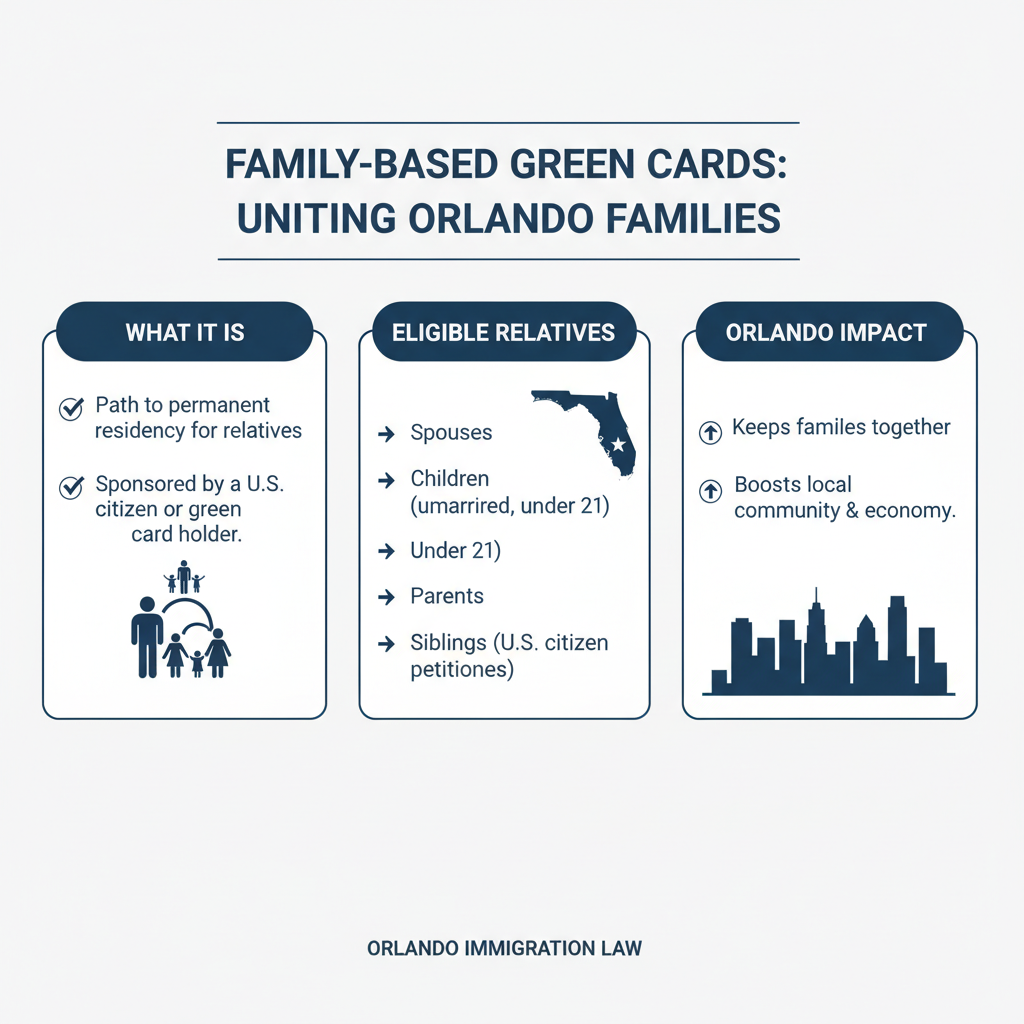
At its core, family-based immigration is the primary way for U.S. citizens and lawful permanent residents (green card holders) to sponsor certain eligible family members to come to live permanently in the United States. This process is often the first step towards obtaining a green card, allowing families to build a life together legally and securely.
A plain-English definition
A family-based immigration petition is a formal request filed with U.S. Citizenship and Immigration Services (USCIS) by a U.S. citizen or a lawful permanent resident (LPR) on behalf of an eligible foreign national relative. This petition, most commonly Form I-130, Petition for Alien Relative, establishes a valid family relationship that qualifies the relative for a green card. Think of it as the legal declaration of your family ties, which is the foundation for your relative to eventually immigrate.
Why does it matter? Because for millions of families, this petition is the gateway to reunification, offering stability, security, and the opportunity to pursue the American dream together. Without it, most family members cannot legally immigrate to the U.S. for permanent residency.
Key terms you need to know
Navigating immigration law requires understanding specific terminology. Here are the key terms associated with family-based petitions:
- Petitioner: The U.S. citizen or lawful permanent resident who files Form I-130 on behalf of their relative.
- Beneficiary: The foreign national relative for whom the Petitioner is filing the Form I-130.
- Immediate Relative: A special category of family members that includes U.S. citizen spouses, unmarried children under 21, and parents of U.S. citizens (who are at least 21 years old). There is no annual limit on the number of immigrant visas for Immediate Relatives, meaning they do not have to wait for a visa to become available once their Form I-130 is approved.
- Preference Categories: Family members who are not Immediate Relatives fall into "preference categories." These categories have annual limits on the number of visas available, leading to waiting times. They include:
- First Preference (F1): Unmarried sons and daughters (21 years of age or older) of U.S. citizens.
- Second Preference (F2): Spouses and children (unmarried, under 21) of LPRs (F2A), and unmarried sons and daughters (21 years of age or older) of LPRs (F2B).
- Third Preference (F3): Married sons and daughters of U.S. citizens.
- Fourth Preference (F4): Brothers and sisters of U.S. citizens (who are at least 21 years old).
- Priority Date: For Preference Category beneficiaries, this is the date USCIS receives your properly filed Form I-130 petition. This date determines your place in the visa queue. You cannot apply for a green card until your Priority Date becomes "current" according to the Visa Bulletin.
- Visa Bulletin: A monthly publication by the U.S. Department of State that lists when immigrant visas are available for specific preference categories and countries. It dictates whether a Priority Date is "current."
- Adjustment of Status (AOS): The process of applying for a green card from within the United States. This is generally available if the beneficiary is already in the U.S. and meets certain eligibility requirements, such as having entered legally and maintained lawful status (though exceptions exist, particularly for Immediate Relatives). It involves filing Form I-485.
- Consular Processing: The process of applying for an immigrant visa (green card) through a U.S. embassy or consulate in the beneficiary's home country. This is used if the beneficiary is outside the U.S. or is ineligible for Adjustment of Status.
- Affidavit of Support (Form I-864): A legally binding document filed by the Petitioner (and sometimes a joint sponsor) to show they can financially support the beneficiary(ies) and ensure they will not become a "public charge" in the U.S.
Current Immigration Law: The Foundation of Family Petitions
Family-based immigration is governed primarily by the Immigration and Nationality Act (INA), specifically sections related to immigrant visas and eligibility. Understanding these legal underpinnings is crucial for a successful petition.
Federal requirements
The core of family-based immigration law is found in the Immigration and Nationality Act (INA). Key provisions include:
- INA §201: Defines who is considered an "Immediate Relative" and sets the worldwide annual limits for Preference Categories.
- INA §203: Establishes the family-sponsored preference categories and their allocation of visas.
- INA §204: Outlines the petitioning process, including the requirement to file Form I-130 and prove the bona fide relationship.
- Eligibility of Petitioner: The U.S. citizen or LPR must prove their status (e.g., birth certificate, naturalization certificate, green card). They must also demonstrate they can financially support the immigrant through Form I-864, Affidavit of Support.
- Eligibility of Beneficiary: The foreign national must demonstrate a legitimate relationship to the petitioner. They must also be admissible to the U.S., meaning they generally must not have certain criminal records, serious health issues, or a history of immigration violations. Waivers may be available for some inadmissibility grounds.
- Bona Fide Relationship: USCIS requires substantial evidence that the relationship is genuine and not solely for immigration purposes. This is particularly important for spousal petitions.
All forms and detailed instructions are available on the USCIS official website. Key forms include:
- Form I-130, Petition for Alien Relative: The initial petition to establish the family relationship.
- Form I-130A, Supplemental Information for Spouse Beneficiary: Required when filing for a spouse.
- Form I-485, Application to Register Permanent Residence or Adjust Status: For beneficiaries seeking a green card from within the U.S.
- Form I-864, Affidavit of Support: The financial sponsorship document.
Florida-specific considerations
While immigration law is federal, practical considerations for Florida residents can differ:
- Orlando USCIS Field Office: If you are applying for Adjustment of Status in Central Florida, your interview will be conducted at the Orlando Field Office. Understanding their specific procedures and common requests can be advantageous.
- State-Level Support: While Florida does not have its own immigration laws, state and local services (e.g., driver's licenses, public assistance) often require proof of legal immigration status, making timely processing of your green card vital.
- Local Legal Expertise: The complexity of these laws underscores the importance of consulting with an immigration attorney experienced in handling cases at the Orlando USCIS Field Office and with the National Visa Center. Imigrar's team is well-versed in these local nuances, offering tailored advice to our clients in Orange County and beyond.
How to File a Family-Based Immigration Petition: A Complete Step-by-Step Guide
The family-based immigration process can be lengthy and intricate, but breaking it down into manageable steps makes it more approachable. Here’s a detailed guide to help you understand what to expect.
1) Determine Eligibility and Category
The first and most critical step is to determine who can petition whom, and under which category. This will dictate the forms you file, the documents you need, and the potential timeline for your case.
- U.S. Citizens can petition for:
- Spouses (Immediate Relative)
- Unmarried children under 21 (Immediate Relative)
- Parents (if the U.S. citizen is 21 or older) (Immediate Relative)
- Unmarried sons and daughters over 21 (First Preference F1)
- Married sons and daughters of any age (Third Preference F3)
- Brothers and sisters (if the U.S. citizen is 21 or older) (Fourth Preference F4)
- Lawful Permanent Residents (Green Card Holders) can petition for:
- Spouses (Second Preference F2A)
- Unmarried children under 21 (Second Preference F2A)
- Unmarried sons and daughters over 21 (Second Preference F2B)
Important: LPRs cannot petition for parents, married children, or siblings.
Required Documents for Step 1 (for Petitioner):
- Proof of U.S. Citizenship (e.g., U.S. birth certificate, naturalization certificate, U.S. passport) OR
- Proof of Lawful Permanent Resident status (e.g., green card - Form I-551)
2) File Form I-130, Petition for Alien Relative
Once you’ve established eligibility, the Petitioner must file Form I-130 with USCIS. This form officially establishes the qualifying relationship.
Required Documents for Step 2 (Form I-130 Packet):
- Completed and signed Form I-130, Petition for Alien Relative.
- Completed and signed Form I-130A, Supplemental Information for Spouse Beneficiary (if petitioning for a spouse).
- Proof of Petitioner's U.S. citizenship or LPR status (e.g., copy of birth certificate, naturalization certificate, U.S. passport, or green card).
- Proof of the qualifying relationship:
- For Spouses: Marriage certificate, divorce decrees from prior marriages (for both), joint bank accounts, joint leases/mortgages, utility bills in both names, birth certificates of shared children, affidavits from friends/family, photos of the couple together.
- For Children: Child's birth certificate (showing parent's name), marriage certificate of parents (if applicable), proof of legal legitimation (if born out of wedlock).
- For Parents: Petitioner's birth certificate (showing parent's name), parents' marriage certificate (if applicable).
- For Siblings: Petitioner's and beneficiary's birth certificates (showing at least one common parent), parents' marriage certificate (if applicable).
- Two passport-style photos of the Petitioner and two of the Beneficiary (if also filing Form I-485 concurrently).
- Applicable filing fee (check USCIS Forms for current fees).
Tip: Organize your documents meticulously. USCIS prefers a well-organized submission with a cover letter and tabs for different sections.
3) Wait for I-130 Approval and Priority Date (if applicable)
After filing, USCIS will send a receipt notice (Form I-797C). This is your official confirmation that the petition has been received. USCIS will then review the petition and supporting evidence. The processing time varies significantly based on the service center and relationship category. You can check current processing times on the USCIS Processing Times page.
- For Immediate Relatives: Once the Form I-130 is approved, the beneficiary can typically move directly to applying for a green card (either through Adjustment of Status or Consular Processing) without waiting for a visa number.
- For Preference Categories: Upon Form I-130 approval, the beneficiary receives a Priority Date. They must then wait for their Priority Date to become "current" according to the monthly Visa Bulletin. This waiting period can range from a few years to over a decade, depending on the category and the beneficiary's country of birth.
Required Documents for Step 3:
- Form I-797C, Notice of Action (receipt notice).
- Form I-797, Approval Notice (once the I-130 is approved).
4) Apply for Green Card (Adjustment of Status or Consular Processing)
Once the Form I-130 is approved and a visa number is available (immediately for Immediate Relatives, or when the Priority Date is current for Preference Categories), the beneficiary can apply for their green card.
Option A: Adjustment of Status (AOS) – If the Beneficiary is in the U.S.
This path is generally available if the beneficiary entered the U.S. legally and is an Immediate Relative, or if their Priority Date is current and they meet other eligibility criteria (e.g., maintained lawful status, no bars to adjustment). For many Orlando residents, this means an interview at the local USCIS Field Office.
Required Documents for Step 4A (Concurrent or Follow-up Filing):
- Form I-485, Application to Register Permanent Residence or Adjust Status.
- Form I-864, Affidavit of Support (from the petitioner and/or a joint sponsor).
- Form I-765, Application for Employment Authorization (optional, allows work authorization while Form I-485 is pending).
- Form I-131, Application for Travel Document (optional, allows travel outside the U.S. while Form I-485 is pending – also known as Advance Parole).
- Form I-693, Report of Medical Examination and Vaccination Record (completed by a USCIS-approved civil surgeon).
- Beneficiary's birth certificate.
- Marriage certificate (if applicable).
- Copies of passport, visa, and Form I-94 (proof of legal entry).
- Police clearance certificates from any country lived in for 6+ months since age 16.
- Two passport-style photos.
- Applicable filing fees.
Reminder: For Immediate Relatives, Form I-130 and Form I-485 can often be filed concurrently.
Option B: Consular Processing – If the Beneficiary is Outside the U.S.
If the beneficiary is outside the U.S. or is ineligible for Adjustment of Status, their case will be sent to the National Visa Center (NVC) after Form I-130 approval. The NVC will collect fees, forms, and civil documents before scheduling an interview at a U.S. embassy or consulate in the beneficiary's home country.
Required Documents for Step 4B (NVC Processing):
- Immigrant Visa Application (Form DS-260) submitted online.
- Form I-864, Affidavit of Support (from the petitioner and/or a joint sponsor).
- Civil documents (birth certificates, marriage certificates, divorce decrees, police certificates, military records) – scanned and uploaded to NVC.
- Passport-style photos.
- Applicable fees (NVC processing fee, Immigrant Visa application fee).
5) Attend Interview (if required)
After submitting the green card application (either Form I-485 or DS-260), most beneficiaries will be required to attend an interview. This is a crucial step where an immigration officer or consular official will verify the information provided and confirm the legitimacy of the relationship.
- For AOS (U.S.-based): The interview will be at a USCIS Field Office (e.g., Orlando USCIS Field Office). Both the petitioner and beneficiary typically attend.
- For Consular Processing (outside U.S.): The interview will be at the designated U.S. embassy or consulate in the beneficiary's country. Only the beneficiary attends.
Required Documents for Step 5 (Interview):
- Originals of ALL documents submitted with the petition and application.
- Any additional evidence of the bona fide relationship that has developed since filing.
- Medical exam results (if not already submitted).
- Passport and travel documents.
- Appointment notice.
Important: Be honest, prepared, and confident. An experienced attorney from Imigrar can help you prepare for your interview, often attending with you for AOS interviews in Orlando.
6) Receive Decision and Green Card
If the interview is successful and all requirements are met, the application will be approved.
- For AOS: You will receive an approval notice, and your green card will be mailed to you within a few weeks.
- For Consular Processing: The beneficiary will receive their immigrant visa stamped in their passport. They then have a limited time to travel to the U.S., where they will be admitted as a lawful permanent resident, and their physical green card will be mailed to their U.S. address.
Congratulations! This marks the successful completion of the family-based immigration petition process, allowing you to keep your family together.
Navigating the family petition process can be complex, but you don't have to do it alone. Imigrar's dedicated team helps families in Orlando and across the nation. Call +1 786-791-3106 today for a free consultation. Se Habla Español.
Practical Steps You Can Take Today
While the full process takes time, there are immediate actions you can take to prepare and strengthen your family-based petition.
Related Articles
You may also be interested in:
-
USCIS Processing Times 2026: What Orlando Immigrants Need to
Understand the latest USCIS processing times and updates for 2026. This comprehensive guide helps Orlando and Florida residents navigate application t...
-
Family-Based Immigration Petitions: Your Orlando Guide to
Navigate family-based immigration with Imigrar's expert guide. Learn about petitions, requirements, and how to reunite with loved ones in Orlando and ...
-
TPS Extension Updates 2026: Your Guide for Florida Immigrants
Stay informed on the latest Temporary Protected Status (TPS) extensions. This guide provides critical updates, eligibility, and steps for immigrants i...
-
Navigating Naturalization: Understanding the 2026 Citizenship
Major changes to the U.S. naturalization test are coming in 2026. Learn what these updates mean for your path to citizenship in Orlando and across Flo...


