

Family-Based Immigration Petitions in 2026: What Changed and Why It Matters
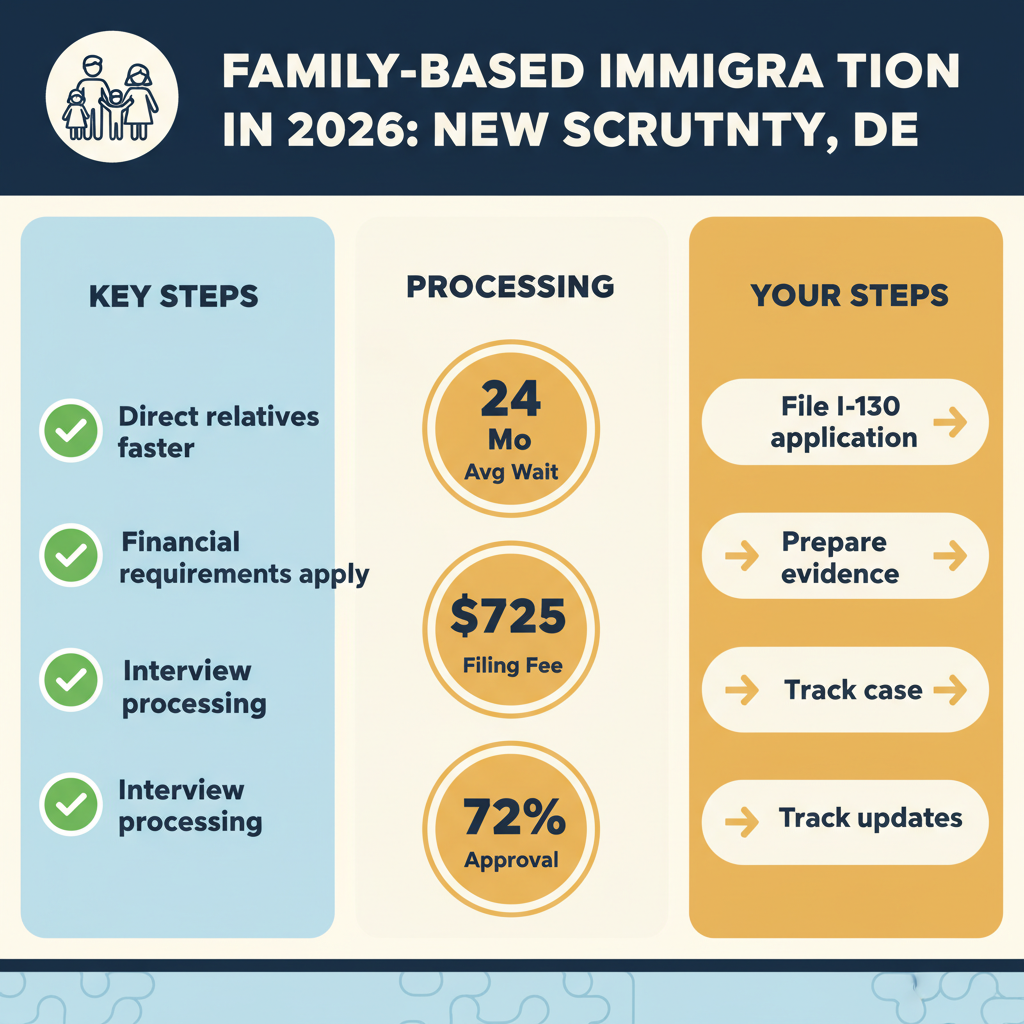
Family-based immigration remains one of the most common paths to a green card in the United States, but 2026 is bringing more scrutiny, shifting timelines, and new security policies that families must understand to avoid delays or denials.[1][2][6] This article focuses on practical, current information families can use to plan, file, and strengthen their petitions in today’s environment.
This guide is designed for immigrants and U.S. citizen or permanent resident sponsors who are:
- Planning to file a new family petition (Form I-130)
- Waiting for a priority date to become current under the Visa Bulletin
- Stuck in long processing or security checks
- Concerned about stricter review of relationships and financial support
1. The Big Picture: How Family-Based Immigration Works in 2026
Family-based green cards still fall into two main groups: immediate relatives of U.S. citizens (no annual cap) and family preference categories (subject to yearly numerical limits and country caps).[5][8]
1.1 Immediate Relatives vs. Preference Categories
Under the Immigration and Nationality Act (INA), family-based visas are allocated as follows:[5]
- Immediate relatives of U.S. citizens (no numerical limit):
- Spouses
- Unmarried children under 21
- Parents (if the U.S. citizen is at least 21)
- Family-sponsored preference categories (numerically capped each year):[5]
- F1: Unmarried sons and daughters (21 or older) of U.S. citizens
- F2A: Spouses and children (under 21) of permanent residents
- F2B: Unmarried sons and daughters (21 or older) of permanent residents
- F3: Married sons and daughters of U.S. citizens
- F4: Brothers and sisters of adult U.S. citizens
For fiscal year 2026, the family-sponsored preference limit is set at 226,000 visas worldwide, with a per‑country cap of 7% for all family and employment preference categories combined.[5]
1.2 Why the Visa Bulletin Still Matters in 2026
If your case is in a preference category (F1–F4 or F2A/F2B), your place in line is determined by your priority date (the date USCIS received your I‑130 petition).[5] Each month, the U.S. Department of State publishes the Visa Bulletin with:
- Final Action Dates – when visas can be issued/green cards approved
- Dates for Filing – when NVC or USCIS will accept the next stage of your case[8]
The January 2026 Visa Bulletin confirms that family preference categories remain numerically limited, and cases are processed strictly in priority date order.[5][7] For many relatives (especially adult children and siblings), this still means years of waiting—even though some categories are inching forward.[7]
2. New Trends in 2026: Stricter Scrutiny of Family Petitions
Although Congress has not changed the basic family categories, USCIS and consular officers are applying tougher review standards in 2026.[1][2] This affects both petitions filed in the U.S. and immigrant visa cases at consulates abroad.
2.1 More Intensive Relationship Review (Not Just for Marriage)
Law firms and advocates report that officers are applying heightened scrutiny to all family relationships, not only marriage cases.[1][2] That means:
- Closer review of birth certificates, adoption records, and custody documents in parent–child cases[2]
- More detailed questions to sibling petitioners about shared parents and upbringing[2]
- Deeper examination of inconsistencies between past applications, prior visas, and new filings[1][2]
Some officers may also look at publicly available information (such as social media) and, in rare cases, conduct site visits when they suspect fraud.[1]
2.2 Tougher Financial & “Public Charge” Review
In 2026, families are seeing more detailed scrutiny of the petitioner’s financial ability to support the immigrant.[1] This may include:
- Closer review of tax returns, W‑2s, pay stubs, and job letters
- Requests for evidence (RFEs) seeking updated income documentation
- Greater use of joint sponsors when the main sponsor’s income is borderline[1]
While the statutory public charge framework has not been radically rewritten, agencies are using their discretion to conduct a more searching analysis of financial eligibility and self‑sufficiency.[1]
2.3 More RFEs and Longer Case Reviews
Because of increased vetting, families can expect:
- More frequent RFEs asking for additional documents or explanations[1][2]
- Occasional Notices of Intent to Deny (NOIDs) where officers believe evidence is weak or inconsistent[2]
- Longer adjudication times for some family categories, particularly where fraud indicators or complex histories exist[1][2]
This does not mean denials are automatic—complete, consistent, well‑documented files are still regularly approved. But families must plan for extra time and be ready to respond quickly to any USCIS or consular requests.
3. Processing Times in 2026: Unpredictable, But Planning Helps
USCIS continues to work through backlogs created during and after the COVID‑19 pandemic.[2] Some cases are moving faster, while others remain slow, especially certain preference categories and consular cases.
3.1 What Families Are Seeing in 2026
Practitioners report that:
- Processing times are still uneven across service centers and case types[2]
- Sibling and adult‑child petitions remain among the slowest‑moving cases[2]
- USCIS is expanding digital tools and hiring, which may help gradually reduce wait times over the year[2]
3.2 How to Track and Manage Your Timeline
Families can take practical steps to stay on top of their case:
- Use the USCIS Case Status and Processing Time tools. Check current estimated times for your form and service center, and compare them to your receipt date.
- Register online for case updates. Creating a USCIS online account allows you to receive email/text alerts and upload some responses electronically.
- Keep a case timeline file. Save copies of all receipts, notices, RFEs, and responses in one place.
- Calendar follow‑up dates. If your case is far beyond normal times, consult an attorney about service requests, congressional inquiries, or other escalation options.
4. January 2026 Visa Bulletin: What It Means for Family Cases
The January 2026 Visa Bulletin confirms several important realities for family petitions.[5][7][8]
4.1 Annual and Per‑Country Limits
For FY 2026:
- The worldwide limit for family-sponsored preference immigrants is 226,000.[5]
- The per‑country limit for all family and employment preference immigrants combined is 7% of the total, or 25,620 per country.[5]
Because of these limits, high‑demand countries (such as Mexico, the Philippines, India, and China) often have longer waits in certain categories.
4.2 Priority Dates and “First Come, First Served”
Under INA §203(e), family‑sponsored visas are issued in the order each petition was filed.[5] This means:
- Your priority date (I‑130 filing date) controls your place in line.
- You cannot “skip the line” by changing lawyers, moving, or upgrading sponsors, although certain changes (like naturalizing from LPR to U.S. citizen) can change your category and sometimes speed up eligibility.
4.3 Practical Tips for Families Stuck in Backlogs
While you wait for your priority date to become current:
- Monitor the Visa Bulletin monthly. Track both the Final Action and Dates for Filing charts for your category and country.[8]
- Update addresses promptly. Notify both USCIS and the National Visa Center (NVC) if you move, so you do not miss critical notices.
- Keep civil documents current. Ensure passports, police clearances, and medical exams (when requested) are valid and updated as needed.
- Document life changes. Keep records of marriages, divorces, births, and deaths; some changes can affect eligibility or derivative beneficiaries.
5. High-Risk Country “Processing Holds” in 2026
A major development for some families is the expansion of “high‑risk country” processing holds by USCIS, effective January 1, 2026.[6]
5.1 Who Is Affected?
According to a January 2026 policy memorandum, USCIS has expanded guidance that allows officers to pause or slow processing of applications filed by individuals who:[6]
- Are citizens or nationals of any of 39 designated countries, or
- Were born in those countries, or
- Travel on Palestinian Authority–issued or endorsed travel documents[6]
The policy applies to family-based and employment-based petitions, as well as some refugee-related benefits.[6] Already pending cases filed before the memo may also be affected by holds and re‑review.[6]
5.2 What a “Hold” Means for Your Family Case
A processing hold is not a denial. It can result in:
- Significantly slower adjudication of I‑130 and related applications
- Additional security and background checks
- Requests for updated information after a long period of inactivity[6]
Many families affected by this policy will not receive a clear time estimate. In such cases, carefully documenting all responses and considering legal advocacy (including congressional assistance or litigation in extreme delays) can be important strategic options.
5.3 Practical Steps if You May Be Impacted
- Confirm whether the beneficiary’s country is on the list. Review official announcements or consult an attorney to determine whether your case may face a hold.
- Respond quickly to any security‑related RFEs. Provide requested documents in full and on time.
- Maintain clean, consistent records. Discrepancies in names, dates of birth, or travel history can trigger longer checks.
- Consider legal options in extreme delays. In certain situations, mandamus or other litigation strategies may be available—seek individualized legal advice first.
6. Step-by-Step: Filing a Strong Family-Based I-130 Petition in 2026
The core of most family-based cases is the Form I‑130, Petition for Alien Relative. While the basic form has not dramatically changed, how you prepare it matters more in a strict‑scrutiny environment.[1][2][3]
6.1 Step 1 – Confirm Eligibility and Category
Before filing, identify:
- The relationship (spouse, child, parent, sibling)
- The status of the petitioner (U.S. citizen or lawful permanent resident)
- Whether the beneficiary is inside or outside the U.S.
- Which preference category applies (immediate relative vs. F1–F4/F2A/F2B)[5]
This determines your expected wait time, whether a visa is immediately available, and whether adjustment of status in the U.S. might be possible later.
6.2 Step 2 – Prepare Evidence of the Family Relationship
In 2026, USCIS is paying special attention to whether the claimed relationship is genuine and properly documented.[1][2]
- Spouse cases (marriage-based I‑130):
- Marriage certificate
- Proof of termination of prior marriages
- Joint lease or mortgage, joint bank accounts, tax returns, insurance, and photographs together[2][3]
- Parent–child cases:
- Birth certificates listing both parents
- Evidence of legitimation or adoption, if applicable
- School, medical, or financial records showing an ongoing relationship[2]
- Sibling cases:
- Birth certificates for both siblings showing at least one common parent
- Evidence explaining name changes, if any
Where documents are missing or unavailable, work with counsel to obtain secondary evidence or affidavits and a country‑conditions explanation.
6.3 Step 3 – Complete and File the I-130 Correctly
Key best practices include:
- Answer all questions fully and consistently. Inconsistent dates, names, or prior immigration history can lead to RFEs or suspicion.


Have Questions About Your Case?
Schedule a free consultation with our attorney-reviewed team today