


At Imigrar, our mission is to Keep Families Together. We understand that for many, the dream of uniting with loved ones in the United States is paramount. As an immigration law firm based in Orlando, Florida, serving clients nationwide, we are dedicated to providing clear, actionable guidance through the often-complex world of U.S. immigration law.
The reporting that sparked this guide
The continuous conversation around family reunification highlights the enduring importance of family-based immigration. Staying informed is crucial, and the ongoing news coverage underscores the need for clear, reliable information. Our comprehensive guide is inspired by the widespread interest in helping families navigate the path to legal residency.
Reference: Family-Based Immigration Petition Guide (Immigration)
Need Help? Our Orlando immigration team is ready to assist. Call +1 786-791-3106 for a free consultation, or message us online. Se Habla Español.
What This News Means for Immigrants in Orlando and Across Florida
The topic of family-based immigration is a constant in the news cycle, reflecting its critical role in the U.S. immigration system. For families in Orlando, Central Florida, and across the nation, understanding the process is the first step toward achieving their dreams of unity.
Why this news is showing up now
Family-based immigration is not a new concept, but it consistently garners attention due to several factors:
- Evolving Policies: While the core framework of family immigration remains stable, administrative policies, processing priorities, and visa availability can shift. These changes often spark new discussions and updates in immigration news, making it essential for applicants to stay informed.
- Processing Backlogs: High demand for certain visa categories, particularly for family members from specific countries, can lead to significant processing delays and backlogs. These delays are frequently highlighted in news reports, impacting the lives of countless families and prompting questions about current wait times and potential solutions.
- Economic and Social Impact: Family reunification has profound economic and social impacts, contributing to local communities, labor forces, and cultural diversity. Discussions around immigration often touch on these broader effects, keeping family-based petitions in the public eye.
- Human Interest Stories: The emotional journeys of families striving to reunite resonate deeply. News outlets often feature stories of individuals navigating the immigration system, bringing the complexities and human element of family petitions to the forefront.
As of August 2026, the demand for family-based visas remains high, and understanding the current landscape is vital for anyone considering this path.
How it can affect Florida residents
Florida is home to one of the largest and most diverse immigrant populations in the United States. For residents in Orlando, Orange County, and along the I-4 corridor, family-based immigration is a deeply personal and relevant issue:
- Direct Impact on Families: Thousands of Florida residents are either U.S. citizens or lawful permanent residents (green card holders) who wish to sponsor their relatives. News about processing times, eligibility, or policy changes directly affects their ability to reunite with spouses, children, parents, and siblings.
- Local USCIS Offices: The Orlando USCIS Field Office and other offices across Florida handle a significant volume of family-based petitions, interviews, and adjustment of status applications. Any news related to operational changes, staffing, or local processing priorities can have a direct bearing on cases here.
- Diverse Communities: Florida’s rich tapestry of communities, including large populations from Latin America and the Caribbean, means that a wide range of family relationships are being sponsored. Understanding country-specific visa bulletin nuances and potential wait times is critical for many Florida families.
- Access to Legal Support: With a large immigrant population, there's a strong demand for knowledgeable legal assistance. News that emphasizes the complexities of the immigration system often reinforces the need for professional guidance, which firms like Imigrar provide to ensure families navigate the process successfully.
At Imigrar, we are deeply familiar with the specific needs and challenges faced by Florida families. We offer tailored advice and support to help you achieve your family reunification goals.
What Family-Based Immigration Petitions Are (and Why They Matter)
Family-based immigration is a cornerstone of the U.S. immigration system, allowing U.S. citizens and lawful permanent residents to sponsor certain family members for green cards. This process is often the most direct and common pathway for families to live together legally in the United States.
A plain-English definition
A family-based immigration petition is essentially a formal request made to the U.S. government, specifically U.S. Citizenship and Immigration Services (USCIS), by a U.S. citizen or lawful permanent resident (the "petitioner") to bring a qualifying relative (the "beneficiary") to live permanently in the United States. If approved, this petition allows the sponsored relative to apply for a green card, which grants them lawful permanent resident status.
The goal is simple: to help families reunite and build new lives together in the U.S. It's a testament to the principle that strong families form the foundation of a strong society.
Key terms you need to know
Navigating immigration law requires understanding specific terminology. Here are some essential terms related to family-based petitions:
- Petitioner: The U.S. citizen or lawful permanent resident who files the immigration petition on behalf of their relative.
- Beneficiary: The foreign national relative who is being sponsored for a green card.
- Form I-130, Petition for Alien Relative: The initial form filed by the petitioner to establish the qualifying family relationship with the beneficiary. This is the starting point for most family-based immigration cases.
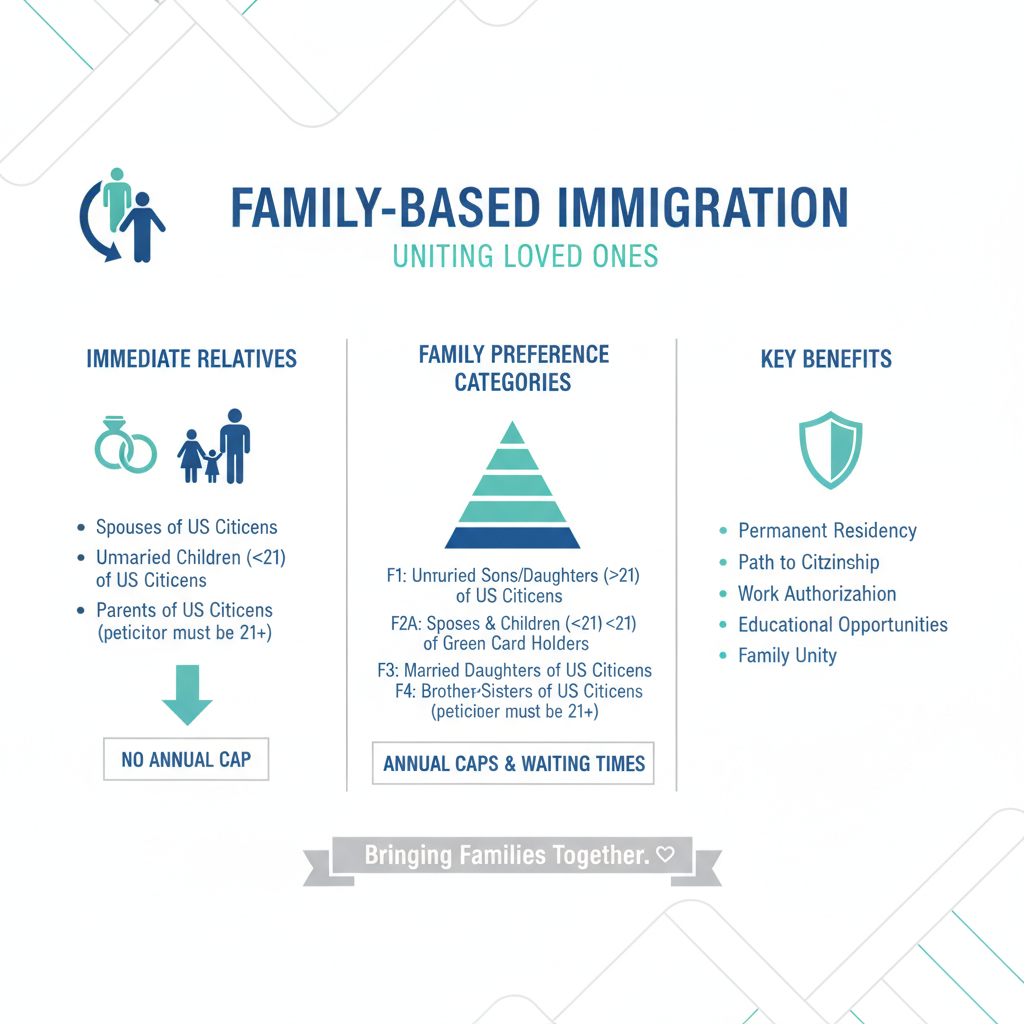
- Immediate Relatives: This category includes spouses of U.S. citizens, unmarried children under 21 of U.S. citizens, and parents of U.S. citizens (if the U.S. citizen is 21 or older). Important: There is no annual numerical limit on visas for Immediate Relatives, meaning they do not have to wait for a visa to become available once the Form I-130 is approved.
- Family Preference Categories: These are categories for family members who are not Immediate Relatives. They include:
- First Preference (F1): Unmarried sons and daughters (21 years of age or older) of U.S. citizens.
- Second Preference (F2A): Spouses and children (unmarried and under 21) of lawful permanent residents.
- Second Preference (F2B): Unmarried sons and daughters (21 years of age or older) of lawful permanent residents.
- Third Preference (F3): Married sons and daughters of U.S. citizens.
- Fourth Preference (F4): Brothers and sisters of U.S. citizens (if the U.S. citizen is 21 or older).
- Priority Date: This is the date USCIS receives your Form I-130 petition. For Family Preference categories, this date determines your place in the visa queue. You cannot move forward with your green card application until your Priority Date becomes "current" according to the Visa Bulletin.
- Visa Bulletin: A monthly publication from the U.S. Department of State that shows which Priority Dates are current for different visa categories and countries. This is crucial for understanding wait times.
- Adjustment of Status (AOS): The process of applying for a green card while physically present in the United States. This typically involves filing Form I-485, Application to Register Permanent Residence or Adjust Status.
- Consular Processing: The process of applying for a green card through a U.S. embassy or consulate in the beneficiary's home country (or another country where they have residency). This is required if the beneficiary is outside the U.S. when their Priority Date becomes current.
- Affidavit of Support (Form I-864): A legally binding document signed by the petitioner (and sometimes a joint sponsor) to demonstrate that the beneficiary will not become a public charge in the U.S. The sponsor must meet specific income requirements.
Navigating these terms can be complex, but you don't have to do it alone. Contact Imigrar for a free consultation. Our team, serving Orlando and clients nationwide, is ready to help. Call +1 786-791-3106 or reach out online. Se Habla Español.
Current Immigration Law: The Foundation
Family-based immigration is primarily governed by the Immigration and Nationality Act (INA), a comprehensive body of federal law. Understanding these foundational laws is crucial for anyone embarking on this journey. As of August 2026, the core principles of the INA continue to guide family petitions.
Federal requirements
The Immigration and Nationality Act (INA) lays out the framework for who can immigrate to the U.S. based on family ties. Key sections include:
- INA Section 201: Defines the categories of immigrants, including Immediate Relatives and Family Preference categories, and sets the numerical limitations for preference visas.
- INA Section 203: Details the allocation of immigrant visas for the preference categories, specifying the percentage of visas available to each and establishing the system of Priority Dates.
- INA Section 204: Outlines the petitioning process, requiring a U.S. citizen or lawful permanent resident to file a petition (Form I-130) on behalf of their relative. It also sets forth the general eligibility criteria for petitioners and beneficiaries.
- INA Section 212: Addresses grounds of inadmissibility, which are reasons a foreign national might be denied entry or a green card, even if a petition is approved. These can include health issues, criminal history, security risks, or likely to become a "public charge."
- INA Section 213A: Mandates the filing of an Affidavit of Support (Form I-864) to ensure that family-sponsored immigrants do not become a financial burden on the U.S. government. The petitioner must meet 125% of the federal poverty guidelines for their household size.
All family-based petitions must adhere to these federal requirements. USCIS, a component of the Department of Homeland Security, is the primary agency responsible for adjudicating these petitions. You can find all official forms and detailed instructions on the USCIS official website.
Florida-specific considerations
While immigration law is federal, certain aspects can have specific implications for residents of Florida:
- State Records: Criminal convictions, even minor ones, obtained in Florida state courts can impact a beneficiary's admissibility. It's crucial to disclose all arrests and convictions, as federal immigration law has its own definitions of "crimes involving moral turpitude" and other offenses that can lead to inadmissibility.
- Proof of Domicile: For petitioners residing in Florida, proving domicile in the U.S. is essential for the Affidavit of Support (Form I-864). This includes providing Florida utility bills, driver's licenses, tax returns from a Florida address, and other evidence of residency in the state.
- Local USCIS Field Office: The Orlando USCIS Field Office, located at 5449 Forbes Pl, Orlando, FL 32812, handles interviews for Adjustment of Status applicants residing in Central Florida. Understanding their specific procedures, appointment scheduling, and local processing times can be beneficial. You can check general processing times on the USCIS Processing Times page.
- State-Specific Resources: Florida offers various resources for immigrants, including community organizations and legal aid groups, that can complement federal services. Being aware of these local networks can be helpful.
Our team at Imigrar, based in Orlando, is intimately familiar with the local context and can provide guidance tailored to your situation as a Florida resident. We understand the nuances of interacting with the Orlando USCIS Field Office and can help you prepare accordingly.
How to File a Family-Based Immigration Petition: A Complete Step-by-Step Guide
Filing a family-based immigration petition is a multi-stage process that requires careful attention to detail. This guide outlines the typical steps involved, whether your family member is applying from within the U.S. or abroad.
1) Determine Eligibility & Category
Before filing anything, the petitioner must confirm their eligibility and identify the correct visa category for their relative.
- Petitioner's Status:
- Are you a U.S. Citizen?
- Are you a Lawful Permanent Resident (Green Card holder)?
- Relationship to Beneficiary:
- Spouse (of U.S. citizen or LPR)
- Unmarried child under 21 (of U.S. citizen or LPR)
- Unmarried son/daughter 21 or older (of U.S. citizen or LPR)
- Married son/daughter (of U.S. citizen)
- Parent (of U.S. citizen 21 or older)
- Brother/Sister (of U.S. citizen 21 or older)
- Identify Visa Category: Based on the above, determine if the beneficiary is an Immediate Relative or falls under a Family Preference Category. This will dictate wait times and subsequent steps.
- Review Inadmissibility Grounds: The beneficiary should review potential grounds of inadmissibility (e.g., criminal history, certain health conditions, prior immigration violations). Some grounds can be waived, but it's crucial to address them early.
Required Documents (for initial assessment):
- Petitioner's proof of U.S. citizenship (U.S. birth certificate, passport, naturalization certificate) or LPR status (green card).
- Proof of qualifying relationship (e.g., marriage certificate, birth certificates showing parent-child relationship).
2) File Form I-130, Petition for Alien Relative
This is the foundational step where the petitioner formally asks USCIS to recognize the qualifying family relationship.
- Complete Form I-130: Fill out Form I-130 accurately and completely. Ensure all questions are answered and information matches supporting documents.
- Gather Supporting Documents:
- Proof of U.S. citizenship or LPR status for the petitioner.
- Proof of the qualifying relationship (e.g., original or certified copy of marriage certificate, birth certificate).
- If applicable, divorce decrees or death certificates for any previous marriages of either petitioner or beneficiary.
- Passport-style photos for both petitioner and beneficiary (check USCIS photo requirements).
- Any necessary certified translations of foreign-language documents.
- Reminder: USCIS requires certified English translations for any document not in English.
- Pay Filing Fee: Submit the correct filing fee for Form I-130. Check the USCIS Forms page for current fees.
- Mail Petition: Send the completed form, supporting documents, and fee to the correct USCIS lockbox facility. The address depends on where you live and the type of petition.
Timeline Expectation: USCIS will send a receipt notice (Form I-797C, Notice of Action) within a few weeks. Processing times for Form I-130 vary significantly by relationship category and USCIS service center, ranging from several months to over a year. Check USCIS Processing Times for current estimates.
3) Wait for I-130 Approval & Priority Date
Once USCIS receives your petition, they will review it to establish the validity of the relationship.
- Receipt Notice: You will receive a Form I-797C, confirming receipt and providing your Priority Date.
- Biometrics Appointment (if applicable): Some petitioners or beneficiaries (especially if already in the U.S.) may receive a notice for a biometrics appointment to collect fingerprints and photos.
- I-130 Approval: If USCIS approves the petition, you will receive an I-797, Approval Notice. This means the relationship is recognized.
- Visa Bulletin & Priority Date Becomes Current:
- For Immediate Relatives, a visa is generally immediately available upon Form I-130 approval.
- For Family Preference Categories, you must wait for your Priority Date to become current according to the Visa Bulletin. This waiting period can be many years, especially for certain categories and countries.
Important: Do not proceed to the next steps until your Form I-130 is approved and, for preference categories, your Priority Date is current.
4) File for Adjustment of Status (Form I-485) OR Consular Processing
This step depends on whether the beneficiary is in the U.S. or abroad.
Option A: Adjustment of Status (Beneficiary in U.S.)
If the beneficiary is in the U.S. and eligible (e.g., entered legally, no serious immigration violations), they can apply for a green card without leaving the country.
- File Form I-485: Complete Form I-485, along with supporting forms:
- Form I-864, Affidavit of Support: Filed by the petitioner (and potentially a joint sponsor) to demonstrate financial capability.
- Form I-693, Report of Medical Examination and Vaccination Record: Completed by a USCIS-approved civil surgeon.
- Form I-765, Application for Employment Authorization (Optional): Allows the beneficiary to work while waiting for green card.
- Form I-131, Application for Travel Document (Optional): Allows the beneficiary to travel internationally while waiting for green card (Advance Parole).
- Gather Supporting Documents for I-485:
- Copy of Form I-130 Approval Notice.
- Beneficiary's birth certificate.
- Copy of beneficiary's passport, visa, and I-94 arrival record.
- Marriage certificate (if applicable).
- Two passport-style photos.
- Police clearances (if required).
- Evidence of financial support (tax returns, employment letters, pay stubs for Form I-864).
- Pay Filing Fees: Submit fees for Form I-485, biometrics, and any optional forms.
- Mail Application: Send the complete package to the correct USCIS lockbox.
Timeline Expectation: USCIS will send a receipt notice. A biometrics appointment will be scheduled. Work permits and travel documents (if requested) are typically issued within several months. The entire Adjustment of Status process can take 1-2 years or more, depending on the USCIS field office (e.g., Orlando USCIS Field Office processing times vary).
Option B: Consular Processing (Beneficiary Abroad)
If the beneficiary is outside the U.S., their case will be sent to the National Visa Center (NVC) for processing.
- NVC Processing: After Form I-130 approval, USCIS sends the case to the NVC. The NVC will contact the petitioner and beneficiary with instructions to submit fees and required documents online.
- Submit Fees & Documents to NVC:
- Affidavit of Support (Form I-864) and supporting financial documents from the petitioner.
- Beneficiary's civil documents (birth certificate, marriage certificate, police certificates, passport copies, photos).
- Complete Form DS-260, Immigrant Visa Application online.
- NVC Review & Interview Scheduling: Once all documents are accepted, the NVC will schedule an interview at the appropriate U.S. embassy or consulate in the beneficiary's country.
Timeline Expectation: NVC processing can take several months. Interview scheduling depends on the embassy's capacity. The entire consular processing can take 6-12 months after NVC completion, once the Priority Date is current.
5) Attend Interview
Whether through Adjustment of Status or Consular Processing, an interview is a critical step.
- Interview Notice: You will receive a notice with the date, time, and location of the interview. For Orlando residents, Adjustment of Status interviews are typically held at the Orlando USCIS Field Office.
- Prepare for Interview:
- Gather all original documents submitted with your applications (birth certificates, marriage certificates, passports, financial documents, medical exam results).
- Bring any additional evidence of your relationship (photos, joint bank accounts, lease agreements, utility bills, etc.), especially for spouses.
- Be prepared to answer questions about your relationship, immigration history, and personal background.
- Attend Interview: Both the petitioner and beneficiary typically attend Adjustment of Status interviews. For Consular Processing, only the beneficiary attends. Answer truthfully and calmly.
Important: An attorney from Imigrar can help prepare you for your interview, ensuring you know what to expect and have all necessary documents.
6) Receive Decision
After the interview, the officer will make a decision on the application.
- Approval:
- Adjustment of Status: If approved, the officer may stamp the beneficiary's passport as temporary proof of permanent residence. The actual green card will be mailed within a few weeks.
- Consular Processing: If approved, the beneficiary will receive an immigrant visa stamp in their passport. They must enter the U.S. before the visa expires (usually 6 months from the medical exam date). The green card will be mailed to their U.S. address after entry.
- Request for Evidence (RFE): If the officer needs more information or documents, they will issue an RFE, providing a deadline (usually 60-90 days) to respond.
- Denial: If the petition or application is denied, USCIS or the consulate will provide a written explanation. You may have options to appeal or refile, depending on the reason for denial.


