

The reporting that sparked this guide
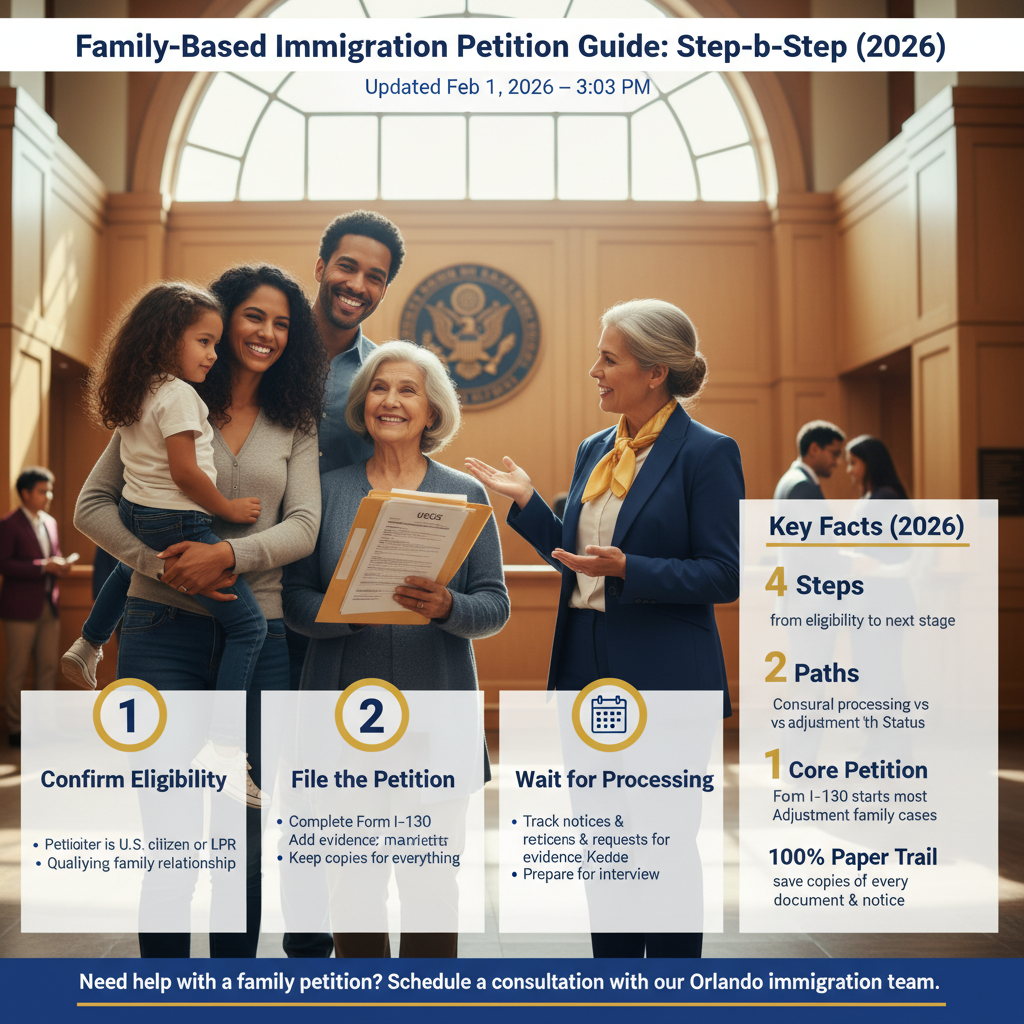
This guide was inspired by ongoing coverage and public interest around family immigration and petition processing updates. See the news stream here: Family-Based Immigration Petition Guide (Immigration).
Need Help? Our Orlando immigration team is ready to assist. Call +1 786-791-3106 for a free consultation, or message us online. Se Habla Español.
What This News Means for Immigrants in Orlando and Across Florida
Why this news is showing up now
Family-based immigration is consistently “trending” because it affects millions of U.S. families and because processing times, visa availability, and policy shifts can change how quickly (and how safely) families reunite. In 2025–2026, many families have been closely watching:
- USCIS backlogs and fluctuating timelines (especially for Form I-130 and Form I-485)
- Visa bulletin movement for preference categories (where the Priority Date controls when a green card can be issued)
- Requests for Evidence (RFEs) and interview practices at field offices
- Public charge and affidavit of support scrutiny (mainly Form I-864 in family cases)
Reminder: “Trending” does not always mean the law has changed overnight. Often, it means more people are filing, more people are checking their case status, and more families are trying to understand the most reliable step-by-step process to avoid delays.
How it can affect Florida residents
Florida is home to large immigrant communities, including many mixed-status families. Family petitions are especially common for spouses, parents, children, and siblings of U.S. citizens and lawful permanent residents (green card holders). If you live in Orlando, Kissimmee, Winter Park, Apopka, or anywhere along the I-4 corridor, family-based filings may involve:
- USCIS case processing through national service centers and then the local field office for interviews
- Medical exams with local civil surgeons and document gathering from multiple countries
- Travel planning and consular appointments for relatives abroad
- Complex questions about unlawful presence, prior entries, or removal proceedings
Important: If your case is in Orlando, local interview scheduling and document expectations can affect your timeline. For Central Florida residents, planning early—especially for translations, civil documents, and financial sponsorship evidence—can prevent months of avoidable delays.
What Family-Based Immigration Petition Guide Is (and Why It Matters)
A plain-English definition
A family-based immigration petition is the process a U.S. citizen or lawful permanent resident uses to help a qualifying relative get a green card (lawful permanent residence). In most cases, the process begins with the petitioner filing Form I-130 (Petition for Alien Relative) with U.S. Citizenship and Immigration Services (USCIS).
After USCIS approves the family relationship, the relative may apply for the green card either:
- Inside the U.S. through Adjustment of Status using Form I-485, or
- Outside the U.S. through consular processing with the National Visa Center (NVC) and a U.S. embassy/consulate
This matters because small mistakes—wrong category, missing documents, filing the wrong form sequence, or misunderstanding the Priority Date—can cause denials, long delays, or even trigger immigration enforcement risks in certain situations.
Key terms you need to know
- Petitioner: The U.S. citizen or green card holder who files the family petition.
- Beneficiary: The relative who will receive the immigration benefit (the green card).
- Immediate Relative: Spouse of a U.S. citizen, unmarried child under 21 of a U.S. citizen, or parent of a U.S. citizen (if the U.S. citizen is 21+). Immediate relatives are not subject to annual visa caps.
- Family Preference Category: Categories with annual limits (e.g., adult children, siblings, spouses/children of green card holders). These require waiting for a visa number.
- Priority Date: The “place in line” date—usually the date USCIS receives Form I-130. It controls when you can move forward in capped categories.
- Visa Bulletin: The Department of State’s monthly publication showing which Priority Date is current for each category and country.
- Adjustment of Status: Applying for a green card from inside the U.S. (usually with Form I-485).
- Consular Processing: Completing the immigrant visa process abroad through a U.S. consulate.
- Affidavit of Support: The sponsor’s financial promise, usually filed on Form I-864, showing the immigrant will not rely on certain public benefits.
- RFE (Request for Evidence): USCIS request for missing or unclear documentation. RFEs can add months.
Warning: Some families assume approval is “automatic” because the relationship is real. USCIS still requires proof and eligibility, and certain past immigration issues (unlawful presence, misrepresentation, prior removal orders) can complicate even strong family cases.
Current Immigration Law: The Foundation
Family-based immigration is governed primarily by the Immigration and Nationality Act (INA) and related federal regulations. While Florida does not create immigration eligibility rules (immigration is federal), Florida residents still face practical, local considerations—like where interviews occur and how local documentation is obtained.
Federal requirements
Key legal foundations include:
- INA § 201 and § 203 (numerical limits and preference categories)
- INA § 204 (family-based petitioning requirements and procedures)
- INA § 245 (rules for Adjustment of Status)
- INA § 212 (grounds of inadmissibility—unlawful presence, fraud/misrepresentation, certain crimes, health-related grounds)
- 8 C.F.R. § 204 (regulations on family petitions)
- 8 C.F.R. § 245 (regulations on adjustment of status)
Official resources you should rely on include the USCIS official website, the USCIS Forms page, and the U.S. Department of State for consular processing and the Visa Bulletin.
Processing estimates should be checked directly on USCIS Processing Times—but keep in mind that “normal” ranges can change and do not guarantee an approval date.
Florida-specific considerations
Florida-specific issues are usually practical rather than legal, such as:
- If your case is in Orlando... you may be scheduled for an in-person interview at The Orlando USCIS Field Office (depending on case type and USCIS interview policies).
- For Central Florida residents... gathering local records (marriage certificates, divorce decrees, name change orders) often involves Orange County or nearby county clerks.
- Travel logistics along the I-4 corridor can matter when you receive short-notice biometrics or interview appointments.
- If a beneficiary is in removal proceedings, coordination with the Executive Office for Immigration Review (EOIR) may be required, and strategy can change significantly.
Important: If you are in immigration court or have a prior removal order, do not file a family case “DIY” without legal advice. The correct path can involve motions, waivers, or court coordination, and mistakes can be costly.
Common USCIS forms in family cases include: Form I-130, Form I-485, Form I-864, Form I-765 (work permit), Form I-131 (advance parole travel document), and Form I-693 (medical exam).
Need Help? Our Orlando immigration team is ready to assist. Call +1 786-791-3106 for a free consultation, or message us online. Se Habla Español.
How to File a Family Petition: A Complete Step-by-Step Guide
Below is a practical, step-by-step roadmap for most family-based green card cases. Your exact steps depend on whether the beneficiary is inside the U.S. and eligible for Adjustment of Status, or outside the U.S. using consular processing.
Reminder: This is general information, not legal advice for your specific case. If there are issues like unlawful presence, entry without inspection, prior deportation, or criminal history, talk to an attorney before filing.
1) Confirm the correct family category and strategy (AOS vs. consular)
Start by identifying (a) who is petitioning, (b) the exact relationship, and (c) where the beneficiary is physically located. This determines whether you can file Form I-485 now or must wait for a current Priority Date and/or complete consular processing.
Typical categories include:
- Immediate relatives of U.S. citizens: spouse, parent (USC 21+), unmarried child under 21
- F1: unmarried adult children (21+) of U.S. citizens
- F2A: spouses and unmarried children under 21 of green card holders
- F2B: unmarried adult children of green card holders
- F3: married children of U.S. citizens
- F4: siblings of U.S. citizens (USC 21+)
If you are in a preference category, your Priority Date must become current based on the Visa Bulletin before the green card can be issued.
Documents to gather for Step 1:
- Petitioner proof of status: U.S. passport, birth certificate, naturalization certificate, or green card
- Proof of relationship: marriage certificate, birth certificates, adoption decrees (if applicable)
- Divorce decrees or death certificates for any prior marriages (petitioner and beneficiary)
- Beneficiary’s entry and status documents (if in the U.S.): I-94, visa stamp, prior approvals/notices
- Any immigration court paperwork (Notices to Appear, hearing notices) if applicable
2) Prepare and file the family petition with USCIS (usually Form I-130)
In most cases, the petition begins with Form I-130. The goal is to prove a qualifying relationship and that it is legitimate (especially for marriage cases). USCIS will issue a receipt notice and later an approval, denial, or RFE.
You may also need Form I-130A (Supplemental Information for Spouse Beneficiary) for spousal cases.
Important: Use the current edition of each form and follow the USCIS filing address or online filing instructions listed on USCIS Forms. Filing to the wrong place can cause rejected packages and lost time.
Documents to gather for Step 2 (common examples):
- Completed and signed Form I-130 (and Form I-130A if required)
- Filing fee (as listed by USCIS at the time of filing)
- Passport-style photos (if required by form instructions)
- Petitioner proof of citizenship/LPR status
- Relationship proof (marriage/birth/adoption documents)
- For marriage cases: evidence of a bona fide marriage (joint lease/mortgage, joint bank statements, insurance, photos, affidavits, children’s birth certificates, travel records)
- Certified translations for any non-English documents
3) Track the Priority Date and decide when to file the green card application
If the beneficiary is an immediate relative of a U.S. citizen and is eligible to adjust status in the U.S., you can often file Form I-485 together with Form I-130 (called “concurrent filing”). If the beneficiary is in a preference category, you may have to wait until the Priority Date is current.
For preference categories, you’ll typically monitor the Visa Bulletin through the U.S. Department of State. USCIS also announces whether to use the “Dates for Filing” chart or the “Final Action Dates” chart for family-based adjustment filings.
Warning: Filing Form I-485 when you are not eligible can lead to rejection or denial and may expose sensitive information. Confirm eligibility first.
Documents to gather for Step 3:
- I-130 receipt notice (for your records)
- Visa Bulletin chart screenshots or notes showing your category and country
- Beneficiary’s immigration history summary (entries/exits, prior filings)
- Any prior USCIS decisions (approvals/denials) relevant to eligibility
4) File the green card application: Adjustment of Status (I-485) or Consular Processing
This step depends on where the beneficiary is located.
Option A: Adjustment of Status (inside the U.S.)
If eligible, the beneficiary files Form I-485. Many applicants also file:
- Form I-765 for a work permit (EAD)
- Form I-131 for advance parole (permission to travel while the case is pending)
- Form I-864 (Affidavit of Support) from the petitioner/sponsor
- Form I-693 medical exam (often submitted later, but strategy varies)
Important: Do not travel internationally without advance parole if your Adjustment of Status case requires it. Leaving the U.S. without proper authorization can be treated as abandoning the application in many situations.
Option B: Consular Processing (outside the U.S.)
After Form I-130 approval, the case typically goes to the National Visa Center (NVC). You pay fees, submit civil and financial documents, and then attend an immigrant visa interview at a U.S. consulate. After entry to the U.S. with the immigrant visa, the beneficiary becomes a permanent resident.
Documents to gather for Step 4 (AOS inside the U.S.):
- Completed and signed Form I-485
- Copy of passport biographic page and all U.S. visas
- I-94 record and entry stamps (if any)
- Birth certificate (with certified translation if needed)
- Marriage certificate/divorce decrees (if applicable)
- Form I-864 with sponsor’s tax returns/W-2s/pay stubs and proof of current employment
- Form I-693 sealed medical exam from a USCIS-designated civil surgeon
- If filing Form I-765/Form I-131: supporting identity and eligibility documents per instructions
Documents to gather for Step 4 (Consular Processing abroad):
- NVC fee payment confirmations
- DS-260 immigrant visa application confirmation (submitted online through DOS systems)
- Police certificates (as required for each country lived in, per DOS reciprocity rules)
- Birth and marriage certificates (plus translations)
- Military records (if applicable)
- Form I-864 and financial evidence from the sponsor
- Medical exam from the panel physician designated by the consulate
5) Complete biometrics, respond to RFEs, and prepare for the interview
For Adjustment of Status, USCIS usually schedules biometrics (fingerprints/photo). Then, many applicants attend an interview at the local field office—often The Orlando USCIS Field Office for Central Florida residents, depending on jurisdiction and case type.
If you receive an RFE, respond carefully and completely by the deadline. USCIS deadlines vary by notice; treat the due date as strict.
Important: Some immigration processes contain time-sensitive rules like the 90-day window concept (often discussed in the context of intent and certain visa entries) and other deadlines in different contexts. Always follow the exact deadline on your USCIS notice, and do not assume you have “extra time.”
Documents to gather for Step 5 (Interview/RFE readiness):
- Original civil documents (birth/marriage/divorce) and certified translations
- Updated bona fide marriage evidence (new lease, bills, bank statements, insurance, photos)
- Updated sponsor financial evidence (recent pay stubs, job letter)
- Government-issued IDs for both spouses (if applicable)
- Copy of the full filing package and all USCIS notices
- If an RFE: a cover letter, indexed exhibits, and the exact requested evidence
6) Receive a decision and plan the next phase (green card, conditions, citizenship)
If approved through Adjustment of Status, USCIS will mail the green card. If approved through consular processing, the beneficiary enters the U.S. as a resident and later receives the card.
Many spouses receive a two-year “conditional” green card if the marriage was less than two years old on the approval/entry date. Removing conditions later requires timely filing (commonly Form I-751, Petition to Remove Conditions on Residence).
Reminder: Keep copies of everything. Your future filings—removal of conditions, replacement cards, and naturalization—will be easier if your record is organized.
Documents to gather for Step 6:
- Approval notices and the green card (front/back copies stored securely)
- Passport stamps or immigrant visa packet documentation (if consular)
- Ongoing proof of shared life for future filings (joint taxes, leases, children’s records)
- Calendar reminders for future deadlines (e.g., conditional residence expiration)
Practical Steps You Can Take Today
Whether you are just starting or you already filed, the best results come from organized documentation and realistic timelines.
Actionable checklist (do these now)
- Create a shared folder (digital + paper) for all immigration documents and receipts.
- Order certified copies of civil documents early (birth, marriage, divorce). If you need records from abroad, start now.
- Collect proof of a real relationship (especially for marriage cases): leases, bills, bank statements, photos over time, travel receipts, messages, and affidavits.
- Check sponsor income and plan for Form I-864. If income is short, explore joint sponsor options before filing.
- Review your full immigration history: every entry, exit, visa, overstay, and prior application. Write it down consistently.
- Check current processing ranges at USCIS Processing Times and set expectations.
Document preparation guidance
- Translations: Use complete, certified translations for any non-English document. Partial translations often trigger RFEs.
- Name variations: If names differ across documents, gather proof (court orders, affidavits, or consistent identity records) before filing.
- Photos and relationship evidence: Provide a timeline over the relationship, not just one event (e.g., wedding day).
- Financial evidence: For Form I-864, prepare the most recent tax return(s), W-2/1099s, and proof of current income.
Timeline expectations (typical ranges)
Every case is different, but many families experience:
- Form I-130 processing: often many months (varies by service center and category)
- Form I-485 (AOS) processing: often many months to over a year, depending on workload and interview practices
- Work permit/travel document: may arrive earlier than the green card, but timing varies
- Preference categories: additional waiting time until the Priority Date is current
Important: If you are counting days for another immigration deadline (for example, certain employment authorization categories or other benefits sometimes use time limits like 180 days), confirm the rule that applies to your exact situation. Family cases don’t follow a single universal “180 days” rule—but other related benefits sometimes do.
Need Help? Our Orlando immigration team is ready to assist. Call +1 786-791-3106 for a free consultation, or message us online. Se Habla Español.
How Imigrar Helps Immigrants in Orlando
At Imigrar, we focus on helping families navigate family-based petitions with clarity, strong documentation, and a strategy that reduces risk. Our mission is simple: Keep Families Together.
We assist with:
- Choosing the correct category and process (consular vs. Adjustment of Status)
- Preparing and filing Form I-130 and Form I-485 packages with organized evidence
- Affidavit of Support planning (Form I-864) and joint sponsor strategies
- RFE responses and interview preparation—especially If your case is in Orlando...
- Complex cases involving prior denials, unlawful presence, or immigration court coordination
We’re based in Orlando and serve clients nationwide. Se Habla Español. If you want a clear plan and a checklist tailored to your family, contact us for a free consultation.
Frequently Asked Questions
Q: Who is eligible to file a family-based petition?
A: Generally, U.S. citizens and lawful permanent residents can file Form I-130 for certain relatives. U.S. citizens can petition for spouses, children (married or unmarried), parents (if the petitioner is 21+), and siblings (21+). Green card holders can petition for spouses and unmarried children. Eligibility also depends on admissibility rules and the beneficiary’s immigration history.
Q: Can I file Form I-130 if the beneficiary is undocumented in the U.S.?
A: You can often file Form I-130 even if the beneficiary is undocumented, but the bigger question is whether the beneficiary can get the green card without leaving the U.S. Some immediate relatives of U.S. citizens may be able to pursue Adjustment of Status if they were inspected/admitted or paroled. Others may need consular processing and possibly a waiver. Warning: Do not assume filing equals protection from removal.
Q: How long does a family petition take in 2026?
A: Timelines vary widely based on category, service center workload, and whether an interview is required. Immediate relative cases are generally faster than preference categories. Check current estimates at USCIS Processing Times. If your case is in Orlando, interview scheduling at The Orlando USCIS Field Office can also influence the final timeline.
Q: What documents are required for a strong marriage-based case?
A: In addition to the marriage certificate and identity documents, USCIS expects proof the marriage is real (bona fide). Strong evidence includes joint lease/mortgage, joint bank accounts, joint insurance, joint tax filings, children’s birth certificates (if any), photos over time, travel itineraries, and affidavits from people who know your relationship. Provide evidence across the relationship timeline, not only from the wedding day.
Q: How much does it cost to file a family-based green card case?
A: Costs typically include USCIS filing fees for Form I-130 and, if applicable, Form I-485, plus possible fees for Form I-765/Form I-131, medical exams (Form I-693), translations, and passport photos. For consular processing, there are Department of State/NVC fees as well. Always confirm current fees on the USCIS Forms page and the U.S. Department of State website.
Q: What happens if USCIS denies my Form I-130 or Form I-485?
A: A denial can happen for missing evidence, credibility concerns, ineligibility, or inadmissibility issues. Next steps may include refiling, filing a motion/appeal (when available), or pursuing consular processing or waivers depending on the reason. Important: If the beneficiary is in the U.S., a denial can sometimes create enforcement risk or trigger removal proceedings depending on the facts. Speak with counsel immediately before taking action.
Q: Do I have to attend an interview for Adjustment of Status?
A: Many family-based Adjustment of Status cases require an interview, especially marriage-based cases. USCIS can waive interviews in some situations, but you should prepare as if an interview will be scheduled. If your case is in Orlando, plan ahead for travel, childcare, and bringing originals of your civil documents and updated relationship evidence.
Q: Can my spouse work while the green card is pending?
A: If your spouse files Form I-485 and also files Form I-765, they may receive an Employment Authorization Document (EAD) while the case is pending. Timing varies. Working without authorization can create complications in some categories, so get advice specific to your situation.
Common Mistakes (and How to Avoid Them)
Mistake #1: Filing without a clear strategy for eligibility and inadmissibility
Families often focus on proving the relationship and overlook eligibility barriers like unlawful presence, prior removals, or misrepresentation. Warning: These issues can require waivers or a different process. Avoid this by reviewing the beneficiary’s full immigration history before filing and getting legal guidance if anything is unclear.
Mistake #2: Submitting weak or disorganized evidence (especially for marriage cases)
USCIS officers look for consistent, credible documentation. A pile of random photos without joint financial or household evidence can lead to RFEs or tougher interviews. Avoid this by building a timeline-based evidence packet and keeping updated documents ready.
Mistake #3: Missing deadlines or traveling at the wrong time
Missing an RFE deadline can lead to denial. Traveling while Adjustment of Status is pending without proper authorization can be treated as abandonment in many cases. Avoid this by tracking every USCIS notice date and consulting counsel before any international travel.
Need Help? Our Orlando immigration team is ready to assist. Call +1 786-791-3106 for a free consultation, or message us online. Se Habla Español.

Closing: Get a Clear Family Petition Plan
Family-based immigration can be straightforward for some cases and highly complex for others—especially when timelines, the Priority Date, and admissibility rules intersect. The best way to protect your family is to file the right case, the right way, with the right evidence from the start.
If you live in Orange County, along the I-4 corridor, or anywhere in Florida—and you want a step-by-step plan tailored to your family—Imigrar is ready to help.
Need Help? Call Imigrar at +1 786-791-3106 for a free consultation or message us online. Se Habla Español. Our mission is to Keep Families Together.


