


At Imigrar, our mission is to Keep Families Together. We understand that for many, the path to living legally in the United States begins with a family connection. Family-based immigration petitions are the cornerstone of this process, allowing U.S. citizens and lawful permanent residents (LPRs) to sponsor eligible relatives for green cards.
This comprehensive guide, updated for 2026, aims to demystify the family-based immigration process, providing practical advice, clear timelines, and essential requirements. Whether you're in Orlando, elsewhere in Florida, or across the nation, understanding these steps is crucial for a successful petition.
Need Help? Our Orlando immigration team is ready to assist. Call +1 786-791-3106 for a free consultation, or message us online. Se Habla Español.
The reporting that sparked this guide
The continuous discourse and evolving landscape around family reunification in the U.S. immigration system frequently spark interest and confusion. This guide is directly inspired by ongoing public discussion and resources like the Family-Based Immigration Petition Guide (Immigration), which highlights the perpetual need for clear, actionable information on this vital immigration pathway. Our goal is to provide that clarity, ensuring families have the accurate knowledge they need.
What This News Means for Immigrants in Orlando and Across Florida
While there hasn't been a single dramatic policy shift regarding family petitions in early 2026, the consistent attention on "immigration law" in news cycles underscores the ongoing relevance and complexity of these processes. For individuals and families in Orlando and throughout Florida, this means staying informed is more critical than ever.
Why this news is showing up now
The topic of family-based immigration is a perennial fixture in immigration news for several reasons:
- High Demand: Family reunification remains the largest category of legal immigration to the United States. Millions of families worldwide aspire to use this pathway.
- Policy Discussions: Lawmakers and advocacy groups frequently debate proposed changes to the immigration system, with family-based categories often at the forefront. These discussions, even if they don't lead to immediate law changes, keep the topic in the public eye.
- Processing Backlogs: The significant backlogs and long processing times for certain family categories, particularly for applicants from high-demand countries, are a constant source of news and concern, highlighting the need for efficient navigation.
- Evolving Guidance: U.S. Citizenship and Immigration Services (USCIS) regularly updates forms, policies, and processing procedures, requiring continuous monitoring and adaptation from both applicants and legal professionals.
How it can affect Florida residents
Florida, with its diverse population and vibrant immigrant communities, is significantly impacted by family-based immigration policies. For residents of Orlando, Miami, Tampa, and other cities along the I-4 corridor and across the state:
- Local USCIS Impact: The Orlando USCIS Field Office, along with other offices in Florida, processes a high volume of family-based petitions and interviews. Understanding current processing times and local procedures can directly affect your case.
- Community Connections: Many Floridians have family members abroad or are sponsoring relatives already present in the U.S. The efficiency and accessibility of the family petition process directly influence the ability of these families to reunite and thrive in the Sunshine State.
- Economic Contributions: New immigrants often contribute significantly to Florida's economy, filling labor gaps, starting businesses, and paying taxes. Smooth family immigration processes support this vital economic engine.
- Legal Support Needs: The complexity of the process means that many Florida residents seek experienced legal counsel. Law firms like Imigrar play a crucial role in guiding families through the intricate federal requirements.
What Family-Based Immigration Petitions Are (and Why It Matters)
At its core, a family-based immigration petition is a formal request filed with USCIS by an eligible U.S. citizen or lawful permanent resident (the "petitioner") on behalf of a qualifying foreign national relative (the "beneficiary"), seeking to establish a family relationship that allows the beneficiary to immigrate to the United States and obtain a green card.
A plain-English definition
Think of it this way: if you are a U.S. citizen or have a green card, you can ask the U.S. government to allow certain family members to come live permanently in the United States and get their own green card. The "petition" is the official paperwork you file to prove your relationship. Once that relationship is approved, and a visa becomes available (which can take time for some categories), your family member can apply for their green card.
Key terms you need to know
- Petitioner: The U.S. citizen or Lawful Permanent Resident (LPR) who files Form I-130, Petition for Alien Relative, on behalf of their family member.
- Beneficiary: The foreign national family member for whom the petition is filed, seeking to immigrate to the U.S.
- Green Card (Lawful Permanent Resident Status): The official document (Form I-551) that grants a foreign national the right to live and work permanently in the United States.
- Form I-130, Petition for Alien Relative: The initial form filed by the petitioner to establish the qualifying family relationship with the beneficiary.
- Priority Date: The date USCIS receives your correctly filed Form I-130 petition. This date is crucial for tracking your place in the visa queue, especially for preference categories.
- Visa Bulletin: A monthly publication from the U.S. Department of State that shows which Priority Dates are current, indicating when beneficiaries in preference categories can move forward with their green card application.
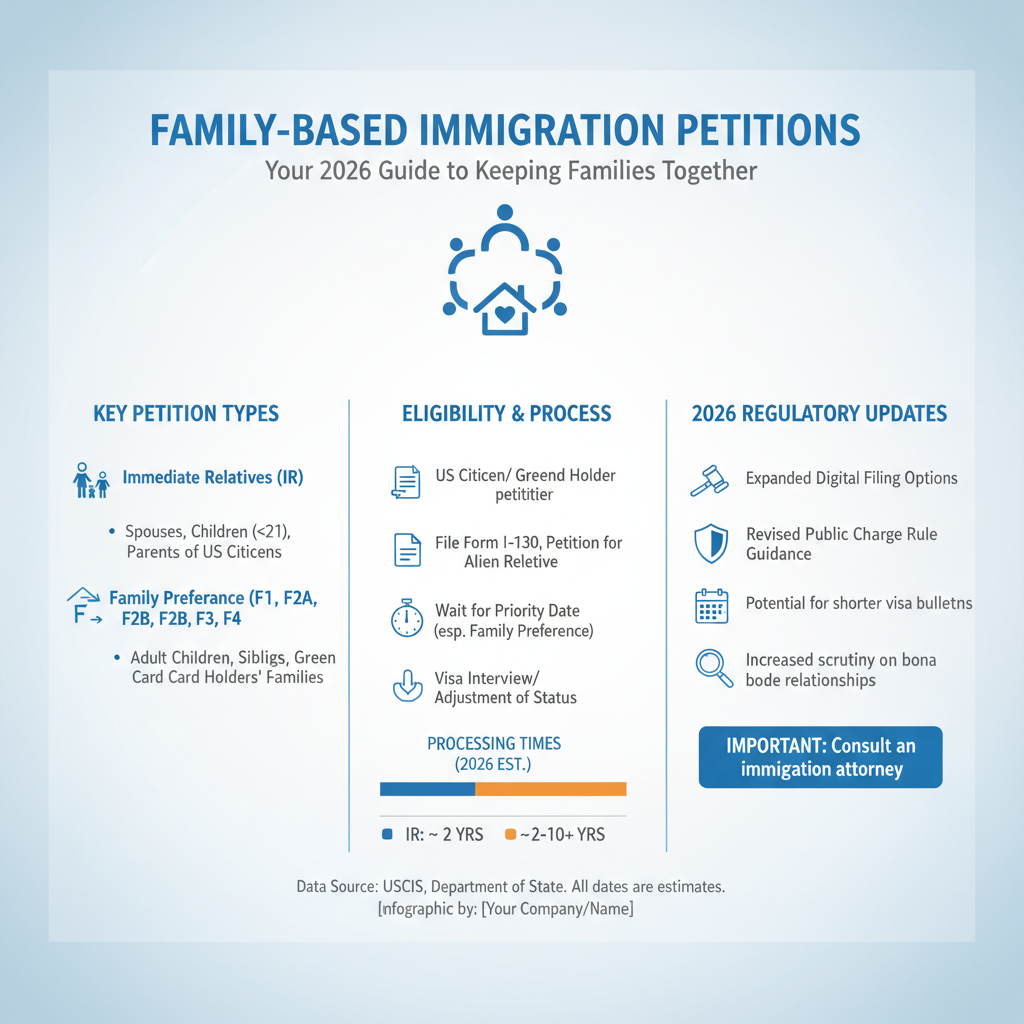
- Immediate Relatives: This category includes spouses of U.S. citizens, unmarried children under 21 of U.S. citizens, and parents of U.S. citizens (if the U.S. citizen is 21 or older). There are an unlimited number of visas for Immediate Relatives, meaning no long waits for a visa to become available once the Form I-130 is approved.
- Family Preference Categories: Other family relationships (e.g., adult children, siblings, spouses of LPRs) fall into preference categories with limited annual visas, leading to potential waiting periods based on the Priority Date.
- Adjustment of Status (AOS): The process of applying for a green card while physically present in the United States. This typically involves filing Form I-485, Application to Register Permanent Residence or Adjust Status.
- Consular Processing: The process of applying for an immigrant visa at a U.S. embassy or consulate abroad if the beneficiary is outside the United States.
- Affidavit of Support (Form I-864): A legally binding document signed by the petitioner (and sometimes a joint sponsor) to demonstrate that the beneficiary will not become a public charge in the U.S.
Concerned about eligibility? Our Orlando immigration attorneys specialize in family petitions. Call +1 786-791-3106 for a free, confidential consultation. Se Habla Español.
Current Immigration Law: The Foundation
Family-based immigration is primarily governed by the Immigration and Nationality Act (INA), which outlines the categories of relationships that qualify for sponsorship and the numerical limitations for certain categories. Understanding these laws is critical for a successful petition.
Federal requirements
The INA establishes two main types of family-based immigrant visas:
- Immediate Relatives of U.S. Citizens:
- Spouses of U.S. citizens (IR-1, CR-1)
- Unmarried children under 21 of U.S. citizens (IR-2, CR-2)
- Parents of U.S. citizens (IR-5) – the U.S. citizen must be at least 21 years old.
This category has no annual limit on the number of visas, meaning once the Form I-130 is approved, the beneficiary can typically apply for their green card immediately, without waiting for a Priority Date to become current (unless they are already in the U.S. and need to wait for their Adjustment of Status application to be processed).
- Family Preference Categories: These categories are subject to annual numerical limits, which often results in waiting periods based on the beneficiary's country of birth and their Priority Date.
- First Preference (F1): Unmarried sons and daughters (21 years of age or older) of U.S. citizens.
- Second Preference (F2A): Spouses and unmarried children (under 21 years of age) of Lawful Permanent Residents (LPRs).
- Second Preference (F2B): Unmarried sons and daughters (21 years of age or older) of Lawful Permanent Residents (LPRs).
- Third Preference (F3): Married sons and daughters of U.S. citizens.
- Fourth Preference (F4): Brothers and sisters of U.S. citizens (the U.S. citizen must be at least 21 years old).
Key Legal Reference: These categories are detailed in Section 201 and 203 of the Immigration and Nationality Act (INA). You can find more information on the USCIS official website.
Florida-specific considerations
While immigration law is federal, certain aspects touch upon state-level dynamics:
- Marriage Validity: If a family petition is based on marriage, the marriage must be legally valid under the laws of the jurisdiction where it took place. Florida recognizes most legal marriages, but understanding state marriage laws can be important for initial eligibility.
- Birth Certificates: Florida birth certificates are generally accepted as proof of relationship, but ensuring they meet federal requirements (e.g., long-form certificates) is essential.
- Criminal Records: Any criminal history in Florida (or elsewhere) for either the petitioner or beneficiary can significantly impact eligibility and may require waivers.
- Access to Legal Aid: For Central Florida residents, access to experienced immigration attorneys like Imigrar, located in Orlando, is a crucial resource for navigating these complex federal laws within a local context.
Important USCIS Forms:
- Form I-130, Petition for Alien Relative
- Form I-130A, Supplemental Information for Spouse Beneficiary
- Form I-485, Application to Register Permanent Residence or Adjust Status (for those in the U.S.)
- Form I-864, Affidavit of Support Under Section 213A of the INA
- Form I-765, Application for Employment Authorization (often filed concurrently with Form I-485)
- Form I-131, Application for Travel Document (often filed concurrently with Form I-485)
- Form DS-260, Immigrant Visa Electronic Application (for Consular Processing)
How to File a Family-Based Immigration Petition: A Complete Step-by-Step Guide
Filing a family-based petition is a multi-stage process that requires meticulous attention to detail. This guide breaks down the journey into actionable steps.
1) Determine Eligibility and Gather Initial Documentation
Before filing any forms, it's crucial to confirm that both the petitioner and beneficiary meet the basic eligibility criteria and to gather foundational documents.
- Petitioner's Eligibility:
- Must be a U.S. citizen or Lawful Permanent Resident (LPR).
- Must be able to prove a qualifying relationship with the beneficiary.
- Must be at least 18 years old to file Form I-130 and at least 21 years old to sponsor a parent or sibling.
- Must meet income requirements for the Affidavit of Support (Form I-864).
- Beneficiary's Eligibility:
- Must be a qualifying relative (spouse, child, parent, sibling) of the petitioner.
- Must not be inadmissible to the U.S. (e.g., due to certain criminal convictions, past immigration violations, health issues).
- Required Documents for Eligibility:
- Proof of Petitioner's Status:
- U.S. Birth Certificate, U.S. Passport, Certificate of Naturalization (Form N-550 or N-570), or Certificate of Citizenship (Form N-560 or N-561) for U.S. citizens.
- Green Card (Form I-551) for LPRs.
- Proof of Relationship:
- Marriage Certificate (for spouses).
- Birth Certificates (for parent-child relationships, showing both parent and child's names).
- Adoption Decrees (for adopted children).
- Divorce Decrees or Death Certificates for all prior marriages of both petitioner and beneficiary (if applicable).
- Beneficiary's Identification: Copy of beneficiary's passport, birth certificate.
- Passport-style photographs for both petitioner and beneficiary (following USCIS specifications).
- Proof of Petitioner's Status:
2) File Form I-130, Petition for Alien Relative
This is the first official step in the family-based immigration process. The petitioner files this form with USCIS to prove the qualifying relationship.
- Complete Form I-130: Fill out every section accurately and completely. If sponsoring a spouse, also complete Form I-130A.
- Attach Supporting Documents: Include all documents gathered in Step 1, along with any other evidence required for your specific relationship (e.g., evidence of a bona fide marriage if sponsoring a spouse).
- Pay Filing Fees: Check the USCIS website for current fees. Fees are non-refundable.
- Mail the Petition: Send the complete package to the correct USCIS Lockbox facility. The address depends on where you live and the type of petition.
- Receive Receipt Notice: USCIS will send a Form I-797C, Notice of Action, confirming receipt of your petition and providing a Priority Date. Keep this notice safe.
Required Documents (for Form I-130 submission):
- Completed and signed Form I-130 and Form I-130A (if applicable).
- Copy of petitioner's proof of U.S. citizenship or LPR status.
- Copy of petitioner's birth certificate (if sponsoring a parent or child).
- Copy of beneficiary's birth certificate.
- Copy of marriage certificate (if sponsoring a spouse).
- Copies of divorce decrees or death certificates for any prior marriages of both petitioner and beneficiary (if applicable).
- Passport-style photos of both petitioner and beneficiary.
- Evidence of a bona fide marriage (for spousal petitions): joint bank accounts, joint leases/mortgages, joint utility bills, affidavits from friends/family, photos together, etc.
- Proof of name change (if applicable).
- Filing fee (check or money order).
3) Wait for Petition Approval and Priority Date to Become Current
After filing Form I-130, USCIS will review your petition. This stage involves waiting for approval and, for preference categories, waiting for a visa to become available.
- USCIS Processing: USCIS will process your Form I-130. Processing times vary significantly by service center and petition type. You can check current USCIS Processing Times online.
- Approval Notice: If approved, you will receive Form I-797, Approval Notice.
- Visa Bulletin Monitoring (for Preference Categories): If your beneficiary is in a family preference category, you must monitor the U.S. Department of State Visa Bulletin monthly. Your Priority Date must be "current" before the beneficiary can apply for a green card.
- Immediate Relatives: For Immediate Relatives, once the Form I-130 is approved, the beneficiary can generally proceed to the next step without waiting for a visa to become current.
Important: Keep all notices from USCIS. Do not discard your Form I-797, Approval Notice.
4) Apply for a Green Card (Adjustment of Status or Consular Processing)
Once the Form I-130 is approved and a visa is available (for preference categories), the beneficiary can apply for their green card.
- Option A: Adjustment of Status (AOS)
- If the beneficiary is already in the U.S. and is eligible, they can apply to adjust their status to a lawful permanent resident without leaving the country. This typically involves filing Form I-485, Application to Register Permanent Residence or Adjust Status.
- Often, other forms like Form I-765 (Employment Authorization) and Form I-131 (Travel Document/Advance Parole) are filed concurrently.
- Required Documents for AOS:
- Completed and signed Form I-485.
- Copy of Form I-797, Approval Notice for Form I-130.
- Copy of beneficiary's passport, visa, and I-94 arrival record.
- Beneficiary's birth certificate.
- Two passport-style photographs of the beneficiary.
- Completed Form I-864, Affidavit of Support, from the petitioner (and joint sponsor if needed), with supporting financial documents (tax returns, pay stubs, employment verification letter).
- Form I-693, Report of Medical Examination and Vaccination Record, completed by a USCIS-approved civil surgeon.
- Copies of any criminal records (if applicable).
- Form I-765 (optional, for work permit) and Form I-131 (optional, for travel permit).
- Filing fees for Form I-485 and biometrics.
- Option B: Consular Processing
- If the beneficiary is outside the U.S. or is not eligible for Adjustment of Status, their case will be processed through a U.S. embassy or consulate in their home country.
- Once Form I-130 is approved, the National Visa Center (NVC) takes over, sending instructions to the petitioner and beneficiary to submit civil documents and the Affidavit of Support.
- Required Documents for Consular Processing (submitted to NVC):
- Completed Form DS-260, Immigrant Visa Electronic Application.
- Copy of Form I-797, Approval Notice for Form I-130.
- Copy of beneficiary's passport, birth certificate.
- Two passport-style photographs of the beneficiary.
- Completed Form I-864, Affidavit of Support, from the petitioner (and joint sponsor if needed), with supporting financial documents.
- Police certificates from all countries where the beneficiary has lived.
- Marriage certificate, divorce decrees (if applicable).
- Filing fees for NVC processing and immigrant visa application.
5) Attend Interview
This is a critical step where the beneficiary (and often the petitioner for spousal cases) meets with an immigration officer.
- Adjustment of Status Interview:
- The interview will typically be at a USCIS Field Office (e.g., the Orlando USCIS Field Office for Central Florida residents).
- Both petitioner and beneficiary are usually required to attend, especially for marriage-based green cards.
- The officer will review your application, ask questions about your relationship, and verify the information provided.
- Bring original documents: All documents submitted with your application, plus any additional evidence of your relationship or eligibility.
- Consular Interview:
- The interview will be at the U.S. embassy or consulate in the beneficiary's home country.
- Only the beneficiary attends the interview.
- A medical examination (Form I-693 equivalent) must be completed by a panel physician abroad before the interview.
- The Consular Officer will review documents, ask questions, and determine eligibility.
- Bring original documents: All civil documents and supporting evidence previously submitted to NVC.
6) Receive Decision
After the interview, the immigration officer will make a decision on the green card application.
- Approval:
- For Adjustment of Status, you may receive an approval notice and your green card in the mail within a few weeks.
- For Consular Processing, the embassy/consulate will stamp a visa in the beneficiary's passport. The beneficiary will then travel to the U.S., be admitted as a lawful permanent resident, and receive their green card by mail.
- Request for Evidence (RFE): If the officer needs more information, they may issue an RFE. Responding promptly and thoroughly is crucial.
- Denial: If the application is denied, USCIS or the consulate will provide a reason. It is vital to understand the denial and explore potential options, such as filing a motion to reconsider or reopening, or appealing the decision.
Warning: The immigration process can be complex. Even a small error or omission can lead to significant delays or denial. Consulting with an experienced immigration attorney from Imigrar is highly recommended throughout this entire process.
Practical Steps You Can Take Today
Starting the family-based immigration process can feel overwhelming, but there are concrete steps you can take right now to prepare.
Actionable Checklist (5+ items)
- Gather Core Documents: Start collecting birth certificates, marriage certificates, divorce decrees, and proof of your (petitioner's) U.S. citizenship or LPR status. Ensure they are originals or certified copies and consider obtaining official translations if not in English.
- Review Relationship Eligibility: Double-check that your relationship falls into one of the eligible categories (Immediate Relative or Family Preference). Understand the potential waiting times for your specific category by reviewing the Visa Bulletin.
- Assess Financial Sponsorship: Understand the income requirements for the Affidavit of Support (Form I-864). Gather your recent tax returns and pay stubs. If you anticipate not meeting the requirement, identify a potential joint sponsor early.
- Check for Inadmissibility Issues: Honestly assess if the beneficiary has any criminal history, prior immigration violations, or health issues that might make them inadmissible. These often require waivers and are best addressed proactively.
- Start a Dedicated Folder (Physical and Digital): Create an organized system for all immigration documents. Keep originals safe and make copies of everything you send to USCIS or NVC.
- Consult with an Immigration Attorney: This is arguably the most crucial step. An experienced attorney can assess your unique situation, identify potential pitfalls, and guide you through every stage, saving you time and stress.
Document preparation guidance
- Accuracy is Key: Ensure all information on forms matches your supporting documents exactly. Discrepancies can lead to RFEs or denials.
- Translations: Any document not in English must be accompanied by a complete and certified English translation. The translator must certify that they are competent to translate and that the translation is accurate.
- Copies, Not Originals (Usually): Unless specifically requested, send copies of supporting documents with your initial petition. Keep your originals safe. However, you MUST bring originals to your interview.
- Organize Clearly: Present your documents in a logical order, perhaps with tabs or cover sheets, to make it easy for the USCIS officer to review.
- Photographs: Adhere strictly to USCIS passport-style photo specifications (2x2 inches, white background, no glasses, etc.).
Timeline expectations
The timeline for family-based immigration varies wildly depending on several factors:
- Relationship Category: Immediate Relatives of U.S. citizens generally have the fastest processing. Preference categories involve waiting for a visa number to become available, which can take several years, even decades, for some categories and countries.
- Service Center Workload: USCIS processing times fluctuate. Always check the USCIS Processing Times page for the most up-to-date estimates.
- Completeness of Application: Errors or missing documents will lead to Requests for Evidence (RFEs) or Notices of Intent to Deny (NOIDs), significantly extending your timeline.
- Interview Scheduling: Interview availability at USCIS Field Offices (like the Orlando USCIS Field Office) or U.S. consulates abroad can impact how quickly your case progresses.
Reminder: While the overall process can take time, diligently preparing your documents and seeking expert guidance can help avoid unnecessary delays.

How Imigrar Helps Immigrants in Orlando
Navigating the complex landscape of U.S. immigration law, especially for family-based petitions, requires deep knowledge and experience. At Imigrar, we are dedicated to providing compassionate, effective legal representation to families in Orlando, Central Florida, and nationwide.
Our experience and expertise
Our team of seasoned immigration attorneys possesses extensive experience in all facets of family-based immigration. We have successfully helped countless clients:
- Determine Eligibility: We meticulously assess your unique family situation to identify the most appropriate immigration pathway and address any potential challenges from the outset.
- Prepare and File Petitions: From Form I-130 to Form I-485, and all supporting documentation, we ensure every form is accurately completed, all required evidence is submitted, and the application package is meticulously organized to prevent delays.
- Address Complex Issues: We are adept at handling intricate cases involving prior immigration violations, criminal records, waivers of inadmissibility, or other complications that can arise.
- Interview Preparation: We thoroughly prepare you for your USCIS or consular interview, ensuring you understand the process and feel confident answering questions about your relationship and eligibility.
- Respond to RFEs and Denials: If you receive a Request for Evidence or face a denial, we provide expert guidance and representation to craft strong responses and explore all available remedies.
- Guidance on Consular Processing vs. Adjustment of Status: We help you understand which pathway is best for your family member and guide you through the specific requirements for each.
Our commitment is to guide you through every step, providing clarity and support, so you can focus on the joyous prospect of reuniting with


