


At Imigrar, we understand that the dream of reuniting with family is at the heart of many immigration journeys. For families across Orlando, Florida, and the entire nation, navigating the intricate landscape of U.S. immigration law can be daunting. That's why we’re committed to providing clear, actionable guidance to help you keep your family together.
Today, we delve into the essential process of family-based immigration petitions – a pathway that allows U.S. citizens and lawful permanent residents to sponsor eligible relatives for a green card. This guide is designed to empower you with the knowledge and tools needed to understand and successfully navigate this critical process.
Need Help? Our Orlando immigration team is ready to assist. Call +1 786-791-3106 for a free consultation, or message us online. Se Habla Español.
The reporting that sparked this guide
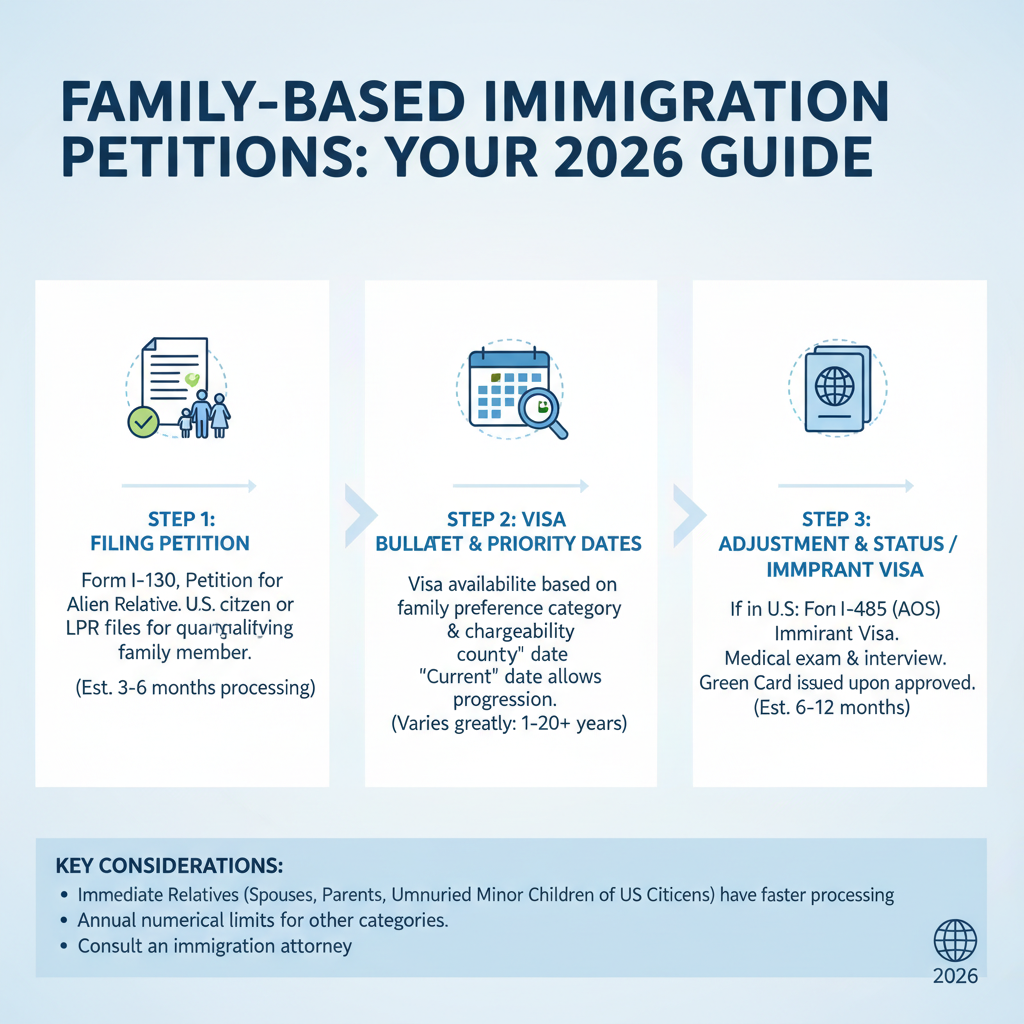
The continuous conversation around immigration law and family reunification remains a central topic in national news. Recent reporting, like that highlighted in a Family-Based Immigration Petition Guide (Immigration), underscores the ongoing need for clear, accessible information for families seeking to navigate the U.S. immigration system. These discussions emphasize the importance of understanding the step-by-step process for family petitions, from initial filing to final approval, and the critical role accurate guidance plays in ensuring successful outcomes.
What This News Means for Immigrants in Orlando and Across Florida
The sustained focus on family-based immigration underscores its enduring importance within the U.S. immigration framework. For immigrants and their families residing in Orlando, Central Florida, and throughout the Sunshine State, this means that the pathways for family reunification remain a cornerstone of immigration policy, albeit with complexities that require careful attention.
Why this news is showing up now
Immigration is a dynamic and often politically charged topic. Updates, discussions, and guides on family-based petitions frequently surface due to several factors:
- Ongoing Demand: There's a constant, high demand for family reunification. Thousands of petitions are filed annually, making it a perpetually relevant subject.
- Policy Changes & Updates: While the core law (Immigration and Nationality Act) is stable, administrative policies, processing times, and interpretations by U.S. Citizenship and Immigration Services (USCIS) can evolve. News outlets often report on these changes or simply re-emphasize existing processes for clarity.
- Backlog & Processing Times: Significant backlogs in certain visa categories and fluctuating processing times at USCIS and the Department of State consistently generate public interest and the need for updated guidance.
- Legislative Debates: While major legislative overhauls are rare, ongoing debates in Congress about immigration reform often highlight the family-based system, prompting renewed attention.
As of April 2026, the emphasis remains on efficient, accurate filing and understanding current processing realities.
How it can affect Florida residents
For individuals and families in Florida, particularly in diverse hubs like Orlando, Tampa, and Miami, the implications of family-based immigration news are direct and profound:
- Local USCIS Impact: The Orlando USCIS Field Office, located at 5449 Forbes Pl, Orlando, FL 32812, processes many local interviews and applications for adjustment of status. Understanding the federal guidelines directly affects how cases are handled at this local level.
- Community Relevance: Florida has a large and vibrant immigrant population, with family ties stretching across the globe. News and guides on family petitions are directly relevant to countless families living along the I-4 corridor and beyond, who are actively seeking to bring loved ones to the U.S.
- State-Specific Resources: While immigration law is federal, access to legal aid, document translation services, and community support groups can vary by state and even by county (e.g., Orange County, Osceola County). Staying informed helps residents leverage available local resources.
- Economic and Social Integration: Successful family reunification contributes significantly to Florida's economy and social fabric. When families can unite, they build stable lives, contribute to the workforce, and enrich communities.
For those living in Florida, especially in areas like Orlando, understanding the nuances of family-based immigration is not just theoretical; it’s a practical necessity that directly impacts their ability to build a future with their loved ones.
What Family-Based Immigration Petitions Are (and Why They Matter)
At its core, a family-based immigration petition is the primary legal pathway for U.S. citizens and lawful permanent residents (green card holders) to sponsor certain eligible family members for immigration to the United States. This process begins with demonstrating a valid family relationship to the U.S. government.
Why does it matter? Because it is often the only way for families to legally reunite and for sponsored relatives to obtain a green card, allowing them to live, work, and study permanently in the U.S. Without this process, millions of families would remain separated, unable to share their lives in the same country.
A plain-English definition
Think of a family-based immigration petition as a formal request to the U.S. government to recognize a family relationship for immigration purposes. If you are a U.S. citizen or a green card holder, you can ask the government to allow specific relatives to come and live permanently in the United States. This request starts with filing a specific form, typically Form I-130, Petition for Alien Relative. Once approved, it establishes that a legitimate family connection exists, which is the first crucial step toward your loved one receiving their green card.
Key terms you need to know
Navigating immigration can be like learning a new language. Here are some essential terms you’ll encounter:
- Petitioner: The U.S. citizen or lawful permanent resident who files Form I-130 to sponsor a relative.
- Beneficiary: The foreign national relative who is being sponsored for a green card.
- Immediate Relative: This is a special category for spouses of U.S. citizens, unmarried children under 21 of U.S. citizens, and parents of U.S. citizens (if the U.S. citizen is 21 or older). There are an unlimited number of visas available for Immediate Relatives, meaning they do not have to wait for a visa to become available based on an annual quota.
- Family Preference Categories: These are categories for other eligible relatives who are not Immediate Relatives. They include:
- First Preference (F1): Unmarried sons and daughters (21 or older) of U.S. citizens.
- Second Preference (F2A): Spouses and children (unmarried, under 21) of lawful permanent residents.
- Second Preference (F2B): Unmarried sons and daughters (21 or older) of lawful permanent residents.
- Third Preference (F3): Married sons and daughters of U.S. citizens.
- Fourth Preference (F4): Brothers and sisters of U.S. citizens (if the U.S. citizen is 21 or older).
- Priority Date: This is the date USCIS receives your properly filed Form I-130. It establishes your place in line for a visa, especially for Family Preference Categories. You can track this date using the Visa Bulletin, published monthly by the U.S. Department of State.
- Visa Bulletin: A monthly publication that indicates which priority dates are current for different visa categories and countries. When your priority date becomes "current," it means a visa is available for your relative, and they can proceed with their green card application.
- Adjustment of Status (AOS): The process of applying for a green card while physically present in the United States. This is typically done by filing Form I-485, Application to Register Permanent Residence or Adjust Status.
- Consular Processing: The process of applying for an immigrant visa at a U.S. embassy or consulate abroad. This is for beneficiaries who are outside the U.S. and cannot adjust status.
- Affidavit of Support: A legally binding document (Form I-864, Affidavit of Support Under Section 213A of the INA) signed by the petitioner, promising financial support for the beneficiary to ensure they do not become a public charge in the U.S.
- Public Charge Rule: A long-standing principle in immigration law that allows the U.S. government to deny admission or a green card to individuals who are likely to become primarily dependent on government assistance.
Current Immigration Law: The Foundation of Family Petitions
The legal framework for family-based immigration is primarily established by the Immigration and Nationality Act (INA). This comprehensive body of law dictates who can immigrate, under what conditions, and through which processes. Understanding the INA is crucial, as it underpins every step of the family petition process.
Specifically, Sections 201 through 204 of the INA define the categories of family relationships eligible for sponsorship, the numerical limitations for preference categories, and the procedures for filing petitions. These sections are regularly interpreted and applied by USCIS and the Department of State.
Federal requirements
The federal government, through agencies like USCIS and the U.S. Department of State, sets the overarching rules for family-based immigration:
- Valid Relationship: The petitioner must prove a genuine family relationship with the beneficiary, as defined by the INA. This requires submitting birth certificates, marriage certificates, and sometimes additional evidence to prove the relationship is legitimate and not solely for immigration purposes.
- Petitioner Eligibility: The petitioner must be either a U.S. citizen or a lawful permanent resident. They must also be at least 18 years old to file the Form I-130, and at least 21 years old to sponsor a parent or sibling.
- Financial Sponsorship: The petitioner must demonstrate the financial ability to support the beneficiary at 125% above the federal poverty guidelines (or 100% for active military members sponsoring a spouse or child). This is shown through Form I-864, Affidavit of Support Under Section 213A of the INA, and supporting financial documents like tax returns, pay stubs, and employment verification letters. If the petitioner's income is insufficient, a joint sponsor may be required.
- Admissibility: The beneficiary must be admissible to the U.S., meaning they must not have certain criminal records, past immigration violations, specific health conditions, or other grounds of inadmissibility. Waivers may be available for some grounds.
- Proper Documentation: All forms must be correctly filled out, signed, and accompanied by all required supporting documents and fees. Failure to do so can lead to delays or denials. You can find all necessary forms and instructions on the USCIS Forms page.
Warning: The immigration process is complex. Even minor errors can cause significant delays. It's vital to follow all instructions precisely.
Florida-specific considerations
While immigration law is federal, certain aspects can have practical, local implications for Florida residents:
- Local USCIS Offices: For those undergoing Adjustment of Status, interviews are typically conducted at the nearest USCIS Field Office. For Central Florida residents, this is the Orlando USCIS Field Office. Familiarity with local office procedures and common interview questions can be beneficial.
- State Document Requirements: When gathering birth certificates, marriage licenses, or divorce decrees, ensure they meet Florida's state requirements for official documents (e.g., certified copies).
- Access to Services: Florida, especially metropolitan areas like Orlando, Miami, and Tampa, offers a robust network of legal and support services for immigrants. This includes legal aid organizations, community centers offering language assistance, and notaries familiar with immigration documents.
- Public Charge Implications: While the public charge rule is federal, the availability of state-specific benefits and understanding how they interact with federal guidelines can be important for sponsors and beneficiaries residing in Florida.
Reminder: No state has its own immigration laws separate from federal law. However, local resources and administrative procedures can impact the practical application of federal law for Florida residents.
For more information on federal immigration processes and to access official forms, always refer to the USCIS official website.
Need Help? Our Orlando immigration team is ready to assist. Call +1 786-791-3106 for a free consultation, or message us online. Se Habla Español.
How to File a Family-Based Immigration Petition: A Complete Step-by-Step Guide
Filing a family-based petition is a multi-step process that requires precision and patience. Here’s a comprehensive guide to help you navigate each stage:
1) File Form I-130, Petition for Alien Relative
This is the foundational step. The U.S. citizen or lawful permanent resident (the Petitioner) files this form with USCIS to establish the qualifying family relationship with the foreign national (the Beneficiary).
- Who Files: The U.S. citizen or LPR petitioner.
- Where to File: USCIS Lockbox facility, or online for certain categories. Check the USCIS Form I-130 page for current filing instructions.
- Required Documents for Form I-130:
- Completed and signed Form I-130.
- Proof of U.S. citizenship (e.g., birth certificate, passport, naturalization certificate) or LPR status (green card copy) for the petitioner.
- Proof of the qualifying relationship (e.g., marriage certificate for spouses, birth certificates for parent-child relationships, proof of legal termination of prior marriages for both parties if applicable).
- Passport-style photos of both the petitioner and beneficiary (if filing concurrently with Form I-485, or if specifically requested).
- Copy of the beneficiary's birth certificate.
- Filing fee (check USCIS Fee Schedule for current amounts).
- Any additional evidence to prove the bona fides of the relationship (e.g., photos, joint bank accounts, lease agreements, affidavits from friends/family – especially for spousal petitions).
- Translations of any foreign language documents, certified by a competent translator.
- Processing Time: Varies significantly by relationship category and USCIS service center. Check USCIS Processing Times for current estimates.
2) Wait for I-130 Approval and Priority Date to Become Current
After filing, USCIS will send a receipt notice (Form I-797C, Notice of Action). You can use the receipt number to track your case online. Once USCIS approves the Form I-130, they will send an approval notice (Form I-797, Notice of Action).
- Immediate Relatives: For spouses, unmarried children under 21, and parents of U.S. citizens, there is no visa quota, so a visa is "immediately available" once the I-130 is approved. They can often proceed directly to the next step, sometimes even filing Form I-485 concurrently with Form I-130 if eligible.
- Family Preference Categories: This is where the Priority Date and Visa Bulletin become critical. Once your Form I-130 is approved, you must wait for your priority date to become current in the monthly Visa Bulletin. This waiting period can range from a few years to over a decade, depending on the category and the beneficiary's country of birth.
Important: Keep your I-797 notices safe. They are proof of your petition filing and approval.
3) Choose the Green Card Application Pathway: Adjustment of Status or Consular Processing
Once the Form I-130 is approved and a visa is available (if applicable), the beneficiary can apply for their green card. The path they take depends on whether they are already in the U.S. or abroad.
- Adjustment of Status (AOS) – For Beneficiaries in the U.S.:
- If the beneficiary is physically present in the U.S. and entered legally, they may be eligible to "adjust" their status to a lawful permanent resident without leaving the country.
- They will file Form I-485, Application to Register Permanent Residence or Adjust Status, along with supporting forms like Form I-765 (Application for Employment Authorization) and Form I-131 (Application for Travel Document).
- This is often done concurrently with Form I-130 for Immediate Relatives.
- Required Documents for I-485 (and concurrent filings):
- Completed and signed Form I-485.
- Copy of Form I-130 approval notice (if not filed concurrently).
- Birth certificate.
- Marriage certificate (if applicable).
- Passport-style photos.
- Form I-864, Affidavit of Support, with petitioner's financial documents (tax returns, employment letter).
- Form I-693, Report of Medical Examination and Vaccination Record, completed by a USCIS-approved civil surgeon in Orlando or elsewhere in Florida.
- Copies of passport, visa, and I-94 arrival/departure record.
- Copies of all previous immigration documents (e.g., EAD cards, advance parole, previous visa stamps).
- Criminal history records (if applicable).
- Filing fees for Form I-485, Form I-765, and Form I-131 (check USCIS fee schedule).
- Consular Processing – For Beneficiaries Outside the U.S.:
- If the beneficiary is outside the U.S., or ineligible for Adjustment of Status, their case will be forwarded to the National Visa Center (NVC), part of the U.S. Department of State.
- The NVC will collect fees and required civil and financial documents, including Form I-864.
- The beneficiary will complete the online Form DS-260, Immigrant Visa Application.
- Once all documents are submitted and reviewed, the NVC will schedule an interview at the U.S. embassy or consulate in the beneficiary's home country.
- Required Documents for Consular Processing (NVC stage):
- Confirmation page of Form DS-260.
- Form I-864, Affidavit of Support, with petitioner's financial documents.
- Beneficiary's birth certificate.
- Marriage certificate (if applicable).
- Police certificates from all countries where the beneficiary lived for certain periods.
- Military records (if applicable).
- Court and prison records (if applicable).
- Passport-style photos.
- Valid passport.
- Translations of any foreign language documents.
4) Attend Biometrics Appointment and Interview
Regardless of whether the beneficiary is adjusting status or undergoing consular processing, biometrics (fingerprints, photos, signature) and an interview are almost always required.
- Biometrics: USCIS will send a notice for a biometrics appointment at an Application Support Center (ASC). For Orlando residents, this typically means the ASC located in the greater Orlando area. This step is for background checks.
- Interview:
- AOS Interview: If adjusting status, the beneficiary and often the petitioner will attend an interview at a USCIS Field Office (e.g., Orlando USCIS Field Office). The officer will verify the information on the forms and ask questions about the relationship and the beneficiary's eligibility.
- Consular Interview: The beneficiary will attend an interview at the U.S. embassy or consulate abroad. They will need to bring all original documents submitted to the NVC, along with their passport and interview notice. A medical exam will also be required with a panel physician approved by the embassy/consulate.
- Documents to Bring to Interview:
- Originals of all documents submitted (birth certificates, marriage certificates, passports, I-94, etc.).
- Any additional evidence of the bona fides of the relationship (e.g., recent photos, joint bills, travel itineraries).
- Updated financial documents for the petitioner (most recent pay stubs, employment verification letter).
- Interview notice.
5) Receive Decision and Green Card
The final step is the decision on the green card application.
- Approval:
- AOS: If approved, USCIS will mail the green card directly to the beneficiary. This usually happens within a few weeks after the interview.
- Consular Processing: If approved, the consular officer will stamp a visa in the beneficiary's passport. The beneficiary can then travel to the U.S. and will receive their physical green card by mail after paying the USCIS Immigrant Fee online and entering the U.S.
- Conditional Green Card: If the marriage to a U.S. citizen is less than two years old at the time the green card is approved, the beneficiary will receive a conditional green card valid for two years. They will need to file Form I-751, Petition to Remove Conditions on Residence, within the 90-day window before the two-year card expires to get a 10-year permanent green card.
- Denial: If the application is denied, USCIS or the consular officer will provide a reason. It is crucial to understand the reason for denial, as it may be possible to appeal or refile, depending on the circumstances.
Practical Steps You Can Take Today for Your Family Petition
Starting the family-based immigration process can feel overwhelming, but taking proactive steps can significantly streamline your journey. Here’s an actionable checklist:
- 1. Gather All Necessary Documents: Start compiling birth certificates, marriage licenses, divorce decrees, passports, and any other identity or relationship documents for both the petitioner and beneficiary. Ensure they are official, certified copies.
- 2. Review Eligibility Criteria: Double-check that both the petitioner (U.S. citizen or LPR) and the beneficiary meet all the eligibility requirements for the specific family category. Pay close attention to age requirements, marital status, and previous immigration history.
- 3. Assess Financial Sponsorship Capacity: Collect the petitioner's tax returns (for the last three years), W-2s, pay stubs, and an employment letter. Determine if your income meets the 125% federal poverty guidelines. If not, identify a potential joint sponsor early.
- 4. Organize Your Records: Create a well-organized system for all your documents, both physical and digital. Label folders clearly and keep a checklist of what you have and what you still need. This will save immense time and stress later.
- 5. Understand Timelines: While specific processing times vary, research the general timelines for your category using the USCIS Processing Times tool. This helps set realistic expectations and allows you to plan for potential delays. Remember, the Priority Date is key for preference categories.
- 6. Begin Learning Key Terms: Familiarize yourself with terms like Adjustment of Status, Consular Processing, Priority Date, and Visa Bulletin. The more you understand the jargon, the easier it will be to comprehend the process.
- 7. Seek Professional Guidance: The best proactive step is to consult with an experienced immigration attorney. An attorney can help you identify potential issues, ensure correct form completion, and guide you through every stage.
Document preparation guidance
Accuracy and completeness are paramount. Every document submitted must be legible and accurate. If a document is in a foreign language, it must be accompanied by a full English translation certified by a competent translator. Do not submit original documents unless specifically requested by USCIS, always send certified copies. Keep your own copies of everything you submit.
Timeline expectations
Expect the process to take time. For Immediate Relatives, the total process can range from 6 months to 2 years, especially if there are requests for evidence (RFEs). For Family Preference Categories, waiting for a priority date to become current can add years, sometimes over a decade, to the total timeline. Patience and continuous monitoring of the Visa Bulletin are essential.
Need Help? Our Orlando immigration team is ready to assist. Call +1 786-791-3106 for a free consultation, or message us online. Se Habla Español.

How Imigrar Helps Immigrants in Orlando and Beyond
At Imigrar, we are more than just legal advisors; we are advocates for families.


