


Family-Based Immigration Petitions: Your Orlando Guide to Keeping Families Together
At Imigrar, we understand that nothing is more important than family. For many, the dream of living together in the United States begins with a family-based immigration petition. This process, while incredibly rewarding, can also be complex and overwhelming. Our mission is to simplify this journey, providing clear, actionable guidance to help you keep your family together.
Need Help? Our Orlando immigration team is ready to assist. Call +1 786-791-3106 for a free consultation, or message us online. Se Habla Español.
The reporting that sparked this guide:
The continuous flow of information regarding immigration processes, particularly those involving family reunification, is always at the forefront of our news consumption. Recent reporting from various immigration news outlets highlights the ongoing need for clear, accessible information on family-based petitions. This guide is inspired by the persistent public interest in understanding and navigating these crucial pathways:
Family-Based Immigration Petition Guide (Immigration)
What This News Means for Immigrants in Orlando and Across Florida
The consistent focus on family-based immigration in news cycles underscores its critical importance to countless individuals and families. For those living in Orlando, across Florida, and indeed nationwide, this ongoing discussion is a constant reminder of both the opportunities and the challenges within the U.S. immigration system.
Why this news is showing up now
Family-based immigration is a perennial topic because it represents the cornerstone of U.S. immigration policy – the principle of family unity. As policies evolve, processing times fluctuate, and global events influence migration patterns, the mechanics of family petitions remain a subject of intense public interest. Every year, millions of individuals seek to reunite with their loved ones, making the family petition process a consistently relevant and trending topic in immigration news. Furthermore, legislative discussions and administrative policy changes frequently impact how these petitions are processed, leading to renewed media attention and public inquiry.
How it can affect Florida residents
Florida, with its vibrant and diverse immigrant communities, is particularly impacted by developments in family-based immigration. For residents in Orlando and Central Florida, understanding the latest requirements and procedures is vital. Whether you are a U.S. citizen or a lawful permanent resident (Green Card holder) hoping to bring a spouse, child, parent, or sibling to the U.S., or you are the beneficiary of such a petition, changes or clarifications in law directly affect your future. Longer processing times, new document requirements, or shifts in interview protocols can have significant consequences. Florida's high population of immigrants means that any updates to the family petition process resonate deeply within communities from Miami to Jacksonville, including right here in Orange County. Keeping informed allows families to plan more effectively and seek timely legal assistance.
What Family-Based Immigration Petitions Are (and Why They Matter)
At its core, a family-based immigration petition is the first formal step a U.S. citizen or lawful permanent resident takes to help a foreign-national family member immigrate to the United States and obtain a Green Card. These petitions are the bedrock of family reunification in America, reflecting the nation's commitment to keeping families together.
A plain-English definition
Think of a family-based immigration petition as an official request to the U.S. government, specifically U.S. Citizenship and Immigration Services (USCIS), asking them to recognize a family relationship. If USCIS approves this petition, it means they agree that a legitimate family tie exists between the U.S. citizen or Green Card holder (the "petitioner") and their relative (the "beneficiary"). This approval then allows the beneficiary to apply for an immigrant visa (if outside the U.S.) or adjust their status to a lawful permanent resident (if already inside the U.S.) – essentially, to get their Green Card.
Key terms you need to know
- Petitioner: The U.S. citizen or lawful permanent resident who files the immigration petition for their relative.
- Beneficiary: The foreign national relative who wishes to immigrate to the U.S.
- Form I-130, Petition for Alien Relative: The primary form filed by the petitioner to establish the family relationship.
- Green Card: Official documentation (Form I-551) proving lawful permanent resident status in the United States.
- Lawful Permanent Resident (LPR): An individual who has been granted the privilege of permanently residing in the United States. Also known as a Green Card holder.
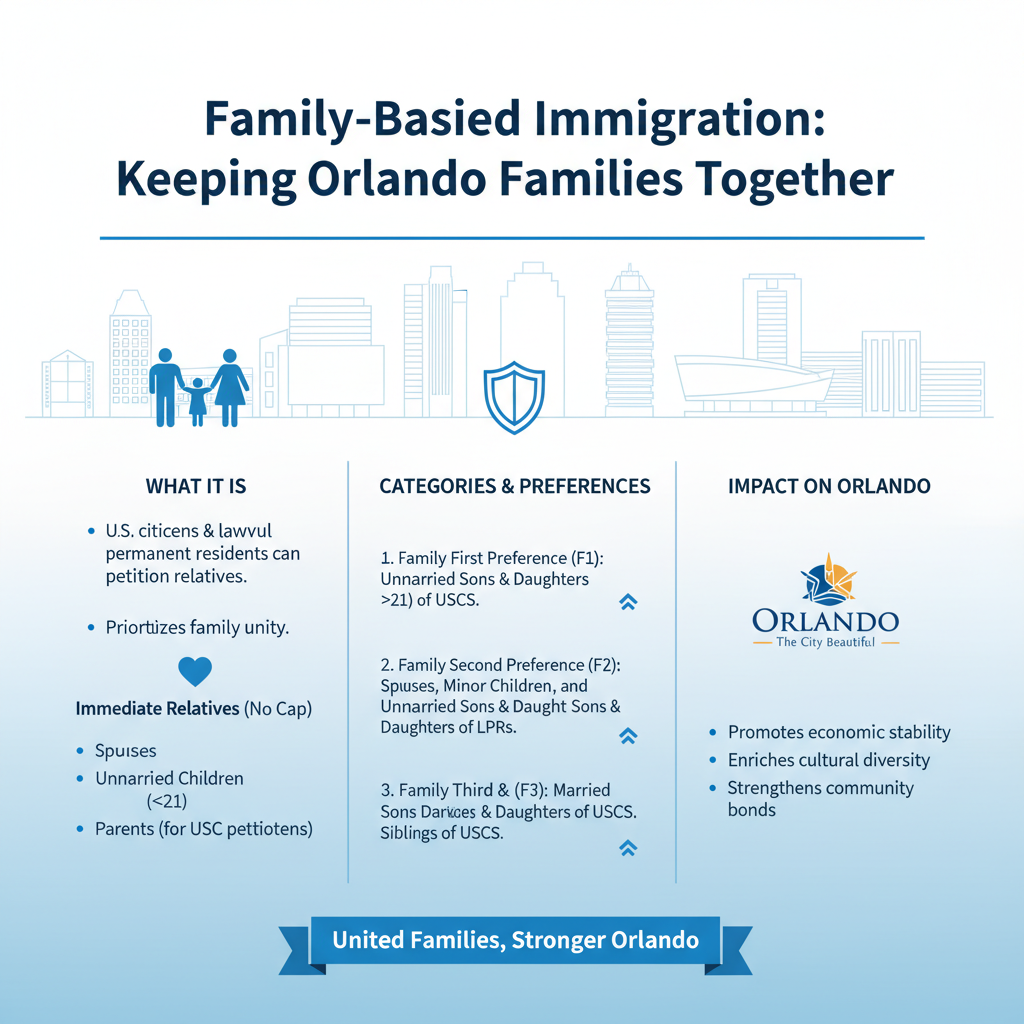
- Immediate Relatives: This category includes spouses of U.S. citizens, unmarried children under 21 of U.S. citizens, and parents of U.S. citizens (if the U.S. citizen is 21 or older). There are an unlimited number of visas available for immediate relatives, meaning they do not have to wait for a visa to become available once the Form I-130 is approved.
- Family Preference Categories: These categories are for specific, more distant family relationships or for relatives of lawful permanent residents. There are annual limits on the number of visas available in these categories, which means beneficiaries often face a waiting period based on their "Priority Date" and the "Visa Bulletin."
- Priority Date: The date USCIS receives your Form I-130 petition. This date determines your place in the waiting line for a visa if you are in a preference category.
- Visa Bulletin: A monthly publication by the U.S. Department of State that lists when immigrant visas become available for specific preference categories and countries. Available at U.S. Department of State Visa Bulletin.
- Adjustment of Status (AOS): The process for eligible foreign nationals already present in the U.S. to apply for lawful permanent resident status without having to return to their home country. This typically involves filing Form I-485.
- Consular Processing: The process for foreign nationals living outside the U.S. to apply for an immigrant visa at a U.S. embassy or consulate in their home country.
- Affidavit of Support (Form I-864): A legally binding document filed by the petitioner (and sometimes a joint sponsor) to show that the beneficiary will not become a "public charge" and has adequate financial support.
Current Immigration Law: The Foundation of Family Petitions
Family-based immigration is primarily governed by the Immigration and Nationality Act (INA), which outlines the categories of relationships that qualify for immigration and sets the framework for the entire process. Understanding these legal foundations is crucial.
Federal requirements
The INA establishes two main categories for family-based immigration:
- Immediate Relatives (IR): As defined in INA Section 201(b)(2)(A)(i), this category includes:
- Spouses of U.S. citizens (IR-1/CR-1)
- Unmarried children under 21 of U.S. citizens (IR-2/CR-2)
- Parents of U.S. citizens (IR-5), provided the U.S. citizen is at least 21 years old.
- Family Preference Categories: These categories are subject to annual numerical limitations set by Congress (INA Section 201(c) and 203(a)) and often involve significant waiting periods. The categories are:
- First Preference (F1): Unmarried sons and daughters (21 years of age or older) of U.S. citizens.
- Second Preference (F2): Spouses and children (unmarried, under 21) of lawful permanent residents (F2A); and unmarried sons and daughters (21 years of age or older) of lawful permanent residents (F2B).
- Third Preference (F3): Married sons and daughters of U.S. citizens.
- Fourth Preference (F4): Brothers and sisters of U.S. citizens, provided the U.S. citizen is at least 21 years old.
In addition to proving the relationship, petitioners must also demonstrate the financial ability to support the beneficiary. This is typically done through Form I-864, Affidavit of Support, ensuring the immigrant will not become a "public charge." This is a requirement under INA Section 212(a)(4).
All forms and detailed instructions are available on the USCIS Forms page and the USCIS official website.
Florida-specific considerations
While immigration law is federal, practical aspects can have local nuances. For Central Florida residents, your case will generally be processed through the USCIS service centers, but if an interview is required for Adjustment of Status, it will likely take place at the Orlando USCIS Field Office. Familiarity with local office procedures and common interview questions can be beneficial. Furthermore, access to local resources, such as accredited legal assistance and community organizations, is vital. Imigrar, located in Orlando, is deeply familiar with the local landscape and can provide tailored advice for clients in Orange County and along the I-4 corridor.
Need Help? Our Orlando immigration team is ready to assist. Call +1 786-791-3106 for a free consultation, or message us online. Se Habla Español.
How to File a Family-Based Immigration Petition: A Complete Step-by-Step Guide
Navigating the family-based immigration petition process can feel like a labyrinth. Below is a comprehensive step-by-step guide to help you understand what's involved, from initial eligibility to obtaining the Green Card.
1) Determine Eligibility & Gather Initial Information
Before you even fill out a form, you must confirm that the petitioner and beneficiary meet the basic eligibility criteria. This involves verifying the petitioner's status (U.S. citizen or LPR) and the nature of the family relationship.
- Petitioner's Eligibility:
- Must be a U.S. citizen or a lawful permanent resident.
- Must be able to prove the qualifying relationship.
- Must be at least 18 years old to sponsor an immigrant for financial purposes (Form I-864). For parents of U.S. citizens, the U.S. citizen must be at least 21.
- Beneficiary's Eligibility:
- Must be in a qualifying relationship with the petitioner (e.g., spouse, child, parent, sibling).
- Must not be inadmissible to the U.S. (e.g., due to certain criminal convictions, past immigration violations, health issues).
- Required Documents for Initial Assessment:
- Petitioner's proof of U.S. citizenship (U.S. birth certificate, naturalization certificate, U.S. passport) OR proof of LPR status (Green Card copy).
- Proof of relationship: Marriage certificate (for spouses), birth certificates (for parents/children), adoption decrees (for adopted children), etc.
- Proof of legal name changes (if any).
2) File Form I-130, Petition for Alien Relative
This is the foundational step. The U.S. citizen or LPR (petitioner) files Form I-130 with USCIS to establish the qualifying relationship with their foreign national relative (beneficiary).
- Completing Form I-130: Fill out the form accurately and completely. Any errors or omissions can lead to delays or denials.
- Required Documents to submit with Form I-130:
- Completed and signed Form I-130.
- Filing fee (check USCIS Filing Fees for current amount).
- Proof of U.S. citizenship or LPR status for the petitioner (e.g., copy of U.S. passport, birth certificate, naturalization certificate, or Green Card).
- Proof of qualifying relationship (e.g., marriage certificate, birth certificate, adoption decree).
- Passport-style photos of both petitioner and beneficiary (if required, check instructions for your specific case type).
- For spouses: Marriage certificate, divorce decrees from prior marriages (if applicable), joint documents proving the marriage is bona fide (e.g., joint bank statements, utility bills, photos together, affidavits from friends/family).
- For children: Birth certificate showing parentage.
- For parents: U.S. citizen's birth certificate showing parentage.
- Submission: Mail the complete package to the USCIS Lockbox facility specified in the Form I-130 instructions.
- What Happens Next: USCIS will send a receipt notice (Form I-797C, Notice of Action) confirming they received your petition. This notice will contain your Priority Date.
3) Wait for Form I-130 Approval & Priority Date to Become Current
After filing, USCIS processes the petition. This stage involves waiting for approval and, for preference categories, waiting for a visa to become available.
- USCIS Processing: USCIS reviews the petition and supporting documents. They may send a Request for Evidence (RFE) if they need more information.
- Approval (Form I-797, Notice of Action): If approved, USCIS sends an approval notice.
- Waiting for a Visa (Preference Categories ONLY):
- If the beneficiary is an Immediate Relative, they can move to the next step once Form I-130 is approved.
- If the beneficiary is in a Family Preference Category, they must wait for their Priority Date to become current according to the Visa Bulletin. This waiting period can range from a few years to over a decade, depending on the category and the beneficiary's country of birth.
- Checking Processing Times: You can check estimated processing times for Form I-130 on the USCIS Processing Times website.
4) Choose Path: Adjustment of Status (Form I-485) or Consular Processing
Once the Form I-130 is approved and a visa is available (if applicable), the beneficiary can apply for their Green Card. The path depends on whether they are inside or outside the U.S.
- Option A: Adjustment of Status (AOS) - For Beneficiaries IN the U.S.
- Eligibility: Generally, beneficiaries must have entered the U.S. legally and maintained their nonimmigrant status (though there are exceptions, like for immediate relatives who entered legally).
- Forms: The beneficiary files a package of forms with USCIS:
- Form I-485, Application to Register Permanent Residence or Adjust Status
- Form I-864, Affidavit of Support (filed by the petitioner)
- Form I-693, Report of Medical Examination and Vaccination Record (completed by a USCIS-approved civil surgeon)
- Form I-765, Application for Employment Authorization (optional, allows work while AOS is pending)
- Form I-131, Application for Travel Document (optional, allows travel while AOS is pending, also known as "Advance Parole")
- Required Documents for AOS Package:
- All completed and signed forms listed above.
- Filing fees for all forms (check USCIS Filing Fees).
- Copy of Form I-130 approval notice.
- Copies of beneficiary's passport, visa, Form I-94 (arrival/departure record).
- Birth certificate of beneficiary.
- Marriage certificate (if applicable).
- Passport-style photos of beneficiary.
- Medical exam results (Form I-693).
- Police clearances/criminal records (if applicable).
- Financial documents for Form I-864 (tax returns, W-2s, employment verification letter, bank statements).
- Submission: Mail the complete package to the USCIS Lockbox facility specified in the Form I-485 instructions.
- Option B: Consular Processing - For Beneficiaries OUTSIDE the U.S.
- Process: Once Form I-130 is approved and a visa is available, USCIS forwards the approved petition to the National Visa Center (NVC).
- NVC Stage: The NVC will contact the petitioner and beneficiary to collect additional documents and fees, including the Affidavit of Support (Form I-864) and civil documents (birth certificates, marriage certificates, police certificates, etc.).
- Required Documents for NVC Stage:
- Affidavit of Support (Form I-864) from the petitioner and any joint sponsors, along with supporting financial documentation.
- Beneficiary's birth certificate, marriage certificate (if applicable), divorce decrees (if applicable).
- Police certificates from all countries where the beneficiary has lived for certain periods.
- Passport biographical page.
- Digital passport-style photos.
- Scheduling Interview: Once all documents and fees are submitted to the NVC and accepted, the NVC schedules an immigrant visa interview at the U.S. embassy or consulate in the beneficiary's home country.
5) Attend Interview
Both Adjustment of Status and Consular Processing generally require an interview.
- For AOS (in the U.S.):
- The petitioner and beneficiary attend an interview at a USCIS Field Office (e.g., the Orlando USCIS Field Office for Central Florida residents).
- An officer will review the application, verify the relationship, and confirm eligibility.
- Be prepared to answer questions about your relationship, background, and intent.
- Bring originals of all documents submitted, plus any new evidence.
- For Consular Processing (outside the U.S.):
- The beneficiary attends an interview at the designated U.S. embassy or consulate.
- Before the interview, the beneficiary must undergo a medical examination with a panel physician approved by the embassy/consulate.
- The consular officer will review the application, verify the relationship, ensure no inadmissibility grounds exist, and confirm eligibility for the immigrant visa.
- Bring all original civil documents, medical exam results, and passport.
6) Receive Green Card or Immigrant Visa
This is the culmination of the process.
- For AOS: If the interview is successful, USCIS will approve the Form I-485. The beneficiary will receive their physical Green Card (Form I-551) by mail, typically within a few weeks.
- For Consular Processing: If the interview is successful, the consular officer will issue an immigrant visa stamp in the beneficiary's passport. The beneficiary then has a limited time (usually 6 months) to travel to the U.S. and officially enter as a lawful permanent resident. Upon entry, the Green Card will be mailed to their U.S. address. There is typically an immigrant visa fee to be paid before the Green Card is produced.
Practical Steps You Can Take Today
The journey to a Green Card through family-based immigration can be long, but proactive steps can make a significant difference. Here’s how you can prepare.
Actionable checklist
- Verify Eligibility: Double-check that both the petitioner and beneficiary meet all eligibility requirements for the chosen immigration path.
- Gather Documents Early: Start collecting all necessary civil documents (birth certificates, marriage certificates, divorce decrees, passports, etc.) for both parties. Obtain certified copies where required.
- Financial Readiness: Ensure the petitioner meets the income requirements for the Affidavit of Support (Form I-864). If not, identify a joint sponsor. Gather tax transcripts, W-2s, and employment letters.
- Maintain Records: Keep meticulous records of all communications with USCIS, NVC, and any submitted documents. Create a master file for your case.
- Stay Informed: Regularly check the USCIS Processing Times and the Visa Bulletin (if applicable) for updates.
- Seek Legal Counsel: Consult with an experienced immigration attorney. An attorney can help identify potential issues, ensure proper documentation, and guide you through each stage.
Document preparation guidance
- Originals vs. Copies: Generally, USCIS requests copies of documents, but you should always have the originals available for interviews. Never send original irreplaceable documents unless specifically requested.
- Translations: Any document not in English must be accompanied by a complete and certified English translation. The translator must certify that they are competent to translate from the foreign language into English and that the translation is accurate.
- Organization: Organize your documents logically. Use tabs, coversheets, and a table of contents for large submissions. This helps USCIS officers process your application more efficiently.
- Photographs: Ensure all passport-style photos meet USCIS specifications (2x2 inches, white background, taken within the last 6 months).
Timeline expectations
It's crucial to manage expectations regarding timelines, as they can vary significantly:
- Immediate Relatives: While there's no visa backlog, processing can still take 6-18 months from filing Form I-130 to receiving a Green Card (if adjusting status in the U.S.) or immigrant visa (if consular processing).
- Family Preference Categories: These can take much longer, often several years, due to visa quotas. The wait time is determined by the Priority Date and the country of origin, as shown in the Visa Bulletin. Some categories for certain countries can have waits exceeding 10-15 years.
- Processing Times: USCIS processing times for individual forms (Form I-130, Form I-485, etc.) can be checked online. These are estimates and can change.
Reminder: Delays can arise from RFEs, interview backlogs, or administrative processing.

How Imigrar Helps Immigrants in Orlando Keep Families Together
At Imigrar, our core mission is to "Keep Families Together." We understand the emotional and logistical challenges involved in the family-based immigration process, especially for those navigating the system from Orlando and across Florida. Our dedicated team is here to provide the expert guidance and support you need every step of the way.
Our experience and expertise
Our firm brings extensive experience in all facets of family-based immigration law. We have successfully assisted countless families in reuniting in the United States, guiding them through the complexities of Form I-130 petitions, Adjustment of Status applications, consular processing, and Affidavit of Support requirements. We stay current with the latest immigration policies and USCIS procedures, ensuring that your application is prepared accurately and strategically. We are intimately familiar with the requirements of the Orlando USCIS Field Office and can provide localized insights and support.
Free consultation offer
We believe that everyone deserves access to clear legal advice. That's why Imigrar offers a free initial consultation. During this consultation, we will assess your unique situation, explain your options, and outline the best path forward for your family. This is your opportunity to ask questions, understand the process, and learn how our team can advocate for you without any upfront financial commitment.
Se Habla Español. We are proud to serve Florida's diverse communities and offer comprehensive immigration legal services in both English and Spanish, ensuring that language is never a barrier to understanding your rights and options.
Need Help? Our Orlando immigration team is ready to assist. Call +1 786-791-3106 for a free consultation, or message us online. Se Habla Español.
You may also be interested in: Stay informed on the latest Temporary Protected Status (TPS) extensions. This guide provides critical updates, eligibility, and steps for immigrants i... Major changes to the U.S. naturalization test are coming in 2026. Learn what these updates mean for your path to citizenship in Orlando and across Flo... Stay informed about DACA updates and the renewal process. Imigrar provides a comprehensive guide for Dreamers in Orlando and across Florida to protect... Prepare confidently for your green card interview with Imigrar's expert guide. Learn what to expect, gather documents, and get practical tips for succ...Related Articles


