


The journey to reunite families through immigration can be complex, but it is one of the most rewarding paths in U.S. immigration law. For countless individuals in Orlando, across Florida, and nationwide, the dream of bringing loved ones to the United States is a powerful motivator. At Imigrar, we understand this deeply held desire to "Keep Families Together."
The reporting that sparked this guide:
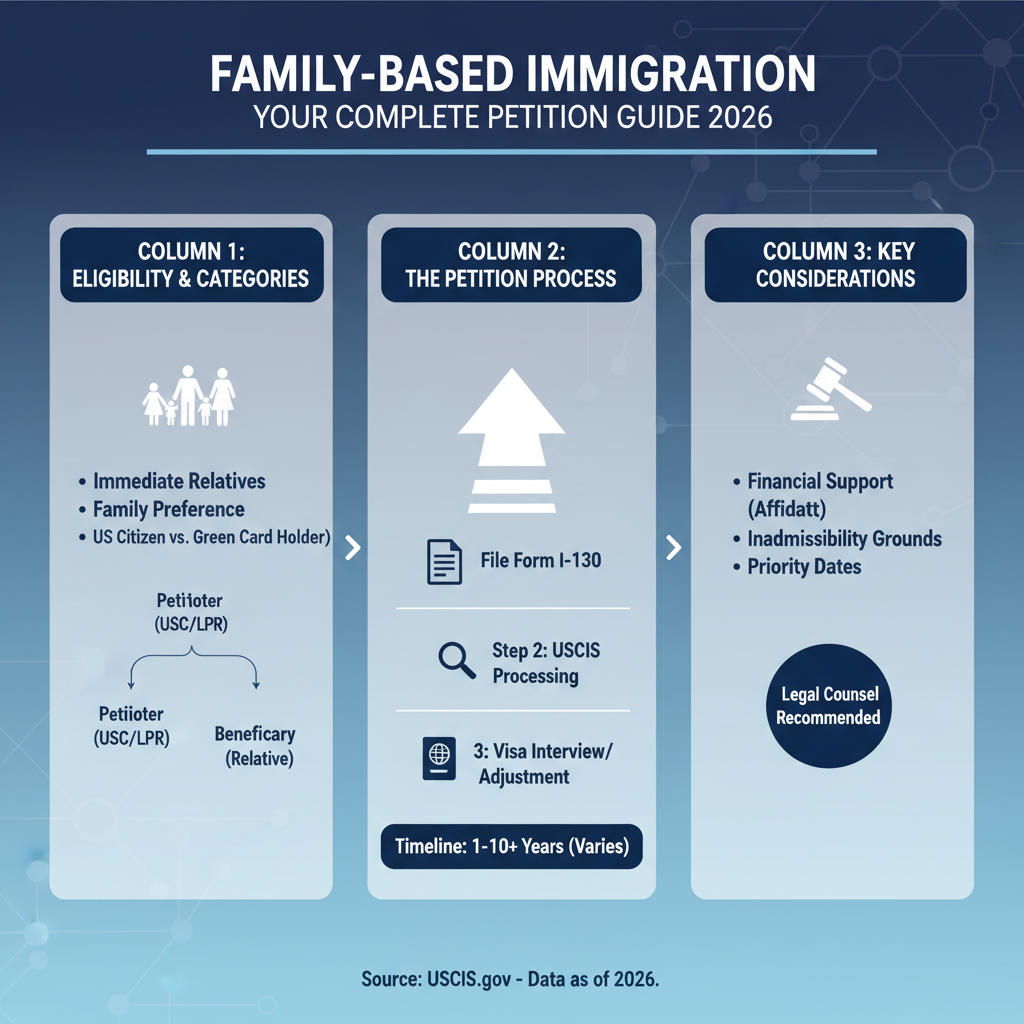
Immigration news is constantly evolving, with policy updates, processing shifts, and trending discussions on family reunification pathways. Our comprehensive guide is inspired by the ongoing public interest and reporting on Family-Based Immigration Petition Guide (Immigration), highlighting the perennial need for clear, actionable information for immigrants and their families.
What This News Means for Immigrants in Orlando and Across Florida
The continuous focus on family-based immigration underscores its fundamental role in the U.S. immigration system. For families hoping to navigate this crucial process, staying informed is paramount. This guide aims to demystify the steps involved, providing clarity and confidence.
Why this news is showing up now
Family-based immigration is not just a trending topic; it's a foundational pillar of U.S. immigration policy, constantly under discussion due to its significant impact. News outlets frequently cover updates related to processing times, visa bulletin advancements, policy changes, and legislative proposals that could affect family reunification. As of 2026, the ongoing efforts to streamline immigration processes and address backlogs continue to generate public interest. Furthermore, with global events and evolving economic landscapes, the demand for family-sponsored visas remains consistently high, making any news or guidance on the process highly relevant. This persistent demand, coupled with the inherent complexities of the system, ensures that a step-by-step guide to family petitions remains a vital resource for millions.
How it can affect Florida residents
Florida boasts a vibrant and diverse immigrant population, with a significant number of families striving to reunite. For residents in Orlando and throughout Central Florida, understanding the intricacies of family-based petitions is not just academic; it's deeply personal. The efficiency and clarity of the petition process directly impact thousands of families hoping to live together in the Sunshine State. Any changes to processing times, documentation requirements, or policy shifts can have immediate and profound effects. For instance, an increase in processing efficiency at the Orlando USCIS Field Office could mean faster reunification for local families. Conversely, delays or increased scrutiny can prolong separation and cause significant stress. Imigrar, located in Orlando, is acutely aware of these local impacts, serving clients from Orange County to the entire I-4 corridor and beyond, ensuring they are well-prepared for their immigration journey.
What Family-Based Immigration Is (and Why It Matters)
Family-based immigration serves as the cornerstone of the U.S. immigration system, allowing U.S. citizens and lawful permanent residents to sponsor eligible family members for immigration to the United States. This pathway is designed to promote family unity, reflecting the nation's values of keeping families together. For millions, it represents the most direct and often the only route to obtaining a Green Card and building a new life in America.
A plain-English definition
Simply put, **family-based immigration** is the process by which a U.S. citizen or a lawful permanent resident (Green Card holder) formally requests the U.S. government to allow a qualifying family member to immigrate to the United States. If approved, this process ultimately leads to the sponsored family member receiving a Green Card, granting them **Lawful Permanent Resident (LPR)** status. This status allows them to live and work permanently in the U.S., eventually providing a path to U.S. citizenship. It's a structured, multi-step process governed by federal law, requiring specific forms, evidence, and adherence to various eligibility criteria. The goal is to ensure that legitimate family relationships are recognized and that those who qualify can join their loved ones in the U.S. legally and safely.
Key terms you need to know
Navigating the family-based immigration system requires understanding specific terminology. Here are the key terms you'll encounter:
- Petitioner: The U.S. citizen or **Lawful Permanent Resident (LPR)** who is sponsoring a family member. They initiate the process by filing a petition.
- Beneficiary: The foreign national family member who is being sponsored to immigrate to the U.S.
- Green Card: The official identification card issued to **Lawful Permanent Residents (LPRs)**, proving their authorization to live and work permanently in the United States.
- Immediate Relatives: A special category of family members who are exempt from annual visa quotas and do not have to wait for a visa number to become available. This category includes spouses of U.S. citizens, unmarried children under 21 of U.S. citizens, and parents of U.S. citizens (provided the U.S. citizen is at least 21 years old).
- Family Preference Categories: Other eligible family relationships that are subject to annual numerical limitations (visa quotas). This means there's a waiting list for visas to become available. These categories include:
- **First Preference (F1):** Unmarried sons and daughters of U.S. citizens (21 years of age or older).
- **Second Preference (F2A):** Spouses and children (unmarried, under 21) of **Lawful Permanent Residents (LPRs)**.
- **Second Preference (F2B):** Unmarried sons and daughters (21 years of age or older) of **Lawful Permanent Residents (LPRs)**.
- **Third Preference (F3):** Married sons and daughters of U.S. citizens.
- **Fourth Preference (F4):** Brothers and sisters of U.S. citizens (provided the U.S. citizen is at least 21 years old).
- Priority Date: The date **U.S. Citizenship and Immigration Services (USCIS)** receives your properly filed **Form I-130**. For **Family Preference Categories**, this date determines your place in the visa queue. Once your **Priority Date** becomes "current" according to the monthly **Visa Bulletin** published by the U.S. Department of State, a visa number is available for your family member.
- Adjustment of Status (AOS): The process of applying for a Green Card from within the United States. This is typically available to beneficiaries who are already physically present in the U.S. and meet specific eligibility criteria, often through filing **Form I-485**.
- Consular Processing: The process of applying for an immigrant visa at a U.S. Embassy or Consulate in the beneficiary's home country (or country of last residence) outside the United States. This is for beneficiaries who are outside the U.S. or ineligible for **Adjustment of Status**.
- Affidavit of Support: A legally binding document (Form I-864) signed by the **Petitioner** (and sometimes a joint sponsor) to demonstrate that the immigrating family member will have adequate financial support and will not become a public charge in the United States.
- Visa Bulletin: A monthly publication by the U.S. Department of State that provides information on the availability of immigrant visas for the various **Family Preference Categories** and employment-based categories. It lists cut-off dates for each category and country of chargeability, indicating which **Priority Dates** are current.
Need Help? Navigating these terms and processes can be overwhelming. Our Orlando immigration team is ready to assist. Call +1 786-791-3106 for a free consultation, or message us online. Se Habla Español.
Current Immigration Law: The Foundation
Family-based immigration is primarily governed by the Immigration and Nationality Act (INA), specifically sections 201 and 203. These sections establish the categories of family relationships that qualify for immigration and impose the numerical limitations for the various **Family Preference Categories**. Understanding these foundational laws is crucial for any family embarking on this journey.
Federal requirements
The core requirements for family-based immigration are set at the federal level by the U.S. Congress and administered by **U.S. Citizenship and Immigration Services (USCIS)**, the U.S. Department of State, and other agencies. Key aspects include:
- Petitioner Eligibility: The **Petitioner** must be either a U.S. citizen or a **Lawful Permanent Resident (LPR)** and must be at least 18 years old to sign the **Affidavit of Support (Form I-864)**. For parents of U.S. citizens, the citizen must be at least 21 years old. The **Petitioner** must also reside in the U.S. or a U.S. territory.
- Beneficiary Eligibility (Relationship): The relationship between the **Petitioner** and **Beneficiary** must fall into one of the established categories (Immediate Relative or Family Preference). This relationship must be proven with clear documentary evidence, such as birth certificates, marriage certificates, adoption decrees, and divorce decrees.
- Admissibility: The **Beneficiary** must be admissible to the United States. This means they must not have any grounds of inadmissibility, such as certain criminal convictions, health issues, previous immigration violations, or security concerns. Some grounds of inadmissibility may be waived, but it often requires filing additional forms and providing compelling reasons.
- Financial Sponsorship: The **Petitioner** must demonstrate the financial capacity to support the **Beneficiary** at or above 125% of the federal poverty guidelines, typically by filing Form I-864, **Affidavit of Support**. If the **Petitioner**'s income is insufficient, a joint sponsor may be required.
All forms and detailed instructions are available on the USCIS official website. Key forms include Form I-130 (Petition for Alien Relative), Form I-485 (Application to Register Permanent Residence or Adjust Status), and Form I-864 (Affidavit of Support).
Florida-specific considerations
While immigration law is federal, its application and impact are felt locally. For Central Florida residents, navigating the family petition process involves interaction with local and regional federal offices. The Orlando USCIS Field Office, for example, conducts interviews for **Adjustment of Status** applicants residing in the area. Understanding local processing nuances, interview procedures, and available resources can significantly ease the journey. Although Florida does not have its own immigration laws, the state's diverse population means that specific cultural and linguistic considerations are often important. Imigrar, with its presence in Orlando, is well-versed in these local dynamics, offering services in both English and Spanish (Se Habla Español) to ensure all clients receive clear and culturally sensitive guidance.
How to File a Family Petition: A Complete Step-by-Step Guide
Filing a family-based immigration petition can be a lengthy and intricate process. Below is a comprehensive, step-by-step guide to help you understand what to expect. This guide assumes the **Petitioner** is a U.S. citizen or **Lawful Permanent Resident (LPR)** and the **Beneficiary** is an eligible family member.
1) Determine Eligibility and Category
Before initiating any paperwork, the first crucial step is to determine who can petition and for whom, and under which category your family member falls. This will dictate the processing timeline and requirements.
- Petitioner Status: Are you a U.S. Citizen or a **Lawful Permanent Resident (LPR)**? Your status determines who you can sponsor.
- U.S. Citizens can petition for: spouses, unmarried children under 21 (Immediate Relatives); unmarried children 21 or older (F1); married children (F3); and brothers and sisters (F4, if the U.S. citizen is 21+). They can also petition for parents (Immediate Relatives, if the U.S. citizen is 21+).
- Lawful Permanent Residents (LPRs) can petition for: spouses and unmarried children under 21 (F2A); and unmarried children 21 or older (F2B). They cannot petition for parents or siblings.
- Relationship Verification: Ensure the relationship is legally recognized and can be documented.
- Category Identification: Understand if your **Beneficiary** is an **Immediate Relative** (no visa quota) or falls under a **Family Preference Category** (subject to visa quotas and waiting times).
Required Documents (for initial assessment):
- Proof of **Petitioner**'s U.S. citizenship (e.g., U.S. birth certificate, naturalization certificate, U.S. passport) OR **Lawful Permanent Resident** status (e.g., Green Card, **Form I-551**).
- Proof of relationship (e.g., birth certificate for parent/child, marriage certificate for spouse, adoption decree for adopted child).
2) File Form I-130, Petition for Alien Relative
This is the foundational step where the **Petitioner** officially requests **USCIS** to recognize the qualifying relationship with the **Beneficiary**. This form establishes the relationship and creates the **Priority Date** for **Family Preference Categories**.
- Complete Form I-130: Fill out the form accurately and completely. Any errors or omissions can lead to delays or denials.
- Gather Supporting Documents: Collect all necessary evidence to prove the relationship and the **Petitioner**'s status.
- Pay the Filing Fee: As of 2026, the filing fee for **Form I-130** is subject to change, so always check the USCIS website for current fees.
- Mail the Petition: Send the completed form, fee, and supporting documents to the appropriate **USCIS Lockbox** facility.
Required Documents (to submit with Form I-130):
- Completed and signed Form I-130.
- Proof of **Petitioner**'s U.S. citizenship or **LPR** status (copy of U.S. passport, birth certificate, naturalization certificate, or Green Card).
- Proof of relationship:
- For spouses: Marriage certificate, divorce decrees (if any prior marriages), and extensive evidence of a bona fide marriage (e.g., joint bank statements, joint utility bills, joint leases/mortgages, shared photos, affidavits from friends/family).
- For children: Child's birth certificate showing both parents' names.
- For parents: U.S. citizen's birth certificate showing parent's name.
- For siblings: Birth certificates of both siblings showing common parent(s).
- Passport-style photos for both **Petitioner** and **Beneficiary** (check specific requirements).
- Any official name change documents (e.g., marriage certificate, court order).
- Appropriate filing fee (check USCIS Forms for current fees).
3) Await Form I-130 Approval and Monitor Priority Date
**USCIS** will send a receipt notice (**Form I-797C, Notice of Action**) after receiving your petition. This notice confirms your **Priority Date**. Processing times vary significantly based on the service center and the relationship category. You can check estimated processing times on the USCIS Processing Times website.
- Immediate Relatives: Once **Form I-130** is approved, a visa is generally immediately available.
- Family Preference Categories: You must wait for your **Priority Date** to become "current" in the monthly **Visa Bulletin**. This can take several years or even over a decade, depending on the category and the **Beneficiary**'s country of birth. Regularly check the U.S. Department of State Visa Bulletin.
Important: Keep your receipt notice safe, as it contains your case number and **Priority Date**.
4) Choose the Path: Adjustment of Status or Consular Processing
Once the **Form I-130** is approved and a visa number is available (or immediately for **Immediate Relatives**), the **Beneficiary** can apply for their Green Card. The path they take depends on whether they are in the U.S. or abroad.
**Adjustment of Status (AOS)**
If the **Beneficiary** is physically present in the United States and entered legally (and meets other eligibility criteria, such as not having committed certain immigration violations), they may apply for **Adjustment of Status**. This allows them to obtain their Green Card without leaving the country.
Required Documents (to submit with Form I-485):
- Completed and signed Form I-485 (Application to Register Permanent Residence or Adjust Status).
- Appropriate filing fee, including the biometrics services fee (check USCIS Forms for current fees).
- Completed and signed Form I-864, **Affidavit of Support**, with supporting financial documents (tax returns, W-2s, bank statements, employment verification letter) from the **Petitioner** and any joint sponsor.
- Medical examination report (Form I-693) from a **USCIS**-approved civil surgeon (often submitted at the interview or mailed later).
- Copy of **Beneficiary**'s birth certificate.
- Copy of **Beneficiary**'s passport biographic page and U.S. visa (if applicable).
- Proof of lawful entry to the U.S. (e.g., **Form I-94** Arrival/Departure Record).
- Passport-style photos for the **Beneficiary**.
- Copies of all previous **Form I-797** approval notices (e.g., for **Form I-130**).
- Optional: Form I-765 (Application for Employment Authorization) to get a work permit while the **I-485** is pending.
- Optional: Form I-131 (Application for Travel Document) for **Advance Parole**, allowing international travel while the **I-485** is pending.
**Consular Processing (CP)**
If the **Beneficiary** is outside the United States, or is in the U.S. but ineligible for


