

In the heart of Orlando and across Florida, families strive to stay connected, often across international borders. At Imigrar, our mission is simple: "Keep Families Together." This commitment drives us to provide clear, actionable guidance on the often-complex journey of U.S. immigration. Today, we're diving deep into one of the most vital pathways to family unity: the family-based immigration petition.
Need Help? Our Orlando immigration team is ready to assist. Call +1 786-791-3106 for a free consultation, or message us online. Se Habla Español.
The reporting that sparked this guide
The continuous flow of news and updates regarding immigration law underscores the importance of staying informed. The intricate nature of U.S. immigration policy means that guidance, particularly on fundamental processes like family petitions, is always in demand. The ongoing discussion and public interest, as seen in general immigration news, highlights the need for a comprehensive, accessible resource for families looking to navigate these waters.
For more general news and updates on immigration law, you can refer to broad journalistic coverage such as: Family-Based Immigration Petition Guide (Immigration).
What This News Means for Immigrants in Orlando and Across Florida
Why this news is showing up now
While the concept of family-based immigration is not new, the conversation surrounding it is constantly evolving. Factors such as changing processing times, policy adjustments, and judicial interpretations mean that the "news" around family petitions is evergreen. Reports often highlight delays, new forms, fee changes, or shifts in enforcement priorities. For families trying to reunite, these constant shifts make a reliable, up-to-date guide indispensable. The fundamental desire for family unity remains a core tenet of U.S. immigration law, ensuring that family petitions are always a trending topic for those impacted.
How it can affect Florida residents
Florida, with its vibrant, diverse population and status as a gateway state, is significantly impacted by immigration policies. For residents in Orlando and across Central Florida, understanding family-based immigration is particularly crucial. Our state is home to millions of immigrants and their families, many of whom are either sponsoring relatives or hoping to be sponsored. The Orlando USCIS Field Office and the Miami Field Office process thousands of applications annually, making local knowledge and expert guidance invaluable.
Delays or policy changes at the federal level can have direct consequences for families along the I-4 corridor, in Orange County, and throughout the state. For instance, extended processing times can mean longer separations for loved ones. Conversely, streamlined processes or clear guidance can accelerate reunification. This guide aims to cut through the complexity, offering Florida residents a clear pathway to understanding and successfully navigating their family immigration journey.
What Family-Based Immigration Petitions Are (and Why It Matters)
A plain-English definition
At its core, a **family-based immigration petition** is the legal process by which a U.S. citizen or a lawful permanent resident (Green Card holder) formally requests that certain eligible family members be granted a visa to come to the United States and become lawful permanent residents themselves. Think of it as the first, crucial step in asking the U.S. government to allow your loved one to live and work permanently in the U.S. It's the foundation upon which family unity is built within the legal framework of immigration.
Key terms you need to know
Navigating immigration law requires understanding specific terminology. Here are some key terms vital to family-based petitions:
- Petitioner: This is the U.S. citizen or lawful permanent resident who files the immigration petition for their relative.
- Beneficiary: This is the eligible foreign national family member for whom the petition is filed.
- Immediate Relatives (IR): This is a special category for close family members of U.S. citizens. It includes spouses, unmarried children under 21, and parents (if the U.S. citizen petitioner is at least 21 years old). There are no annual visa limits for Immediate Relatives, meaning their waiting times are generally shorter once the petition is approved.
- Preference Categories: For family members of U.S. citizens not classified as Immediate Relatives, and for certain family members of lawful permanent residents, specific categories exist with annual visa limits. These categories are:
- First Preference (F1): Unmarried sons and daughters of U.S. citizens, and their minor children.
- Second Preference (F2A): Spouses and children (unmarried and under 21) of lawful permanent residents.
- Second Preference (F2B): Unmarried sons and daughters (21 years of age or older) of lawful permanent residents.
- Third Preference (F3): Married sons and daughters of U.S. citizens, and their spouses and minor children.
- Fourth Preference (F4): Brothers and sisters of U.S. citizens (if the U.S. citizen petitioner is at least 21 years old), and their spouses and minor children.
- Priority Date: This is the date USCIS receives your **Form I-130** petition. It's critically important for Preference Categories because it determines your place in the visa queue.
- Visa Bulletin: Published monthly by the U.S. Department of State, the Visa Bulletin provides information on when immigrant visas become available for different preference categories and countries of chargeability. You must check the Visa Bulletin to see if your Priority Date is "current" before proceeding with the final steps of your immigration process. U.S. Department of State Visa Bulletin
- Adjustment of Status (AOS): This is the process for eligible beneficiaries already in the U.S. to apply for lawful permanent resident status without leaving the country. This typically involves filing **Form I-485**.
- Consular Processing: This is the process for beneficiaries who are outside the U.S. to apply for an immigrant visa at a U.S. embassy or consulate in their home country.
- Affidavit of Support: A legally binding document (**Form I-864**) signed by the petitioner (and sometimes a joint sponsor) to demonstrate that the beneficiary will not become a "public charge" in the U.S.
Current Immigration Law: The Foundation
The U.S. immigration system is primarily governed by the Immigration and Nationality Act (INA), a comprehensive body of law that dictates who can enter the U.S., under what conditions, and for how long. Family-based immigration is a cornerstone of the INA, reflecting a long-standing policy objective to keep families united.
Federal requirements
The core of family-based immigration lies in establishing a qualifying relationship between the petitioner and the beneficiary, as defined by the INA. The process begins with filing **Form I-130, Petition for Alien Relative**, with U.S. Citizenship and Immigration Services (USCIS). This form serves to prove the legitimate familial relationship.
Eligibility Requirements for Petitioners:
- Must be a U.S. citizen or a lawful permanent resident (Green Card holder).
- Must prove their status (e.g., U.S. birth certificate, naturalization certificate, Green Card).
- Must be able to prove the qualifying relationship with the beneficiary.
- Must be at least 18 years old to file an affidavit of support, though a U.S. citizen can petition for a spouse or child regardless of age.
- Must have a domicile in the United States (or intend to re-establish one).
Eligibility Requirements for Beneficiaries:
- Must be a qualifying family member as defined by the INA (spouse, child, parent, sibling).
- Must not be inadmissible to the U.S. (e.g., due to certain criminal convictions, health issues, or past immigration violations).
- Must generally undergo a medical examination.
- Must not be likely to become a "public charge" (i.e., dependent on government assistance), which is addressed through the Affidavit of Support.
The categories of relationships allowed under federal law are strictly defined. For U.S. citizens, they can petition for: spouses, unmarried children (under 21), unmarried sons/daughters (21 or older), married sons/daughters (any age), and brothers/sisters (if the citizen is at least 21). For Lawful Permanent Residents, they can petition for: spouses and unmarried sons/daughters (any age).
All forms and instructions can be found on the USCIS Forms page.
Florida-specific considerations
While immigration law is federal, practical aspects can have a local flavor. For residents of Florida, particularly those in the Orlando metropolitan area, several factors are worth noting:
- USCIS Field Offices: The Orlando USCIS Field Office primarily handles interviews for Adjustment of Status applicants residing in Central Florida. Knowing its location and typical procedures can be beneficial. Other field offices in Florida include Miami, Tampa, and Jacksonville.
- Local Resources: Florida has a robust network of community organizations and legal aid groups that offer support to immigrant families. While Imigrar serves clients nationwide, our local presence in Orlando means we are intimately familiar with the unique needs and demographics of Central Florida's diverse communities.
- High Volume: Due to Florida's large immigrant population, USCIS offices and consulates handling cases from Florida residents often experience high volumes. This can sometimes impact processing times, making accurate and complete application packages even more critical.
Understanding these federal requirements and local nuances is the first step toward a successful family petition. Always refer to the USCIS official website for the most current information and official forms.
Need Clarity? Family immigration can be complex. Let Imigrar guide you through every regulation and requirement. Call +1 786-791-3106 for your free consultation, or message us online. Se Habla Español.
How to File a Family-Based Immigration Petition: A Complete Step-by-Step Guide
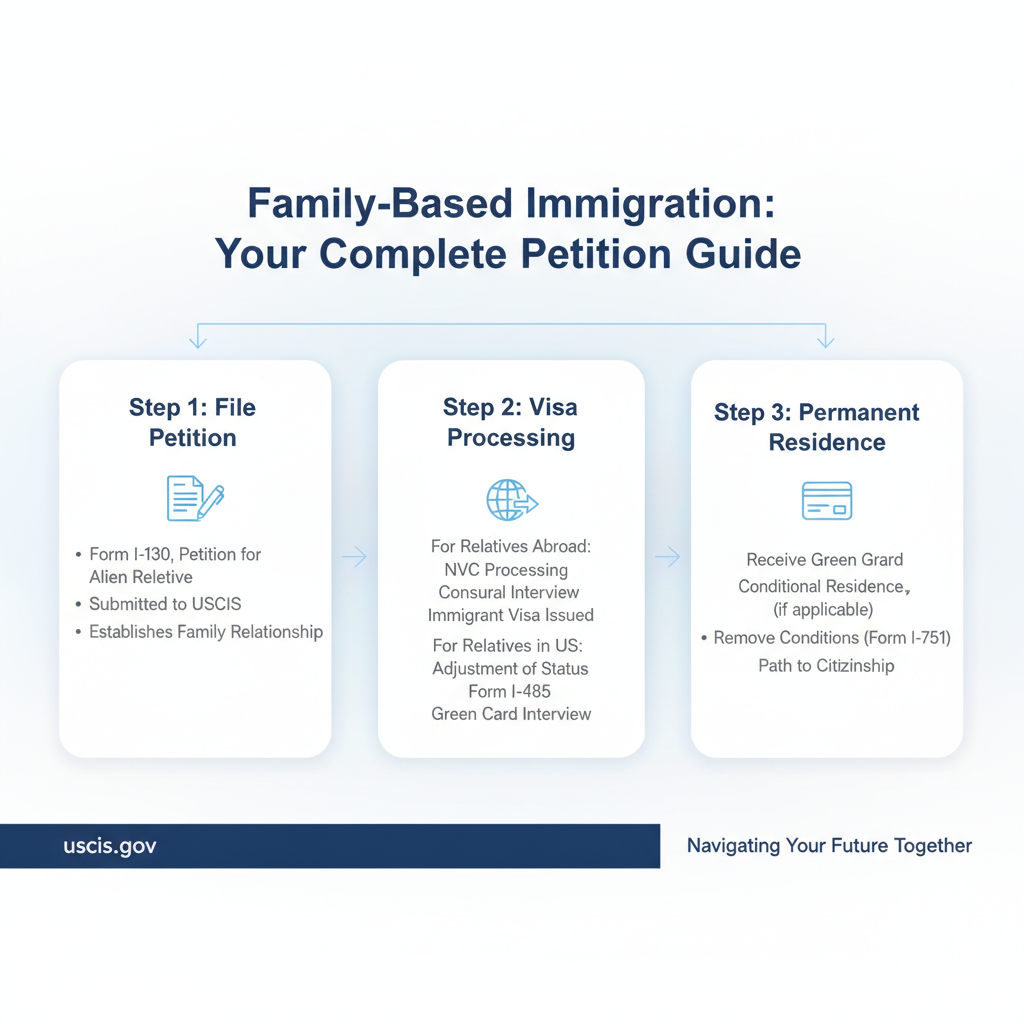
Filing a family-based immigration petition is a multi-stage process that requires careful attention to detail. Here’s a comprehensive guide to help you navigate each step:
1) Determine Eligibility and Gather Initial Information
Before you begin, confirm that both the petitioner and beneficiary meet the basic eligibility criteria. This involves verifying the petitioner's U.S. citizenship or lawful permanent resident status and the qualifying family relationship. This initial assessment is critical to avoid unnecessary delays or denials.
- Petitioner's Status Proof: U.S. birth certificate, naturalization certificate, valid U.S. passport, or Green Card (Form I-551).
- Proof of Relationship:
- For spouses: Marriage certificate, birth certificates of common children, joint financial documents (bank statements, tax returns), photos, affidavits from friends/family.
- For children: Birth certificate showing parentage. If adopted, adoption decree.
- For parents: Petitioner's birth certificate showing parentage.
- For siblings: Birth certificates of both petitioner and beneficiary, showing common parents.
- Identity Documents: Copies of passports, national ID cards for both petitioner and beneficiary.
Important: Ensure all documents are accurate, complete, and translated into English by a certified translator if they are in another language.
2) File Form I-130, Petition for Alien Relative
This is the foundational step. The U.S. citizen or lawful permanent resident (the petitioner) files **Form I-130** with USCIS to establish the qualifying relationship with their foreign national relative (the beneficiary). The purpose of this form is to prove that a legitimate family relationship exists, as recognized by U.S. immigration law.
- Completed Form I-130: Fill out accurately and completely.
- Filing Fee: Check the USCIS website for the current fee. Payment must be made by check, money order, or credit card (**Form G-1450**).
- Supporting Documents: Include all documents gathered in Step 1 (proof of petitioner's status, relationship proof, identity documents).
- Form I-130A, Supplemental Information for Spouse Beneficiary: If petitioning for a spouse, this form is also required.
Once filed, USCIS will send a receipt notice (**Form I-797C, Notice of Action**) acknowledging receipt of your petition. This notice will include your **Priority Date**.
3) Wait for I-130 Approval and Monitor Priority Date
After filing, USCIS will review your **Form I-130**. This process can take several months, or even years, depending on the service center, caseload, and the complexity of your case. You can check USCIS processing times on their official website: USCIS Processing Times.
Once approved, you will receive an approval notice (**Form I-797, Notice of Action**). If the beneficiary is an Immediate Relative, they can often proceed to the next step relatively quickly. If they are in a Preference Category, they must wait for their **Priority Date** to become current, as indicated in the monthly U.S. Department of State Visa Bulletin.
For preference categories, the approved petition is then sent to the National Visa Center (NVC). The NVC will hold the petition until the priority date is current and then contact the petitioner and beneficiary with instructions for the next steps.
4) Choose Your Path: Adjustment of Status or Consular Processing
Once the **Form I-130** is approved and (if applicable) the **Priority Date** is current, the beneficiary can apply for their Green Card. The path depends on whether the beneficiary is already in the United States or abroad.
- Adjustment of Status (AOS): If the beneficiary is physically present in the U.S. and meets eligibility requirements (e.g., entered legally, no serious immigration violations), they can file **Form I-485, Application to Register Permanent Residence or Adjust Status**, with USCIS. This allows them to obtain a Green Card without leaving the U.S.
- Consular Processing: If the beneficiary is outside the U.S., they will go through consular processing. The NVC will send instructions for submitting required documents and fees to the U.S. embassy or consulate in their home country. This typically involves filing **Form DS-260, Immigrant Visa Application**.
Warning: Attempting Adjustment of Status if ineligible (e.g., unlawful entry, certain criminal history) can lead to serious negative consequences. Always consult with an attorney to confirm eligibility.
5) Complete Visa Application (DS-260) or Adjustment of Status (I-485)
This is a critical stage requiring extensive documentation and attention to detail.
For Adjustment of Status (AOS) - Filing Form I-485:
- Form I-485, Application to Register Permanent Residence or Adjust Status: Completed and signed.
- Filing Fee: Check current USCIS fees.
- Form I-693, Report of Medical Examination and Vaccination Record: Completed by a USCIS-approved civil surgeon.
- Form I-864, Affidavit of Support: From the petitioner (and potentially a joint sponsor) with supporting financial documents (tax transcripts, employment letters, pay stubs).
- Form I-765, Application for Employment Authorization (Optional): Allows beneficiary to work while **Form I-485** is pending.
- Form I-131, Application for Travel Document (Optional): Allows beneficiary to travel internationally while **Form I-485** is pending (Advance Parole).
- Supporting Documents: Birth certificate, passport photos, copies of passport, visa, I-94 arrival/departure record, criminal records (if any).
For Consular Processing - Filing Form DS-260:
- Completed Form DS-260, Immigrant Visa Application: Submitted online to the NVC.
- Civil Documents: Birth certificates, marriage certificates, police certificates, military records, court records (if any).
- Form I-864, Affidavit of Support: From the petitioner (and potentially a joint sponsor) with financial documents.
- Passport Photos: Meeting U.S. Department of State specifications.
- Passport: Valid for at least six months beyond the intended date of entry into the U.S.
After submitting these documents and fees, the NVC or USCIS will schedule an interview.
6) Attend Interview and Receive Decision
Whether through Adjustment of Status or Consular Processing, most beneficiaries will be required to attend an interview. This interview is a crucial step where an immigration officer or consular officer will verify the information provided in the application, confirm the bona fides of the relationship, and determine admissibility to the U.S.
- For AOS (Orlando Field Office): The interview will be at the Orlando USCIS Field Office (or another local office). Both the petitioner and beneficiary typically attend.
- For Consular Processing: The interview will be at the U.S. embassy or consulate in the beneficiary's home country. Only the beneficiary attends, though the petitioner may be asked to attend if the relationship is questioned.
What to Bring: Bring originals of all documents submitted, plus any additional evidence of the relationship (e.g., photos, communication records, joint leases, utility bills, financial statements). Be prepared to answer questions honestly and clearly.
If the interview is successful and all requirements are met, the officer will approve the application. For consular processing, the immigrant visa will be stamped in the beneficiary's passport. For Adjustment of Status, the Green Card will be mailed to the beneficiary.
7) Post-Approval Steps and Green Card Issuance
Congratulations! If your petition is approved, there are still a few final steps:
- Immigrant Visa Holder (Consular Processing): The beneficiary will receive an immigrant visa packet. They must pay the USCIS Immigrant Fee online before or after arriving in the U.S. Upon arrival at a U.S. port of entry, a Customs and Border Protection (CBP) officer will review the packet and stamp their passport with a temporary Green Card. The physical Green Card will be mailed within a few weeks.
- Adjustment of Status (AOS): The Green Card will be mailed directly to the beneficiary's address in the U.S.
- Conditional Green Card: If the marriage was less than two years old on the day the Green Card was approved, the beneficiary will receive a **conditional Green Card** valid for two years. They will need to file **Form I-751, Petition to Remove Conditions on Residence**, jointly with the petitioner, within the 90-day window before the conditional Green Card expires.
Reminder: Keep copies of all submitted documents and notices. An experienced immigration attorney can provide invaluable assistance at every stage, helping you avoid errors and navigate complex situations.
Practical Steps You Can Take Today for Your Family Petition
Starting the family immigration process can feel overwhelming, but taking small, organized steps can make a big difference. Here’s how you can prepare:
- Organize Your Documents: Start gathering all vital records for both petitioner and beneficiary – birth certificates, marriage certificates, divorce decrees, passports, and any previous immigration documents. Ensure all foreign documents are translated into English by a certified translator.
- Understand Your Relationship Category: Clearly identify whether your family member falls into the Immediate Relative category or a Preference Category. This will significantly impact your expected timeline.
- Review the Visa Bulletin: If your relative is in a Preference Category, familiarize yourself with the monthly Visa Bulletin. Understand how to read it and what it means for your **Priority Date**. This will help manage expectations regarding waiting times.
- Assess Financial Eligibility: Begin collecting financial documents for the petitioner’s Affidavit of Support (**Form I-864**). This includes tax returns (for the last three years), W-2s, pay stubs, and employment verification letters. Ensure the petitioner meets the income requirements.
- Open Communication with Your Family: Maintain open and honest communication with the beneficiary. Share information, discuss expectations, and coordinate document gathering. This is a team effort.
- Consult with an Experienced Immigration Attorney: This is arguably the most crucial step. An attorney can assess your unique situation, identify potential challenges, ensure all forms are correctly filled, and represent you throughout the process.
Document Preparation Guidance
- Accuracy is Key: Double-check all information on forms against your original documents. Even minor discrepancies can cause delays.
- Certified Translations: If any document is not in English, it must be accompanied by a complete and accurate English translation and a certification by the translator.
- Copies vs. Originals: Generally, USCIS requires copies of supporting documents, not originals (unless specifically requested). Always keep your originals safe.
- Organize Your Submission: Use fasteners, tabs, and cover letters to present your application neatly and logically.
Timeline Expectations
Timelines for family-based petitions vary wildly based on the relationship category, the USCIS service center handling the case, and the beneficiary's country of origin. Immediate Relative petitions generally process faster, often within 12-18 months from start to finish. Preference Categories can take many years, sometimes even over a decade, due to annual visa limits. Always check the USCIS Processing Times tool and the Visa Bulletin for the most current estimates.
How Imigrar Helps Immigrants in Orlando Keep Families Together
At Imigrar, we understand that the journey of family immigration is deeply personal and often filled with hope, anxiety, and complex legal hurdles. Located in Orlando, Florida, we are dedicated to helping families navigate this intricate process, not just in Central Florida but nationwide. Our tagline, "Keep Families Together," isn't just a slogan; it's the core of our practice.
Our Experience and Expertise: Our team of experienced immigration attorneys possesses in-depth knowledge of U.S. immigration law, including the nuances of family-based petitions. We stay abreast of the latest policy changes, processing updates, and legal precedents to provide accurate, up-to-date advice. Whether you're petitioning for a spouse, child, parent, or sibling, we can guide you through every step, from initial eligibility assessment to interview preparation and post-approval procedures.
Personalized Guidance: We know that no two family situations are exactly alike. We offer personalized legal strategies tailored to your specific circumstances, ensuring that your application is as strong and complete as possible. For our clients in Orlando, we are familiar with the local USCIS Field Office procedures and can offer targeted advice.
Comprehensive Support: Our services extend beyond just filling out forms. We help you gather and organize necessary documentation, prepare affidavits of support, respond to Requests for Evidence (RFEs) from USCIS, and thoroughly prepare you for your immigration interview. Our goal is to minimize stress and maximize the chances of a successful outcome.
Free Consultation Offer: We believe that everyone deserves access to expert legal advice. That's why we offer a free initial consultation to discuss your family's immigration needs. This is an opportunity for you to understand your options, assess your eligibility, and learn how Imigrar can assist you without any upfront commitment.
Se Habla Español: We are proud to serve the diverse communities of Florida and beyond. Our team is fully bilingual, and we are ready to assist you in both English and Spanish, ensuring clear communication and understanding throughout your legal journey.
Ready to Unite Your Family? Don't face the immigration process alone. Imigrar is here to help. Contact us today for a free consultation at +1 786-791-3106, or reach out online. Se Habla Español.

Frequently Asked Questions About Family-Based Immigration
Q: Who can petition for a family member, and which family members are eligible?
A: U.S. citizens can petition for their spouses, unmarried children (under 21), unmarried sons/daughters (21 or older), married sons/daughters (any age), and brothers/sisters (if the U.S. citizen is at least 21). Lawful Permanent Residents (Green Card holders) can petition for their spouses and unmarried sons/daughters (any age). The relationship must be legitimate and legally recognized. For example, common-law marriages are only recognized if the state or country where the marriage occurred legally recognizes them. The petitioner must prove their U.S. citizen or LPR status and the bona fides of the relationship.
Q: How does my immigration status affect my ability to petition for a family member?
A: Your immigration status is crucial. Only U.S. citizens and lawful permanent residents can file a **Form I-130** petition. If you are on a temporary visa (e.g., H-1B, F-1, B-2) or have no legal status, you cannot petition for a family member for permanent residency. Furthermore, a petitioner's own immigration history (e.g., past violations, criminal record) can impact their ability to successfully sponsor a relative or meet the financial requirements of the **Affidavit of Support**.
Q: How long does the family petition process take from start to finish?
A: The timeline varies significantly. For **Immediate Relatives** (spouses, unmarried children under 21, and parents of U.S. citizens), there's no visa backlog, so the process can take approximately 12 to 18 months once the I-130 is filed and approved. For **Preference Categories**, the wait can be much longer, ranging from a few years to over a decade, depending on the specific category and the beneficiary's country of origin, due to annual visa limits. You must regularly check the
You may also be interested in: The H-1B visa lottery for FY2027 has new, critical rules. Learn what the beneficiary-centric selection means for you, how to navigate the changes, and... Stay informed on DACA updates for 2026. This guide details renewal steps, eligibility, and how Imigrar helps DACA recipients in Orlando and across Flo... Navigate the H-1B Visa Lottery changes for FY2027 with Imigrar. Learn about the new beneficiary-centric selection process, key dates, and practical st... Navigate the family-based immigration petition process with Imigrar's expert guide. Learn requirements, steps, and how to unite your family in the U.S...Related Articles


