


What This News Means for Immigrants in Orlando and Across Florida
The constant flow of news regarding immigration law can often feel overwhelming, filled with complex terminology and shifting policies. When reports highlight general "immigration law" or "family petitions," it’s a clear signal that the foundational pathways for families to unite are a persistent and critical topic. This ongoing conversation underscores the importance of understanding the established processes, especially for those seeking to bring their loved ones to the United States. For families navigating these waters, staying informed about the core elements of family-based immigration is not just helpful—it’s essential.Why this news is showing up now
The subject of family-based immigration is perennially relevant because it forms the bedrock of the U.S. immigration system, allowing U.S. citizens and lawful permanent residents (LPRs) to sponsor eligible family members. While specific policies or executive actions might change around the edges, the core structure established by the Immigration and Nationality Act (INA) remains largely consistent. The current attention often stems from several factors:- Processing Backlogs: Ongoing challenges at U.S. Citizenship and Immigration Services (USCIS) and Department of State (DOS) regarding processing times lead to discussions about efficiency and reforms.
- Visa Bulletin Updates: Monthly updates to the Visa Bulletin, which dictates when certain preference category visas become available, are always significant news for families awaiting their turn.
- Legislative Debates: While comprehensive immigration reform remains elusive, there are always ongoing discussions in Congress about potential changes to family-based categories, either expanding or restricting them.
- Economic and Social Impact: The role of immigrant families in the U.S. economy and society is a constant point of discussion, especially in a state like Florida with a large and vibrant immigrant population.
- Increased Demand: As global events unfold and economies shift, the desire for family reunification remains strong, leading to continued high demand for these visa categories.
How it can affect Florida residents
Florida, particularly Central Florida and the Orlando area, is a vibrant hub for diverse communities, including a large immigrant population. This means that news regarding family-based immigration has a direct and profound impact on residents here.- Local Impact on Families: Thousands of families in Orlando, Kissimmee, Sanford, and across the I-4 corridor are actively pursuing or planning to pursue family petitions. Delays, policy changes, or even clarifications directly affect their hopes and futures.
- Orlando USCIS Field Office: Residents often interact with the Orlando USCIS Field Office for interviews related to Adjustment of Status. Understanding the process helps prepare for these local interactions.
- Community Resources: The demand for accurate information and legal assistance is high. News about family petitions reinforces the need for reliable legal counsel to navigate the complex federal system.
- Economic Contribution: Immigrant families are integral to Florida’s economy, contributing to various sectors from tourism to agriculture. Streamlined or complicated family immigration processes directly influence the state's workforce and consumer base.
- "Se Habla Español": Given the significant Spanish-speaking population in Florida, particularly in the Orlando area, the need for clear communication in both English and Spanish about these processes is paramount. Imigrar proudly offers services in both languages to ensure no one is left behind due to language barriers.
Need Help? Our Orlando immigration team is ready to assist. Call +1 786-791-3106 for a free consultation, or message us online. Se Habla Español.
What Family-Based Immigration Is (and Why It Matters)
Family-based immigration is the cornerstone of the United States’ legal immigration system, designed to facilitate the reunification of families. It allows U.S. citizens and lawful permanent residents (Green Card holders) to sponsor certain eligible relatives to come to live permanently in the U.S. This pathway is deeply rooted in American values of family unity and is responsible for a significant portion of all immigrants who gain legal permanent residency each year.A plain-English definition
At its simplest, family-based immigration is the process by which a U.S. citizen or a Green Card holder (the "petitioner") asks the U.S. government to allow a specific family member (the "beneficiary") to immigrate to the United States and become a lawful permanent resident. This process typically starts with the petitioner filing a form, usually Form I-130, Petition for Alien Relative, with USCIS. Once approved and a visa becomes available, the beneficiary can then apply for a Green Card, either by adjusting their status if they are already in the U.S. or by applying for an immigrant visa through a U.S. consulate abroad (Consular Processing). The ultimate goal is for families to live together legally and permanently in the United States.Key terms you need to know
Navigating family-based immigration requires understanding a specific set of terms. Here are some of the most important:- Petitioner: The U.S. citizen or lawful permanent resident (Green Card holder) who files the immigration petition (e.g., Form I-130) on behalf of their family member.
- Beneficiary: The foreign national family member for whom the petition is filed, seeking to immigrate to the U.S.
- U.S. Citizen (USC): A person who is a citizen of the United States, either by birth or naturalization. USCs can petition for a broader range of relatives and their immediate relatives are not subject to visa quotas.
- Lawful Permanent Resident (LPR) / Green Card Holder: An individual who has been granted the privilege of residing permanently in the United States. LPRs can petition for fewer categories of relatives, and all their beneficiaries are subject to visa quotas.
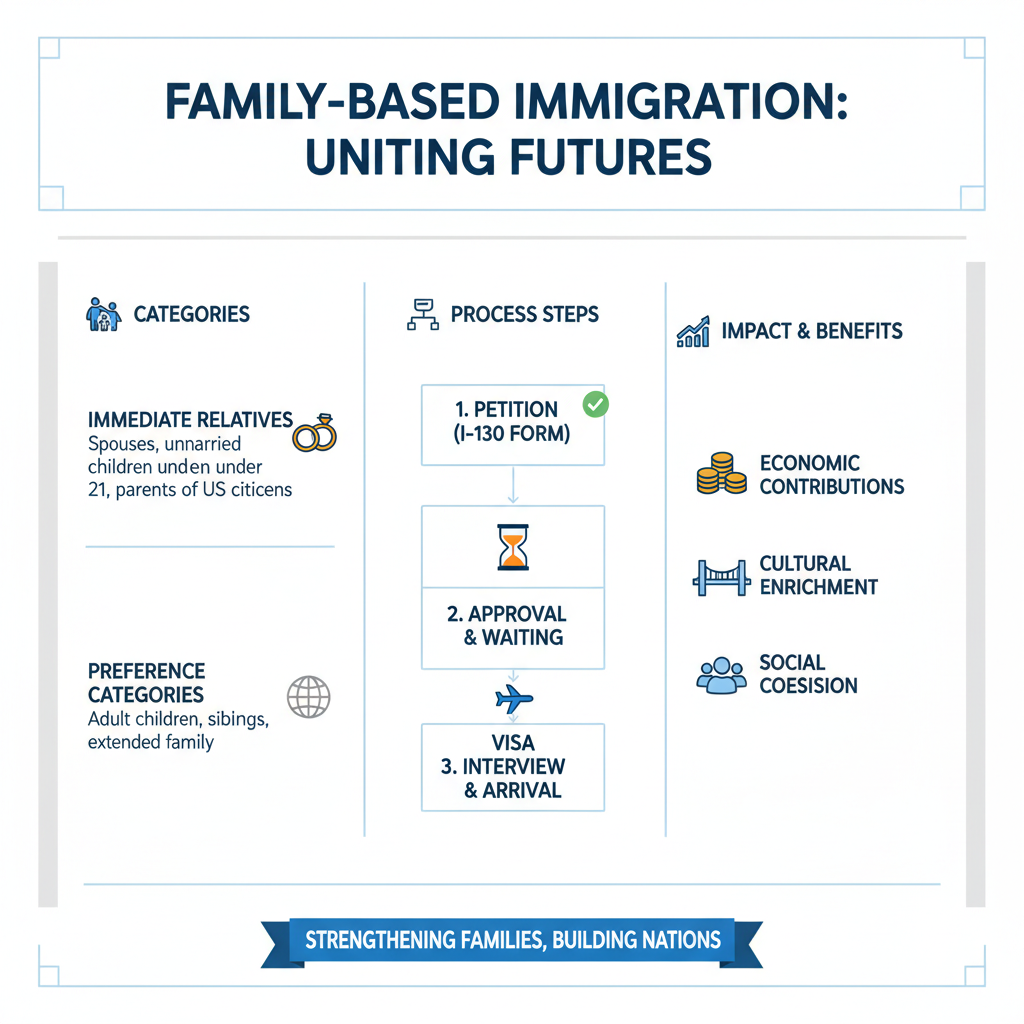
- Immediate Relatives: This category includes spouses of U.S. citizens, unmarried children under 21 of U.S. citizens, and parents of U.S. citizens (if the U.S. citizen is 21 or older). The crucial aspect of Immediate Relatives is that there are no annual numerical limits (quotas) on the number of visas available, meaning their wait times are generally shorter once the petition is approved.
- Family Preference Categories: These are categories for relatives who are not "Immediate Relatives." They include:
- First Preference (F1): Unmarried sons and daughters (21 years of age or older) of U.S. citizens.
- Second Preference (F2A): Spouses and unmarried children (under 21 years of age) of lawful permanent residents.
- Second Preference (F2B): Unmarried sons and daughters (21 years of age or older) of lawful permanent residents.
- Third Preference (F3): Married sons and daughters of U.S. citizens.
- Fourth Preference (F4): Brothers and sisters of U.S. citizens (if the U.S. citizen is 21 or older).
- Priority Date: This is the date USCIS receives a properly filed family-based petition (usually Form I-130). It determines a beneficiary's place in the visa queue for Family Preference Categories. Once your Priority Date becomes "current" on the Visa Bulletin, you can proceed with the next steps.
- Visa Bulletin: A monthly publication from the U.S. Department of State that lists the Priority Dates that are "current" for each visa category and country. It tells beneficiaries in the Family Preference Categories when they can move forward with their Green Card application.
- Adjustment of Status (AOS): The process of applying for a Green Card while physically present in the United States. This is typically done by filing Form I-485, Application to Register Permanent Residence or Adjust Status.
- Consular Processing: The process of applying for an immigrant visa at a U.S. embassy or consulate abroad. This is for beneficiaries who are living outside the U.S. or who are ineligible for Adjustment of Status.
- Affidavit of Support (Form I-864): A legally binding document filed by the petitioner (and sometimes a joint sponsor) to demonstrate that the immigrant will not become a "public charge" and has sufficient financial means.
- Public Charge: A term used in immigration law to identify individuals who are likely to become primarily dependent on the government for subsistence. Meeting the financial requirements of the Affidavit of Support is crucial to overcome this ground of inadmissibility.
Current Immigration Law: The Foundation
Family-based immigration is primarily governed by the Immigration and Nationality Act (INA), specifically Sections 201, 203, and 204. These sections establish the framework for who can petition for whom, the categories of relatives, and the annual numerical limitations (quotas) for certain categories. Understanding these foundational laws is crucial for any family embarking on this journey.Federal requirements
The federal government, primarily through USCIS and the Department of State, sets the rules for family-based immigration. Here are the core federal requirements:- Eligible Petitioner: The petitioner must be either a U.S. citizen or a lawful permanent resident (Green Card holder). They must be at least 18 years old to file the Affidavit of Support, though they can file the Form I-130 at any age.
- Qualifying Relationship: There must be a legally recognized family relationship between the petitioner and the beneficiary. This means marriage certificates, birth certificates, and sometimes adoption decrees are critical.
- Financial Sponsorship: The petitioner must demonstrate the financial ability to support the beneficiary at 125% of the federal poverty guidelines (or 100% if they are on active duty in the U.S. armed forces and petitioning for their spouse or child). This is shown through the Affidavit of Support (Form I-864). If the petitioner's income is insufficient, a joint sponsor may be required.
- Admissibility: The beneficiary must be "admissible" to the United States. This means they must not fall under any grounds of inadmissibility, such as certain criminal convictions, health issues, or past immigration violations. Waivers may be available for some grounds of inadmissibility.
- No Fraud: The relationship must be bona fide (genuine) and not entered into solely for immigration purposes. USCIS scrutinizes relationships, especially marriages, to prevent fraud.
- Form I-130, Petition for Alien Relative: This is the initial form filed by the U.S. citizen or LPR petitioner to establish the qualifying relationship with the foreign relative.
- Form I-130A, Supplemental Information for Spouse Beneficiary: Filed along with Form I-130 when petitioning for a spouse.
- Form I-485, Application to Register Permanent Residence or Adjust Status: Filed by the beneficiary if they are already in the U.S. and eligible to adjust their status to a Green Card holder.
- Form I-864, Affidavit of Support Under Section 213A of the INA: Filed by the petitioner (and any joint sponsors) to prove financial capability.
- Form DS-260, Immigrant Visa and Alien Registration Application: Filed online by beneficiaries undergoing Consular Processing.
Florida-specific considerations
While immigration law is federal, certain aspects can have a localized impact on Florida residents:- Orlando USCIS Field Office: For Central Florida residents, the Orlando Field Office is where many Adjustment of Status interviews take place. Understanding local procedures and wait times at this specific office can be beneficial. While the law is federal, the experience can vary slightly by field office.
- Access to Resources: Florida has numerous community organizations and legal aid groups that offer assistance, especially to low-income immigrants. However, these are often overwhelmed. Imigrar is proud to serve the Orlando community and clients across Florida, providing personalized and expert legal guidance.
- State Legislative Landscape: While Florida cannot create its own immigration laws, state legislation can sometimes impact the daily lives of immigrants (e.g., driver's license policies, access to certain state benefits), which can indirectly influence family planning. However, the core family petition process remains federal.
- High Demand: Due to Florida's large immigrant population, there's a high volume of family-based petitions originating from and being processed for residents of the state. This can sometimes contribute to local processing variations.
Need Help? Our Orlando immigration team is ready to assist. Call +1 786-791-3106 for a free consultation, or message us online. Se Habla Español.

How to File a Family-Based Petition: A Complete Step-by-Step Guide
The process of sponsoring a family member for a Green Card is multi-faceted and requires careful attention to detail. Here’s a complete step-by-step guide to help you navigate it.1) Determine Eligibility and Category
The very first step is to confirm that both the petitioner and the beneficiary meet the basic eligibility requirements and to correctly identify the appropriate visa category. This is critical as it dictates the forms, required documents, and potential wait times. **Petitioner Eligibility:** * Must be a U.S. citizen or a lawful permanent resident (LPR). * Must be able to prove a qualifying relationship with the beneficiary. * Must meet financial sponsorship requirements. **Beneficiary Eligibility:** * Must have a qualifying relationship to the petitioner (e.g., spouse, child, parent, sibling). * Must be admissible to the U.S. (no serious criminal record, certain health issues, or past immigration violations that would make them ineligible). **Relationship Categories:** * Immediate Relatives (IR): Spouses, unmarried children under 21, and parents of U.S. citizens. No visa quotas, generally faster processing. * Family Preference Categories (F1, F2A, F2B, F3, F4): Other relatives of U.S. citizens and LPRs. Subject to annual numerical limits, leading to potentially long wait times. **Required Documents for Step 1 (for initial assessment):** * Petitioner's proof of U.S. citizenship (U.S. birth certificate, naturalization certificate, U.S. passport) or LPR status (Green Card copy). * Beneficiary's birth certificate and passport. * Marriage certificate (if applicable). * Divorce decrees or death certificates for any previous marriages of either party (if applicable). * Adoption decrees (if applicable).2) File Form I-130, Petition for Alien Relative
This is the foundational step. The U.S. citizen or LPR petitioner files Form I-130 with USCIS to establish the legitimate family relationship. **Filling out Form I-130:** * Complete all sections accurately and thoroughly. Incomplete forms will be rejected or delayed. * Provide detailed information about both the petitioner and the beneficiary. * Include information about the relationship, including how and when it was established. * If petitioning for a spouse, also complete and submit Form I-130A, Supplemental Information for Spouse Beneficiary. **Evidence of Relationship:** * For spouses: Marriage certificate, joint financial documents (bank accounts, taxes), joint leases/mortgages, utility bills, photos together, affidavits from friends/family, birth certificates of children born to the marriage. * For children: Birth certificate showing the petitioner as a parent. If a stepchild, marriage certificate of parent to stepparent and child's birth certificate. * For parents: Petitioner's birth certificate showing the beneficiary as a parent. * For siblings: Both petitioner's and beneficiary's birth certificates showing at least one common parent. **Required Documents for Step 2:** * Completed and signed Form I-130 (and Form I-130A if applicable). * Copy of petitioner's proof of U.S. citizenship or LPR status. * Copy of beneficiary's birth certificate. * Copy of marriage certificate (for spouses). * Copies of divorce decrees or death certificates for all previous marriages of both petitioner and beneficiary. * Passport-style photos for both petitioner and beneficiary (check USCIS requirements for number and size). * Proof of bona fide relationship (e.g., photos, joint documents, affidavits). * Applicable filing fee (check USCIS Filing Fees). **Submission:** Mail the complete petition package to the correct USCIS lockbox facility. The address depends on the type of petition and where you live. Always check the "Where to File" instructions on the USCIS Form I-130 page.3) Wait for Approval and Monitor Priority Date (if applicable)
After filing, USCIS will send a receipt notice (Form I-797C, Notice of Action). This notice includes your receipt number, which you can use to check your case status online on the USCIS Case Status website. **I-130 Processing:** * USCIS reviews the petition and supporting evidence to determine if the relationship is legitimate and if the petitioner is eligible. * Processing times can vary significantly based on the service center and the specific relationship category. Check USCIS Processing Times for current estimates. * If USCIS needs more information, they will send a Request for Evidence (RFE). Respond to RFEs promptly and thoroughly. * Once approved, USCIS sends an approval notice (Form I-797). **Priority Date and Visa Bulletin (for Family Preference Categories only):** * If the beneficiary is in a Family Preference Category, the Priority Date becomes crucial. This is the date USCIS *received* your Form I-130. * You must wait for your Priority Date to become "current" in the Visa Bulletin before moving to the next stage. This can take months or many years, depending on the category and the beneficiary's country of origin. * Immediate Relatives (spouses, unmarried children under 21, and parents of U.S. citizens) do not have to wait for a Priority Date to become current, as there are no numerical limits on their visas.4) Choose Path: Adjustment of Status (Form I-485) or Consular Processing
Once the Form I-130 is approved and the Priority Date is current (if applicable), the beneficiary can apply for their Green Card. The path depends on whether the beneficiary is already in the U.S. or abroad. **Path A: Adjustment of Status (AOS) – For Beneficiaries in the U.S.** If the beneficiary is physically present in the U.S. and entered legally (or is an Immediate Relative of a U.S. citizen who may be eligible for certain waivers), they may be able to file for Adjustment of Status. This allows them to get their Green Card without leaving the country. * Concurrent Filing: Immediate Relatives of U.S. citizens can often file Form I-130 and Form I-485 concurrently (at the same time). * Separate Filing: For Family Preference Categories, Form I-485 can only be filed *after* the Form I-130 is approved and the Priority Date is current according to the Visa Bulletin's "Dates for Filing" or "Final Action Dates" chart. **Required Documents for Adjustment of Status (Form I-485 package):** * Completed and signed Form I-485, Application to Register Permanent Residence or Adjust Status. * Copy of Form I-797, Approval Notice for Form I-130. * Copy of beneficiary's birth certificate. * Copy of beneficiary's passport biographic page and visa stamp (if applicable). * Copies of Form I-94, Arrival/Departure Record. * Two passport-style photos of the beneficiary. * Completed Form I-864, Affidavit of Support (from petitioner and any joint sponsor, with supporting financial documents like tax returns, W-2s, pay stubs). * Completed Form I-693, Report of Medical Examination and Vaccination Record (completed by a USCIS-approved civil surgeon). * Completed Form I-765, Application for Employment Authorization (optional, allows beneficiary to work while AOS is pending). * Completed Form I-131, Application for Travel Document (optional, allows beneficiary to travel internationally while AOS is pending, known as "Advance Parole"). * Applicable filing fees for all forms. **Path B: Consular Processing – For Beneficiaries Abroad** If the beneficiary is outside the U.S. or ineligible for Adjustment of Status, their case will be sent to the National Visa Center (NVC) after Form I-130 approval. The NVC is part of the Department of State and handles pre-processing for immigrant visas. **NVC Stage:** * NVC will send instructions and a case number. * Petitioner and beneficiary will submit required fees (Affidavit of Support fee, Immigrant Visa Application processing fee). * Beneficiary completes Form DS-260, Immigrant Visa and Alien Registration Application, online. * Petitioner and beneficiary upload/mail all required civil documents (birth certificates, marriage certificates, police certificates, court records, etc.) and the Form I-864 package to NVC. * NVC reviews documents. Once all documents are accepted, the case becomes "documentarily qualified." **Required Documents for Consular Processing (NVC Stage):** * Copy of Form I-797, Approval Notice for Form I-130. * Completed Form DS-260. * Copy of beneficiary's birth certificate, marriage certificate, divorce decrees (if applicable). * Copy of beneficiary's passport. * Police certificates from all countries where beneficiary lived for certain periods. * Court and prison records (if applicable). * Military records (if applicable). * Completed Form I-864 (with supporting financial documents). * Passport-style photos of beneficiary.5) Attend Interview (if required)
This is a critical step where a USCIS officer or Consular Officer will review your application and ask questions. **For Adjustment of Status (in the U.S.):** * Beneficiary and petitioner (for marriage-based cases) will attend an interview at a local USCIS Field Office, such as the Orlando USCIS Field Office. * The officer will verify the information on the forms, confirm the bona fides of the relationship, and check for any grounds of inadmissibility. * Bring all original documents submitted with your application, plus any new evidence. **For Consular Processing (abroad):** * The NVC schedules an interview at the U.S. embassy or consulate in the beneficiary's country of residence. * Beneficiary undergoes a medical examination by an embassy-approved physician *before* the interview. * Beneficiary attends the interview with all original civil documents, medical exam results, and passport-style photos. * The consular officer makes a decision on the immigrant visa.6) Receive Decision and Green Card/Immigrant Visa
The final step is the decision on your application. **For Adjustment of Status (in the U.S.):** * If approved, the beneficiary typically receives a stamp in their passport indicating their LPR status (I-551 stamp) and the Green Card is mailed within a few weeks. * If denied, USCIS will send a denial letter explaining the reasons. You may have options to appeal or refile. **For Consular Processing (abroad):** * If approved, the beneficiary receives an immigrant visa stamp in their passport. * They must enter the U.S. before the visa expires (usually six months from the date of issuance). * Upon entry, they are admitted as a lawful permanent resident, and the Green Card is mailed to their U.S. address. * If denied, the consular officer will provide a reason for the denial. **Important:** For marriage-based Green Cards where the marriage is less than two years old at the time of approval, the Green Card will be a "conditional" Green Card, valid for two years. You will need to file Form I-751, Petition to Remove Conditions on Residence, within the 90-day window before the conditional Green Card expires to obtain a 10-year permanent Green Card.Feeling overwhelmed by the paperwork? Imigrar is here to simplify the process. Contact our Orlando office at +1 786-791-3106 for expert guidance on your family petition. Se Habla Español.


