


In the United States, the principle of keeping families together is a cornerstone of immigration policy. For countless individuals and families in Orlando, across Florida, and nationwide, the dream of reuniting with loved ones hinges on understanding and successfully navigating the family-based immigration petition process. This guide from Imigrar, your dedicated immigration law firm in Orlando, aims to demystify this critical journey.
The reporting that sparked this guide:
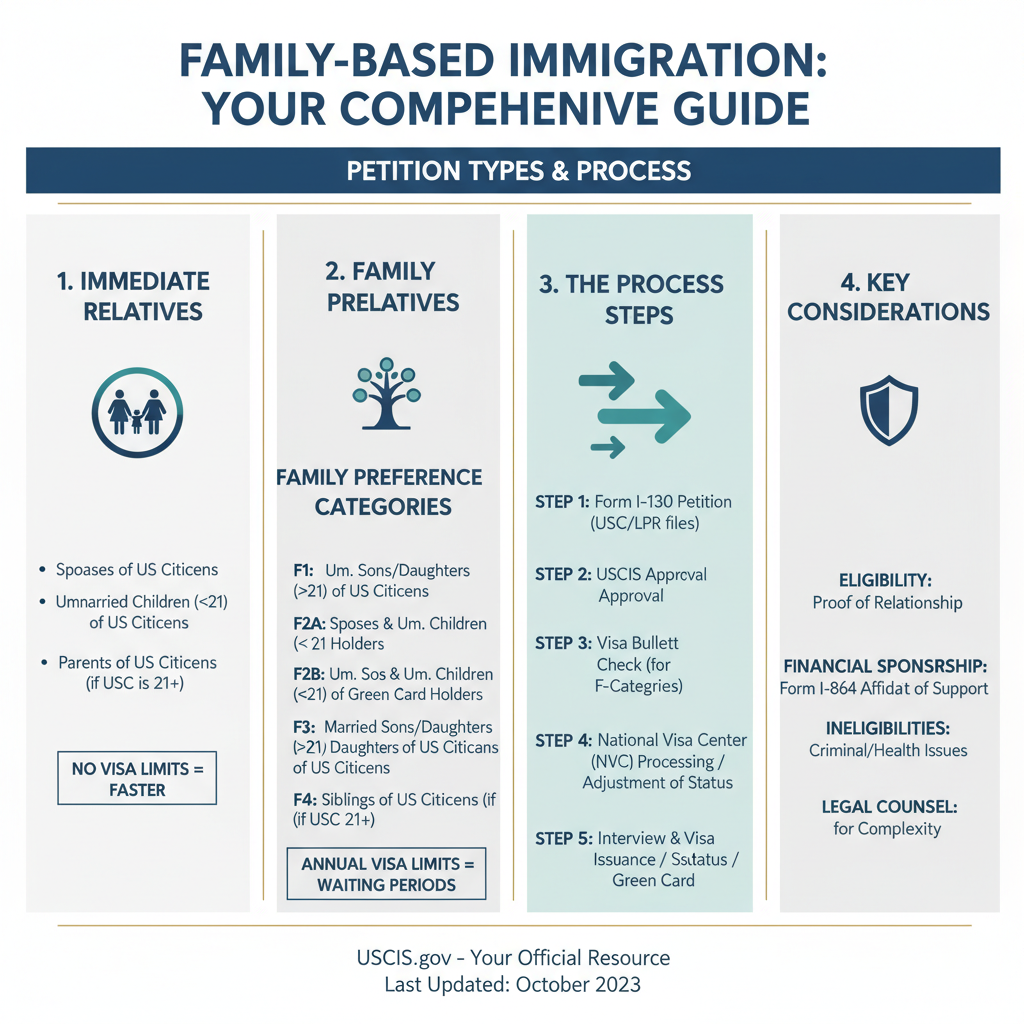
The ongoing importance and public interest in family reunification efforts are consistently highlighted by various news outlets. The reporting that sparked this guide is Family-Based Immigration Petition Guide (Immigration), reflecting the continuous need for clear, actionable information on this fundamental aspect of U.S. immigration law.
What This News Means for Immigrants in Orlando and Across Florida
While specific policies and processing times may fluctuate, the core principles of family-based immigration remain a constant and vital topic in the news. For families yearning to be together, understanding the petition process is paramount. This consistent focus underscores the profound impact these laws have on real lives.
Why this news is showing up now
Family-based immigration is perennially newsworthy because it touches the lives of millions. As of 2026, discussions around immigration reform, USCIS processing backlogs, and the evolving landscape of global migration patterns keep family petitions at the forefront. Every update, every new statistic, every policy discussion directly impacts those waiting to reunite with loved ones. It's a fundamental human desire to be with family, and the legal pathways to achieve this are always under scrutiny, making "family petitions" a trending and essential topic.
How it can affect Florida residents
Florida, a state with a vibrant and diverse immigrant population, is significantly impacted by family-based immigration policies. For residents of Orlando, Central Florida, and the entire state, the ability to petition for a spouse, child, parent, or sibling is often the most direct route to legal residency. Changes in processing times, eligibility requirements, or even the interpretation of existing laws can have immediate and profound effects. For example, the efficiency of the Orlando USCIS Field Office, the availability of resources for document translation, or the prevalence of specific visa categories within the local community can all influence the experience of Florida residents. Understanding this process correctly helps families plan their futures, avoid pitfalls, and ultimately, Keep Families Together.
Need Help? Our Orlando immigration team is ready to assist. Navigating family petitions can be complex, but you don't have to do it alone. Call +1 786-791-3106 for a free consultation, or message us online. Se Habla Español.
What Family-Based Immigration Is (and Why It Matters)
At its heart, family-based immigration is the legal pathway for U.S. citizens and Lawful Permanent Residents (LPRs), also known as Green Card holders, to sponsor certain eligible family members for immigration to the United States. This process typically leads to the sponsored family member obtaining a Green Card, granting them permanent residency.
A plain-English definition
Imagine you are a U.S. citizen living in Orlando, and your spouse lives abroad. Family-based immigration is the set of rules and procedures that allows you, the U.S. citizen, to "petition" the U.S. government on behalf of your spouse so they can come to live permanently in the United States. It's about demonstrating a legitimate family relationship and ensuring the sponsored individual won't become a public charge.
Key terms you need to know
To successfully navigate this process, it's crucial to understand the specialized terminology:
- Petitioner: The U.S. citizen or Lawful Permanent Resident (LPR) who files the immigration petition on behalf of a family member.
- Beneficiary: The foreign national family member for whom the petition is filed.
- Immediate Relatives (IR): This category includes spouses of U.S. citizens, unmarried children under 21 of U.S. citizens, and parents of U.S. citizens (if the U.S. citizen is 21 or older). There are an unlimited number of visas available for Immediate Relatives, meaning they do not have to wait for a visa number to become current.
- Family Preference Categories: These categories are for family members who are not Immediate Relatives. They are subject to annual numerical limits, which often results in waiting periods for a visa number to become available. These categories include:
- First Preference (F1): Unmarried sons and daughters (21 or older) of U.S. citizens.
- Second Preference (F2A): Spouses and unmarried children (under 21) of Lawful Permanent Residents.
- Second Preference (F2B): Unmarried sons and daughters (21 or older) of Lawful Permanent Residents.
- Third Preference (F3): Married sons and daughters of U.S. citizens.
- Fourth Preference (F4): Brothers and sisters of U.S. citizens (if the U.S. citizen is 21 or older).
- Priority Date: The date USCIS receives your properly filed **Form I-130**. This date establishes your place in line for a visa number in the Family Preference Categories.
- Visa Bulletin: A monthly publication by the U.S. Department of State that lists the immigrant visa numbers available for the upcoming month. It indicates which **Priority Dates** are current for each preference category and country of chargeability. U.S. Department of State Visa Bulletin
- Adjustment of Status (AOS): The process for eligible foreign nationals already present in the U.S. to apply for a Green Card without leaving the country.
- Consular Processing: The process for eligible foreign nationals living outside the U.S. to apply for an immigrant visa (Green Card) through a U.S. Embassy or Consulate in their home country.
- Affidavit of Support (Form I-864): A legally binding document signed by the petitioner (and sometimes a joint sponsor) to demonstrate that the beneficiary will have adequate financial support and will not become a public charge in the U.S.
- Green Card: The official document (Form I-551) that proves a foreign national is a **Lawful Permanent Resident** of the United States.
- Lawful Permanent Resident (LPR): An individual who has been granted the privilege of permanently residing in the United States as an immigrant.
Current Immigration Law: The Foundation
Family-based immigration is governed primarily by the Immigration and Nationality Act (INA), specifically sections related to immigrant visas. Understanding these legal frameworks is crucial for a successful petition.
Federal requirements
The core legal provisions for family-based immigration are found in the Immigration and Nationality Act (INA). Key sections include:
- INA Section 201: Establishes the worldwide numerical limitations on immigrant visas, separating Immediate Relatives from the numerically limited preference categories.
- INA Section 203: Defines the family preference categories and the allocation of immigrant visas within those categories.
- INA Section 204: Outlines the petitioning process, requiring a U.S. citizen or LPR to file a petition to establish the familial relationship.
- INA Section 212: Details grounds of inadmissibility, which can prevent a beneficiary from receiving a Green Card (e.g., health issues, criminal history, public charge concerns).
- INA Section 245: Governs the **Adjustment of Status** process for those already in the U.S.
Generally, to qualify, the petitioner must prove their U.S. citizenship or LPR status, establish a bona fide (real) qualifying family relationship with the beneficiary, and demonstrate the financial ability to support the beneficiary. The beneficiary must also be admissible to the U.S., meaning they do not fall under any grounds of inadmissibility.
Florida-specific considerations
While immigration law is federal, practical considerations for Florida residents can be unique. The Orlando USCIS Field Office, located in Orange County, serves many Central Florida residents for interviews and biometrics appointments related to **Adjustment of Status** cases. Familiarity with local office procedures, common interview questions for Orlando residents, and the demographics of the local immigrant community can be advantageous. For example, specific language services or cultural nuances might be more prevalent in the I-4 corridor region. Working with an attorney familiar with the local landscape, such as Imigrar, can provide a significant advantage.
Key USCIS forms you will encounter:
- Form I-130, Petition for Alien Relative
- Form I-130A, Supplemental Information for Spouse Beneficiary (if applicable)
- Form I-485, Application to Register Permanent Residence or Adjust Status
- Form I-864, Affidavit of Support Under Section 213A of the INA
- Form I-765, Application for Employment Authorization (often filed concurrently with **Form I-485**)
- Form I-131, Application for Travel Document (for Advance Parole, often filed concurrently with **Form I-485**)
- Form I-693, Report of Medical Examination and Vaccination Record
- Form DS-260, Immigrant Visa Electronic Application (for Consular Processing)
For more details on these forms and all immigration matters, always refer to the USCIS official website.

How to File a Family-Based Immigration Petition: A Complete Step-by-Step Guide
The family-based immigration process can be lengthy and intricate, requiring careful attention to detail. This guide outlines the typical steps involved.
1) Determine Eligibility and Relationship Category
Before filing any paperwork, it's crucial to confirm that both the petitioner and beneficiary meet the basic eligibility criteria and to correctly identify the relationship category.
- Petitioner Status: Are you a U.S. Citizen or a Lawful Permanent Resident? Your status dictates who you can petition for.
- Beneficiary Relationship: What is your exact relationship to the beneficiary (spouse, unmarried child under 21, unmarried adult child, married adult child, parent, sibling)? This determines whether they fall into the Immediate Relative or one of the Family Preference Categories.
- Bona Fide Relationship: You must be able to prove that your relationship is real and not solely for immigration purposes.
Required documents for this initial assessment:
- Proof of petitioner's U.S. citizenship (e.g., U.S. birth certificate, naturalization certificate, U.S. passport) or LPR status (e.g., Green Card, I-551 stamp).
- Proof of the familial relationship (e.g., birth certificates, marriage certificates, adoption decrees).
- Any prior divorce decrees or death certificates to show termination of previous marriages for both petitioner and beneficiary.
Important: Incorrectly identifying the relationship or failing to provide sufficient proof can lead to significant delays or denial.
2) File Form I-130, Petition for Alien Relative
This is the foundational step. The U.S. citizen or LPR petitioner files **Form I-130** with USCIS to establish the qualifying family relationship.
- Purpose: To prove to USCIS that a legitimate family relationship exists between the petitioner and the beneficiary.
- Filing Location: The form is typically filed with the USCIS Lockbox facility that corresponds to your state of residence. Always check the USCIS website for direct filing addresses.
- Filing Fee: As of today, the filing fee for **Form I-130** is $535 (this fee is subject to change, always check the USCIS Filing Fees page).
Required documents for **Form I-130**:
- Completed and signed **Form I-130**.
- Completed and signed **Form I-130A** (if petitioning for a spouse).
- Copy of petitioner's proof of U.S. citizenship or LPR status.
- Copy of beneficiary's birth certificate.
- Copy of marriage certificate (if petitioning for a spouse).
- Copy of divorce decrees or death certificates for any previous marriages of both petitioner and beneficiary.
- Two passport-style photos of both the petitioner and beneficiary (for spousal petitions).
- Proof of bona fide marriage (for spousal petitions): joint bank accounts, joint leases/mortgages, utility bills, photos, affidavits from friends/family.
- **Form G-1145**, E-Notification of Application/Petition Acceptance (optional, but recommended for electronic notifications).
Reminder: All foreign language documents must be accompanied by a certified English translation.
3) Wait for I-130 Approval and Priority Date to Become Current (If Applicable)
After filing, USCIS will send a **Form I-797C**, Notice of Action, acknowledging receipt and providing a **Priority Date**. For Immediate Relatives, a visa number is always available, so they generally don't wait for a **Priority Date** to become current. However, for Family Preference Categories, this is a significant waiting period.
- Priority Date: The date your **Form I-130** was received by USCIS.
- Visa Bulletin: You must regularly monitor the U.S. Department of State Visa Bulletin to see when your **Priority Date** becomes "current" under your specific preference category and country of chargeability. This wait can range from a few months to over 20 years, depending on the category and demand.
What to do while waiting:
- Maintain legal status if the beneficiary is in the U.S.
- Keep all personal documents current (passports, IDs).
- Gather financial documents for the upcoming **Affidavit of Support**.
- Notify USCIS of any address changes using **Form AR-11**.
4) Choose the Path to a Green Card: Adjustment of Status or Consular Processing
Once the **Form I-130** is approved and (if applicable) the **Priority Date** is current, the beneficiary can apply for their Green Card. The path depends on whether the beneficiary is physically present in the U.S. or abroad.
Option A: Adjustment of Status (AOS) – For Beneficiaries in the U.S.
If the beneficiary is in the U.S. and meets eligibility criteria (e.g., entered legally, no serious immigration violations, and their **Priority Date** is current), they can apply for **Adjustment of Status** without leaving the country. Immediate Relatives of U.S. citizens can often file their **Form I-485** concurrently with **Form I-130**, or once the **I-130** is approved.
Required documents for **Form I-485** package (filed with USCIS):
- Completed and signed **Form I-485**, Application to Register Permanent Residence or Adjust Status.
- Copy of **Form I-797C** (I-130 approval notice).
- Copy of beneficiary's birth certificate.
- Copy of marriage certificate (if applicable).
- Copies of passport pages, visa, and **Form I-94** arrival/departure record.
- Two passport-style photos.
- Completed and sealed **Form I-693**, Report of Medical Examination and Vaccination Record (can be submitted later, but often speeds up processing if included).
- Completed and signed **Form I-864**, Affidavit of Support, with supporting financial documents (tax returns, employment letters, pay stubs).
- **Form I-765**, Application for Employment Authorization (optional, allows work while AOS is pending).
- **Form I-131**, Application for Travel Document (for Advance Parole, optional, allows travel outside U.S. while AOS is pending without abandoning application).
- Applicable fees (e.g., **I-485** fee, biometrics fee, and potentially **I-765** and **I-131** fees if not filed concurrently with **I-485** as an Immediate Relative).
Warning: Traveling outside the U.S. on **Advance Parole** is crucial for AOS applicants. Leaving without it can lead to abandonment of your application.
Option B: Consular Processing – For


