


In the complex landscape of U.S. immigration law, few pathways are as vital and emotionally charged as family-based immigration. For countless individuals and families in Orlando, across Florida, and throughout the nation, the ability to reunite with loved ones is not just a legal process—it's the realization of a deeply held dream. At Imigrar, we understand this profound desire to "Keep Families Together," and we are dedicated to guiding you through every step of this journey.
The reporting that sparked this guide
The constant conversation around immigration law, particularly family reunification, frequently highlights the need for clear, accessible information. The recent surge in interest, as evidenced by general immigration news, underscores the enduring importance of this topic. This guide is inspired by the ongoing public discourse and the consistent demand for practical, step-by-step instructions on how to navigate the family-based immigration petition process. For the latest updates and broader context, you can always refer to general immigration news sources:
Family-Based Immigration Petition Guide (Immigration)
What This News Means for Immigrants in Orlando and Across Florida
The consistent focus on family-based immigration in news and policy discussions serves as a critical reminder of its centrality to the U.S. immigration system. For families in Orlando and throughout Florida, understanding this process isn't just about legal compliance; it's about securing their future and maintaining the bonds that matter most.
Why this news is showing up now
The topic of family-based immigration is perennially relevant, but it often gains renewed prominence due to several factors. As of 2026-06-18, global events, shifts in national immigration policies, and ongoing debates in Congress about comprehensive immigration reform continually bring family reunification to the forefront. There's a constant effort to balance national interests with humanitarian concerns, leading to frequent discussions about processing times, eligibility criteria, and the overall efficiency of the system. Additionally, with a vast number of immigrants residing in the U.S., the demand for family petitions remains consistently high, prompting media attention and legislative scrutiny.
How it can affect Florida residents
Florida is a vibrant melting pot, home to one of the largest and most diverse immigrant populations in the United States. For residents in Orlando, Miami, Tampa, and communities along the I-4 corridor, family-based immigration is a daily reality. The implications of news surrounding this topic are significant:
- Increased Awareness: News coverage helps spread awareness about available pathways and potential changes, encouraging more people to explore their options for family reunification.
- Processing Times: Discussions often touch upon USCIS and NVC processing times. For Florida residents, especially those utilizing the Orlando USCIS Field Office, understanding these timelines is crucial for planning their lives. Delays or accelerations can have a profound impact on families awaiting decisions.
- Policy Changes: Any proposed or enacted changes to federal immigration law directly affect Florida's immigrant communities. These could include adjustments to visa quotas, eligibility requirements, or enforcement priorities.
- Resource Demand: A heightened focus on family immigration often leads to increased demand for legal services, community resources, and support networks across the state.
- Economic Impact: Family reunification contributes significantly to Florida's economy by adding to the workforce, consumer base, and cultural richness of the state.
For Central Florida residents, staying informed and seeking professional legal guidance is paramount to navigating the intricacies of the system effectively and ensuring their families can remain together.
Need Help? Our Orlando immigration team is ready to assist. Call +1 786-791-3106 for a free consultation, or message us online. Se Habla Español.
What Family-Based Immigration Is (and Why It Matters)
Family-based immigration is the cornerstone of the U.S. immigration system, allowing U.S. citizens and lawful permanent residents (Green Card holders) to sponsor certain family members to obtain permanent residency in the United States. This pathway embodies the principle of family unity, which has long been a guiding tenet of American society.
A plain-English definition
Simply put, family-based immigration is the legal process by which a U.S. citizen or a lawful permanent resident (LPR) can petition the U.S. government to allow specific foreign national relatives to immigrate to the United States and become lawful permanent residents themselves. This process typically begins with filing a petition to establish the qualifying family relationship. Once approved, and a visa is available (if applicable), the sponsored relative can then apply for a Green Card, either from within the U.S. (Adjustment of Status) or from abroad (Consular Processing).
Key terms you need to know
Navigating family-based immigration requires understanding a specific vocabulary. Here are some essential terms:
- Petitioner: The U.S. citizen or Lawful Permanent Resident (Green Card holder) who files the immigration petition on behalf of their relative.
- Beneficiary: The foreign national family member for whom the petition is filed, seeking to immigrate to the U.S.
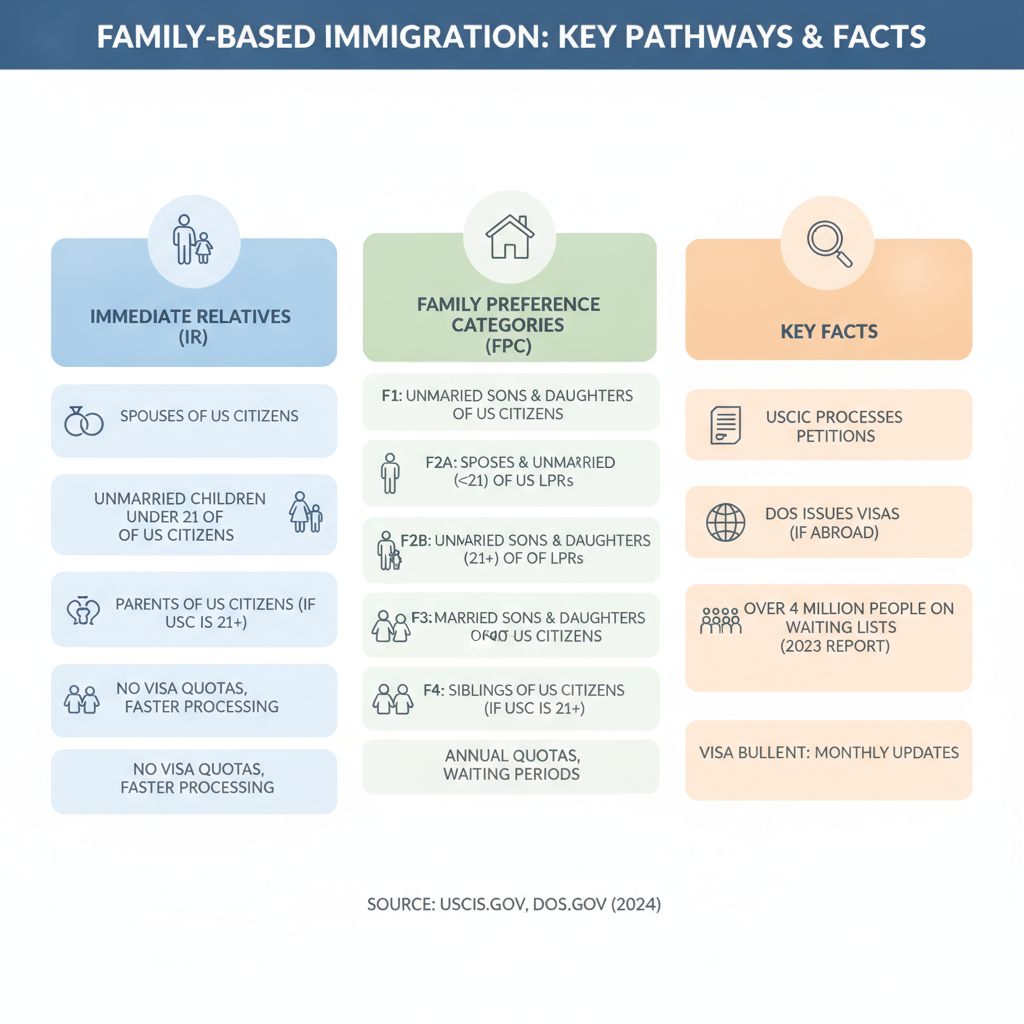
- Immediate Relatives: This category includes spouses of U.S. citizens, unmarried children under 21 of U.S. citizens, and parents of U.S. citizens (if the U.S. citizen is 21 or older). There are no numerical limitations (visa quotas) for Immediate Relatives, meaning they do not have to wait for a visa to become available once the petition is approved.
- Family Preference Categories: These are other family relationships that are subject to annual numerical limitations (visa quotas). They include:
- First Preference (F1): Unmarried sons and daughters (21 years or older) of U.S. citizens.
- Second Preference (F2A): Spouses and children (unmarried, under 21) of Lawful Permanent Residents.
- Second Preference (F2B): Unmarried sons and daughters (21 years or older) of Lawful Permanent Residents.
- Third Preference (F3): Married sons and daughters of U.S. citizens.
- Fourth Preference (F4): Brothers and sisters of U.S. citizens (if the U.S. citizen is 21 or older).
- Priority Date: The date USCIS officially receives your **Form I-130** petition. For Family Preference Categories, this date determines your place in the visa queue and is crucial for tracking when an immigrant visa might become available. Immediate Relatives do not have a waiting period based on a Priority Date.
- Visa Bulletin: A monthly publication by the U.S. Department of State that lists the "cut-off dates" for visa availability for the Family Preference Categories and employment-based categories. It indicates which Priority Dates are current and can proceed with their Green Card application.
- Adjustment of Status (AOS): The process for eligible foreign nationals who are already physically present in the United States to apply for lawful permanent resident status (a Green Card) without having to leave the country. This involves filing **Form I-485**.
- Consular Processing: The process for eligible foreign nationals who are living outside the United States to obtain an immigrant visa at a U.S. embassy or consulate in their home country. Once the visa is granted, they can then enter the U.S. as a lawful permanent resident.
- Affidavit of Support (Form I-864): A legally binding document signed by the petitioner (and sometimes a joint sponsor) to accept financial responsibility for the immigrant beneficiary, ensuring they will not become a "public charge" in the U.S.
Understanding these terms is the first step in demystifying the family immigration process and preparing for a successful application.
Current Immigration Law: The Foundation
Family-based immigration is firmly rooted in the Immigration and Nationality Act (INA), the primary body of U.S. immigration law. The INA outlines who can sponsor family members, which relationships qualify, and the processes involved in obtaining lawful permanent residency.
The core provisions for family-based immigration are found in sections 201 and 203 of the INA. INA §201 establishes the concept of Immediate Relatives and their exemption from numerical limitations, while INA §203 details the Family Preference Categories and their annual visa quotas. These statutes dictate the fundamental rules and distinctions that govern eligibility and processing times.
Federal requirements
To initiate a family-based immigration petition, several federal requirements must be met:
- Qualifying Relationship: The petitioner (U.S. citizen or LPR) must have a legally recognized relationship with the beneficiary. This includes spouses, children, parents, and siblings, as defined by U.S. immigration law. Proof of this relationship (e.g., birth certificates, marriage certificates) is paramount.
- Petitioner's Status: The petitioner must be either a U.S. citizen or a Lawful Permanent Resident. The type of relationship they can sponsor depends on their status (e.g., LPRs cannot petition for parents or siblings).
- Age Requirements: For a U.S. citizen to petition for a parent or sibling, the U.S. citizen must be at least 21 years old. For a U.S. citizen to petition for an unmarried child under 21, the child must indeed be under 21.
- Financial Sponsorship: The petitioner must demonstrate the financial ability to support the immigrant beneficiary at 125% of the federal poverty guidelines. This is primarily done through the Affidavit of Support (Form I-864). If the petitioner’s income is insufficient, a qualified joint sponsor may be required.
- Admissibility: The beneficiary must be admissible to the United States. Certain factors, such as criminal history, past immigration violations, or specific health conditions, can render an individual inadmissible and may require a waiver.
The initial step for nearly all family-based immigration cases is the filing of Form I-130, Petition for Alien Relative, with U.S. Citizenship and Immigration Services (USCIS). This form establishes the legal family relationship between the petitioner and the beneficiary.
For more detailed information on forms and requirements, always consult the USCIS official website.
Florida-specific considerations
While U.S. immigration law is federal, its application and impact are often felt locally. Florida does not have its own state-specific immigration laws that would alter federal family-based immigration requirements. However, there are practical considerations for residents of Orlando and the surrounding areas:
- Local USCIS Field Office: The Orlando USCIS Field Office serves a significant portion of Central Florida. If your beneficiary is applying for Adjustment of Status, their interview will likely be scheduled at this office. Familiarity with local procedures and typical interview questions for the Orlando office can be beneficial.
- Community Resources: Florida’s diverse communities, particularly in Orange County and along the I-4 corridor, offer various support networks, cultural organizations, and language services that can be invaluable during the immigration process.
- Legal Expertise: Due to Florida's large immigrant population, there is a robust legal community specializing in immigration law. Access to experienced attorneys who are familiar with federal regulations and local application patterns, like those at Imigrar, is a significant advantage.
- Logistics: For those undergoing Consular Processing, while the interview takes place abroad, the petitioner and their attorney in Florida will be managing the initial petition and communication with the National Visa Center (NVC).
Understanding these local dynamics, even within a federal framework, can help streamline your application process and prepare you for what to expect.
How to File a Family-Based Petition: A Complete Step-by-Step Guide
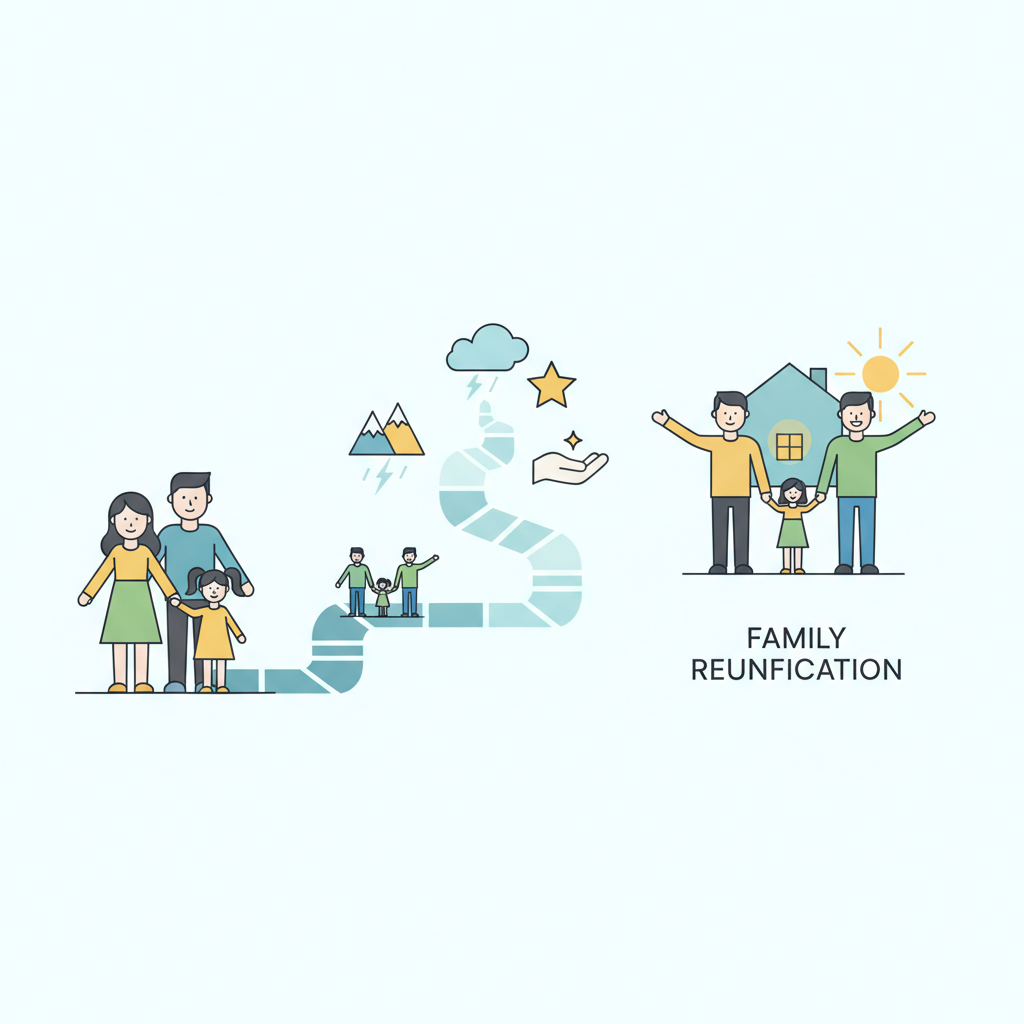
The journey to family reunification through immigration can be complex, but by breaking it down into manageable steps, it becomes much clearer. This guide outlines the typical process for filing a family-based petition.
1) Determine Eligibility and Category
The very first step is to confirm that a qualifying relationship exists and to identify the correct visa category. This is critical as it dictates the forms, required documents, and potential wait times.
- Petitioner's Status: Are you a U.S. citizen or a Lawful Permanent Resident (LPR)? Your status determines who you can sponsor.
- U.S. Citizens can petition for: Spouses, unmarried children under 21 (Immediate Relatives); unmarried sons/daughters 21 or older (F1); married sons/daughters of any age (F3); parents (Immediate Relatives, if USC is 21+); brothers/sisters (F4, if USC is 21+).
- LPRs can petition for: Spouses (F2A); unmarried children under 21 (F2A); unmarried sons/daughters 21 or older (F2B).
- Beneficiary's Relationship: Gather official documents proving the relationship (e.g., birth certificates for parent-child, marriage certificates for spouses).
- Immediate Relative vs. Preference Category: Understand the difference. Immediate Relatives have no visa quota and generally faster processing. Preference Categories have annual limits, requiring a wait based on the **Priority Date** and the **Visa Bulletin**.
Required Documents for Step 1 (for initial assessment):
- Proof of Petitioner's U.S. Citizenship (e.g., U.S. birth certificate, naturalization certificate, unexpired U.S. passport) or LPR Status (e.g., copy of Green Card - **Form I-551**).
- Proof of Qualifying Relationship (e.g., marriage certificate, birth certificate, divorce decrees from prior marriages for both petitioner and beneficiary).
- Any official name change documents (if applicable).
2) File Form I-130, Petition for Alien Relative
Once eligibility is confirmed, the petitioner files **Form I-130** with USCIS. This form formally requests USCIS to recognize the familial relationship.
- Purpose: To establish that a valid family relationship exists between the petitioner and the beneficiary according to U.S. immigration law.
- Who Files: The U.S. citizen or LPR (petitioner).
- Filing Fee: There is a USCIS filing fee for **Form I-130**. Always check the USCIS website for the most current fee schedule.
- Where to File: The filing location depends on where the petitioner lives and whether concurrent filing (filing **Form I-130** and **Form I-485** together) is an option. Most petitions are sent to a USCIS Lockbox facility.
Required Documents for Step 2:
- Completed and signed **Form I-130**.
- Payment for the filing fee (check, money order, or credit card using **Form G-1450**).
- Copy of Petitioner's proof of U.S. Citizenship or LPR status.
- Copy of Beneficiary's birth certificate.
- Copy of Marriage Certificate (if petitioning for spouse).
- Proof of termination of any prior marriages for both petitioner and beneficiary (e.g., divorce decrees, death certificates).
- Passport-style photos of both petitioner and beneficiary (usually two each).
- Any other relevant relationship evidence (e.g., joint bank statements, utility bills, photos together, affidavits from witnesses for spouses).
3) Wait for I-130 Approval and Priority Date Establishment
After filing, USCIS will send a receipt notice (**Form I-797C, Notice of Action**), acknowledging receipt of your petition. For Family Preference Categories, this receipt date becomes your **Priority Date**.
- Processing Times: USCIS processing times vary significantly based on the service center, the visa category, and current caseloads. You can check estimated times online.
- Approval Notice: If USCIS approves your petition, you will receive an **Form I-797, Approval Notice**. This means USCIS recognizes the qualifying family relationship.
- Importance of Priority Date: For Preference Categories, your Green Card application cannot proceed until your **Priority Date** becomes "current" according to the **Visa Bulletin**. Immediate Relatives do not have this wait.
Reminder: Keep all notices from USCIS in a safe place. You can monitor your case status and check processing times on the USCIS Processing Times website.
4) Navigate Visa Availability (for Preference Categories)
This step is primarily for beneficiaries in the Family Preference Categories. Immediate Relatives of U.S. citizens do not need to wait for a visa number to become available.
- The Visa Bulletin: The U.


