


The landscape of U.S. immigration law is constantly evolving, and for those aspiring to work in the United States, staying informed is not just beneficial—it's critical. Today, we're diving deep into some of the most impactful changes announced for the H-1B visa lottery for Fiscal Year 2027 (FY2027). These updates are set to reshape the process for countless skilled professionals and their employers, particularly those right here in Florida's thriving economy.
At Imigrar, an immigration law firm based in Orlando, Florida, our mission is to "Keep Families Together" by providing expert legal guidance. We understand the complexities of these changes and are here to help you navigate them with confidence. Whether you're an employer in the tech corridor of Orlando or a talented professional seeking opportunities across the Sunshine State, these new rules will likely affect your journey.
Our team, fluent in both English and Spanish (Se Habla Español), is dedicated to offering personalized, accurate, and actionable advice. This comprehensive guide will break down the H-1B lottery changes, explain their implications, and provide a clear roadmap for preparing your application.
NEWS SOURCE REFERENCE SECTION
The reporting that sparked this guide: H-1B Visa Lottery Changes for FY2027 (Legal News)
What This News Means for Immigrants in Orlando and Across Florida
The H-1B visa is a highly sought-after nonimmigrant visa that allows U.S. employers to temporarily employ foreign workers in specialty occupations. These occupations generally require a bachelor's degree or higher in a specific field. Due to high demand, the U.S. government employs a lottery system to allocate the limited number of H-1B visas available each fiscal year. The recent changes for FY2027 are designed to address long-standing issues within this system, aiming for greater fairness and integrity.
Why this news is showing up now
The U.S. Citizenship and Immigration Services (USCIS) typically announces changes to major immigration programs well in advance of the new fiscal year. For FY2027, the H-1B cap registration period usually opens in March of the calendar year 2026. USCIS has been working on reforms to the H-1B program for some time, driven by concerns over fraud, abuse of the lottery system, and the need to ensure that the program aligns with its original intent: to bring highly skilled workers to fill critical gaps in the U.S. workforce. These latest regulations, finalized after public comment periods, are USCIS's response to these challenges, designed to be in effect for the upcoming registration cycle.
The announcement of these rules now provides employers and potential beneficiaries with crucial lead time to understand and adapt to the new requirements before the registration window opens for the FY2027 lottery. This proactive communication is vital for proper preparation and to minimize disruptions to legitimate H-1B filings.
How it can affect Florida residents
Florida, and particularly the Orlando area, is a vibrant hub for many industries that rely heavily on H-1B workers. Our state boasts growing sectors in technology, aerospace, healthcare, tourism management, and engineering—all fields that frequently sponsor H-1B visas. For individuals living in Orlando, Tampa, Miami, or anywhere along the I-4 corridor, these changes have direct implications:
- For Prospective H-1B Beneficiaries: If you are a foreign national currently studying or working in Florida on another visa (like an F-1 OPT) and aspire to obtain an H-1B visa, these new rules will directly impact your chances of selection in the lottery. Understanding the new registration process and eligibility criteria is paramount.
- For Florida Employers: Companies in Central Florida, from startups in Lake Nona's Medical City to established tech firms in Orange County, frequently use the H-1B program to attract global talent. The changes will require these employers to adjust their recruitment and sponsorship strategies, ensuring compliance with the updated registration and petition filing requirements.
- Increased Scrutiny: The new rules aim to curb fraud, meaning all applications, including those from Florida-based companies and individuals, may face closer examination. This emphasizes the need for meticulous preparation and adherence to all regulations.
Need Help? Our Orlando immigration team is ready to assist. Call +1 786-791-3106 for a free consultation, or message us online. Se Habla Español.
What H-1B Visa Lottery Changes for FY2027 Is (and Why It Matters)
The H-1B visa program is a cornerstone of U.S. immigration for skilled workers. Each year, 85,000 new H-1B visas are available: 65,000 for the regular cap and an additional 20,000 for those with a U.S. master's degree or higher (the "master's cap"). Demand consistently far outstrips supply, necessitating a lottery. The recent changes for FY2027 represent a significant overhaul of how this lottery operates, specifically targeting the registration process.
A plain-English definition
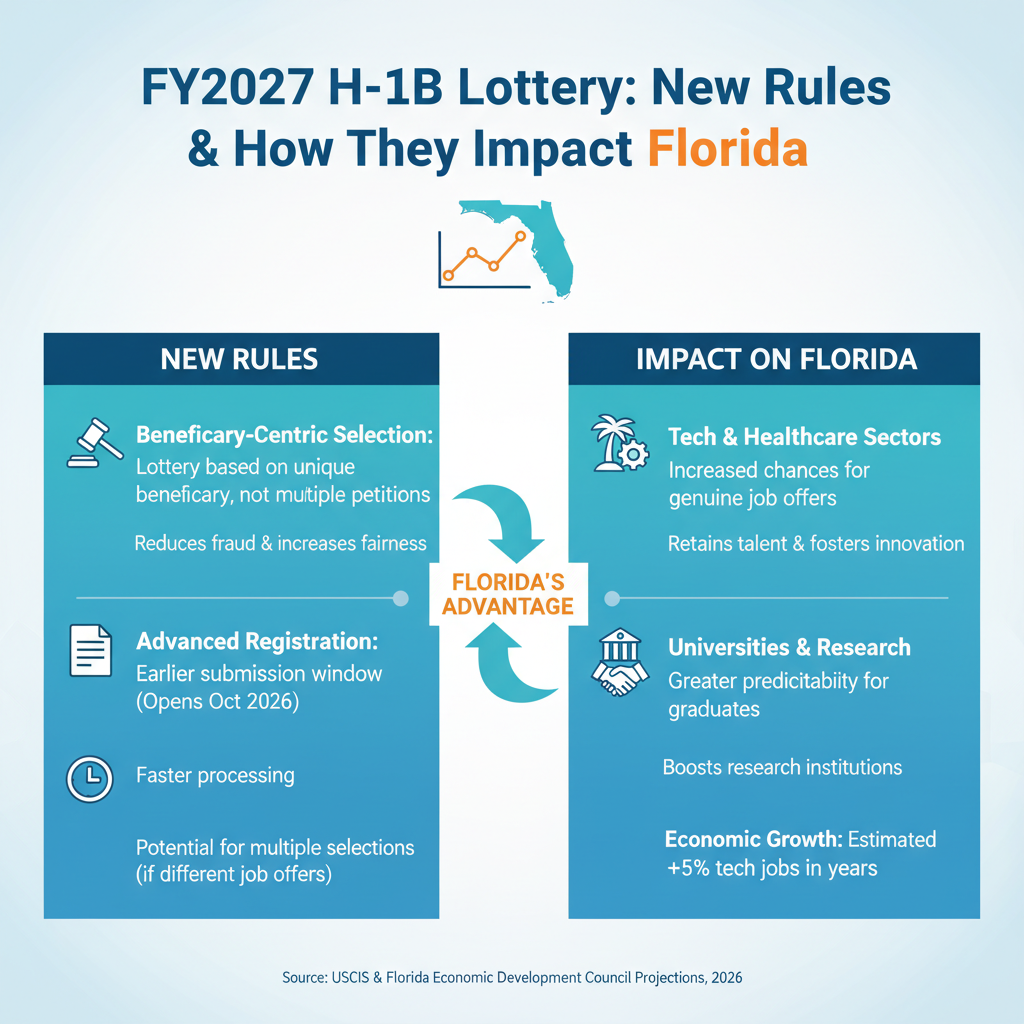
Imagine the H-1B lottery as a raffle for highly skilled jobs. Before, multiple employers could submit entries for the same person, potentially inflating their chances. The new rule changes this: for the FY2027 lottery and onwards, each individual beneficiary will only be counted once, regardless of how many employers register them. If a beneficiary has multiple job offers, only one registration for that individual will be entered into the lottery. If selected, any of the employers who registered that individual can then file a petition on their behalf.
This fundamental shift is designed to eliminate the practice of "multiple registrations" by different employers for the same person, a tactic often used to game the system and increase selection odds. USCIS believes this will make the lottery fairer, giving every unique individual a truly equal chance of selection.
Additionally, USCIS has increased the filing fees for H-1B petitions, which will also impact the overall cost for employers sponsoring H-1B workers. These fee adjustments are part of a broader effort by USCIS to recover operational costs and improve processing efficiency.
Key terms you need to know
Navigating immigration requires understanding specific terminology. Here are the key terms related to the H-1B program and the recent changes:
- H-1B Visa: A nonimmigrant visa that allows U.S. employers to temporarily employ foreign workers in specialty occupations.
- Specialty Occupation: An occupation that generally requires a bachelor's degree or higher in a specific specialty or its equivalent.
- H-1B Cap: The annual numerical limit on the number of H-1B visas issued. The current annual cap is 65,000, with an additional 20,000 for beneficiaries with a U.S. master's degree or higher (the "master's cap" exemption).
- H-1B Lottery: The random selection process USCIS uses when the number of H-1B registrations exceeds the annual cap.
- Beneficiary: The foreign national worker who will be employed in the H-1B specialty occupation.
- Petitioner: The U.S. employer who files the H-1B petition on behalf of the beneficiary.
- H-1B Registration: The electronic process where prospective petitioners (employers) submit information about themselves and the beneficiary to USCIS during a designated period. This is the entry into the lottery.
- Unique Beneficiary Selection: The core of the new rule. Instead of selecting registrations, USCIS will select unique beneficiaries. If a beneficiary is registered by multiple employers, they will still only have one chance in the lottery. If selected, any of those registered employers can file a petition. This aims to prevent multiple registrations for the same individual from increasing their odds.
- LCA (Labor Condition Application): Form ETA-9035. An application filed with the Department of Labor by the employer, attesting that they will pay the H-1B worker at least the prevailing wage or the actual wage, whichever is higher, and provide working conditions that will not adversely affect other workers. This must be certified before filing the H-1B petition.
- FY (Fiscal Year): The federal government's fiscal year runs from October 1 to September 30. The FY2027 H-1B visas will be for employment starting October 1, 2026.
- USCIS: U.S. Citizenship and Immigration Services, the agency responsible for administering immigration and naturalization benefits.
- Fraud Detection and National Security (FDNS): A USCIS directorate focused on detecting and deterring immigration fraud. The new H-1B rules give FDNS more tools to investigate fraudulent registrations.
- Pre-registration Requirements: The new rules may also include updated requirements for information provided during the electronic registration phase to ensure the validity of the job offer.
Understanding these terms is crucial as you prepare for the upcoming H-1B lottery. The shift to Unique Beneficiary Selection is the most significant change, fundamentally altering strategy for both employers and beneficiaries.
Current Immigration Law: The Foundation
The H-1B visa program is authorized by the Immigration and Nationality Act (INA), specifically Section 101(a)(15)(H)(i)(b) and Section 214(g). These sections define the H-1B nonimmigrant classification, establish the annual cap, and outline general eligibility requirements. The recent changes are implemented through regulatory amendments to Title 8 of the Code of Federal Regulations (8 CFR), specifically 8 CFR Part 214.2(h).
Federal requirements
To be eligible for an H-1B visa, both the employer and the beneficiary must meet specific federal requirements:
- For the Employer (Petitioner):
- Must offer a job in a specialty occupation.
- Must file a certified Labor Condition Application (LCA), Form ETA-9035, with the Department of Labor. This attests to paying the prevailing wage or actual wage, whichever is higher, and providing suitable working conditions.
- Must have an Employer Identification Number (EIN).
- Must submit a valid H-1B registration for the beneficiary in the designated period and be selected in the lottery (if applicable).
- Must file Form I-129, Petition for a Nonimmigrant Worker, along with all supporting documentation and required fees, once selected.
- For the Employee (Beneficiary):
- Must hold a bachelor's degree or its equivalent, or a higher degree, or possess a license that permits practice in a specialty occupation, or have work experience equivalent to a bachelor's degree in the specialty field.
- Must be qualified to perform services in the specialty occupation.
- If selected in the lottery, must provide necessary personal and educational documentation to the employer for the petition filing.
The new rules for FY2027 primarily modify the selection process for the lottery, not the fundamental eligibility criteria for the H-1B visa itself. However, the increased scrutiny on registrations means that the job offer must be bona fide and the employer-employee relationship clearly established even at the registration stage.
For detailed information on current H-1B regulations and forms, always refer to the USCIS official website.
Florida-specific considerations
While immigration law is federal, its impact is felt locally. In Florida, the H-1B program is vital for sectors such as:
- Technology: Orlando, Tampa, and Miami are growing tech hubs, attracting software developers, data scientists, and IT specialists.
- Healthcare: Hospitals and medical research facilities across the state, including Orlando's Lake Nona, sponsor doctors, nurses, and medical researchers.
- Aerospace & Defense: Florida's Space Coast and other areas employ engineers and scientists.
- Hospitality & Tourism Management: Given Florida's robust tourism industry, highly skilled managers and specialists are often sought.
For employers in these industries within Orange County and beyond, understanding the new H-1B lottery changes is crucial for workforce planning and talent acquisition. The changes aim to level the playing field, which could benefit smaller, legitimate Florida businesses that previously felt disadvantaged by the multi-registration system. Conversely, it means that even if a beneficiary has multiple strong offers from reputable Florida companies, their single chance in the lottery remains. This puts a greater premium on finding the right employer and ensuring a robust, compliant registration.
If your case is in Orlando, the local USCIS Field Office may handle certain aspects of status adjustments or interviews, though H-1B petitions are generally processed at USCIS service centers. However, having local counsel familiar with the Florida business landscape and the local USCIS environment can be a significant advantage.
How to Navigate the H-1B Lottery Changes: A Complete Step-by-Step Guide
The H-1B lottery process for FY2027, with its new unique beneficiary selection rule, demands a precise and strategic approach. This guide outlines the essential steps for both employers and beneficiaries.
1) Understand the New Unique Beneficiary Selection Rule
Detailed Explanation: This is the most critical change. Previously, if one beneficiary had five job offers, five separate employers could register that person, effectively giving the beneficiary five entries into the lottery. Now, if the same beneficiary is registered by multiple employers, USCIS will consolidate these registrations, and the beneficiary will only be counted once in the lottery pool. If selected, any of the employers who submitted a valid registration for that beneficiary can then proceed to file the Form I-129 petition.
Action for Beneficiaries: Be transparent with all potential employers. Inform them that you are pursuing multiple H-1B opportunities and that only one entry per person is now permitted in the lottery. Discuss which employer you prefer to file on your behalf if selected, or agree on a strategy. While multiple employers can still register you, your personal odds do not increase. Focus on ensuring each registration is legitimate and robust.
Action for Employers: Understand that simply registering more beneficiaries with multiple offers will no longer increase the odds of selection for those individuals. Your focus should be on identifying truly qualified candidates and submitting legitimate, well-prepared registrations. If your candidate is selected, be prepared to file the petition quickly.
Required Documents (for understanding): No documents are submitted at this stage for the beneficiary, but employers must have the beneficiary's basic biographical information.
2) Employer Pre-Registration and LCA Filing
Detailed Explanation: Before the H-1B registration period opens, employers must prepare. This includes identifying the specialty occupation, determining the prevailing wage for the position in the geographic area (e.g., Orlando, FL), and ensuring they meet all H-1B requirements. The first formal step is to file a Labor Condition Application (LCA), Form ETA-9035, with the Department of Labor (DOL). This LCA must be certified by the DOL before an H-1B petition can be filed. While an LCA is not needed for the *registration* phase, it's a critical prerequisite for the *petition* filing if selected.
Action: Employers should initiate LCA filing well in advance, as DOL processing times can vary. For positions in Orlando or Central Florida, ensure the prevailing wage determination accurately reflects the local market.
Required Documents:
- Detailed job description, including duties, minimum educational requirements, and salary.
- Employer's Federal Employer Identification Number (EIN).
- Beneficiary's full name, date of birth, country of birth, country of citizenship, gender, and passport number.
- Copy of the beneficiary's highest degree certificate and transcripts.
- Evaluation of foreign degrees (if applicable).
- Beneficiary's resume/CV.
- Any relevant professional licenses or certifications.
3) Electronic H-1B Cap Registration
Detailed Explanation: USCIS announces a specific window (usually in March) for employers to electronically register prospective H-1B beneficiaries. During this period, employers create a USCIS online account, provide basic information about their company and the beneficiary, and pay a small registration fee (which has also seen an increase for FY2027). This is the "entry ticket" to the lottery. With the new rules, employers must ensure all beneficiary information is accurate, as USCIS will use this to identify unique individuals.
Action: Employers must complete and submit the electronic registration accurately within the designated window. Important: Double-check all beneficiary data. Errors could lead to disqualification or issues later. Beneficiaries should provide accurate information to all employers they are working with.
Required Documents (information needed for registration):
- Employer's legal name, EIN, and mailing address.
- Authorized representative's name, title, and contact information.
- Beneficiary's full name, date of birth, country of birth, country of citizenship, gender, and passport number.
- Whether the beneficiary has a U.S. master's or higher degree.
4) Lottery Selection and Notification
Detailed Explanation: After the registration period closes, if USCIS receives more registrations than available visas, they conduct the lottery. For FY2027, this lottery will select unique beneficiaries. USCIS then notifies registered employers of the selection results through their online accounts. Selected registrations will receive a selection notice, indicating they can proceed with filing an H-1B petition.
Action: Employers must regularly check their USCIS online accounts for notifications. Beneficiaries should communicate with their registering employers to inquire about selection status. If selected, employers must notify the beneficiary and begin preparing the full petition.
Timeline Expectation: Selection notifications are typically issued by the end of March or early April.
5) H-1B Petition Filing (Form I-129)
Detailed Explanation: If a beneficiary is selected, the registering employer (or one of the registering employers, if multiple registered the same selected beneficiary) has a specific window (usually 90 days) to file the complete H-1B petition, Form I-129, Petition for a Nonimmigrant Worker, with USCIS. This petition must include the certified LCA, proof of the beneficiary's qualifications, evidence of a specialty occupation, and all required fees. The new rules may also lead to increased scrutiny during this phase, verifying the bona fides of the job offer and employer-employee relationship.
Action: This is where meticulous preparation is paramount. Gather all supporting documentation, draft a detailed employer letter, and ensure the petition is error-free. Consider premium processing if speed is critical, though this comes with an additional fee.
Required Documents (for Form I-129):
- Certified Form ETA-9035 (LCA).
- Original selection notice.
- Letter from the employer supporting the H-1B petition, detailing the job, salary, and why the beneficiary is qualified.
- Beneficiary's educational documents (degrees, transcripts, foreign degree evaluations).
- Beneficiary's resume/CV.
- Copies of any previous U.S. visas or immigration documents (e.g., I-20, EAD).
- Beneficiary's passport copy, birth certificate.
- Employer's financial statements, business licenses, articles of incorporation, and tax returns to prove ability to pay and legitimate business operations.
- Organizational chart.
- Detailed job description, including duties, responsibilities, and required qualifications.
- Evidence of the employer-employee relationship (e.g., offer letter, employment agreement).
- Form G-28, Notice of Entry of Appearance as Attorney or Accredited Representative (if using legal counsel).
- All applicable USCIS filing fees (Form I-129, Fraud Prevention and Detection Fee, American Competitiveness and Workforce Improvement Act of 1998 (ACWIA) fee, Public Law 114-113 fee if applicable).
6) Adjudication and Approval
Detailed Explanation: USCIS reviews the filed petition. They may issue a Request for Evidence (RFE) if they need more information or clarification. If approved, USCIS issues an I-797 Approval Notice. If the beneficiary is outside the U.S., they will need to apply for an H-1B visa stamp at a U.S. consulate abroad. If already in the U.S. and granted a Change of Status, their status automatically changes on October 1st.
Action: Respond to any RFEs promptly and comprehensively. If approved, celebrate, but also plan for the next steps, whether it's visa stamping or starting employment on October 1st. If denied, consult with an experienced immigration attorney immediately to understand options, such as filing a motion to reconsider or appeal.
Navigating these changes can be complex. Don't go through it alone. Imigrar's Orlando immigration lawyers are here to help. Call +1 786-791-3106 for a free consultation. Se Habla Español.
Practical Steps You Can Take Today
Proactive preparation is key to success in the H-1B process, especially with the new FY2027 changes. Here's what you can do:
Actionable Checklist:
- Consult with an Immigration Attorney: This is the most crucial step. An expert like Imigrar can assess your specific situation, guide employers through the new rules, and ensure compliance. This is especially important for Florida businesses adapting to the unique beneficiary selection.
- Review Job Offers and Employer Relationships: If you're a beneficiary with multiple potential employers, discuss the new "unique beneficiary" rule with each. Decide which employer will register you, or at least understand how the process will work. Ensure all job offers are legitimate and well-defined.
- Gather Personal Documents: Start compiling all necessary personal and educational documents (degrees, transcripts, passport, previous visa copies, I-20s, EADs). Ensure foreign degrees are evaluated if required.
- Verify Employer Eligibility and Intent: Employers should verify their ability to pay the prevailing wage, establish a legitimate employer-employee relationship, and ensure the position qualifies as a specialty occupation.
- Stay Informed on USCIS Announcements: Regularly check the USCIS official website for the latest updates on registration dates, fee changes, and any further clarifications on the new rules.
- Understand the Cost Implications: Be aware of the increased USCIS filing fees for FY2027. Employers should budget accordingly, and beneficiaries should understand the overall financial commitment.
- Prepare for Potential RFEs: Even with careful preparation, RFEs are common. Having all potential supporting documentation organized and ready can expedite responses.
Document Preparation Guidance:
- Accuracy is paramount: Ensure all names, dates, and numbers match exactly across all documents (passport, degrees, registrations).
- Translations: Any document not in English must be accompanied by a certified English translation.
- Organization: Keep digital and physical copies of everything. Create a well-organized folder for all H-1B related documents.
- Proof of Status: For beneficiaries already in the U.S., maintain copies of all I-94 records, visa stamps, EADs, and I-20s (if applicable).
Timeline Expectations:
- Late 2025/Early 2026: Employers begin LCA filing and internal preparations. Beneficiaries gather documents and finalize job offers.
- March 2026 (approx.): H-1B Cap Electronic Registration period for FY2027 opens (typically 2-3 weeks).
- Late March/Early April 2026: USCIS conducts the lottery and notifies selected registrants.
- April - June 2026 (approx.): Selected employers have a 90-day window to file the full Form I-129 petition.
- October 1, 2026: Earliest start date for approved H-1B petitions for FY2027.
- Processing Times: USCIS processing times vary significantly. Check USCIS Processing Times for current estimates. Premium processing is available for an additional fee to expedite adjudication.
Warning: Missing deadlines or submitting inaccurate information can lead to registration rejection or petition denial, potentially setting back your immigration goals by a full year.

How Imigrar Helps Immigrants in Orlando
At Imigrar, we understand that the H-1B visa process, especially with these new changes, can be daunting. Our firm, located in Orlando, Florida, is committed to providing comprehensive, compassionate, and effective legal representation to individuals and businesses nationwide. Our tagline, "Keep Families Together," underscores our dedication to every client's journey.
Our experience and expertise:
- Deep Knowledge of H-1B: Our attorneys possess extensive experience with H-1B visas, from initial LCA filings and cap registration to petition preparation, RFE responses, and visa interviews. We are fully up-to-date on the latest regulations, including the FY2027 lottery changes.
- Strategic Guidance: We don't just fill out forms; we develop personalized strategies tailored to your unique circumstances. For employers, this means optimizing your approach to the new unique beneficiary selection rule. For beneficiaries, it means ensuring your profile is presented in the strongest possible light.
- Fraud Prevention: With increased USCIS scrutiny, preventing even the appearance of fraud is critical. We ensure all registrations and petitions are meticulously prepared and fully compliant, protecting both employers and beneficiaries.
- Local Insight: While we serve clients nationwide, our Orlando base provides us with specific insight into the Central Florida business landscape and the needs of our local community, from tech companies in Lake Mary to healthcare providers in Kissimmee.
- Multilingual Support: We proudly offer services in both English and Spanish (Se Habla Español), ensuring clear communication and understanding for a diverse client base.
Whether you're an employer in Orlando trying to understand how these changes affect your hiring strategy, or a talented professional in Florida hoping to secure an H-1B visa, Imigrar is your trusted partner. We are here to simplify the complex,


