

The journey to obtaining a Green Card, or lawful permanent residency, in the United States is a significant milestone for many immigrants and their families. While the process can seem complex, one of its most critical stages is the Green Card interview. This meeting with a U.S. Citizenship and Immigration Services (USCIS) officer is often the final hurdle before achieving your dream of permanent residence. At Imigrar, we understand the importance of this moment and are dedicated to ensuring our clients are thoroughly prepared.
Today, with ever-evolving immigration policies and a continuous flow of applications, staying informed about the interview process is more crucial than ever. This comprehensive guide aims to demystify the Green Card interview, providing you with the knowledge, tools, and confidence needed for a successful outcome. Whether you’re applying through family sponsorship, employment, or another pathway, proper preparation is key.
NEWS SOURCE REFERENCE SECTION
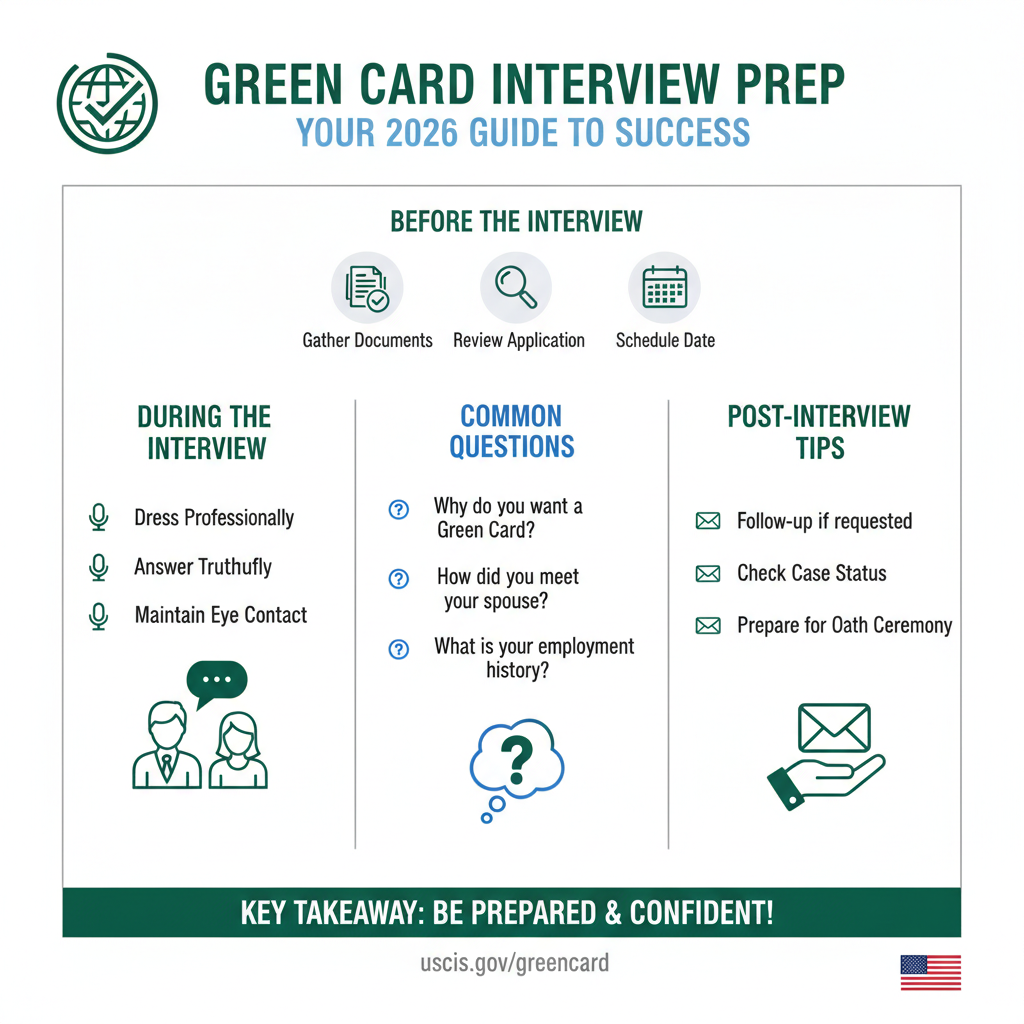
The reporting that sparked this guide: Green Card Interview Preparation Tips (Immigration Law)
What This News Means for Immigrants in Orlando and Across Florida
Immigration law is dynamic, and while the core requirements for a Green Card interview remain consistent, the nuances of preparation and current USCIS processing can shift. This ongoing focus on interview preparation highlights its enduring importance in the immigration landscape.
Why this news is showing up now
The topic of Green Card interview preparation is perennially relevant because it represents a critical, often final, step in the permanent residency process for hundreds of thousands of applicants each year. As of 2026, USCIS continues to process a significant backlog of applications, leading to interviews being scheduled for cases that have been pending for various lengths of time. This continuous flow, coupled with the high stakes involved, means that reliable and up-to-date guidance on interview preparation is always in demand. Furthermore, as technology and communication methods evolve, so do the expectations for how applicants present their cases and interact with immigration officials. Staying prepared is not just about knowing the law, but also about understanding the current operational environment of USCIS.
How it can affect Florida residents
For immigrants and their families residing in Florida, particularly in the bustling Orlando metropolitan area, this news is highly pertinent. Florida is home to a vast and diverse immigrant population, with many individuals and families pursuing permanent residency through various avenues. The primary USCIS Field Office serving Central Florida is located right here in Orlando. This means that many local applicants will have their interviews at the Orlando USCIS Field Office, making local context and preparation strategies particularly valuable.
Understanding the specific procedures and expectations of the Orlando office, while generally consistent with national guidelines, can provide a significant advantage. The volume of applications from Orange County and surrounding areas, including those along the I-4 corridor, ensures that the Green Card interview remains a central concern for many of our neighbors. Effective preparation helps mitigate delays, reduces the likelihood of Requests for Evidence (RFEs), and ultimately brings families closer to achieving their American dream.
Need Help? Our Orlando immigration team is ready to assist. Call +1 786-791-3106 for a free consultation, or message us online. Se Habla Español.
What Green Card Interviews Are (and Why They Matter)
The Green Card interview is a pivotal stage in the journey to becoming a lawful permanent resident of the United States. It is a formal meeting with a USCIS officer designed to verify the information provided in your application and determine your eligibility for permanent residency.
A plain-English definition
Simply put, a Green Card interview is your opportunity to personally present your case to a U.S. immigration officer. During this meeting, the officer will ask you questions about your application, your background, and the basis of your eligibility for a Green Card. For family-based petitions, especially marriage-based ones, the interview aims to confirm the legitimacy of your relationship. It’s a chance for USCIS to ensure that all information is accurate, that you meet all legal requirements, and that there are no factors that would disqualify you from receiving a Green Card.
Key terms you need to know
- Adjustment of Status (AOS): This refers to the process of applying for a Green Card while you are physically present in the United States. If you are applying for AOS, your interview will typically be held at a USCIS Field Office, such as the one in Orlando.
- Consular Processing: If you are applying for a Green Card from outside the United States, you will go through Consular Processing. Your interview will take place at a U.S. embassy or consulate in your home country.
- Petitioner: The U.S. citizen or lawful permanent resident who files an immigration petition (e.g., a relative petition like Form I-130) on behalf of an immigrant.
- Beneficiary: The immigrant who is seeking a Green Card based on the petition filed by the petitioner.
- Affidavit of Support (Form I-864): A legally binding document signed by the petitioner (and sometimes a joint sponsor) to demonstrate their financial ability to support the beneficiary and ensure the beneficiary will not become a "public charge" in the U.S.
- Public Charge: A term in immigration law referring to an individual who is primarily dependent on the government for subsistence, as demonstrated by the receipt of certain public benefits. The interview officer will assess if you are likely to become a public charge.
- Request for Evidence (RFE): A letter from USCIS requesting additional documents or information to support your application. This can be issued before, during, or after your interview.
- Notice of Intent to Deny (NOID): A letter from USCIS indicating their intent to deny your application unless you provide specific information or evidence to overcome the grounds for denial.
Current Immigration Law: The Foundation for Your Green Card Interview
Understanding the legal framework governing Green Card interviews is paramount. The process is rooted in the Immigration and Nationality Act (INA), which is the body of law that governs immigration to the United States.
Federal requirements
The authority for Green Card issuance and interviews stems primarily from the Immigration and Nationality Act (INA). Specific sections relevant to your Green Card application and interview include:
- INA § 201-204: These sections outline the provisions for immigrant visas, including family-sponsored and employment-based categories, and define who is eligible to immigrate.
- INA § 212: This section details the grounds of inadmissibility, which are reasons an individual might be denied entry or a Green Card. These can include health-related grounds, criminal grounds, security grounds, public charge considerations, and more. The interview serves to ensure you are not inadmissible.
- INA § 245: This section governs the Adjustment of Status process, allowing eligible individuals already in the U.S. to apply for a Green Card without leaving the country.
- INA § 221(g) and 222(g): These pertain to consular processing and the requirement for applicants to establish their eligibility for an immigrant visa at a U.S. embassy or consulate abroad.
During your interview, the USCIS officer will be evaluating your eligibility against these federal statutes. They will confirm that you meet the criteria for your specific Green Card category, that your relationship (if family-based) is genuine, and that you are not subject to any grounds of inadmissibility. Your medical examination results (submitted on Form I-693) and any necessary waivers are also reviewed to ensure compliance with health-related requirements.
Florida-specific considerations
While immigration law is federal, the practical application often involves local USCIS field offices. For residents of Central Florida, your interview will likely be scheduled at the Orlando USCIS Field Office. While the federal laws remain the same, understanding the local office's procedures for scheduling, document submission, and interview conduct can be beneficial. Florida does not have its own specific immigration laws that would alter the Green Card interview process; it operates under federal guidelines. However, the high volume of cases processed in Florida means that officers are highly experienced in a wide range of situations.
You will interact directly with U.S. Citizenship and Immigration Services (USCIS) throughout this process. It is crucial to always refer to their official website for the most accurate and up-to-date information regarding forms, fees, and procedures: USCIS official website.
Here are some of the key USCIS forms you will likely have filed, and which will be central to your interview:
- Form I-130, Petition for Alien Relative
- Form I-485, Application to Register Permanent Residence or Adjust Status (for those adjusting status in the U.S.)
- Form I-864, Affidavit of Support Under Section 213A of the INA
- Form I-693, Report of Medical Examination and Vaccination Record
- Form I-765, Application for Employment Authorization (often filed concurrently with Form I-485)
- Form I-131, Application for Travel Document (for Advance Parole, often filed concurrently with Form I-485)
Need Help? Navigating the intricacies of immigration law can be challenging. Let Imigrar guide you through every step. Call +1 786-791-3106 for a free consultation, or message us online. Se Habla Español.
How to Prepare for Your Green Card Interview: A Complete Step-by-Step Guide
Thorough preparation is the cornerstone of a successful Green Card interview. Follow these steps to ensure you are ready to present your case confidently and effectively.
1) Understand Your Interview Notice (Form I-797C)
Your journey to the interview officially begins when you receive your interview notice, typically Form I-797C, Notice of Action. This document is critically important and contains essential information you need to know.
- Date and Time: Mark your calendar immediately and plan to arrive well in advance. For the Orlando USCIS Field Office, arriving 30-45 minutes early is recommended to allow for parking, security, and check-in.
- Location: Confirm the exact address of the USCIS Field Office. For most Central Florida residents, this will be the Orlando office.
- Required Documents: The notice will list specific documents you must bring. This list is not exhaustive; you should always bring all original documents related to your application, even if not explicitly listed.
- Attendees: For marriage-based interviews, both the petitioner and beneficiary must attend. For other categories, only the beneficiary might be required. If you have an attorney, they should also attend with you.
Important: Read every word of your interview notice as soon as you receive it. Contact Imigrar immediately if anything is unclear or if you cannot make the scheduled date (though rescheduling should be avoided if possible).
2) Gather ALL Required Documents
This is arguably the most crucial step. You must bring originals of all documents submitted with your application, plus any new evidence that has become available. Create a checklist to ensure nothing is missed.
- Identification:
- Valid passport (for both petitioner and beneficiary, if applicable)
- Driver's license or state ID
- Travel documents (e.g., advance parole document)
- Interview Notice: The original Form I-797C.
- Application Forms: Copies of all forms you submitted (e.g., Form I-130, Form I-485, Form I-864, Form I-693).
- Birth Certificates: Original birth certificates for both petitioner and beneficiary, translated if not in English.
- Marriage Certificate: Original marriage certificate (if applicable).
- Divorce Decrees/Death Certificates: Originals of any prior marriage terminations (for both petitioner and beneficiary, if applicable).
- Medical Examination: The original sealed envelope containing your Form I-693, Report of Medical Examination and Vaccination Record, if you haven't already submitted it. Do NOT open this envelope.
- Photographs: Two U.S. passport-style photos for each applicant, taken within the last 30 days.
- Financial Documents (for Form I-864):
- Original Form I-864, Affidavit of Support, signed by the petitioner and any joint sponsor.
- Federal income tax returns (IRS transcripts preferred) for the last three years.
- W-2s, 1099s, and proof of current employment and income (pay stubs, employment verification letter).
- Bank statements, asset documentation.
- Evidence of Relationship (for marriage-based petitions): This is vital to prove a "bonafide marriage." Bring as much original evidence as possible, including:
- Joint bank accounts statements
- Joint lease agreements, mortgage statements, property deeds
- Utility bills in both names
- Joint insurance policies (health, auto, life)
- Children's birth certificates (if applicable)
- Photographs of your relationship over time (wedding, family events, vacations)
- Affidavits from friends and family attesting to the legitimacy of your marriage
- Correspondence (emails, text messages, cards)
- Travel itineraries for joint trips
- Police Clearances/Court Records: Originals of any police clearance certificates or court disposition records for any arrests or convictions, even if expunged.
- Previous Immigration Filings: Copies of previous visa applications, petitions, or notices from USCIS.
Reminder: For any document not in English, you must provide a certified English translation along with a copy of the original document.
3) Organize Your Documents Meticulously
A well-organized set of documents makes a strong impression and helps the interview proceed smoothly. USCIS officers appreciate clear, accessible evidence.
- Folders and Tabs: Use a binder or accordion folder with clearly labeled tabs for each document category (e.g., "Passports," "Birth Certificates," "Marriage Evidence," "Financial Documents").
- Originals vs. Copies: Keep originals separate but easily accessible. Have a complete set of copies of everything, just in case.
- Chronological Order: Organize evidence within each category chronologically, especially for relationship evidence like photos or bank statements.
4) Review Your Application Forms Thoroughly
Before your interview, meticulously review copies of every application form you submitted to USCIS. You need to be intimately familiar with every answer you provided.
- Know Your Answers: The officer will refer to your forms and ask questions based on the information provided. Your answers should be consistent with what's on the forms.
- Identify Discrepancies: If you find any errors or information that has changed since filing, make a note of it. Be prepared to explain any discrepancies honestly and clearly. It's better to correct a mistake than to be caught off guard.
- Dates and Addresses: Pay special attention to dates of entry, addresses of residence, employment history, and travel history.
5) Practice Answering Questions
While you cannot predict every question, you can anticipate common lines of inquiry. Practice helps you articulate your answers clearly and confidently.
- Common Questions:
- About your identity and background (name, date of birth, place of birth).
- About your immigration history (how and when you entered the U.S., previous visas, any prior immigration applications).
- About your current employment and education.
- About any criminal history or arrests.
- For marriage-based cases: How you met, where you live, daily routines, family interactions, future plans, children (if any). Be prepared for detailed questions about your life together.
- About the information on your Form I-485 and Form I-130.
- Questions related to grounds of inadmissibility (e.g., public charge, past misrepresentations).
- Honesty and Consistency: Always be truthful. Inconsistencies between your testimony and your application or documents can lead to serious problems.
- Listen Carefully: Listen to the entire question before answering. If you don't understand a question, politely ask the officer to repeat or rephrase it.
- Keep Answers Concise: Answer the question directly, but avoid volunteering unnecessary information.
Warning: Never lie or provide false information. Doing so can lead to a denial, a finding of misrepresentation, and potentially a permanent bar from the U.S.
6) Attend the Interview Prepared (Appearance, Punctuality, Demeanor)
Your conduct on the day of the interview matters.
- Dress Appropriately: Dress in business casual or professional attire. This demonstrates respect for the process and the officer.
- Arrive Early: Plan to arrive at the Orlando USCIS Field Office at least 30-45 minutes before your scheduled time. This accounts for traffic, parking, security checks, and finding the correct waiting area.
- Be Respectful and Polite: Greet the officer courteously. Maintain eye contact. Be patient and cooperative throughout the interview.
- Bring an Interpreter (if needed): If you are not fluent in English, you may bring your own interpreter (not the petitioner, if applicable), unless USCIS provides one. Inform USCIS in advance if you require an interpreter. Se Habla Español at Imigrar, and we can guide you on this.
- Bring Your Attorney: Having an experienced immigration attorney from Imigrar by your side can provide immense reassurance and advocacy, especially if complex issues arise.
7) Know What Happens After the Interview
The interview is not always the final step. Be prepared for different outcomes.
- Approval: If everything goes well, the officer may tell you on the spot that your application is approved. You will then receive your Green Card in the mail.
- Request for Evidence (RFE): The officer might request additional documents or information. You will receive a written RFE with a deadline to respond.
- Continuance: The officer may need more time to review your case or conduct further checks. Your case will be continued, and you might be scheduled for a second interview or receive a decision later.
- Notice of Intent to Deny (NOID): In more serious cases, USCIS might issue a NOID, giving you a chance to respond before a final denial.
- Denial: If your application is denied, you will receive a written explanation. You may have options to appeal or re-file, but it's crucial to consult an attorney immediately.
Practical Steps You Can Take Today for Interview Success
Don't wait until the last minute. Start preparing now with these actionable steps.
Actionable Checklist:
Document preparation guidance
When organizing your documents, always bring the original document along with a high-quality photocopy. The USCIS officer will examine the original and typically keep the copy. For marriage-based cases, think about the "story" your documents tell about your relationship. Arrange photos chronologically and label them. For financial documents, ensure they are current and reflect your ability to meet the income requirements for the Affidavit of Support. If you are missing an original document, try to obtain a certified copy from the issuing authority. If that's not possible, gather secondary evidence (e.g., school records, medical records) and consider an affidavit from someone who has personal knowledge of the facts.
Timeline expectations
The time from filing your Green Card application to receiving an interview notice can vary significantly based on your application type, country of origin, and the specific USCIS field office workload. You can check approximate USCIS Processing Times online. After your interview, a decision can be made on the same day, or it could take weeks or even months. If your case is continued or an RFE is issued, the timeline will be extended. Patience is crucial, but so is staying informed and prepared for any follow-up actions.
How Imigrar Helps Immigrants in Orlando Prepare for Their Green Card Interview
At Imigrar, we understand that the Green Card interview can be one of the most stressful parts of the immigration process. Our mission, "Keep Families Together," drives our dedicated approach to client service.
Our experience and expertise
Imigrar has extensive experience in guiding immigrants through every stage of their Green Card journey, including comprehensive interview preparation. Our attorneys are intimately familiar with USCIS procedures, the types of questions officers typically ask, and the specific evidence required to prove eligibility. We stay up-to-date on the latest immigration policies and processing trends, including those specific to the Orlando USCIS Field Office.
We provide personalized support, from meticulously reviewing your application and documents to conducting mock interviews and accompanying you to the actual interview. Our goal is to ensure you feel confident, prepared, and fully represented, minimizing the chances of unexpected challenges.
Free consultation offer
We invite you to take advantage of our free consultation. This is an opportunity to discuss your specific Green Card application, understand the interview process, and learn how Imigrar can assist you. Our team will assess your case, answer your questions, and outline a clear strategy for successful interview preparation. Don't face this critical step alone.
Se Habla Español. Our team is fully bilingual, ensuring that you can communicate comfortably and clearly in your preferred language. We believe that effective communication is key to building trust and achieving the best possible outcomes for our clients in Orlando and across Florida.

Frequently Asked Questions About Green Card Interviews
Q: What if I have eligibility concerns, such as a past immigration violation or a criminal record?
A: Any past immigration violation (e.g., overstay, unlawful entry) or criminal record (even minor arrests) must be fully disclosed to USCIS. These issues can trigger grounds of inadmissibility. It is absolutely critical to discuss these concerns with an experienced immigration attorney at Imigrar *before* your interview. Depending on the specific issue, you may require a waiver (e.g., Form I-601, Application for Waiver of Grounds of


