


The journey to obtaining a Green Card, or lawful permanent residency, is a pivotal moment for many immigrants and their families. While the process can be complex, one of the most critical stages is often the Green Card interview. This interview is your opportunity to present your case directly to a U.S. Citizenship and Immigration Services (USCIS) officer, verify the information in your application, and demonstrate your eligibility for permanent residency.
For many, the thought of an interview can bring anxiety. What questions will be asked? What documents do I need? How do I ensure everything goes smoothly? At Imigrar, an immigration law firm based in Orlando, Florida, we understand these concerns. Our mission is to "Keep Families Together," and a crucial part of that is empowering you with the knowledge and support needed to navigate every step, including your Green Card interview.
This comprehensive guide, updated for 2026, is designed to demystify the Green Card interview process. We'll provide you with practical advice, detailed requirements, and official references to help you prepare thoroughly and confidently.
Need Help? Our Orlando immigration team is ready to assist. Call +1 786-791-3106 for a free consultation, or message us online. Se Habla Español.
The reporting that sparked this guide: Green Card Interview Preparation Tips (Immigration Law)
What This News Means for Immigrants in Orlando and Across Florida
Why this news is showing up now
The topic of Green Card interview preparation is perennially relevant in immigration law, but it frequently gains renewed attention due to several factors. As of 2026, USCIS continues to refine its interview protocols, often in response to evolving security concerns, changes in immigration policy, and efforts to streamline processing while maintaining robust integrity checks. There's an ongoing emphasis on thorough vetting, particularly in family-based petitions, to combat potential fraud and ensure applicants meet all eligibility criteria. Furthermore, the sheer volume of Green Card applications means that interviews remain a cornerstone of the review process, making effective preparation a constant priority for applicants and legal professionals alike. Regular updates from USCIS and discussions within the legal community keep this topic trending, as practitioners and applicants seek the most current and effective strategies.
How it can affect Florida residents
Florida is home to one of the largest and most diverse immigrant populations in the United States. For residents across the state, from the bustling cities of Miami and Orlando to the smaller communities along the I-4 corridor and the Gulf Coast, the Green Card interview is a common and critical step. The Orlando USCIS Field Office, like others in Florida (such as Miami, Tampa, and Jacksonville), handles a significant number of Adjustment of Status interviews for individuals already present in the U.S. Conversely, many Floridians sponsor family members who undergo Consular Processing interviews at U.S. Embassies and Consulates abroad. This constant flow means that reliable, up-to-date interview preparation advice is invaluable for countless families in Orange County and beyond. Understanding the nuances of the interview process can significantly reduce stress and improve outcomes for those pursuing lawful permanent residency, whether they are applying from within Florida or sponsoring family members from overseas.
What Green Card Interviews Are (and Why They Matter)
A plain-English definition
A Green Card interview is a mandatory meeting with a U.S. Citizenship and Immigration Services (USCIS) officer (or a Consular Officer if you are applying from outside the U.S.) where you will discuss your application for lawful permanent residency. The primary purpose of this interview is for the officer to verify the information provided in your application forms, confirm your eligibility for a Green Card, and ensure that you are not inadmissible to the United States under current immigration law. Think of it as a formal conversation where you answer questions about your background, your relationship (if applicable), your finances, and why you qualify for a Green Card. It’s a crucial step that can determine the success or denial of your application.
Key terms you need to know
- Green Card: Also known as a Permanent Resident Card, it is proof of your authorization to live and work permanently in the United States.
- USCIS: U.S. Citizenship and Immigration Services, the government agency responsible for overseeing lawful immigration to the United States.
- Adjustment of Status (AOS): The process of applying for a Green Card while you are physically present in the United States. Your interview will be at a USCIS Field Office.
- Consular Processing: The process of applying for a Green Card through a U.S. Embassy or Consulate in your home country (or another country if eligible). Your interview will be with a Consular Officer.
- Petitioner: The U.S. citizen or lawful permanent resident who files an immigration petition (e.g., Form I-130) on behalf of a foreign national.
- Beneficiary: The foreign national seeking an immigration benefit, such as a Green Card, who is named in an immigration petition.
- Affidavit of Support (Form I-864): A legally binding document signed by a petitioner (sponsor) to accept financial responsibility for the immigrant. This ensures the immigrant will not become a "public charge."
- Public Charge Rule: A long-standing provision in U.S. immigration law (INA 212(a)(4)) that allows the government to deny a Green Card to individuals deemed likely to primarily depend on certain government benefits. While the Trump-era expansion was reversed, the underlying principle remains relevant, and applicants must demonstrate they are not likely to become a public charge.
- Inadmissibility: A legal term referring to certain grounds (e.g., criminal history, certain health conditions, prior immigration violations) that can prevent an individual from entering or remaining in the U.S. or obtaining a Green Card.
Need Help? Our Orlando immigration team is ready to assist. Call +1 786-791-3106 for a free consultation, or message us online. Se Habla Español.
Current Immigration Law: The Foundation for Your Green Card Interview
The Green Card interview process is firmly rooted in the Immigration and Nationality Act (INA), which is the body of law governing immigration to the United States. Understanding the relevant statutes helps clarify why certain questions are asked and what an officer is looking for.
Federal requirements
The primary legal framework for Green Card eligibility and the interview process is found in several sections of the INA:
- INA Section 245 (Adjustment of Status): This section outlines the eligibility requirements for individuals seeking to adjust their status to lawful permanent resident while in the United States. Key provisions include having been inspected and admitted or paroled into the U.S., being eligible for an immigrant visa, and being admissible to the U.S.
- INA Section 212 (General Classes of Aliens Ineligible to Receive Visas and Ineligible for Admission): This critical section details the grounds of inadmissibility, which can prevent an applicant from receiving a Green Card. These grounds include health-related issues, criminal history, security concerns, prior immigration violations, and the Public Charge Rule (INA 212(a)(4)). During your interview, the officer will assess whether any of these grounds apply to you.
- INA Section 204 (Procedure for Granting Immigrant Status): This section governs the filing and approval of immigrant petitions (e.g., Form I-130, Petition for Alien Relative), which are often the first step in the Green Card process. The interview confirms the validity of the underlying petition.
Applicants must demonstrate eligibility for their specific Green Card category (e.g., family-based, employment-based, asylum/refugee status, diversity lottery). The interview is designed to verify that all information provided in your application is truthful and consistent, and that you meet all statutory requirements.
Florida-specific considerations
While federal law governs the Green Card process nationwide, the execution of interviews can have regional considerations. For those undergoing Adjustment of Status in Central Florida, your interview will likely take place at the Orlando USCIS Field Office. It's important to be aware of the specific procedures and common practices of this office, as officer styles and typical interview durations can vary. For example, the Orlando office serves a diverse population, and officers are well-versed in handling cases from various backgrounds. Ensuring all documents are meticulously organized and correctly translated is paramount, as is arriving punctually for your scheduled appointment.
Important: Always refer to the official USCIS official website for the most current forms, instructions, and policy updates.
Key USCIS forms you will have already submitted and should be familiar with for your interview include:
- Form I-130, Petition for Alien Relative (filed by the U.S. citizen or LPR petitioner)
- Form I-485, Application to Register Permanent Residence or Adjust Status (the main Green Card application for those in the U.S.)
- Form I-864, Affidavit of Support Under Section 213A of the INA (filed by the financial sponsor)
- Form I-693, Report of Medical Examination and Vaccination Record (completed by a USCIS-approved civil surgeon)
- Form I-765, Application for Employment Authorization (often filed concurrently with Form I-485)
- Form I-131, Application for Travel Document (often filed concurrently with Form I-485 for Advance Parole)
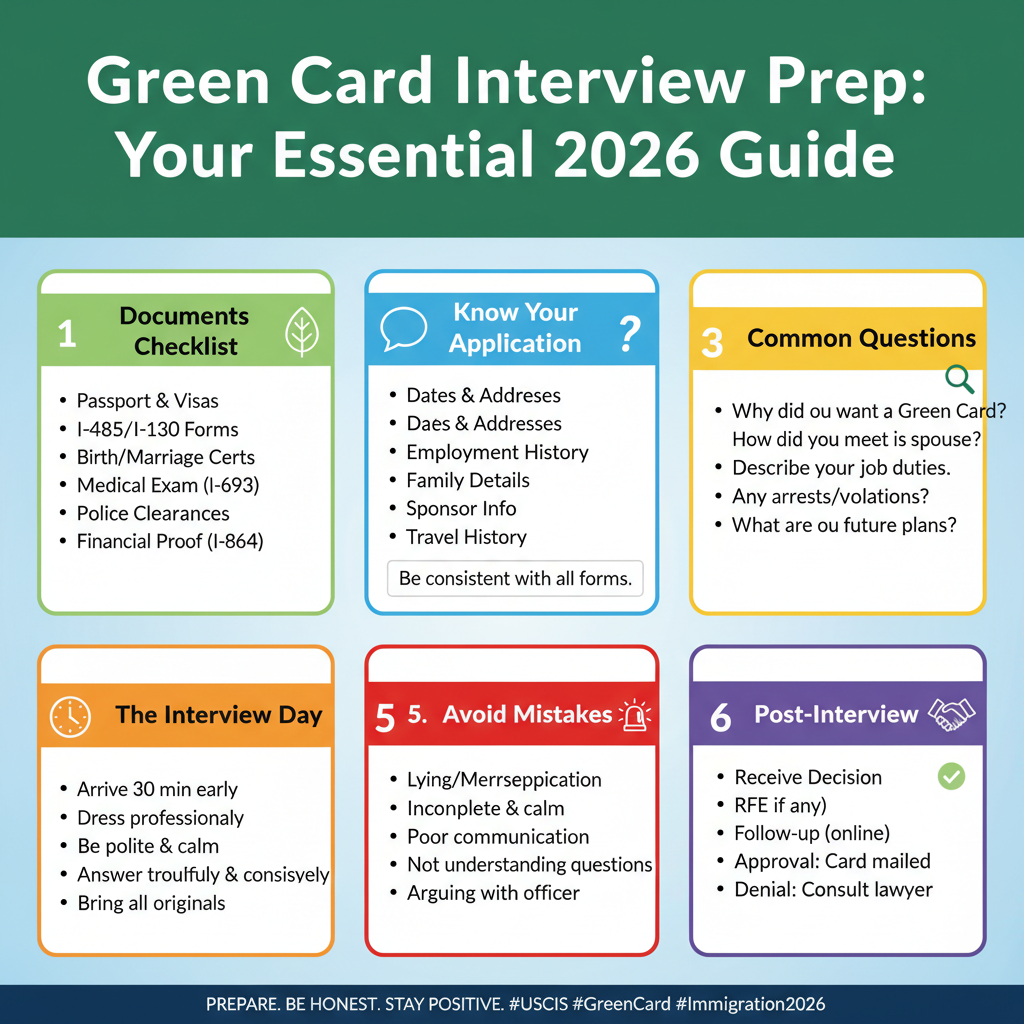
How to Prepare for Your Green Card Interview: A Complete Step-by-Step Guide
Thorough preparation is the single most important factor for a successful Green Card interview. Follow these steps to ensure you're ready for your big day.
1) Understand Your Case Type and Eligibility
Before anything else, be intimately familiar with the basis of your Green Card application. Are you applying through a family member (spouse, parent, child), an employer, as an asylum seeker, or through the Diversity Visa Lottery? Each category has specific eligibility requirements that the interviewing officer will focus on.
- Family-Based Petitions: If you're applying based on marriage, be prepared to answer detailed questions about your relationship's bona fides (genuineness). If through another family relationship, understand the lineage and family history.
- Employment-Based Petitions: Know the details of your job offer, employer, and qualifications.
- Asylum/Refugee Status: Be ready to recount your experiences and the reasons you fear persecution.
Important: If your eligibility has changed since you filed your application (e.g., divorce, new job), discuss this immediately with your attorney.
2) Gather All Required Documents
This is perhaps the most critical logistical step. You must bring originals AND copies of every document submitted with your application, plus any new documents that have emerged since filing. Organize them neatly in a binder with tabs. Do not staple or clip documents together unless instructed.
- Personal Identity Documents:
- Passport (current and expired)
- Birth Certificate (original and certified translation if not in English)
- National ID card (if applicable)
- Driver's License or state ID (especially for Florida residents)
- Previous immigration documents (visas, I-94 records, previous EADs/AP)
- Relationship Documents (for family-based petitions):
- Original Marriage Certificate (and divorce decrees for all prior marriages of both spouses)
- Birth Certificates of any children you share
- Photos together (spanning your relationship, with dates and descriptions)
- Joint bank accounts statements, joint utility bills, joint leases/mortgages
- Joint tax returns (Important: Bring transcripts from the IRS, not just copies of what you filed)
- Life insurance policies listing spouse as beneficiary
- Affidavits from friends/family attesting to the bona fides of your relationship
- Financial Documents:
- Form I-864, Affidavit of Support, signed by your sponsor (if applicable)
- Sponsor's tax returns (most recent 3 years, with all W-2s, 1099s, etc. – again, IRS transcripts are preferred)
- Sponsor's proof of income (pay stubs, employment verification letter)
- Proof of assets (bank statements, property deeds) if needed to meet income requirements
- Your own employment history and income documents
- Medical Examination:
- Original sealed envelope containing your Form I-693 (if not already submitted)
- Vaccination records
- Any other supporting documents:
- Police clearances from all countries where you lived for 6+ months since age 16
- Court disposition records for any arrests or criminal charges
- Proof of any waivers filed (e.g., Form I-601, Application for Waiver of Grounds of Inadmissibility)
- Any Request for Evidence (RFE) responses you submitted
- Interview Notice: The original appointment letter (Form I-797C, Notice of Action).
Reminder: For any document not in English, you must provide a certified English translation along with a copy of the original document. The translator must certify that they are competent to translate and that the translation is accurate.
3) Review Your Application Forms Thoroughly
You must know every answer you provided on your Form I-485, Form I-130, and all other submitted forms. The officer will compare your verbal answers to the written information. Inconsistencies, even minor ones, can raise red flags and lead to further questioning or even denial. Read through every line, especially sections on criminal history, past immigration violations, and personal background. If you don't remember an answer or spot an error, discuss it with your attorney who can advise on how to address it during the interview.
4) Practice Your Answers and Anticipate Questions
While you can't predict every question, many are common. Practice answering them truthfully and concisely. Some common questions include:
- "What is your full name and date of birth?"
- "What is your spouse's full name and date of birth?" (for marriage-based)
- "How and when did you meet your spouse?"
- "Describe your wedding day."
- "Where do you live? Who lives with you?"
- "What is your employment history?"
- "Have you ever been arrested or convicted of a crime?"
- "Have you ever overstayed a visa?"
- "Do you have any children?"
- "Do you understand the oath you just took?"
For marriage-based cases, expect questions designed to ascertain the genuineness of your relationship. These can be very personal, such as "What did you have for breakfast today?" or "Who does the laundry?" Be prepared to answer honestly and consistently with your spouse (if they are attending).
5) Prepare Your Interview Day Logistics
- Location: Confirm the address of the Orlando USCIS Field Office (or the U.S. Embassy/Consulate). Plan your route and account for traffic, especially if you're traveling from other parts of Florida like the Space Coast or Tampa.
- Time: Arrive at least 30 minutes before your scheduled appointment. Late arrivals can lead to rescheduling or even denial.
- Attire: Dress professionally, as you would for a job interview. This demonstrates respect for the process.
- Attorney Presence: If you are represented by an attorney from Imigrar, they will accompany you. Their presence can provide comfort and ensure your rights are protected.
- Interpreter: If you are not fluent in English, you must bring a certified interpreter. Your attorney may also serve as your interpreter if they are certified. Do not rely on family members or friends unless USCIS explicitly permits it (which is rare). Se Habla Español at Imigrar, and we can assist with interpretation if needed.
6) What to Expect During the Interview
Upon arrival, you will check in and wait to be called. When your name is called, you'll be directed to an interview room. Both the petitioner and beneficiary (if applicable) will be sworn in to tell the truth. The officer will review your identity documents and then proceed with questions.
- Officer Demeanor: Officers are generally professional, but their approach can vary. Remain calm, polite, and respectful.
- Types of Questions: The questions will cover your biographical information, the basis of your petition, your immigration history, and grounds of inadmissibility. For marriage-based cases, questions about your relationship will be extensive.
- Truthfulness: Always tell the truth. Providing false information or misrepresenting facts can lead to severe penalties, including a permanent bar from the U.S.
- "I Don't Know" or "I Don't Remember": It's okay to say you don't know or don't remember, rather than guessing or fabricating an answer.
- Clarification: If you don't understand a question, politely ask the officer to repeat or rephrase it.
- Additional Documents: The officer may ask for additional documents not originally submitted. If you have them, provide them. If not, explain why.
7) Post-Interview Procedures and Follow-Up
At the end of the interview, the officer may tell you if your case is approved, or if they need more time or additional documents (a Request for Evidence - RFE). Sometimes, a decision is made within a few days, other times it can take weeks or months. Ensure you understand any instructions given by the officer.
- Approval: If approved, you will typically receive a notice of approval (Form I-797) and your Green Card will be mailed to you within a few weeks.
- Request for Evidence (RFE): If an RFE is issued, respond promptly and thoroughly with the requested information.
- Notice of Intent to Deny (NOID): This is a more serious notice, indicating the officer intends to deny your case. You will have an opportunity to respond and address the concerns.
- Denial: If your application is denied, it's crucial to consult with an attorney immediately to understand your options, which may include filing a motion to reopen/reconsider or appealing the decision.
Monitor your case status online at USCIS Case Status Online using your receipt number. For general processing times, check USCIS Processing Times.
Practical Steps You Can Take Today for Interview Success
Don't wait until the last minute to start preparing. Here’s an actionable checklist to guide your efforts:
- Create a Master Document Checklist: Go through your entire application and list every document you submitted. Then, identify any new documents or updates since filing (e.g., new lease, recent tax returns, updated bank statements).
- Organize Your Documents in a Binder: Use dividers and labels for easy access. Keep originals separate from copies. This organization will impress the officer and help you quickly retrieve documents.
- Review All Submitted Forms: Print out copies of your complete application package and read it cover-to-cover. Highlight any areas where you anticipate questions.
- Practice with a Mock Interview: Ask a trusted friend, family member, or your attorney to conduct a mock interview. Practice answering questions about your personal history, the basis of your petition, and your relationship (if applicable).
- Consult an Experienced Immigration Attorney: This is arguably the most important step. An attorney can review your entire application, identify potential issues, help you gather documents, conduct mock interviews, and accompany you to the interview. For residents in Orlando and nationwide, Imigrar offers this crucial support.
- Check USCIS Processing Times and Your Mail Regularly: Stay informed about your case status and be prepared to receive your interview notice. Interview notices are typically sent out 3-4 weeks before the interview date, but it can vary.
- Address Any Potential Issues Proactively: If you have any criminal history, prior immigration violations, or complex issues, discuss them with your attorney immediately. Don't wait for the interview to disclose these.
Document preparation guidance
Originals vs. Copies: Always bring original documents, but also bring a complete set of photocopies. The officer will typically review the original and may keep the copy. Translations: Ensure all non-English documents have certified English translations. The translation must include a statement from the translator that they are competent to translate from the foreign language into English and that the translation is complete and accurate. Photographs: For marriage-based cases, arrange photos chronologically, with captions indicating dates, locations, and people. Include photos from before marriage, wedding, and after marriage with family and friends. Financial Evidence: For Form I-864, IRS tax transcripts are preferred over copies of tax returns. You can request these from the IRS website.
Timeline expectations
The timeline from filing your application to receiving an interview notice can vary significantly based on your application type, the USCIS field office jurisdiction (e.g., Orlando vs. Miami), and current processing backlogs. After your interview, a decision can be immediate, or it could take several weeks or even months. USCIS aims to process most Adjustment of Status applications within 6-12 months, but delays are possible. Always check the USCIS Processing Times page for the most up-to-date estimates for the Orlando field office or your specific service center.
Need Help? Our Orlando immigration team is ready to assist. Call +1 786-791-3106 for a free consultation, or message us online. Se Habla Español.

How Imigrar Helps Immigrants in Orlando and Beyond
At Imigrar, we understand that the Green Card interview is a high-stakes moment. Our mission to "Keep Families Together" drives our commitment to providing expert legal guidance and compassionate support throughout your immigration journey. Based in Orlando, Florida, we serve clients nationwide, bringing extensive experience to every case.
Our team of dedicated immigration attorneys specializes in Green Card applications, including complex family-based and employment-based cases. We pride ourselves on our meticulous attention to detail and our proactive approach to preparing clients for their interviews. When you choose Imigrar, you can expect:
- Comprehensive Case Review: We will review your entire application, identify any potential issues or inconsistencies, and advise you on the best course of action.
- Personalized Document Preparation: We'll help you compile, organize, and prepare all necessary documents, ensuring nothing is overlooked.
- Thorough Interview Preparation: We conduct mock interviews tailored to your specific case, familiarizing you with common questions and helping you articulate your answers clearly and confidently.
- Attorney Representation: One of our experienced attorneys can accompany you to your interview at the Orlando USCIS Field Office or other locations, providing a layer of confidence and legal protection.
- Ongoing Support: From responding to RFEs to addressing post-interview challenges, we are with you every step of the way.
Navigating immigration law can be daunting, but you don't have to


