


The journey to obtaining a Green Card, or lawful permanent residency, is a pivotal moment for many immigrants and their families in the United States. While the application process itself can be complex, the Green Card interview is often the final and most nerve-wracking hurdle. Understanding what to expect and how to prepare thoroughly can significantly impact the outcome, bringing you closer to your American dream.
Need Expert Guidance for Your Green Card Interview? Don't face this crucial step alone. Our Orlando immigration team at Imigrar is ready to assist you with comprehensive preparation. Call +1 786-791-3106 for a free consultation today, or message us online. Se Habla Español.
The reporting that sparked this guide
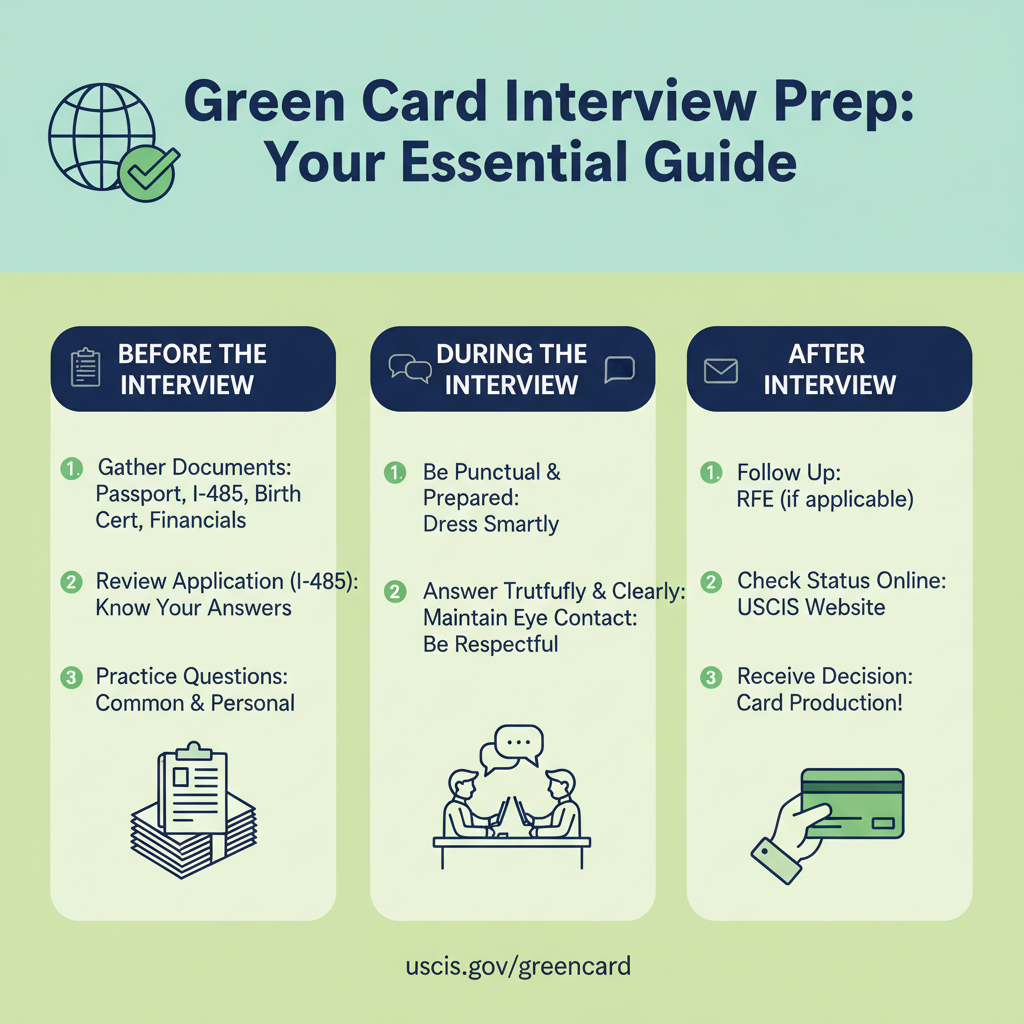
Recent trends and discussions within Green Card Interview Preparation Tips (Immigration Law) highlight the ongoing importance of meticulous preparation for the final interview stage of the Green Card process. Immigration legal news consistently underscores that while the interview might seem like a formality after extensive paperwork, it is a critical opportunity for applicants to affirm their eligibility and for USCIS to verify the authenticity of their claims. This focus on preparation is not new, but its consistent appearance in immigration discourse emphasizes its enduring relevance and the need for up-to-date guidance.
What This News Means for Immigrants in Orlando and Across Florida
For individuals and families pursuing permanent residency, particularly those residing in Orlando and across Florida, news emphasizing Green Card interview preparation is a vital reminder to take this step seriously. Florida, with its diverse population and numerous immigration pathways, sees a significant volume of Green Card applications processed through local USCIS field offices, including the Orlando USCIS Field Office. The success of these applications often hinges on a well-prepared interview.
Why this news is showing up now
The renewed emphasis on Green Card interview preparation is a constant in immigration law for several reasons. Firstly, immigration policies and enforcement priorities can shift, leading to more rigorous scrutiny of applications. Secondly, as processing times fluctuate, applicants may have a longer wait between filing and interview, making it crucial to refresh their memory and documents. Thirdly, the complexity of immigration fraud prevention means that USCIS officers are trained to identify inconsistencies, making thorough and honest preparation paramount. Finally, with the increasing volume of applications, ensuring each interview is conducted efficiently and effectively is a priority for USCIS, placing the onus on applicants to come fully prepared.
How it can affect Florida residents
For Florida residents, particularly those along the I-4 corridor and in Orange County, this news directly impacts their Green Card journey. The Orlando USCIS Field Office, like others nationwide, conducts thousands of interviews annually for various Green Card categories, including family-based petitions (Form I-130, Petition for Alien Relative), employment-based petitions, and asylum-based adjustments. A lack of adequate preparation can lead to delays, requests for additional evidence (RFE), or even a denial, prolonging the separation of families or delaying career opportunities. Given Florida's status as a hub for international communities, many residents are navigating these processes, making expert guidance invaluable to avoid common pitfalls and ensure a smooth interview experience.
What Green Card Interview Preparation Is (and Why It Matters)
The Green Card interview is the final stage for many individuals seeking lawful permanent residency in the United States. It is a mandatory appointment with a USCIS (U.S. Citizenship and Immigration Services) officer who reviews your application, verifies your identity, and assesses your eligibility for a Green Card. This interview is not merely a formality; it is a critical opportunity for you to present your case, clarify any ambiguities, and demonstrate that you meet all legal requirements for permanent residency. For many, it's the culmination of years of effort, and proper preparation is key to a successful outcome.
A plain-English definition
Simply put, a Green Card interview is a meeting with a U.S. government official to confirm that you are truly eligible to live permanently in the United States. During this meeting, the officer will ask you questions about your application, your background, your relationship (if it’s a marriage-based Green Card), and your intentions. They will also review all the documents you submitted, along with any new evidence you bring. It's your chance to directly answer questions and prove your case.
Key terms you need to know
- Adjustment of Status (AOS): The process of applying for a Green Card while you are already in the United States. The Green Card interview is typically part of this process.
- Consular Processing: The process of applying for a Green Card through a U.S. embassy or consulate in your home country. While different, it also involves an interview.
- USCIS (U.S. Citizenship and Immigration Services): The government agency responsible for processing immigration benefits, including Green Cards.
- Interview Notice (Form I-797C): The official document from USCIS that schedules your interview, providing the date, time, and location (e.g., Orlando USCIS Field Office). It also lists documents you must bring.
- Principal Applicant: The main person applying for the Green Card.
- Derivative Beneficiary: A spouse or child who applies for a Green Card based on the principal applicant's petition.
- Affidavit of Support (Form I-864): A legally binding document signed by a sponsor (often the petitioner) to accept financial responsibility for the immigrant.
- Medical Examination (Form I-693): A required medical exam conducted by a USCIS-approved civil surgeon to ensure the applicant is not inadmissible due to health-related grounds.
- Request for Evidence (RFE): A letter from USCIS asking for additional documents or information to support your application.
- Notice of Intent to Deny (NOID): A letter from USCIS indicating their intention to deny your application unless you provide further evidence or explanation.
- Priority Date: The date your immigration petition (e.g., Form I-130) was properly filed. This date determines when your Green Card becomes available in certain categories.
Feeling Overwhelmed by Immigration Terminology? Imigrar is here to simplify the process. Our bilingual team (Se Habla Español) can explain every term and guide you through your Green Card application. Call us at +1 786-791-3106 for a free consultation.
Current Immigration Law: The Foundation
The Green Card interview process is rooted in U.S. immigration law, primarily the Immigration and Nationality Act (INA). The INA sets forth the criteria for who is eligible for permanent residency and establishes the procedures for obtaining it. The interview serves as a mechanism for USCIS to ensure compliance with these laws and to uphold the integrity of the immigration system.
Federal requirements
At the federal level, the core requirements for Green Card eligibility are outlined in various sections of the INA. For most Green Card applicants, the interview focuses on verifying the information provided in the initial petition (e.g., Form I-130 for family-based, or Form I-140 for employment-based) and the subsequent application for adjustment of status (Form I-485). Key legal principles the interviewing officer will consider include:
- Admissibility: Sections 212(a) of the INA detail grounds of inadmissibility, which can prevent an applicant from receiving a Green Card. These include health-related grounds, criminal grounds, security grounds, public charge concerns, and prior immigration violations. The interview is a chance for the officer to assess if any of these apply.
- Eligibility for the Specific Category: Whether the applicant genuinely meets the requirements for the Green Card category they applied under (e.g., a bona fide marriage for marriage-based Green Cards, or the qualifications for a specific employment visa).
- Absence of Fraud or Misrepresentation: Officers are trained to detect any signs of fraud, misrepresentation, or attempts to circumvent immigration laws.
- Financial Support: For most family-based Green Cards, the petitioner must submit Form I-864, Affidavit of Support, demonstrating they can financially support the applicant above 125% of the federal poverty guidelines, ensuring the applicant will not become a "public charge."
All forms and official guidelines can be found on the USCIS official website.
Florida-specific considerations
While the federal laws are uniform across the nation, the application of these laws and the interview experience can have local nuances. For Florida residents, particularly those whose cases are processed at the Orlando USCIS Field Office, understanding the local context can be helpful:
- Orlando USCIS Field Office Procedures: While fundamental procedures are standardized, each field office develops certain local practices. Being familiar with these, often through experienced local counsel, can be advantageous.
- Processing Times: Processing times for Form I-485 can vary significantly by field office. You can check current processing times on the USCIS Processing Times page. For those in Orlando, tracking the local office's times is crucial for managing expectations.
- Local Resources: Florida has a robust network of community organizations and legal aid groups that can offer support, though for complex cases, a private immigration attorney is highly recommended.
Reminder: Staying informed about federal immigration policies and how they are implemented locally is vital. An experienced immigration attorney in Orlando can provide tailored advice based on the latest legal developments and local practices.
How to Prepare for Your Green Card Interview: A Complete Step-by-Step Guide
Preparing for your Green Card interview is a multi-faceted process that requires attention to detail, thorough organization, and a clear understanding of your application. Follow these steps to maximize your chances of a successful interview.
1) Understand Your Interview Notice (Form I-797C)
Your interview notice is your official invitation and instruction sheet. Do not overlook any detail within it. It will specify the date, time, and location of your interview (e.g., the Orlando USCIS Field Office). Crucially, it will also list specific documents you must bring to the interview. Review this list carefully and immediately begin gathering these items.
- Required Documents for this step:
- Original Form I-797C, Interview Notice
2) Gather and Organize All Documents (Originals & Copies)
This is perhaps the most critical step. You must bring originals of all documents you submitted with your application, plus copies, and any new evidence that has developed since your submission. Organize everything neatly in a binder or folder, clearly labeled. It’s wise to create separate sections for original documents, copies, and additional evidence.
- General Required Documents:
- Your passport (and any expired passports)
- Your birth certificate (original and certified translation if not in English)
- Marriage certificate (if applicable, original and certified translation)
- Divorce decrees or death certificates for any previous marriages (for both applicant and petitioner, if applicable)
- Originals of all forms submitted (Form I-130, Form I-485, Form I-765, Form I-131, Form I-864, etc.)
- Medical examination report (Form I-693) in a sealed envelope (if not already submitted or if expired)
- Original I-94 arrival/departure record
- Two passport-style photos meeting USCIS specifications
- Employment authorization document (EAD) and Advance Parole (AP) cards, if you have them
- Proof of identity (state ID, driver’s license – especially important for Florida residents)
- Police clearances from all countries where you have lived for more than six months since age 16
- Court and police records for any arrests or convictions (even if charges were dropped or expunged)
- Additional Evidence (especially for marriage-based Green Cards):
- Joint bank statements, credit card statements
- Joint lease agreements, mortgage statements, property deeds
- Joint utility bills (electricity, water, internet)
- Health insurance, life insurance, car insurance policies showing both names
- Birth certificates of any children you have together
- Photos of your relationship (dating, wedding, family events, travel)
- Affidavits from friends and family attesting to the bona fide nature of your marriage
- Any other evidence demonstrating commingling of finances and lives (e.g., joint tax returns, wills)
3) Review Your Application Forms Thoroughly
Go through every single form you submitted (Form I-130, Form I-485, Form I-864, etc.) line by line. Familiarize yourself with every answer you provided. The USCIS officer will have your application in front of them and will ask questions based on the information you submitted. Any inconsistencies between your answers at the interview and your written application can raise red flags.
- Actionable Tip: Print out copies of all your submitted forms and highlight key information. Practice recalling dates, addresses, and other details.
4) Practice Your Answers and Prepare for Questions
While you cannot predict every question, you can anticipate common lines of inquiry. For marriage-based Green Cards, expect detailed questions about your relationship, how you met, your daily life together, and future plans. For other categories, questions will focus on your background, employment history, and reasons for seeking permanent residency.
- Common Interview Questions:
- What is your full name and date of birth?
- Where do you live? Who lives with you?
- How did you meet your spouse (if applicable)? When did you get married?
- What is your spouse's date of birth/place of employment?
- Describe a typical day in your household.
- Have you ever been arrested or convicted of a crime?
- Have you ever violated immigration laws?
- Have you ever claimed to be a U.S. citizen?
- Do you support the U.S. Constitution and form of government?
- Important: Always answer truthfully and concisely. If you don't understand a question, ask the officer to rephrase it. Do not guess.
5) Dress Appropriately and Plan Your Travel
Your appearance matters. Dress in clean, professional attire, as if you are going to a job interview. This demonstrates respect for the process and the officer. Also, plan your travel to the Orlando USCIS Field Office (or your designated location) well in advance. Account for traffic, parking, and security checks. Arrive at least 30 minutes before your scheduled interview time.
- Travel Tip for Central Florida Residents: The Orlando USCIS Field Office is located at 6650 Corporate Centre Blvd, Orlando, FL 32822. Be aware of rush hour traffic, especially if traveling from other parts of Orange County or along the I-4 corridor.
6) What to Expect on Interview Day
Upon arrival, you will check in and wait for your name to be called. When you meet the officer, you will be sworn in to tell the truth. The interview will typically begin with biographical questions, then move to questions about your application and supporting documents. For marriage-based cases, the petitioner (U.S. citizen or LPR spouse) must also attend and will be questioned alongside or sometimes separately from the applicant. Stay calm, be polite, and answer honestly.
- Key Actions During Interview:
- Listen carefully to each question before answering.
- Answer truthfully and directly. Do not volunteer extra information unless asked.
- If you brought new evidence, offer it when relevant to a question.
- If you have an attorney, they will be present to represent you and ensure fairness.
7) Follow-Up Actions
At the end of the interview, the officer may tell you if your case is approved, or they may state that a decision will be mailed. Sometimes, they may issue a Request for Evidence (RFE) if they need more information. If an RFE is issued, respond promptly and completely within the given deadline. If approved, you will typically receive your Green Card by mail within a few weeks.
- Important: Keep copies of everything you submit, including RFE responses.
Practical Steps You Can Take Today
The journey to a Green Card can be long, but proactive preparation for your interview can significantly ease the process. Here’s an actionable checklist:
Actionable Checklist:
- Review Your Application: Immediately pull out copies of your entire Green Card application package (Form I-130, Form I-485, etc.) and read through every answer. Highlight any areas where you might need to refresh your memory or gather additional evidence.
- Start Document Gathering: Identify all original documents required by your interview notice and those you submitted previously. Begin locating them now. If any are missing or expired, start the process of obtaining new ones.
- Organize Your Files: Invest in a binder or accordion folder. Create tabs for different categories of documents (e.g., "Personal IDs," "Marriage Evidence," "Financial," "Medical"). This organization will impress the officer and help you quickly retrieve documents.
- Identify New Evidence: Think about any new evidence that has emerged since you filed your application. For marriage-based cases, this could be new joint bills, photos, or additions to your family. For employment-based cases, it might be updated employment letters or financial statements.
- Consult an Attorney: Even if you filed your application yourself, consider a consultation with an experienced immigration attorney before your interview. They can review your case, conduct a mock interview, and identify potential issues.
- Plan Logistics: Confirm the interview location, parking, and travel time. If you need special accommodations (e.g., a sign language interpreter), notify USCIS in advance as per your interview notice instructions.
Document Preparation Guidance:
- Originals vs. Copies: Always bring the original of every document, along with a high-quality photocopy. The officer will typically review the original and keep the copy.
- Translations: Any document not in English must be accompanied by a complete and accurate English translation, certified by a competent translator. The translator must include a statement that they are fluent in both languages and that the translation is accurate.
- Photographs: Ensure any photos you submit as evidence are clearly labeled with dates and names. For marriage-based cases, photos with family and friends are particularly helpful.
Timeline Expectations:
- Interview Notice: You typically receive your interview notice (Form I-797C) several weeks to a few months before your scheduled interview date. The exact timeframe can vary based on the USCIS field office and case workload.
- Interview Scheduling: After your Form I-485 is filed and your priority date becomes current (if applicable), USCIS will schedule your biometrics appointment, followed by the interview. This entire process can take several months to over a year, depending on the current USCIS Processing Times.
- Decision: In many cases, the officer will tell you at the end of the interview if your case is approved or if a decision will be mailed. If approved, your Green Card will typically arrive within 90 days of the interview. If an RFE is issued, you usually have 60-90 days to respond.
Warning: Do not miss your interview. If you absolutely cannot attend, you must notify USCIS immediately and request a rescheduling. Unexcused absences can lead to denial of your application.
How Imigrar Helps Immigrants in Orlando
At Imigrar, we understand that the Green Card interview is a monumental step for you and your family. Our firm, based right here in Orlando, Florida, is dedicated to "Keep Families Together" by providing expert, compassionate legal representation throughout the entire immigration process, including comprehensive Green Card interview preparation.
Our experienced immigration attorneys have a deep understanding of federal immigration law and specific insights into the practices of the Orlando USCIS Field Office. We pride ourselves on offering personalized guidance, ensuring that you are not just prepared, but truly confident on interview day.
Our Experience and Expertise
We assist clients with all types of Green Card applications, including family-based petitions (marriage Green Cards, parent-child petitions), employment-based Green Cards, and adjustment of status cases. Our services include:
- Thorough Application Review: We review your entire Green Card application package to ensure accuracy and consistency, identifying any potential issues before the interview.
- Document Organization: We help you organize all necessary documents, ensuring you have both originals and copies, and advise on any additional evidence that could strengthen your case.
- Mock Interviews: We conduct realistic mock interviews, covering common questions and specific inquiries related to your case, helping you practice your answers and build confidence.
- Legal Representation: An Imigrar attorney can attend the interview with you, providing legal support, clarifying questions, and protecting your rights throughout the process.
- Responding to RFEs: Should USCIS issue a Request for Evidence, we will help you prepare a comprehensive and timely response.
For Central Florida residents, our local presence means we are familiar with the specific dynamics of the Orlando USCIS Field Office, providing a distinct advantage in navigating your case.
Free Consultation Offer
We believe that everyone deserves access to quality legal advice. That’s why Imigrar offers a free initial consultation. This is your opportunity to discuss your specific situation, understand the preparation process, and learn how our team can support you. Call us today at +1 786-791-3106 to schedule your consultation.
Se Habla Español. Our bilingual team is ready to assist you in the language you are most comfortable with, ensuring clear communication and understanding every step of the way.
Ready to Secure Your Green Card with Confidence? Let Imigrar be your trusted partner. We offer free consultations to discuss your Green Card interview preparation. Call us at +1 786-791-3106 or contact us online. Se Habla Español.
Frequently Asked Questions
Q: What if I don't understand a question during the interview?
A: It's crucial to understand every question. If you don't, politely ask the USCIS officer to rephrase it or explain what they mean. Do not guess or answer a question you don't fully comprehend. If there's a language barrier, and you did not request a USCIS interpreter in advance, you might need to reschedule. For those who require it, Imigrar can help ensure an interpreter is present or advise on the proper procedure for requesting one. Remember, honesty and clarity are paramount.
Q: Can my immigration status be negatively impacted if I make a mistake during the interview?
A: Yes, mistakes can have significant consequences. Providing inconsistent information, misrepresenting facts, or failing to disclose required information can lead to a Request for Evidence (RFE), a Notice of Intent to Deny (NOID), or even a denial of your Green Card application. In some severe cases, intentional misrepresentation can lead to findings of fraud, making you inadmissible for future immigration benefits. This is why thorough preparation and truthful answers are absolutely essential. Consulting with an attorney from Imigrar beforehand can help you avoid such pitfalls.
Q: How long after my interview will I receive a decision or my Green Card?
A: The timeline varies. Sometimes, the USCIS officer will approve your case on the spot, and you may receive a stamp in your passport indicating temporary permanent residency. More commonly, you will receive a decision notice by mail within a few weeks to a few months. Your physical Green Card typically arrives within 90 days of approval. You can check the status of your case online using the receipt number on the USCIS official website. If your case is delayed, an attorney can help inquire about its status.
Q: What documents are absolutely critical to bring, besides those listed on the interview notice?
A: While the interview notice provides a core list, always bring all original documents you submitted with your application (Form I-130, Form I-485, etc.), along with copies. For marriage-based cases, bring an abundance of joint evidence that demonstrates a bona fide marriage, even if you’ve submitted it before. This includes recent joint bank statements, utility bills, photos, and any new shared financial documents. Always have your passport, birth certificate, and marriage certificate (if applicable) handy. If you’ve traveled recently, bring your updated I-94 records. When in doubt, it's better to bring more documents than fewer. An Imigrar attorney can help you compile a comprehensive list tailored to your case.
Q: Are there any costs associated with the Green Card interview itself?
A: No, there is typically no separate fee for the Green Card interview itself. The fees for the Green Card application (e.g., filing fees for Form I-485, biometrics fee) are paid when you initially submit your application. However, you might incur costs related to preparing for the interview, such as obtaining certified copies of documents, getting translations, or hiring an immigration attorney for guidance and representation. Imigrar offers a free initial consultation to discuss your specific needs and potential costs.
Q: What happens if my Green Card application is denied after the interview?
A: A denial is a serious setback, but it’s not always the end of the road. If your application is denied, USCIS will send you a written explanation for the denial. Depending on the reason, you might have options such as filing a motion to reconsider or reopen the case, or in some instances, filing an appeal with the Administrative Appeals Office (AAO) or the Executive Office for Immigration Review. It is critical to consult with an experienced immigration attorney immediately upon receiving a denial notice, as there are strict deadlines for these actions. Imigrar can review your denial and advise you on the best course of action to pursue your Green Card.

Common Mistakes (and How to Avoid Them)
Even with meticulous preparation, applicants can sometimes make mistakes that jeopardize their Green Card application. Being aware of these common pitfalls can help you avoid them.
Mistake #1: Underestimating the Importance of the Interview
Some applicants view the interview as a mere formality after submitting extensive paperwork. This is a dangerous misconception. The interview is the USCIS officer's opportunity to personally assess your credibility, verify your information, and ensure you meet all legal requirements. Underestimating its importance can


