


The journey to obtaining a Green Card, or lawful permanent residency, is a pivotal moment for countless individuals and families seeking a future in the United States. A critical step in this process for many is the Green Card interview. This isn't just a formality; it's an opportunity for U.S. Citizenship and Immigration Services (USCIS) to verify the information in your application, ensure eligibility, and confirm the legitimacy of your claims.
For immigrants in Orlando, across Florida, and throughout the nation, understanding how to prepare for this interview can significantly impact its outcome. At Imigrar, "Keep Families Together" isn't just a tagline—it's our mission. We understand the stakes involved and are dedicated to providing clear, actionable guidance to help you navigate every stage of your immigration journey, including this crucial interview.
Need Expert Guidance for Your Green Card Interview? Don't face your interview unprepared. Our Orlando immigration team is ready to assist you in meticulously preparing every detail. Call +1 786-791-3106 for a free consultation today, or message us online. Se Habla Español.
The reporting that sparked this guide: Green Card Interview Preparation Tips (Immigration Law)
What This News Means for Immigrants in Orlando and Across Florida
The topic of Green Card interview preparation is perennially relevant in immigration law. While there may not be specific breaking news about a new law or policy change regarding interviews, the ongoing discussion in immigration circles and legal news outlets consistently emphasizes the importance of thorough preparation. This trend reflects the complex and often high-stakes nature of the interview process itself.
Why this news is showing up now
The "news" surrounding Green Card interview preparation isn't about a sudden shift in policy, but rather a continuous emphasis on best practices. Immigration processes, while standardized, are also subject to evolving interpretations, increased scrutiny, and the sheer volume of applications. As USCIS streamlines processes and focuses on efficiency, the interview remains a critical bottleneck where adjudicators ensure compliance and legitimacy. Therefore, ongoing discussions about preparation tips are a constant fixture because applicants consistently seek reassurance and expert advice to navigate this challenging step. It's a testament to the enduring need for reliable, up-to-date guidance in a field that impacts so many lives.
How it can affect Florida residents
For the vibrant immigrant communities throughout Florida, and particularly in Central Florida with its substantial population growth and diverse demographics, the importance of Green Card interview preparation cannot be overstated. The Orlando USCIS Field Office, located at 5449 Forbes Pl, Orlando, FL 32812, serves a vast area, including Orange County, Seminole County, Osceola County, and beyond. This office handles a significant number of Adjustment of Status interviews for individuals seeking Green Cards while residing in the U.S.
Residents along the I-4 corridor, from Tampa to Daytona Beach, often have their interviews scheduled at the Orlando office. The volume of cases means that adjudicators are highly experienced but also under pressure, making a well-prepared applicant stand out. Furthermore, Florida’s unique position as a major port of entry and a hub for international tourism and business means a diverse array of Green Card cases, from family-based petitions to employment-based applications, are processed here. Understanding the local nuances, interview styles, and common challenges faced by applicants in this region is crucial. Imigrar, based in Orlando, is intimately familiar with the local USCIS office's procedures and expectations, providing tailored advice for Florida residents.
What Green Card Interview Preparation Is (and Why It Matters)
Preparing for your Green Card interview means meticulously reviewing your entire application, gathering all necessary supporting documents, understanding the legal basis of your petition, and mentally preparing for a conversation with a USCIS officer. It’s a proactive and comprehensive approach to ensure you present your case clearly, consistently, and truthfully.
A plain-English definition
A Green Card interview is a meeting with a U.S. Citizenship and Immigration Services (USCIS) officer who will review your application for lawful permanent residency. The officer's main goal is to confirm that the information you provided in your application is accurate, that you meet all the eligibility requirements for the Green Card category you're applying under, and that there are no factors that would make you inadmissible to the United States. It's essentially a final check before USCIS makes a decision on your application. For family-based petitions, especially marriage-based ones, the interview also serves to verify the authenticity of the relationship.
Key terms you need to know
- Green Card: Official name is Lawful Permanent Resident Card. It grants you authorization to live and work permanently in the United States.
- Adjustment of Status (AOS): The process of applying for a Green Card while you are already in the United States. This typically involves filing Form I-485, Application to Register Permanent Residence or Adjust Status.
- Consular Processing: The process of applying for a Green Card while you are outside the United States, typically through a U.S. embassy or consulate in your home country. This involves filing Form DS-260, Immigrant Visa Application.
- Petitioner: The U.S. citizen or lawful permanent resident who files an immigration petition on behalf of a foreign national (e.g., filing Form I-130, Petition for Alien Relative).
- Beneficiary: The foreign national who is seeking an immigration benefit, such as a Green Card, based on a petition filed by a U.S. citizen or lawful permanent resident.
- Affidavit of Support: A legally binding document (Form I-864) signed by a petitioner (sponsor) who agrees to financially support the immigrant beneficiary if they are unable to support themselves. This ensures the immigrant does not become a public charge.
- Priority Date: The date USCIS receives your immigration petition. This date is crucial for tracking your place in the visa queue, especially for categories with annual limits.
- Inadmissibility: Legal grounds under which a foreign national may be denied entry into the U.S. or denied a Green Card. These can include health, criminal, security, or public charge grounds.
- Request for Evidence (RFE): A notice from USCIS requesting additional documents or information to support your application.
- Notice of Intent to Deny (NOID): A notice from USCIS indicating their intention to deny your application unless you provide specific information or evidence to overcome the grounds for denial.
- USCIS Field Office: Local offices where interviews are conducted for Adjustment of Status applicants. For Central Florida residents, this is the Orlando USCIS Field Office.
Current Immigration Law: The Foundation
The legal framework for Green Card applications and interviews is primarily found in the Immigration and Nationality Act (INA), various federal regulations (Title 8 of the Code of Federal Regulations), and policy manuals issued by USCIS. Understanding these foundations is key to a successful application and interview.
Federal requirements
The core federal requirements for obtaining a Green Card are outlined in the INA. For most family-based Green Cards, the process begins with a U.S. citizen or lawful permanent resident filing Form I-130, Petition for Alien Relative, with USCIS. This establishes the qualifying relationship.
Once the petition is approved and a visa becomes available (if applicable, based on the priority date and visa bulletin), the beneficiary can then apply for a Green Card. If they are in the U.S. and meet specific eligibility criteria, they can file for Adjustment of Status by submitting Form I-485. The interview is a mandatory step for most I-485 applicants.
Key sections of the INA that govern this process include:
- INA Section 245 (8 U.S.C. § 1255): This section details the eligibility requirements for Adjustment of Status for individuals physically present in the United States. It outlines who can adjust status and under what conditions, including specific bars to adjustment for certain categories of individuals.
- INA Section 201 (8 U.S.C. § 1151): Defines the numerical limitations on immigrant visas, establishing categories for immediate relatives (no numerical limits) and family-preference categories (subject to annual caps).
- INA Section 203 (8 U.S.C. § 1153): Specifies the allocation of immigrant visas for family-sponsored and employment-based preferences, determining the priority dates and waiting times.
- INA Section 212 (8 U.S.C. § 1182): Outlines the grounds of inadmissibility, which are reasons an individual may be denied a Green Card. These include health-related grounds, criminal grounds, security and related grounds, public charge grounds, and misrepresentation. During your interview, the officer will assess if any of these grounds apply to you.
- INA Section 213A (8 U.S.C. § 1183a): Mandates the requirement for an Affidavit of Support (Form I-864) for most family-based and some employment-based immigrants to prevent them from becoming a public charge. The interviewer will verify the sponsor’s income and assets.
It's important to note that the interview process itself is guided by USCIS policy manuals and field office standard operating procedures. The officer's role is to ensure all statutory and regulatory requirements are met. You can find more detailed information on these laws and forms directly on the USCIS official website.
Florida-specific considerations
While immigration law is federal, the implementation and specific processes can have local nuances. For individuals residing in Florida, particularly those served by the Orlando USCIS Field Office:
- Local Adjudicators: Officers at the Orlando office are experienced with the types of cases common in the region, including marriage-based Green Cards, petitions for Cuban Adjustment Act beneficiaries, and various employment-based adjustments. They are well-versed in identifying potential issues related to Florida residency, such as changes of address or specific local documentation.
- Interview Environment: The Orlando office is a professional setting. Familiarizing yourself with its location and parking options beforehand can reduce stress on interview day.
- Wait Times: Processing times can vary by field office. You can check the current average processing times for Form I-485 at the Orlando office on the USCIS Processing Times page.
- Language Services: While Imigrar proudly offers services in English and Spanish (Se Habla Español), USCIS provides interpreters if you are not fluent in English. However, it is often advantageous to bring your own certified interpreter, or to have your attorney interpret if they are fluent, to ensure accuracy and comfort.
Feeling Overwhelmed by Immigration Law? Imigrar simplifies the complex. Let our experienced Orlando immigration attorneys guide you through federal requirements and Florida-specific considerations. Call us at +1 786-791-3106 for a free consultation. Se Habla Español.
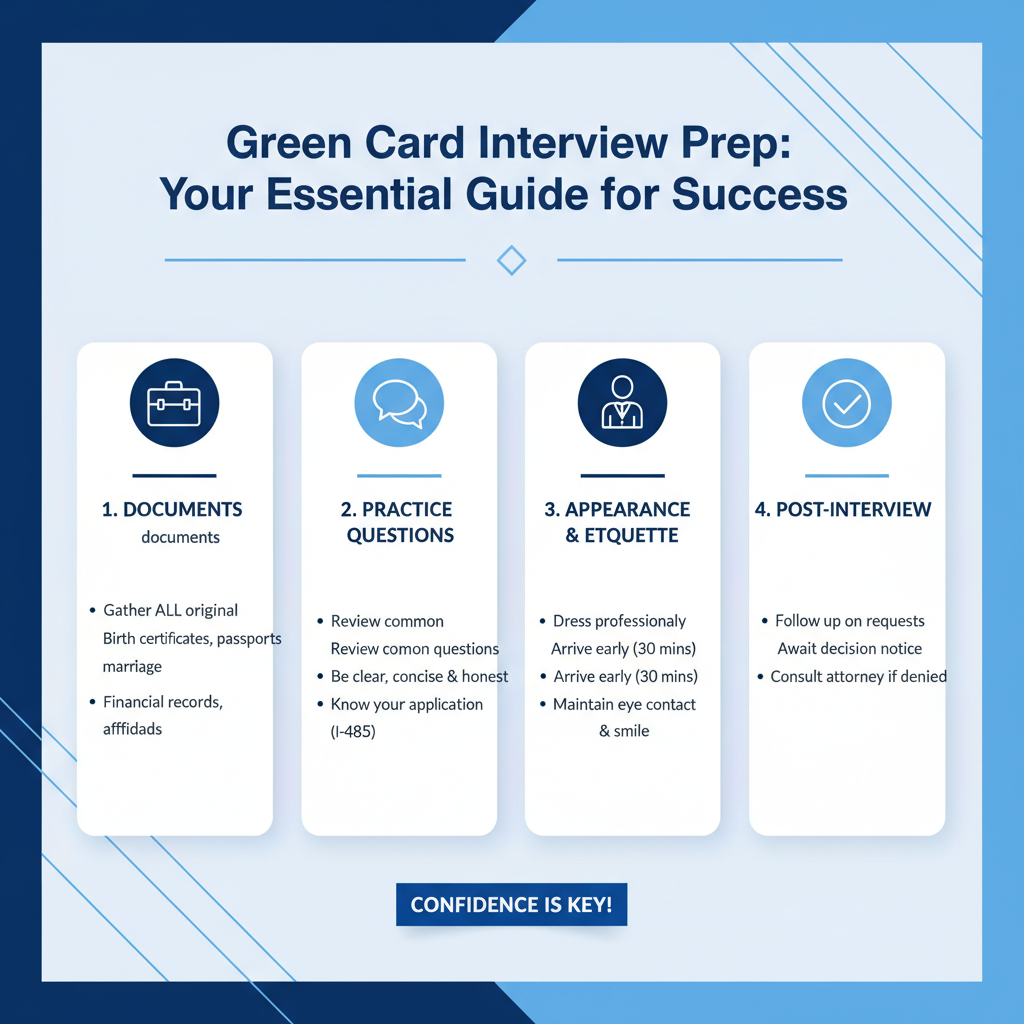
How to Prepare for Your Green Card Interview: A Complete Step-by-Step Guide
Preparation is the cornerstone of a successful Green Card interview. Follow this comprehensive guide to ensure you are ready for every aspect of the process.
1) Understand Your Case Type and Review Your Application
Before anything else, you must fully understand the basis of your Green Card application. Are you applying through a family member, employment, asylum, or another category? Each category has specific eligibility requirements that the USCIS officer will verify.
- Review Your Entire Application Package: Go through every form you submitted (Form I-130, Form I-485, Form I-864, etc.) and all supporting documents. Make sure you recall every detail, date, and answer. The officer will have your file in front of them and will ask questions based on it. Any inconsistencies can raise red flags.
- Know Your Dates and Facts: Be familiar with dates of entry, marriage, birth, employment, and any significant life events mentioned in your application.
- Identify Potential Issues: If there were any past immigration issues, arrests, or complex situations, anticipate how these might be questioned and be prepared to explain them truthfully and clearly.
Required Documents to Review:
- A complete copy of your submitted Form I-130 petition and all supporting documents.
- A complete copy of your submitted Form I-485 application and all supporting documents.
- A complete copy of your submitted Form I-864 Affidavit of Support and all supporting financial documents.
- Any other forms filed, such as Form I-765 (Employment Authorization) or Form I-131 (Travel Document).
2) Gather and Organize All Required Documents
This is arguably the most critical step. You must bring originals of all documents you submitted with your application, plus copies, and any new documents that have emerged since filing. Organize them neatly in a binder or folder, clearly labeled. This demonstrates preparedness and respect for the process.
- Originals and Copies: Bring the original of every document you submitted, along with a complete set of photocopies. USCIS officers typically want to see the originals and will keep the copies for their file.
- New Evidence: If there have been any changes or new developments since you filed your application (e.g., new child, new job, new address, additional shared assets for marriage-based cases), bring evidence of these changes.
- Translations: Any document not in English must be accompanied by a certified English translation. The translator must certify that they are competent to translate and that the translation is accurate.
Commonly Required Documents (Bring Originals and Copies):
- Interview Notice (Form I-797C)
- Valid Passport(s) and Travel Documents
- Birth Certificate (applicant and petitioner/spouse)
- Marriage Certificate (if applicable)
- Divorce Decrees or Death Certificates for all prior marriages (applicant and petitioner/spouse)
- Medical Examination Report (Form I-693) in a sealed envelope, if not already submitted or if it has expired.
- Form I-94 Arrival/Departure Record
- Employment Authorization Document (EAD) and Advance Parole (AP) document (if you have them)
- Social Security Card
- Financial Documents:
- Form I-864, Affidavit of Support, and all supporting documents (tax returns, W-2s, pay stubs, employment verification letter, bank statements) for the petitioner/sponsor.
- If a joint sponsor is used, their Form I-864 and supporting financial documents.
- Police Clearances/Court Records (if applicable)
- Military Records (if applicable)
- Proof of Relationship (for family-based cases):
- Marriage-based: Joint bank accounts, utility bills, leases/mortgages, insurance policies, photos together, affidavits from friends/family, children's birth certificates.
- Parent-child: Birth certificates, school records, medical records, photos.
- Passport-style photos (check your interview notice for specific requirements, usually 2 photos).
Important: Do not bring more documents than necessary, but ensure you have everything relevant. Overwhelming the officer can be counterproductive, but being unprepared is worse.
3) Practice Answering Potential Questions
While you can't predict every question, you can anticipate common lines of inquiry. Practice answering clearly, concisely, and truthfully.
- General Background: Questions about your name, date of birth, place of birth, parents' names, previous addresses, and educational history.
- Immigration History: How and when you entered the U.S., any previous visa applications, past interactions with immigration authorities.
- Eligibility Questions: Questions directly related to your Green Card category. For marriage-based cases, this will involve detailed questions about your relationship, how you met, daily life, shared responsibilities, etc. For employment-based cases, expect questions about your job, employer, and qualifications.
- Inadmissibility Questions: The officer will go through the "Yes/No" questions on Form I-485, Part 8 (Applicant's Statement). These cover criminal history, national security, past immigration violations, health issues, and public charge concerns. Answer truthfully and be prepared to explain any "Yes" answers with supporting documentation.
Tips for Practicing:
- Have a friend or family member conduct a mock interview.
- Focus on consistency with your application answers.
- Practice speaking slowly and clearly.
- Do not memorize answers word-for-word; understand the facts.
4) Prepare for the Interview Day Logistics
The day of the interview is stressful enough without last-minute logistical issues.
- Location and Time: Confirm the address of the Orlando USCIS Field Office and the exact time of your appointment. Plan your route, considering traffic (especially on I-4 during peak hours) and parking. Aim to arrive at least 30 minutes early.
- Dress Code: Dress professionally, as you would for a job interview. This shows respect for the process.
- Accompanying Persons:
- Petitioner/Spouse: For marriage-based Green Cards, the petitioner (your spouse) must attend with you.
- Attorney: Your immigration attorney can and should accompany you.
- Interpreter: If you are not fluent in English, bring a certified interpreter.
- Children: Generally, avoid bringing children unless specifically instructed or if they are also part of the application and their presence is required. Check the interview notice for guidance.
5) Consider Legal Representation
While not legally required, having an experienced immigration attorney from Imigrar accompany you to your Green Card interview offers significant advantages.
- Expert Guidance: An attorney can prepare you thoroughly, identify potential issues, and advise you on how to address them.
- Advocacy: Your attorney can clarify questions, object to improper lines of questioning, and ensure your rights are protected. They can also help present your case in the best light.
- Peace of Mind: Knowing you have an expert by your side can significantly reduce stress and allow you to focus on answering truthfully.
- Post-Interview Follow-up: If an RFE or NOID is issued, your attorney can help you respond effectively.
6) What to Expect During the Interview
Knowing the general flow of the interview can help manage expectations.
- Security Check: You will go through a security checkpoint similar to an airport. Leave prohibited items in your car or at home.
- Waiting Area: You will wait in a designated area until your name is called.
- Oath: The officer will ask you to raise your right hand and swear to tell the truth.
- Review of Application: The officer will go through your application forms, confirming details and asking clarifying questions.
- Document Review: You will be asked to present original documents.
- Questions: The officer will ask questions about your background, immigration history, and the basis of your Green Card application. For marriage-based cases, expect detailed questions about your relationship, sometimes separately and sometimes together.
- Decision: In some cases, the officer may make a decision on the spot. More often, they will inform you that a decision will be mailed to you.
Reminder: Be truthful, calm, and polite. If you don't understand a question, ask for clarification. If you don't know an answer, say so rather than guessing.
7) Post-Interview Actions
The interview is a major step, but the process may not be over immediately.
- Decision: If approved, you will typically receive your Green Card by mail within a few weeks.
- Request for Evidence (RFE): If the officer needs more information, they will issue an RFE, usually giving you a specific deadline (e.g., 90-day window) to respond. Respond promptly and comprehensively.
- Notice of Intent to Deny (NOID): This indicates serious concerns. You will be given a chance to submit additional evidence or arguments to overcome the grounds for denial. This is a critical stage where legal counsel is highly recommended.
- Denial: If your application is denied, you may have options to appeal or refile, depending on the reason for denial. Consult an attorney immediately.
Practical Steps You Can Take Today
Don't wait until the last minute to prepare for your Green Card interview. Here's an actionable checklist:
- Review Your Case Files: Pull out all copies of your submitted applications and supporting documents. Read through them carefully.
- Start Document Gathering: Identify any original documents you don't have readily available and begin the process of obtaining them. This includes birth certificates, marriage certificates, and any other crucial records.
- Organize Your Evidence: Create a physical folder or binder for your interview documents. Label sections clearly (e.g., "Originals," "Copies," "Proof of Relationship").
- Update Your Medical Exam: If you filed your Form I-485 without Form I-693 or if your medical exam is approaching its 2-year expiration date, schedule an appointment with a USCIS-approved civil surgeon. Make sure it's in a sealed envelope.
- Practice Your Story: Think about how you would explain your relationship (for marriage-based cases) or your qualifications (for employment-based cases) in a concise and compelling way.
- Consult an Attorney: Even if you initially filed your application yourself, a consultation with an immigration lawyer can provide invaluable insights and preparation guidance specific to your case.
- Check USCIS Processing Times: Keep an eye on the USCIS Processing Times for the Orlando Field Office to get an idea of when to expect your interview notice.
Document preparation guidance
The key to document preparation is organization and completeness. Make a master checklist based on your specific case type. For each item, verify if you have the original, a good quality copy, and a certified translation if needed. For marriage-based cases, focus on chronological evidence of a shared life. Think of documents that show commingling of finances, shared residences, joint responsibilities, and public recognition of your marriage.
Timeline expectations
The timeline for receiving an interview notice after filing Form I-485 can vary significantly, from a few months to over a year, depending on your Green Card category, the specific USCIS field office (e.g., Orlando Field Office), and current processing backlogs. Once you receive your interview notice, you typically have several weeks to prepare. Decisions often come within a few weeks to a few months after the interview. If an RFE is issued, you usually have 60-90 days to respond.
How Imigrar Helps Immigrants in Orlando
At Imigrar, our commitment is to "Keep Families Together." We understand that the Green Card interview is a high-stakes moment, and our goal is to empower you with confidence and thorough preparation.
- Our Experience and Expertise: Our Orlando-based immigration attorneys possess extensive experience with the Green Card process, including detailed knowledge of the Orlando USCIS Field Office procedures and adjudicator expectations. We stay current with the latest immigration laws and policies, ensuring your advice is always accurate and effective.
- Personalized Interview Preparation: We don't believe in one-size-fits-all solutions. We conduct personalized mock interviews, review your entire application with you, identify potential challenges, and help you articulate your case clearly and truthfully.
- Document Organization: We assist you in gathering and organizing all necessary documents, ensuring you have both originals and copies, along with proper translations, ready for your interview day.
- Attorney Representation: One of our experienced attorneys can accompany you to your interview, providing legal support, clarifying questions, and advocating on your behalf directly with the USCIS officer. This presence can significantly alleviate stress and ensure your rights are protected.
- Post-Interview Support: Should you receive an RFE or NOID, we will guide you through the response process, helping you compile compelling evidence and legal arguments.
- Free Consultation Offer: We invite you to take advantage of a free consultation to discuss your specific Green Card case and learn how Imigrar can assist you. This initial meeting allows us to understand your needs and for you to understand our approach, without any obligation.
We are proud to serve the diverse communities of Orlando, Orange County, and all of Central Florida. Se Habla Español – our bilingual team ensures that language is never a barrier to receiving expert legal advice.
Ready to Prepare for Your Green Card Interview? Don't leave your future to chance. Contact Imigrar for comprehensive legal support. Call +1 786-791-3106 for a free consultation, or message us online. Se Habla Español. Our Orlando immigration attorneys are here to help you "Keep Families Together."

Frequently Asked Questions
Q: What if my circumstances have changed since I filed my application?
A: It's crucial to disclose any significant changes in your circumstances (e.g., new job, new address, birth of a child, divorce, new criminal charges) to USCIS as soon as they occur, ideally by sending an amendment to your application. If you haven't, bring all documentation related to these changes to your interview. Be prepared to explain them truthfully and clearly to the officer. Hiding information can lead to severe consequences, including denial and accusations of misrepresentation. Your attorney can advise you on the best way to present these updates.
Q: Can I travel internationally while my Adjustment of Status is pending?
A: Generally, no, unless you have obtained an Advance Parole document (Form I-131, Application for Travel Document) before you leave the U.S. Departing the U.S. without Advance Parole while your Form I-485 is pending can be considered an abandonment of your Adjustment of Status application, leading to its denial. If you have Advance Parole, travel is generally permitted, but always consult with an attorney before making travel plans, especially if you have any past immigration issues.
Q: How long after the interview will I get a decision on my Green Card?
A: The timeline varies. Some applicants receive an immediate approval or a notice of intent to approve. More commonly, the officer will tell you that a decision will be mailed to you within a few weeks to a few months. Factors like the complexity of your case, the need for further review, or backlogs at the specific field office (like the Orlando USCIS Field Office) can affect the waiting period. You can check your case status online using your receipt number on the USCIS official website.
Q: What if I don't have an original document requested by USCIS?
A: If an original document is genuinely unavailable (e.g., lost,


